Last updated: May 29, 2026
8 min read
In Europe, this effort resulted in the groundbreaking EU Artificial Intelligence Act, the world’s first comprehensive regulatory framework for artificial intelligence.
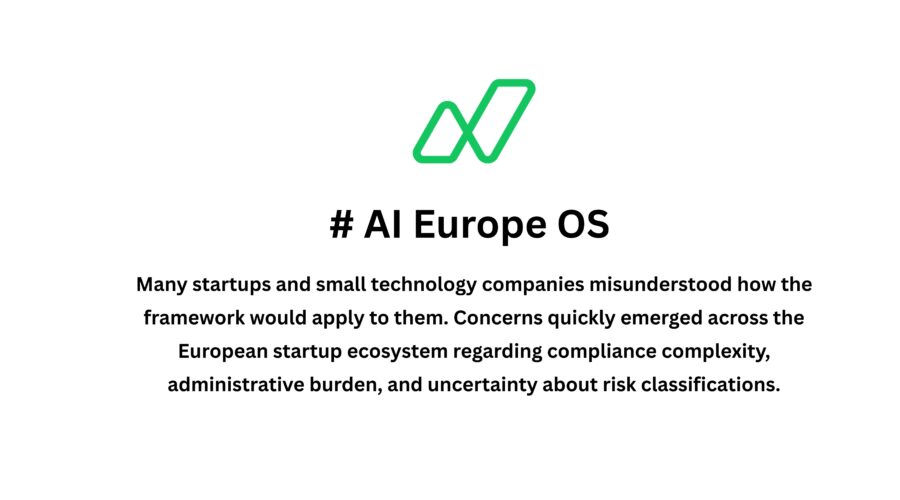
When the regulation was introduced, however, many startups and small technology companies misunderstood how the framework would apply to them. Concerns quickly emerged across the European startup ecosystem regarding compliance complexity, administrative burden, and uncertainty about risk classifications.
By early 2026, the European Commission acknowledged that these misunderstandings were creating hesitation among startups developing AI solutions. As a result, the EU introduced a series of clarifications, simplifications, and support mechanisms to ensure that innovation could continue without unnecessary regulatory friction.
This article explores the original misunderstandings surrounding the EU’s AI regulatory scheme, why they created challenges for startups, and how the EU addressed these issues through policy adjustments and practical support systems in 2026.
Europe’s Vision for Trustworthy Artificial Intelligence
The European approach to artificial intelligence regulation is fundamentally based on trust, safety, and human rights protection. Unlike the largely market-driven approach in the United States or the state-controlled model seen in some other regions, Europe seeks to build a balanced framework that ensures technological innovation while protecting citizens.
The EU Artificial Intelligence Act categorizes AI systems into four levels of risk:
- Unacceptable risk
- High risk
- Limited risk
- Minimal risk
This risk-based model aims to ensure that strict regulations apply only to AI systems that could significantly impact people’s lives, such as healthcare algorithms, employment decision systems, or critical infrastructure management.
However, when the regulation began to take shape after its approval in 2024, many startups initially struggled to interpret how these classifications would affect their AI products.
The Core Misunderstanding: High-Risk Classification
One of the most significant areas of confusion involved the “high-risk AI” classification. Many startups believed their AI tools were relatively simple applications—chatbots, recruitment tools, or recommendation systems.
In reality, some of these systems fell into the high-risk category because they were used in sensitive areas such as:
- Automated hiring and recruitment
- Credit scoring
- Education admissions systems
- Public sector decision-making tools
For example, a startup developing an AI tool that screens job applications might not initially consider the product high risk. However, under the EU framework, automated recruitment tools can significantly affect employment opportunities and therefore fall under stricter regulatory obligations.
This misunderstanding led many startups to worry that they would face expensive certification requirements and complex compliance procedures that could slow down product development or increase operational costs.
Administrative Burden Concerns from Startups
Another challenge for startups was the perceived administrative burden associated with the AI regulation scheme. Early interpretations suggested that developers of high-risk AI systems would need to complete extensive documentation, conformity assessments, and registration procedures before launching their products.
For large technology companies, these compliance obligations are manageable because they already have legal and regulatory teams. Startups, however, typically operate with small teams and limited financial resources.
Many European entrepreneurs feared that the regulation might unintentionally favour large multinational companies over smaller innovators.
Startup founders across the European ecosystem raised concerns that regulatory complexity could:
- Delay product launches
- Increase legal costs
- Create uncertainty in investor decision-making
- Discourage experimentation with new AI applications
These fears contributed to a perception that Europe might fall behind global competitors in artificial intelligence innovation.
The EU Response in 2026: Simplifying Compliance
Recognising these concerns, the European Commission and related EU institutions took steps in 2025 and 2026 to simplify implementation of the AI regulatory scheme.
One of the most significant policy responses involved the introduction of targeted simplifications for startups and SMEs.
These measures focused on reducing administrative overhead while maintaining the core safety objectives of the AI Act.
Reduced Registration Requirements
For AI systems classified as high risk but used in limited operational contexts, the EU introduced reduced registration requirements.
This means startups developing narrow AI tools—such as internal workflow automation or procedural HR assistance systems—may face fewer bureaucratic steps than originally expected.
By adjusting the registration process, regulators aimed to remove unnecessary barriers while ensuring transparency and accountability.
Simplified Technical Documentation
Another major improvement involved the documentation required for high-risk AI systems.
Originally, developers believed they would need to produce extremely detailed technical documentation covering all aspects of system design, testing, and risk mitigation.
In response to startup feedback, regulators clarified that simplified documentation templates could be used for smaller companies.
These templates help startups demonstrate compliance without requiring extensive legal or regulatory expertise.
Aligning Rules with Technical Standards
One of the most practical improvements introduced in 2026 was linking the enforcement timeline for high-risk AI rules to the availability of technical standards.
Initially, companies feared they would need to comply with complex rules before clear guidelines existed. The EU addressed this concern by ensuring that compliance deadlines correspond with the publication of technical standards that explain how to meet regulatory requirements.
This approach reduces uncertainty and provides developers with clearer implementation pathways.
Adjusting the Timeline for Implementation
Another major misunderstanding among startups involved the timeline for implementing the AI Act.
Many entrepreneurs believed the strictest rules would apply immediately after the regulation entered into force. In reality, the EU designed a phased rollout.
The AI Act officially entered into force in August 2024, but different provisions apply at different times.
For example:
- Prohibited AI practices began to take effect earlier.
- General-purpose AI obligations were implemented gradually.
- High-risk system requirements are scheduled to fully apply from August 2026.
This staggered implementation gives companies time to adapt their systems and build compliance processes.
In addition, policymakers proposed further flexibility under initiatives sometimes referred to as the Digital Omnibus reforms, which aim to streamline digital regulations affecting startups and technology companies.
Regulatory Sandboxes: A Major Boost for Innovation
One of the most important initiatives introduced to support AI startups is the creation of regulatory sandboxes.
These controlled testing environments allow companies to develop and experiment with AI systems while receiving guidance from regulators.
The sandbox model has several advantages:
- Startups can test innovative AI systems before commercial launch.
- Regulators can monitor risks in a controlled environment.
- Developers receive direct feedback on compliance requirements.
By August 2026, both national governments and EU-level institutions are expected to operate AI regulatory sandboxes across Europe.
For startups, these environments provide a safe space to experiment with new ideas without fear of immediate regulatory penalties.
This initiative also helps regulators better understand emerging AI technologies and adjust policy frameworks accordingly.
Promoting AI Literacy Among Entrepreneurs
Another important step taken by EU institutions involves improving AI literacy among businesses.
Many of the early misunderstandings surrounding the AI Act stemmed from a lack of clear, accessible guidance.
To address this issue, the EU created resources such as:
- Guidance documents for startups
- Educational materials explaining AI risk categories
- Online repositories of compliance best practices
These tools help entrepreneurs understand their obligations more easily.
Rather than relying solely on enforcement mechanisms, policymakers are encouraging voluntary compliance through education and collaboration.
Clarifying Interaction with Other Laws
European technology regulation can sometimes appear complex because multiple legal frameworks apply simultaneously.
For AI developers, two major legal regimes are particularly relevant:
- The EU Artificial Intelligence Act
- The General Data Protection Regulation
Early on, startups worried that they might face overlapping or conflicting compliance obligations between AI regulations and data protection rules.
In response, EU institutions worked to clarify how these frameworks interact.
For example:
- AI systems that process personal data must still comply with GDPR.
- However, the AI Act focuses primarily on algorithmic transparency, safety, and risk management.
Clarifying the relationship between these regulations reduces legal uncertainty for developers and investors.
Centralized Oversight Through the EU AI Office
Another key development in 2026 was the establishment of the EU AI Office, which plays a central role in supervising certain AI systems across the European Union.
Previously, companies worried they might need to navigate 27 different national regulatory systems.
The AI Office helps coordinate oversight, particularly for general-purpose AI models, ensuring consistent rules across the EU.
For startups developing AI products intended for the European market, this centralization simplifies regulatory interactions and reduces fragmentation.
Why These Changes Matter for European Startups
The adjustments introduced in 2026 represent a critical step toward balancing regulation and innovation.
Without these changes, startups might have been discouraged from developing AI products in Europe.
Instead, the EU is now attempting to create a supportive ecosystem where entrepreneurs can innovate while maintaining ethical and safety standards.
Key benefits for startups include:
- Reduced administrative complexity
- Clearer compliance guidance
- Access to regulatory sandboxes
- Improved coordination across EU member states
Together, these reforms demonstrate that policymakers are willing to adapt regulations based on feedback from the startup community.
The Broader Impact on Europe’s AI Ecosystem
Europe has sometimes been criticised for focusing more on regulation than innovation in the technology sector.
However, the AI Act may ultimately become a competitive advantage for European companies.
By establishing clear rules early, Europe could create a trusted environment for AI development.
Companies operating within the EU framework may gain credibility with customers and investors who value transparency and ethical standards.
In addition, harmonized regulations across the European market allow startups to scale more easily across multiple countries.
This unified digital market could help Europe compete more effectively with AI ecosystems in the United States and Asia.
Key Takeaways for Startups in 2026
For startups building AI products in Europe today, several strategic lessons emerge from the evolution of the AI regulatory scheme.
First, founders should carefully evaluate whether their AI systems fall within the high-risk category defined by the AI Act.
Second, companies should take advantage of regulatory sandboxes and guidance programs offered by EU institutions and national authorities.
Third, startups should integrate compliance planning into their development processes early, rather than treating regulation as an afterthought.
Finally, entrepreneurs should monitor ongoing updates from the European Commission and the EU AI Office, as implementation guidelines continue to evolve.
Conclusion
The early years of the EU Artificial Intelligence Act revealed that groundbreaking regulations can sometimes create confusion, particularly among startups navigating complex legal frameworks.
Misunderstandings about risk classifications, compliance obligations, and implementation timelines initially raised concerns across Europe’s innovation ecosystem.
However, by 2026 the European Union had taken meaningful steps to address these challenges.
Through simplified compliance processes, regulatory sandboxes, improved guidance, and centralized oversight, policymakers have begun to bridge the gap between regulation and innovation.
For startups, these developments signal that Europe is committed not only to responsible AI governance but also to supporting the entrepreneurs who will shape the future of artificial intelligence.
As AI technologies continue to evolve, the EU’s adaptive approach may become a global model for balancing innovation, safety, and ethical responsibility in the digital age.