Last updated: May 29, 2026
5 min read
There is a moment every long-term builder eventually reaches.
It does not announce itself politely.
It does not arrive gradually.
It arrives suddenly.
Yesterday was that moment for Napblog.
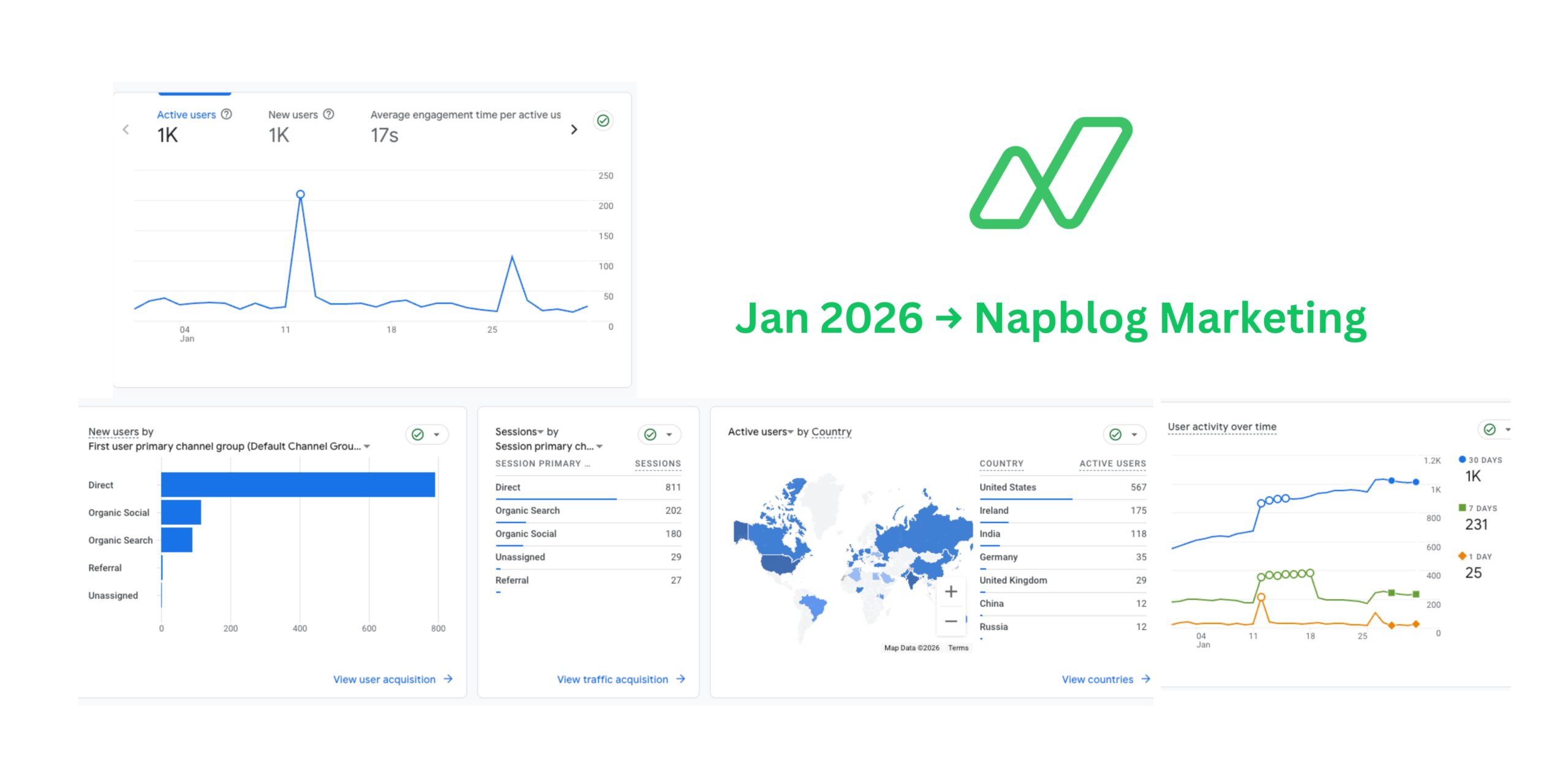
After six months of publishing every single day—without virality, without paid traffic, without shortcuts—Napblog experienced a visible traffic spike. Hundreds of new users in a single day. A doubling of growth signals. A clear shift in how search engines, users, and systems responded.
To most people, this looks like “overnight success.”
To anyone who understands execution systems, it looks exactly like what it is:
Compounding finally crossing the visibility threshold.
This article is not about SEO tips.
It is not about hacks.
It is not about algorithms.
This is about execution architecture—and how NapOS exists specifically to convert invisible daily effort into inevitable results.
The Myth of Linear Progress (and Why Most People Quit Too Early)
The biggest lie modern productivity culture sells is that progress is linear.
Do the work today → get results tomorrow.
That model works for transactions, not for systems.
In reality, meaningful outcomes follow a very different curve:
- Long periods of flat signals
- Minimal external validation
- Internal doubt
- Then, a sudden and disproportionate response
Search engines, audiences, careers, learning, and even personal growth all behave this way.
For six months, Napblog published daily. The numbers moved slowly. Engagement grew quietly. Indexation deepened. User behavior data accumulated. Nothing dramatic happened—until it did.
This is not accidental.
This is how execution systems reward those who stay consistent long enough to pass the trust threshold.
NapOS was designed for exactly this phase.

What Actually Happened Behind the Scenes
Let’s remove the emotion and look at the mechanics.
Over six months of daily execution, several invisible processes were running simultaneously:
1. System-Level Trust Formation
Search engines do not rank posts.
They rank domains with behavioral history.
Consistency told the system:
- This platform is alive
- This platform publishes reliably
- This platform deserves attention
2. Topical Identity Lock-In
Hundreds of related posts clarified one thing clearly:
Napblog is not random content. It is a system narrative.
Once a system understands your identity, it begins testing your content more aggressively.
3. User Behavior Confirmation
Returning users increased.
Time on site stabilized.
Bounce behavior normalized.
This tells any intelligent system one thing:
“This place creates value beyond a single visit.”
4. Compounding Index Coverage
Older posts began supporting newer ones.
Internal relevance increased.
Authority started flowing sideways, not just forward.
The spike was not one blog performing well.
It was the system finally recognizing the whole body of work.
Why Most Creators, Founders, and Builders Never Reach This Point
Because they stop too early.
Most people quit at:
- Month 2 (no feedback)
- Month 3 (doubt)
- Month 4 (comparison)
- Month 5 (fatigue)
NapOS exists because quitting is rarely about laziness.
It is about lack of execution structure.
People do not fail because they cannot work hard.
They fail because they cannot sustain direction without feedback.
NapOS replaces motivation with architecture.
What NapOS Actually Is (Beyond the Name)
NapOS is not a tool.
It is not a dashboard.
It is not a productivity app.
NapOS is a self-reinforcing execution operating system.
It is designed to answer one core problem:
“How do you continue executing daily when results are delayed?”
NapOS solves this by shifting focus away from outcomes and toward system integrity.
Instead of asking:
- “Is this working yet?”
NapOS asks:
- “Did I execute the system today?”
When you win the system, results eventually have no choice but to follow.
Execution → Signals → Results: The NapOS Loop
NapOS operates on a simple but unforgiving loop:
Step 1: Execution Without Negotiation
Daily execution is non-optional.
No mood-based decisions.
No overthinking.
Napblog’s daily publishing was not fueled by inspiration.
It was fueled by non-negotiable execution logic.
Step 2: Signal Accumulation
Every action generates signals:
- Content signals
- Behavioral signals
- Structural signals
These signals compound silently.
NapOS treats signals as assets, not feedback.
Step 3: System Recognition
At scale, systems respond.
Algorithms test.
Audiences engage.
Opportunities surface.
This is where most people think success “appears.”
In reality, success is released, not created.
Why the Spike Happened All at Once (and Not Gradually)
Systems do not reward partial trust.
They reward confidence thresholds.
Google, users, and platforms do not say:
“This is kind of credible.”
They say:
“This is credible—let’s test it.”
That decision happens internally, then manifests externally as a spike.
NapOS prepares you for this moment so that when the system opens the gate, you are still executing—not panicking, pivoting, or stopping.
The Dangerous Phase After the First Breakthrough
The most critical period is not before results.
It is immediately after.
This is where many people unconsciously self-sabotage.
They:
- Slow down
- Change direction
- Chase new ideas
- Try to monetize too early
- Abandon the system that worked
NapOS explicitly prevents this.
The rule is simple:
Do not modify a system while it is compounding.
The spike is not the signal to change.
It is the signal to stay exact.
How NapOS Converts Attention into Long-Term Leverage
Traffic is not the goal.
Attention is not the goal.
Visibility is not the goal.
Leverage is the goal.
NapOS is built to convert visibility into:
- Authority
- Optionality
- Long-term systems
- Real-world execution paths
This is why Napblog does not aggressively monetize early.
This is why it prioritizes system thinking over tactics.
Short-term optimization kills long-term compounding.
NapOS plays the long game by default.
Why This Matters Beyond Blogging
This model applies to:
- Education
- Career building
- Startups
- Skill acquisition
- Independent work
- AI adoption
- Personal transformation
Any meaningful outcome requires:
- Consistency without validation
- Execution without clarity
- Direction without certainty
NapOS is designed to support humans through that uncomfortable middle.
The part where most people stop.
The Real Result Is Not Traffic
The real result is this:
Proof that disciplined execution outperforms talent, timing, and tactics—if you stay long enough.
The spike is not the win.
The system surviving six months is the win.
Everything after that is downstream.
What Happens Next (If the System Holds)
If execution continues unchanged:
- Growth stabilizes, then compounds
- Authority deepens
- Distribution widens
- Optionality expands
If execution stops:
- The spike fades
- Momentum decays
- The system forgets
NapOS exists to ensure the first outcome is inevitable.
Final Thought: Results Are a Lagging Indicator
NapOS does not chase results.
It engineers inevitability.
Results are not goals.
They are symptoms of a functioning system.
Yesterday’s spike did not validate Napblog.
It confirmed something more important:
Consistency, when executed through a system, always wins—eventually.
And when it does, it rarely asks for permission.
Daily execution is what separates intention from achievement. Follow Napblog’s execution-first philosophy on LinkedIn.