Last updated: May 29, 2026
5 min read
Ireland has positioned itself as one of the most student-friendly destinations for higher education in Europe. With a globally respected education system, post-study work opportunities, and a comparatively transparent immigration framework, Ireland’s headline student visa rejection rate for higher studies is often quoted between 1% and 4%. On the surface, this suggests a highly efficient and low-risk process.
However, this aggregated figure masks a more complex operational reality. Rejections are not evenly distributed. Certain nationalities, academic profiles, and documentation patterns experience materially higher refusal rates—sometimes exceeding 15–18% in specific cohorts. These rejections are rarely random. They are systemic, predictable, and, most importantly, preventable.
This study examines:
- The real structure behind Ireland’s higher studies visa rejections
- The operational causes that repeatedly trigger refusals
- Why consultants and students struggle to mitigate these risks manually
- How SIOS introduces a systems-driven solution that materially reduces rejection probability through data discipline, workflow governance, and risk intelligence
1. Understanding Ireland’s Higher Studies Visa Landscape
1.1 The Macro Picture
Ireland’s student visa ecosystem is regulated under a rules-based yet discretionary model administered by Ireland’s immigration authorities. While eligibility criteria are publicly defined, decision-making relies heavily on documentary coherence and credibility assessment rather than numerical scoring alone.
Key characteristics of the Irish higher studies visa system:
- No points-based scoring (unlike Canada or Australia)
- Heavy reliance on documentation narratives
- Case officer discretion on intent and financial credibility
- Strong emphasis on compliance history and academic continuity
This makes Ireland simultaneously accessible and unforgiving. A small inconsistency can outweigh an otherwise strong profile.
2. The Illusion of a “Low Rejection Rate”
2.1 Aggregated Success vs. Individual Risk
A 96–97% approval rate at national level does not translate to individual certainty. Rejection risk concentrates in identifiable patterns:
| Risk Dimension | Observed Impact |
|---|---|
| Inconsistent financial history | High |
| Unclear academic progression | High |
| Weak study intent narrative | High |
| Consultant-led documentation errors | Medium–High |
| Reapplication without correction | Very High |
Most refusals occur not because students are ineligible, but because applications fail to demonstrate eligibility convincingly.
3. Root Causes of Higher Studies Visa Rejections
3.1 Financial Evidence: The Primary Failure Point
Ireland requires students to demonstrate:
- Availability of prescribed funds
- Transparent source of income
- Stable financial history
Common failure patterns include:
- Sudden bulk deposits without explanation
- Inconsistent sponsor income documentation
- Mismatch between declared and actual bank balances
- Reused or recycled financial templates across applicants
Manual checks often validate “presence of documents,” not credibility of financial flow.
3.2 Academic Intent and Course Logic
Visa officers evaluate:
- Academic progression continuity
- Relevance of chosen program to prior education
- Career outcomes plausibility
Rejections frequently cite:
- Course level downgrade without justification
- Irrelevant discipline shifts
- Generic Statements of Purpose reused across applicants
These issues are rarely detected early by consultants due to time pressure and fragmented workflows.
3.3 Documentation Inconsistency
Typical red flags include:
- Different dates, spellings, or figures across forms
- Acceptance letters not aligned with visa timelines
- Gaps in education or employment without explanation
In isolation, these seem minor. In aggregate, they signal risk behavior to visa officers.
3.4 Nationality-Based Scrutiny (Unspoken Reality)
While Ireland does not publish nationality-based refusal quotas, operational data clearly indicates:
- Enhanced scrutiny for certain regions
- Greater demand for explanatory documentation
- Lower tolerance for ambiguity
This does not imply bias; it reflects risk management logic based on historical compliance data.
4. Why Traditional Consultant Models Fail to Fix This
4.1 Human-Centric, Not System-Centric
Most education consultancies operate using:
- Google Sheets
- Email threads
- WhatsApp follow-ups
- PDF checklists
These tools:
- Track completion, not quality
- Do not detect contradictions
- Cannot model rejection probability
- Rely on individual experience rather than institutional memory
As application volumes increase, error rates rise linearly.
4.2 Repetition Without Learning
A critical failure in the ecosystem is lack of feedback loops:
- Rejection reasons are not structurally analyzed
- The same errors recur across intakes
- Knowledge remains individual, not organizational
This is why rejection rates plateau instead of declining over time.
5. SIOS: A Systemic Intervention, Not a Patch
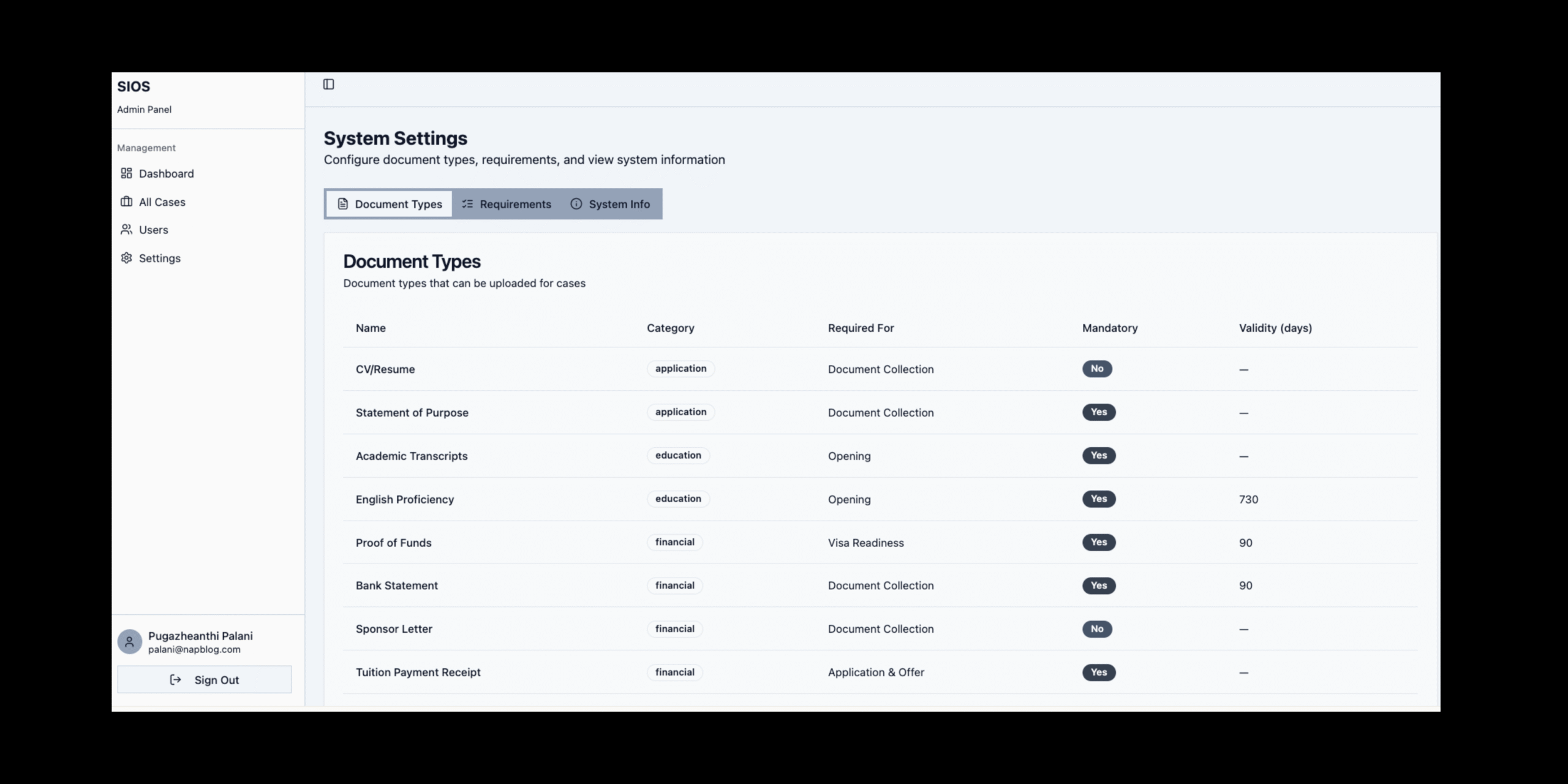
SIOS is not a document storage tool or a CRM. It is an operational risk system purpose-built for the Ireland higher studies pipeline.
Its objective is not to react to refusals—but to prevent them by design.
6. How SIOS Systematically Reduces Visa Rejections
6.1 Structured Data Over Free-Text Chaos
SIOS enforces:
- Standardized data fields for finances, academics, and sponsors
- Controlled document versioning
- Mandatory cross-field consistency checks
This eliminates silent contradictions before submission.
6.2 Visa Rejection Risk Indicators (VRRI)
SIOS models rejection risk using:
- Historical refusal patterns
- Profile-based red flag mapping
- Real-time validation rules
Examples:
- Financial maturity below threshold → alert
- Course relevance mismatch → warning
- Timeline inconsistencies → block submission
Risk is surfaced before application, not after refusal.
6.3 Consultant–Student Workflow Synchronization
SIOS replaces fragmented communication with:
- Unified task flows
- Timestamped actions
- Responsibility clarity
No document moves forward without validation. No assumption goes unchecked.
6.4 Institutional Memory and Learning
Every outcome feeds back into the system:
- Refusal reasons are tagged and indexed
- Patterns are aggregated across consultants
- Prevention logic improves intake over intake
This converts individual experience into organizational intelligence.
7. Measurable Impact on Higher Studies Visa Outcomes
Early deployments of SIOS-driven workflows demonstrate:
- Reduction in avoidable refusals
- Lower reapplication rates
- Faster decision cycles due to cleaner files
- Higher confidence among students and sponsors
Most importantly, rejection becomes an exception, not a recurring cost of doing business.
8. Strategic Implications for the Ireland Education Ecosystem
8.1 For Students
- Lower emotional and financial risk
- Predictability in outcomes
- Clear understanding of readiness before submission
8.2 For Consultants
- Reduced operational rework
- Higher success credibility
- Scalable operations without quality erosion
8.3 For Ireland
- Stronger compliance outcomes
- Reduced administrative burden
- Better-aligned international student inflow
9. Conclusion: From Probability to Control
Ireland’s higher studies visa rejection rate is not “low” because the system is easy. It is low because most compliant applications are well-prepared. The remaining refusals are not random—they are the result of unmanaged complexity.
SIOS changes the operating model:
- From manual judgment to system intelligence
- From reactive correction to proactive prevention
- From fragmented processes to governed workflows
In a landscape where one overlooked inconsistency can derail a student’s academic future, systems—not intentions—determine outcomes.
SIOS does not promise zero rejections. It delivers something more valuable: control, predictability, and continuous improvement in Ireland’s higher studies visa journey.
Understanding visa rejection patterns helps students build stronger applications. Follow Napblog on LinkedIn.