Last updated: May 29, 2026
5 min read
Every year, thousands of international students aiming to study in Ireland receive a visa refusal letter that feels abrupt, opaque, and devastating.
By the time that letter arrives, the damage is already done:
- Tuition deposits are locked
- Intakes are missed
- Confidence is shaken
- Consultants are forced into defensive explanations
- Universities lose confirmed students
The most frustrating part?
In the majority of cases, the refusal was not inevitable.
It was the outcome of risks that existed weeks or months earlier, hidden inside fragmented documents, spreadsheets, emails, and assumptions.
This is exactly the problem SIOS was designed to address.
Today, we are introducing one of the most critical capabilities ever built into Students Ireland OS:
The Visa Rejection Validator (VRRI)
A system-level feature that identifies visa refusal risks before an application is submitted—using real-world consultancy data, structured validation logic, and an explainable risk dashboard.
This is not a checklist.
This is not an opinion.
This is infrastructure.
The Structural Problem No One Talks About
Visa officers do not reject applications randomly.
They reject applications because credibility fails under scrutiny.
Yet the education consulting ecosystem has historically worked in reverse:
- Focus on document collection
- Focus on deadlines
- Focus on submission speed
What gets missed is risk visibility.
Students assume:
“If I submit all documents, the visa should be fine.”
Consultants assume:
“This looks similar to past successful cases.”
Visa officers assess:
“Does this application hold up as a coherent, truthful, financially viable, and temporary study plan?”
That gap—between assumption and assessment—is where refusals are born.
Why Traditional Processes Fail
Even experienced consultants face structural limitations:
- Data spread across Google Sheets, emails, WhatsApp, and PDFs
- No systematic way to detect inconsistencies across documents
- No shared definition of “high risk” vs “fixable risk”
- Heavy reliance on individual experience and intuition
- No audit trail when something goes wrong
When a refusal happens, everyone looks backward.
SIOS is designed to look forward.
Introducing the Visa Rejection Validator (VRRI)
The Visa Rejection Validator is a pre-submission risk intelligence layer inside SIOS.
Its role is simple, but powerful:
To surface hidden visa refusal risks early enough that they can be corrected—systematically, ethically, and transparently.
VRRI does not decide outcomes.
It does not guarantee approvals.
What it does is far more important:
It makes risk visible, explainable, and manageable.
Built on Real Consultancy Data — Not Theory
VRRI is not based on assumptions or scraped advice articles.
It is built using:
- Real case patterns from education consultancies
- Common refusal reasons observed across multiple intakes
- Document consistency failures seen in day-to-day operations
- Financial and academic risk signals repeatedly flagged by visa officers
This allows SIOS to translate collective operational experience into a system that benefits every student and consultant using the platform.
How the Visa Rejection Validator Works
At its core, VRRI evaluates a visa case across multiple risk dimensions, rather than treating the application as a single submission event.
Key Risk Areas Analysed
- Academic Credibility
- Course progression logic
- Gaps in education
- Alignment between past study and proposed programme
- Financial Credibility
- Sufficiency of funds
- Stability and source of money
- Unexplained deposits
- Sponsor clarity
- Documentation Integrity
- Consistency across forms and files
- Name, date, and identity mismatches
- Missing or expired documents
- Intent & Home-Country Ties
- Whether the study plan is genuinely education-led
- Overemphasis on migration outcomes
- Weak articulation of career plans
- Immigration History
- Previous refusals
- Disclosure completeness
- Travel history coherence
- Accommodation & Living Preparedness
- Realistic budgeting
- Awareness of Ireland’s housing realities
- Contingency planning
Each category is assessed independently, then synthesised into an overall risk band.
From Guesswork to Risk Bands
Instead of vague judgments, VRRI classifies cases into clear, explainable bands:
- Low Risk
Strong, consistent, and credible application profile. - Medium Risk
Issues exist, but are fixable with clarification or documentation. - High Risk
Multiple red flags requiring senior consultant review. - Critical Risk
Submission should not proceed until major issues are resolved.
Importantly, SIOS never auto-rejects a case.
High or critical risk triggers attention, not exclusion.
The Consultant Dashboard: Where Insight Becomes Action
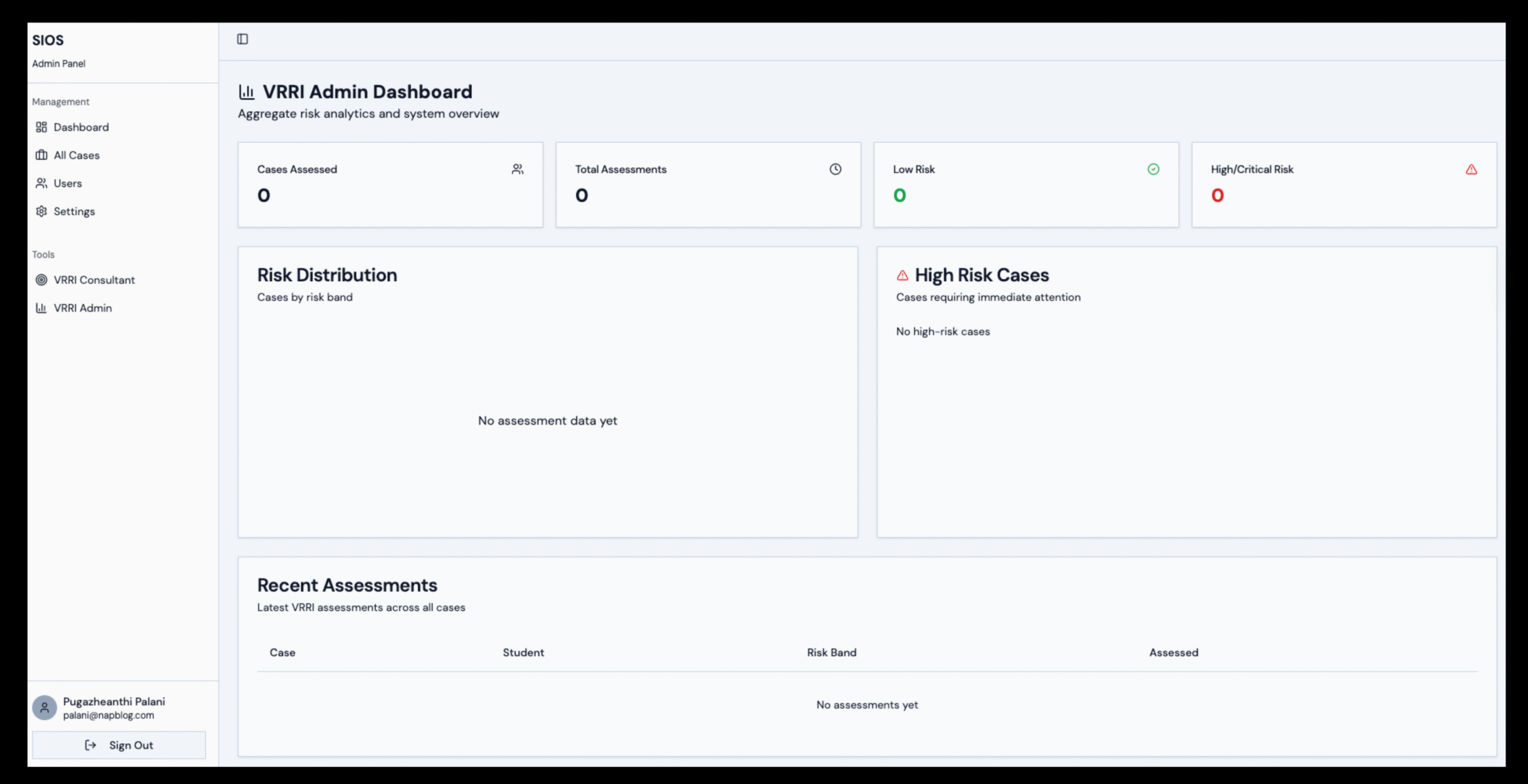
The true power of VRRI is unlocked through the Consultant & Admin Dashboard.
From a single view, consultants can:
- See how many cases are under assessment
- Track risk distribution across all active students
- Identify high-risk cases requiring immediate attention
- Review category-wise risk explanations
- Maintain an audit trail of actions taken
This changes consultant workflows fundamentally.
Instead of reacting to refusals, consultants can:
- Prioritise cases intelligently
- Allocate senior review where it matters most
- Explain decisions clearly to students
- Defend processes with data, not memory
What Students Experience (And Why It Matters)
From the student’s perspective, VRRI introduces something rare in the visa journey: clarity.
Students are no longer told:
“It should be fine.”
They are shown:
- What areas are strong
- What areas need work
- Why certain documents or explanations matter
- What actions can reduce risk before submission
This reduces:
- Anxiety
- Misinformation
- Last-minute panic
- Post-refusal blame
And most importantly, it builds trust.
Prevention Over Appeals
Appeals are expensive, slow, and emotionally draining.
VRRI is built on a simple belief:
The best appeal is the one you never need to file.
By identifying risks early:
- Students avoid preventable refusals
- Consultants avoid reputational damage
- Universities improve enrolment conversion
- The overall ecosystem becomes more credible
Ethical by Design
A critical point must be made clearly.
VRRI:
- Does not discriminate by nationality
- Does not assign hidden scores
- Does not replace human judgment
- Does not encourage manipulation or falsification
Instead, it:
- Increases scrutiny where needed
- Encourages truthful, consistent documentation
- Escalates cases responsibly
- Keeps decision-making explainable
This is essential not only for compliance, but for long-term trust.
Why This Feature Changes the Industry Standard
For decades, student visa processing has depended on:
- Individual consultant experience
- Informal heuristics
- Trial-and-error learning
SIOS changes that by introducing institutional memory into the system.
Every validated case strengthens the platform.
Every risk pattern improves future assessments.
Every consultant benefits from collective intelligence.
This is how operational chaos becomes structured governance.
Looking Ahead
The Visa Rejection Validator is not an endpoint.
It is a foundation.
As SIOS evolves, this capability will integrate with:
- Voice AI guidance for students
- University-level risk insights
- National-scale reporting
- Continuous improvement across intakes
The goal is not just fewer refusals.
The goal is a system where:
- Students are informed, not surprised
- Consultants are proactive, not reactive
- Decisions are reasoned, not rushed
Final Thought
Visa refusals are not personal failures.
They are system failures.
SIOS exists to fix systems—not blame individuals.
The Visa Rejection Validator is a step toward a future where studying in Ireland is governed by clarity, structure, and accountability, rather than uncertainty.
That is the standard we are building.
—
SIOS – Students Ireland Operating System
Built to reduce chaos. Designed to earn trust.
Visa rejection is preventable with the right tools. Follow SIOS updates on LinkedIn.