Last updated: May 29, 2026
6 min read
Across Europe, small and medium-sized businesses (SMBs) and mid-market enterprises are under growing pressure to modernize operations, increase productivity, and remain competitive in a rapidly digitizing economy. Artificial Intelligence is no longer viewed as a future innovation; it is now a present-day operational requirement. Yet for many organizations, AI adoption has been fragmented, experimental, and difficult to govern.
Disconnected tools, opaque workflows, and a shortage of AI and automation expertise have created a significant execution gap. Leaders understand the promise of AI-driven automation, but struggle with implementation, monitoring, compliance, and operational control—particularly within the European regulatory environment.
The newly introduced AIEOS Dashboard directly addresses this challenge. Designed as a centralized control plane, AIEOS enables European SMBs and enterprises to manage AI automations with clarity, security, and confidence—without requiring deep coding expertise or advanced AI domain knowledge.
This article explores how the AIEOS Dashboard transforms AI automation from a technical burden into a manageable, auditable, and scalable business capability.
The European Context: Why AI Automation Requires a Different Approach
European organizations operate under a distinct set of constraints and expectations. Regulatory compliance, data sovereignty, operational resilience, and transparency are not optional—they are fundamental requirements.
At the same time, European SMBs often face:
- Limited in-house engineering resources
- High dependency on external consultants
- Fragmented automation tools (RPA, iPaaS, scripts, AI APIs)
- Lack of real-time visibility into AI-driven processes
Traditional automation platforms were not designed with these realities in mind. They assume technical teams, continuous manual configuration, and tolerance for opaque systems.
AIEOS was built with a different philosophy: AI operations should be observable, controllable, and accessible to business users—while remaining compliant with European standards.
What Is the AIEOS Dashboard?
The AIEOS Dashboard is a centralized AI operations control plane that allows organizations to:
- Monitor all AI-driven workflows in one place
- Manage connectors, APIs, and automations without coding
- Pause, resume, or stop AI processes at an organizational level
- Track events, executions, and failures in real time
- Maintain governance, auditability, and operational oversight
Rather than acting as yet another automation tool, AIEOS functions as an orchestration and governance layer that sits above existing systems, workflows, and integrations.
In practical terms, it becomes the “single source of truth” for AI automation across the organization.
A Control Plane Built for Business, Not Just Engineers
One of the defining characteristics of the AIEOS Dashboard is its emphasis on operational simplicity.
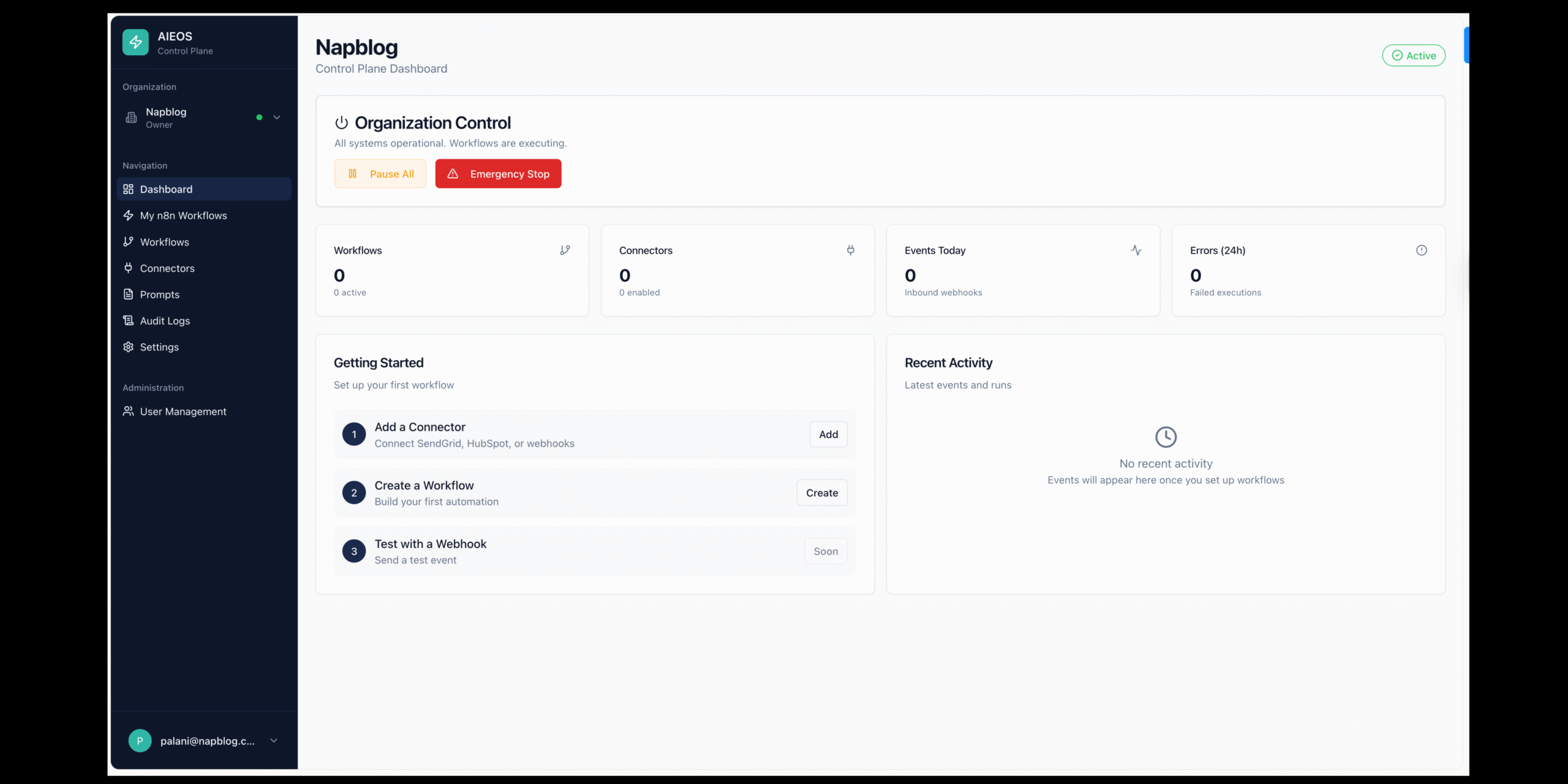
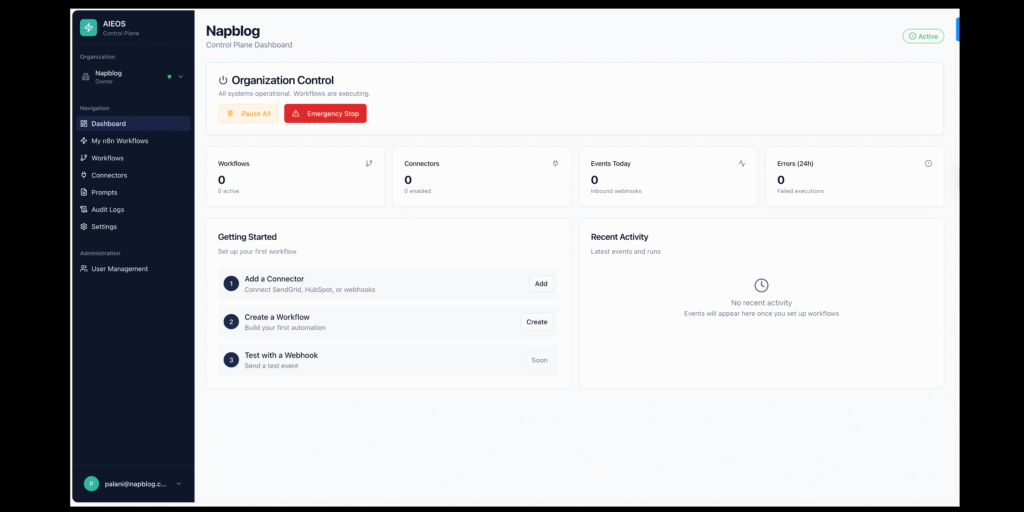
From the moment a user logs in, the interface presents a clear overview of organizational status:
- Active workflows
- Connected systems
- Incoming events
- Execution errors
This design is intentional. Decision-makers do not need to inspect logs or understand code to assess whether AI systems are operating as expected. The dashboard translates technical activity into operational signals that business and IT leaders can act upon immediately.
Organization-Level Controls
A standout feature of AIEOS is Organization Control, which allows authorized users to:
- Pause all workflows instantly
- Trigger an emergency stop across AI automations
- Resume operations once issues are resolved
This capability is particularly valuable for risk management, incident response, and regulatory compliance. In scenarios involving faulty data, misconfigured models, or unexpected behavior, organizations retain full control—at all times.
From Zero to Automation: Guided Onboarding for SMBs
Many SMBs struggle not because AI is too complex, but because the path to adoption is unclear. AIEOS addresses this through a structured “Getting Started” flow embedded directly into the dashboard.
New users are guided through three core steps:
- Add a Connector – Connect external services such as CRMs, email platforms, ERPs, or webhook-based systems
- Create a Workflow – Define business logic visually, without writing code
- Test with a Webhook – Validate the automation using real or simulated events
This approach lowers the barrier to entry significantly. Teams can move from concept to execution in hours rather than weeks, while maintaining confidence that systems are operating correctly.
Managing AI Automations Without Coding or AI Expertise
A critical challenge in AI adoption is the dependency on scarce technical skills. AIEOS deliberately abstracts complexity away from the user.
No-Code and Low-Code by Design
The dashboard enables users to:
- Configure workflows visually
- Connect APIs through standardized connectors
- Monitor execution without inspecting raw logs
- Diagnose issues through structured error reporting
This empowers operations, marketing, finance, and customer support teams to participate directly in automation initiatives—reducing reliance on developers and accelerating time to value.
AI Without “AI Guesswork”
AIEOS focuses on operational AI, not experimentation. The platform emphasizes:
- Predictability over novelty
- Monitoring over black-box execution
- Governance over uncontrolled autonomy
This aligns closely with European enterprise expectations, where AI must be explainable, auditable, and accountable.
Real-Time Visibility and Operational Transparency
One of the most common complaints about AI systems is that they operate “in the background,” unnoticed until something goes wrong.
The AIEOS Dashboard changes this dynamic.
Live Events and Activity Tracking
Users can see:
- Inbound webhook events
- Workflow executions
- Success and failure counts
- Time-based activity summaries
This real-time visibility allows teams to proactively identify issues before they escalate into customer-facing problems or compliance risks.
Error Monitoring and Diagnostics
Rather than cryptic logs, AIEOS presents:
- Clear error counts
- Time-bound failure summaries (e.g., last 24 hours)
- Contextual information to support resolution
This reduces mean time to resolution (MTTR) and increases trust in automated systems.
Governance, Compliance, and Audit Readiness
For European organizations, governance is not an afterthought—it is a prerequisite.
The AIEOS Dashboard incorporates governance features directly into its core architecture:
- Centralized audit logs
- User access controls
- Traceability of workflow executions
- Organizational visibility across teams and departments
These capabilities support compliance with GDPR, internal policies, and sector-specific regulations. More importantly, they allow organizations to scale AI automation without losing oversight.
A Unified View Across Tools and Platforms
Most organizations already use a mix of tools:
- CRM platforms
- Marketing automation systems
- Finance and billing software
- Customer support tools
- AI APIs and workflow engines
AIEOS does not replace these systems. Instead, it unifies them.
By acting as a coordination and monitoring layer, AIEOS allows organizations to:
- Reduce tool sprawl
- Standardize automation practices
- Enforce governance consistently
- Gain visibility across silos
This is especially valuable for growing SMBs transitioning into more complex operational structures.
Business Impact: What This Means for European SMBs and Enterprises
The introduction of the AIEOS Dashboard has tangible business implications:
Faster AI Adoption
Organizations move from pilot projects to production-ready automations more quickly.
Lower Operational Risk
Centralized controls and monitoring reduce the likelihood of unnoticed failures or compliance breaches.
Reduced Cost of Ownership
Less reliance on specialized developers and consultants lowers long-term costs.
Improved Decision-Making
Executives gain visibility into how AI is actually used across the business.
Scalable Foundations
As automation needs grow, AIEOS scales with the organization rather than becoming a bottleneck.
A Practical Step Toward AI Maturity
AI maturity is not defined by how advanced models are, but by how reliably AI systems support business outcomes.
The AIEOS Dashboard represents a shift from experimental AI usage to operational AI management. It provides the structure, visibility, and control required to make AI a dependable part of everyday business operations.
For European SMBs and enterprises, this is a critical step forward—one that balances innovation with responsibility, and automation with governance.
Conclusion: AI Operations, Finally Under Control
The future of AI in Europe will not be driven solely by breakthroughs in algorithms, but by platforms that make AI usable, manageable, and trustworthy at scale.
The AIEOS Dashboard delivers exactly that: a unified control plane where AI automations are visible, controllable, and aligned with real business needs.
For organizations looking to move beyond isolated AI experiments and toward sustainable, compliant, and value-driven automation, AIEOS offers a clear and practical path forward.
The AIEOS dashboard gives European businesses real control over AI automation. Follow updates on LinkedIn.