Last updated: May 29, 2026
5 min read
Every year, international students from more than 180 countries commit their futures to Ireland.
They choose Ireland for its academic reputation, its access to Europe, its post-study opportunities, and its growing global relevance. They invest not just money, but years of planning, family trust, and long-term ambition.
Yet for most of them, the journey does not begin with clarity.
It begins with uncertainty.
This uncertainty is not caused by a lack of information.
It is caused by a lack of structure.
Despite the presence of capable consultants, reputable universities, and established immigration processes, the international student journey to Ireland remains fragmented, unpredictable, and heavily manual.
This article explains:
- Why unpredictability persists despite good intentions
- Why communication breakdowns are structural, not personal
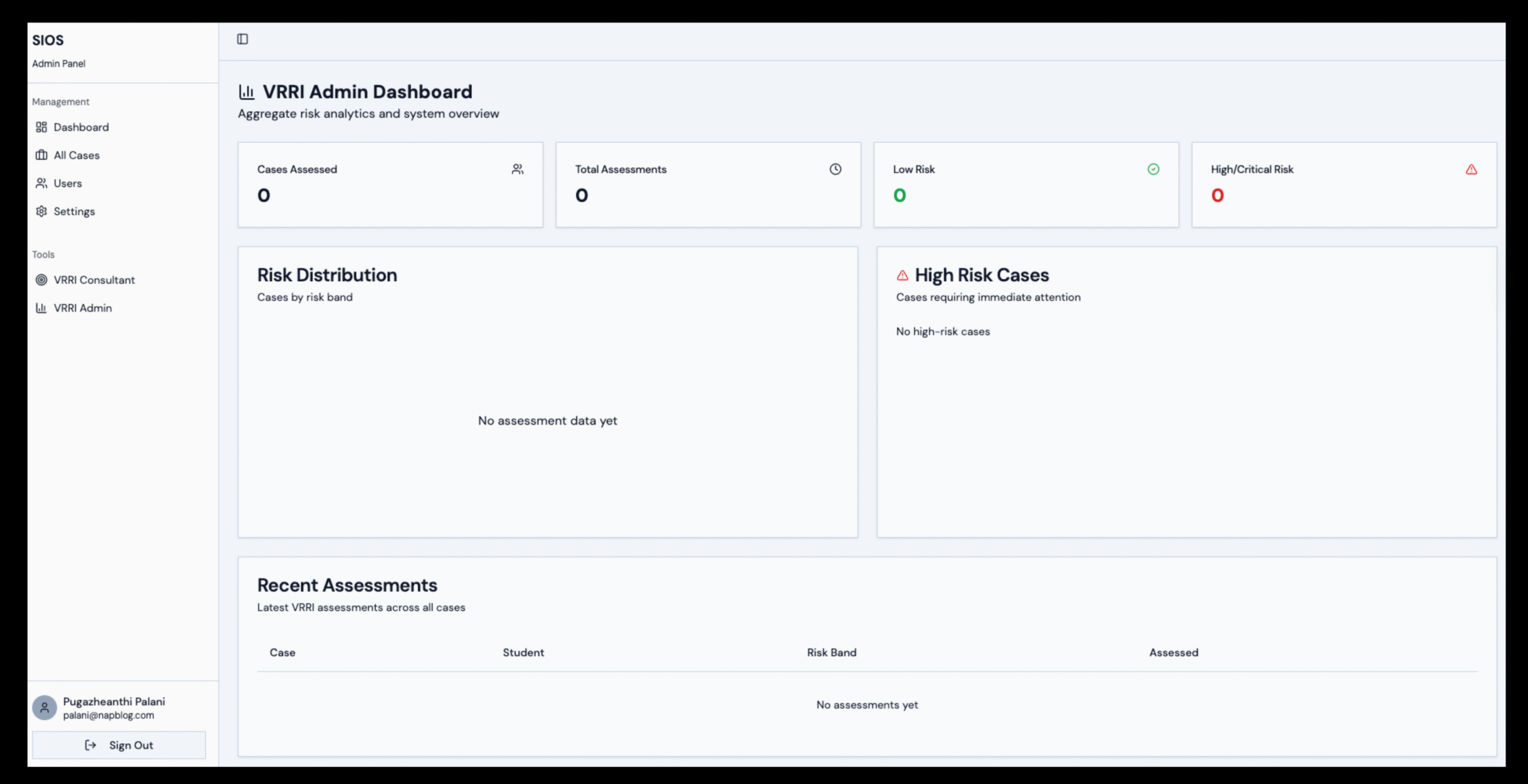
- How SIOS enables seamless, end-to-end coordination between students and consultants
- Why infrastructure—not effort—is the missing layer
This is not a product announcement.
It is an explanation of why an operating system was necessary.
The Global Student Journey Is Predictable in Theory—Chaotic in Practice
On paper, the Ireland-bound student journey appears linear:
- Initial counselling and course selection
- University application
- Offer acceptance
- Financial documentation
- Visa processing
- Pre-departure preparation
- Arrival, registration, and Stamp 2 compliance
In reality, this journey unfolds over six to twelve months, across multiple time zones, with dozens of documents, and constant dependency on follow-ups.
At every stage, communication becomes the bottleneck.
Students ask:
- “Have my documents been received?”
- “What is pending?”
- “Is my visa file complete?”
- “What happens next?”
Consultants ask:
- “Has the student uploaded the correct version?”
- “Is this document valid for this intake?”
- “Which students are falling behind?”
- “Who needs urgent attention today?”
Universities ask:
- “How many confirmed students are actually visa-ready?”
- “Where are the risks?”
- “Why do students drop off after offers?”
The problem is not a lack of communication.
The problem is communication without a shared system.
Why Unpredictability Exists—Even With Experienced Consultants
Educational consultants remain the backbone of international student mobility. Their role is not replaceable.
However, they are operating inside constraints that no amount of effort can fix.
Today’s reality looks like this:
- Student data scattered across Excel sheets
- Documents stored in cloud folders without validation logic
- Visa timelines tracked manually
- Status updates communicated via email or messaging apps
- Knowledge stored in individual consultants’ heads
This creates four systemic risks:
1. Information Asymmetry
Students never see the same view consultants see. They rely on reassurance rather than evidence.
2. Delayed Escalation
Issues surface late because no system flags them early.
3. Consultant Burnout
High-value advisors spend disproportionate time chasing documents instead of guiding decisions.
4. Institutional Blind Spots
Universities and partners see outcomes—but not readiness.
No stakeholder intends this outcome.
But without infrastructure, good intentions collapse under scale.
The Core Question SIOS Was Built to Answer
The real question is not:
“How do we communicate more?”
The real question is:
“How do we ensure every conversation is grounded in verified progress?”
SIOS was designed to answer that question by introducing a shared operational layer between students, consultants, and institutions.
Not another messaging tool.
Not another document folder.
Not another CRM.
An operating system.
What Seamless Communication Actually Means in the SIOS Context
In SIOS, communication is not free-form.
It is context-aware, state-driven, and verification-based.
This distinction matters.
Communication Without Context
“Your visa file is in progress.”
Communication With Context (SIOS)
“Your visa file is 82% complete. Bank statement pending validation. Consultant review scheduled within 48 hours.”
One reduces anxiety.
The other eliminates it.
The Student–Consultant Relationship Inside SIOS
SIOS does not change who owns the student relationship.
Consultants remain the primary advisors.
Students remain the decision-makers.
What changes is how information flows between them.
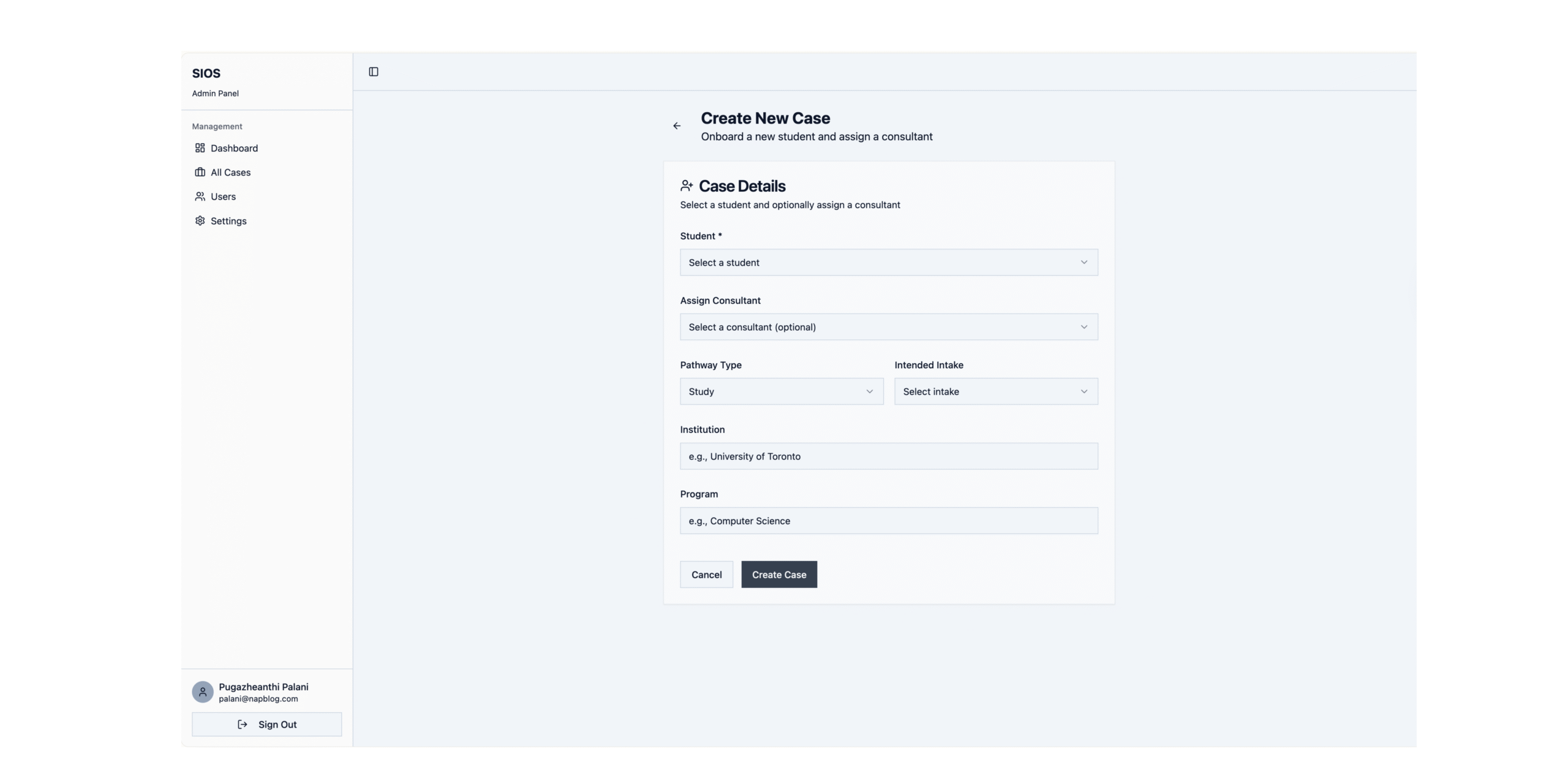
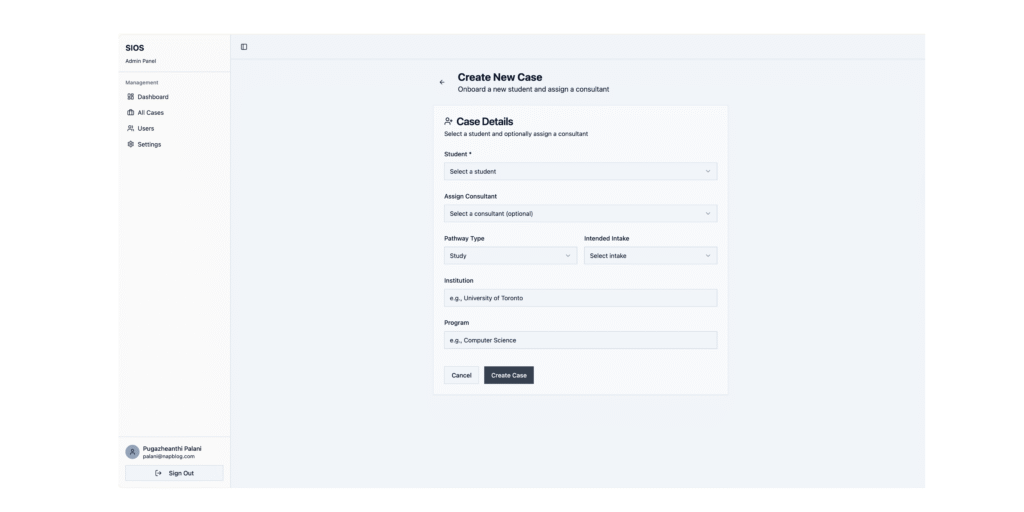
1. A Single Source of Truth
Every student has one structured case file:
- Timeline-based
- Document-validated
- Intake-specific
- Consultant-governed
No parallel spreadsheets.
No duplicate folders.
No conflicting versions.
2. Shared Visibility Without Shared Burden
Students can see:
- What is complete
- What is pending
- What is under review
- What depends on future dates
Consultants control:
- Validation
- Escalation
- Readiness confirmation
This preserves authority while improving transparency.
Eliminating the Most Common Global Friction Points
Time Zone Misalignment
Students in Asia, Africa, and Latin America often wait days for simple confirmations.
SIOS solves this by:
- Making status self-evident
- Reducing the need for clarification emails
- Allowing consultants to respond asynchronously without losing context
Repeated Document Requests
One of the biggest trust killers is being asked for the same document multiple times.
SIOS enforces:
- Structured upload requirements
- Version control
- Validation checkpoints
- Institution-specific acceptance rules
If a document is valid, it stays valid—until it expires.
Unclear “What’s Next”
Uncertainty peaks not during rejection—but during silence.
SIOS models the journey as sequential milestones, so students always know:
- What stage they are in
- What the next trigger is
- Who is responsible
Voice as a First-Class Communication Layer
Text alone does not serve stressed, non-native English speakers effectively.
SIOS integrates Voice AI support, not to replace consultants, but to scale clarity.
This enables:
- Spoken explanations of process stages
- Clarification of common questions
- Guided understanding of timelines
- Reduced repetitive queries to consultants
Crucially:
- Voice interactions are grounded in the student’s real case state
- Responses are consistent with consultant-approved logic
This maintains accuracy while improving accessibility.
Why This Matters at an Ecosystem Level
When student–consultant communication improves, downstream effects compound.
For Consultants
- Fewer manual follow-ups
- Clear prioritisation of at-risk cases
- Higher advisory leverage per consultant
For Universities
- Better intake forecasting
- Higher visa success predictability
- Reduced last-minute withdrawals
For Ireland
- Improved student retention
- Stronger compliance outcomes
- More reliable talent pipelines
This is not incremental improvement.
It is systemic stabilisation.
Why SIOS Is Not a Student App—and Why That Matters
SIOS intentionally does not allow direct individual student sign-ups.
This decision is fundamental.
Direct-to-student platforms:
- Fragment accountability
- Bypass regulated advisory processes
- Introduce compliance risk
SIOS follows an institution-led model:
- Consultants onboard and manage students
- Institutions gain visibility, not control
- Compliance remains professionally governed
This ensures trust at scale.
From Fragmented Effort to Coordinated Infrastructure
Most education ecosystems fail not because people are incompetent, but because systems are incomplete.
Ireland’s international education success now depends on its ability to move from:
- Reactive coordination → proactive readiness
- Manual effort → structured assurance
- Individual heroics → shared infrastructure
SIOS exists to make that transition possible.
This Is the First Layer—Not the Final Word
This article is the first in a LinkedIn newsletter series that will explore:
- Consultant operating models in a systemised future
- Institutional visibility without micromanagement
- Compliance as a design principle
- Education infrastructure as national strategy
SIOS is not a feature set.
It is not a trend.
It is infrastructure.
And infrastructure changes outcomes quietly—but permanently.
Closing Perspective
Students do not fail because they lack ambition.
Consultants do not struggle because they lack dedication.
Institutions do not underperform because they lack intent.
They struggle because the system between them is invisible, fragmented, and informal.
SIOS exists to make that system visible, structured, and dependable.
Not to replace people.
But to let them operate at their best—together.
SIOS helps students and consultants navigate the Ireland journey seamlessly. Follow on LinkedIn.