5 min read
There are two ways to build a product.
You can build in silence.
Or you can build in public.
Most choose silence.
Because it’s safer.
Because it hides mistakes.
Because it delays judgment.
But at Napblog Limited, we chose something different.
We chose pressure.
We chose visibility.
We chose consistency.
And today, we’re celebrating something that sounds simple — but wasn’t:
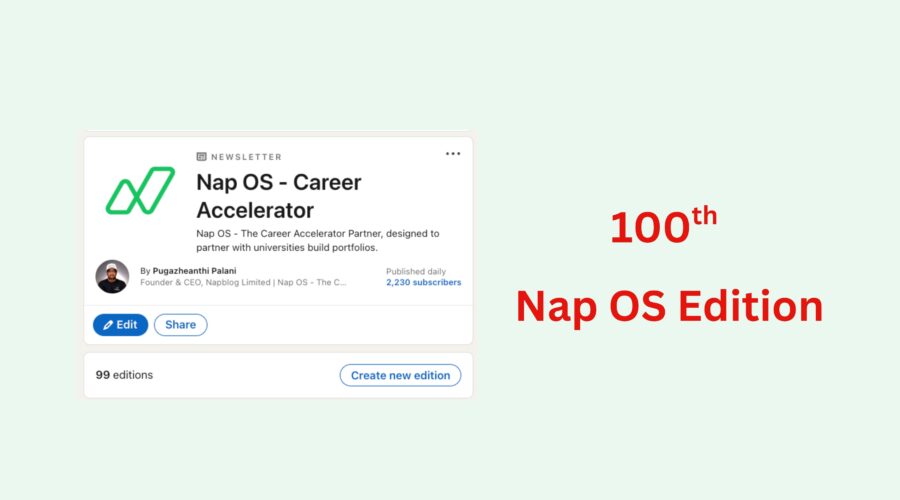
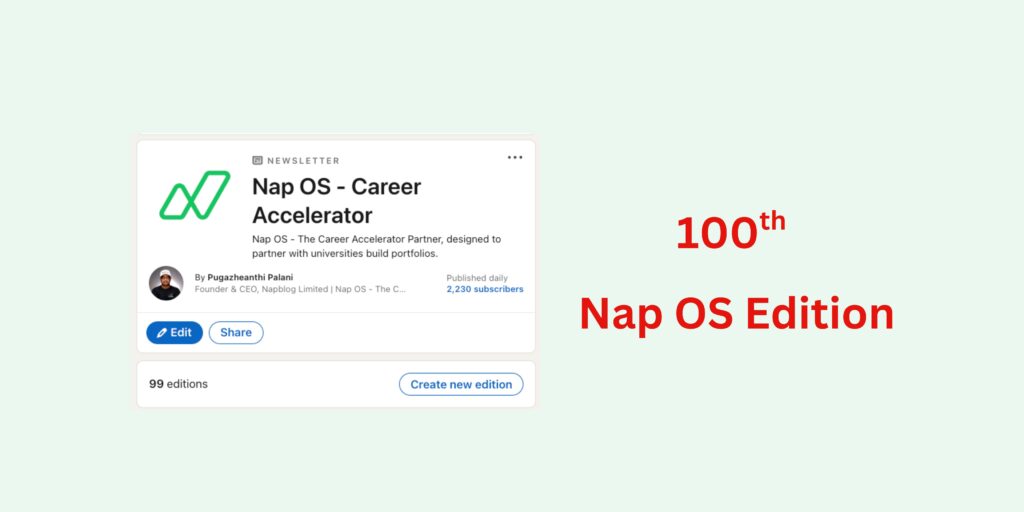
100 editions of Nap OS.
In 100 consecutive days.
What is Nap OS, Really?
At its core, Nap OS is not a product.
It is a belief.
A belief that:
Careers should not be built on assumptions.
They should be built on evidence.
A belief that:
Students don’t lack talent.
They lack structured proof.
A belief that:
Universities don’t fail at education.
They fail at translation to employability.
Nap OS was designed to solve that gap.
To act as a Career Accelerator Partner — not just for individuals, but for universities, immigrants, career changers, and builders.
Why 100 Days? Why This Experiment?
Because ideas are cheap.
Execution is rare.
And consistency?
That’s almost extinct.
We didn’t want Nap OS to be another “big launch” product.
We wanted it to be:
Refined daily
Challenged publicly
Shaped by real feedback
So we committed to:
Shipping one idea, one concept, one perspective — every single day.
No breaks.
No batching.
No perfection.
Just execution.
The Philosophy: Build in Public
Building in public is misunderstood.
People think it’s about marketing.
It’s not.
It’s about accountability.
When you publish daily:
You can’t hide confusion
You can’t delay thinking
You can’t escape clarity
Every edition forces you to answer:
“Does this idea actually make sense?”
And over time, something powerful happens.
You stop building for validation.
You start building for truth.
Nap OS as a University Partner
One of the strongest evolutions of Nap OS during these 100 days was its positioning as a:
Career Accelerator Partner for Universities.
Let’s be honest.
Universities are not broken.
But they are incomplete.
They provide:
Knowledge
Frameworks
Foundations
But they struggle with:
Execution
Portfolio building
Proof of work
That’s where Nap OS fits.
It doesn’t replace universities.
It extends them.
Day In, Day Out: What Nap OS Actually Does
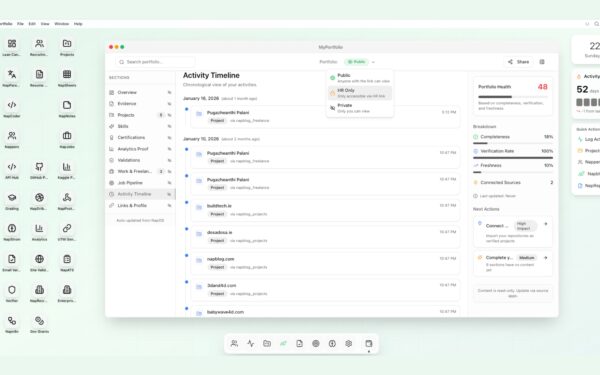
Nap OS is not a concept anymore.
It is a system that works daily.
For every user, it answers three questions:
- What did you do today?
- How does it prove your skill?
- Can someone else verify it?
This daily loop transforms:
Random effort → Structured execution → Verifiable proof
And over time, it creates something powerful:
A portfolio that proves itself.
The Real Problem We Solved
Across these 100 editions, one problem kept appearing again and again:
The Portfolio Gap.
Students had:
Projects scattered everywhere
Certificates without context
Skills without validation
Effort without visibility
As highlighted in Nap OS outcomes, this fragmentation creates “low signal density” for recruiters
Recruiters don’t have time to interpret potential.
They select:
Clarity
Structure
Proof
Nap OS was built to increase that signal.
The Outcome Engine of Nap OS
Nap OS doesn’t sell features.
It produces outcomes.
A consistent transformation pattern emerged:
Disorganized effort
→ Structured execution
→ Verified proof
→ Increased opportunity
This isn’t theory.
It’s repeatable.
Why This Matters More Than Ever
We are entering a world where:
AI writes content
AI generates code
AI automates workflows
So what becomes valuable?
Not knowledge.
Not even skill.
But:
Proof of applied skill.
Nap OS positions users exactly there.
10 Lessons from Building Nap OS in Public
After 100 days, here are the real lessons — not the motivational ones.
The ones that actually matter.
1. Consistency Beats Intelligence
You don’t need 100 great ideas.
You need 100 shipped ideas.
Momentum builds clarity.
Not the other way around.
2. Feedback Comes from Visibility
No one critiques what they can’t see.
By publishing daily, we turned silence into feedback loops.
3. Clarity is Forced, Not Found
Writing daily forced us to simplify complex ideas.
If we couldn’t explain it — we didn’t understand it.
4. The Product Builds Itself (If You Show It Enough)
Something unexpected happened.
Nap OS started evolving through:
User reactions
Questions
Confusion
The audience became co-creators.
5. Imperfection is a Growth Strategy
Waiting for perfection kills momentum.
Shipping imperfect ideas builds direction.
6. Narrative > Features
People don’t connect with features.
They connect with:
Problems
Stories
Outcomes
Nap OS became stronger when we focused on:
Why it exists.
7. Systems Create Sustainability
Motivation fades.
Systems don’t.
As we’ve learned at Napblog, momentum comes from “learning, execution, and reflection loops”
That same system powered these 100 days.
8. Build for Use, Not Applause
Some editions performed well.
Some didn’t.
But the goal wasn’t engagement.
It was:
Usability.
9. The Market Understands Simplicity
The clearer the message:
The stronger the response.
“Build a portfolio that proves itself”
That line worked because it was obvious.
10. Execution is the Only Differentiation Left
Everyone has ideas.
Everyone has access to tools.
But very few execute consistently.
That’s where advantage is created.
Why This Experiment Matters for Brands
This wasn’t just about Nap OS.
It was a blueprint.
Any brand can learn from this.
1. Build Daily, Not Occasionally
Consistency builds trust faster than campaigns.
2. Share Thinking, Not Just Results
People follow journeys.
Not announcements.
3. Let Your Product Evolve Publicly
You don’t need to get it right.
You need to get it moving.
4. Turn Content into Product Thinking
Each post shouldn’t just market.
It should refine the product.
5. Make Your Audience Think
The best content doesn’t inform.
It challenges assumptions.
Nap OS as a Career Infrastructure
After 100 days, one thing became clear:
Nap OS is not a feature.
It is infrastructure.
It sits between:
Education and employment
Learning and execution
Effort and opportunity
And connects them through:
Proof.
The Bigger Vision
Nap OS is evolving into something larger:
A system where:
Universities integrate execution tracking
Students build proof in real-time
Recruiters access verified portfolios
Careers become transparent
This is not a small shift.
It’s a structural one.
From 0 to 100 — What Actually Changed?
In 100 days:
Nap OS moved from idea → system
From concept → application
From theory → outcomes
More importantly:
It moved from:
“What is this?”
To:
“How do I use this?”
And that’s the real milestone.
The Human Side of This Journey
Behind every edition was:
Thinking
Doubt
Iteration
Clarity
Some days were easy.
Most weren’t.
But consistency removed emotion from execution.
We didn’t wait to feel ready.
We showed up anyway.
What Happens Next?
100 is not the end.
It’s the baseline.
Now comes:
Deeper integrations
University partnerships
User-driven evolution
Real-world scaling
Nap OS will continue to evolve.
But one thing won’t change:
It will always be built through execution.
Final Thought
Most people overestimate what they can do in a day.
And underestimate what they can do in 100 days.
This experiment proved one thing:
You don’t need perfect strategy.
You don’t need massive resources.
You need:
Clarity
Consistency
Courage to be seen
Because when you build in public:
You don’t just build a product.
You build:
Trust
Momentum
Reality
100 Days. 100 Editions. One Truth.
Careers don’t change through information.
They change through execution.
And now, with Nap OS,
Execution finally has a system.