Last updated: February 16, 2026
6 min read
The Crisis of Overthinking in Modern Education
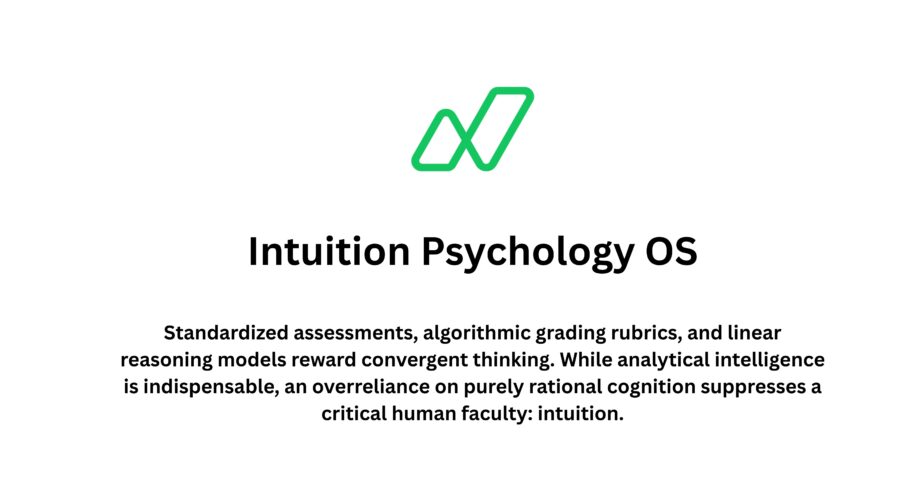
In contemporary education systems, students are trained to optimize for correctness rather than originality. Standardized assessments, algorithmic grading rubrics, and linear reasoning models reward convergent thinking. While analytical intelligence is indispensable, an overreliance on purely rational cognition suppresses a critical human faculty: intuition.
Intuition psychology—the systematic study and cultivation of intuitive cognition—provides a corrective. It restores access to non-linear pattern recognition, emotional attunement, and rapid integrative processing.
For students navigating complex academic, creative, and social environments, intuition is not mystical ornamentation; it is a cognitive asset. When consciously developed, it becomes a mechanism for creativity, decisiveness, and authentic confidence.
This paper presents an intuition psychology perspective on why cultivating intuitive awareness is essential for students seeking to unlock creativity with grounded confidence.
1. Defining Intuition in Psychological Terms
Intuition is often colloquially described as “gut feeling.” In psychological science, however, intuition refers to rapid, non-conscious pattern recognition arising from accumulated experience. It operates through implicit memory systems and affective processing networks.
Daniel Kahneman’s dual-process framework in Thinking, Fast and Slow distinguishes between:
- System 1 – fast, automatic, intuitive cognition
- System 2 – slow, deliberative, analytical cognition
Students are predominantly trained in System 2. Yet creative breakthroughs often emerge from System 1 processing—associative leaps that precede conscious reasoning.
Research on creative insight, including work published in journals like Creativity Research Journal, demonstrates that many novel ideas arise after incubation periods in which unconscious processing reorganizes information. Intuition, in this sense, is not the opposite of intelligence—it is intelligence operating beneath conscious awareness.
2. The Psychological Link Between Intuition and Creativity
Creativity involves two primary stages:
- Generation – producing novel ideas
- Evaluation – refining and selecting viable ideas
Intuition plays a role in both.
A. Idea Generation
During generative phases, intuition synthesizes disparate information into novel configurations. This is evident in artistic innovation, scientific discovery, and entrepreneurial ideation. Insight often appears as a sudden “Aha!” moment, reflecting unconscious pattern integration.
When students over-filter ideas through analytical self-criticism, they inhibit generative flow. Intuition psychology encourages suspension of premature judgment to allow associative cognition to operate freely.
B. Idea Evaluation
Intuition also functions as a tacit evaluator. Experienced learners develop internal criteria for coherence and resonance. This is not arbitrary—it is structured through exposure, repetition, and feedback.
In creative domains, such as design, intuition functions as aesthetic calibration. In problem-solving contexts, it operates as plausibility detection.
Thus, intuition enhances both divergent and convergent thinking when integrated properly.
3. Confidence as a Psychological Byproduct of Intuitive Alignment
Confidence is frequently misunderstood as bravado or self-assurance independent of performance. In psychology, confidence reflects perceived competence and internal congruence.
Students who distrust their intuition often exhibit:
- Chronic indecision
- Over-analysis paralysis
- Fear of original expression
- External validation dependence
When students learn to recognize and trust intuitive signals, confidence emerges from alignment. The individual senses internal coherence between perception, idea, and action.
Positive psychology research, including contributions from platforms such as PositivePsychology.com, highlights how intuitive trust reduces cognitive load. When individuals rely solely on deliberative reasoning, decision fatigue increases. Intuitive calibration streamlines cognitive effort, conserving psychological energy.
Confidence rooted in intuition is distinct from impulsivity. It is informed instinct—rapid yet grounded.
4. Educational Conditioning and the Suppression of Intuition
Sir Ken Robinson’s critique of modern schooling argues that traditional systems “educate creativity out of children.” Students initially exhibit high imaginative fluency and intuitive experimentation. Over time, fear of error suppresses this.
Several psychological mechanisms contribute:
A. Error Aversion Conditioning
Students internalize the belief that mistakes equal incompetence. Intuition, which produces provisional outputs, becomes suppressed.
B. Over-Standardization
Rigid rubrics reward conformity. Divergent ideas become risky.
C. Authority Externalization
Students defer to teachers or textbooks rather than cultivating internal evaluative mechanisms.
The result is cognitive disempowerment.
Intuition psychology proposes a shift from authority dependency toward internal calibration—training students to sense resonance, coherence, and alignment.
5. The Neuroscience of Intuition and Creative Insight
Neuroscientific studies show that creative insight correlates with activation in:
- The Default Mode Network (DMN) – associative thinking
- The Salience Network – relevance detection
- The Anterior Superior Temporal Gyrus – insight moments
Intuition integrates affective signals with memory traces. Emotional markers, sometimes described through somatic marker theory, guide rapid decision-making.
This aligns with findings reported in outlets like The Guardian, which have summarized research on the neuroscience of “going with your gut.” Though popularized language simplifies it, the underlying mechanism reflects advanced neural integration.
Students trained exclusively in linear cognition underutilize these neural networks.
6. Intuition as Psychological Safety in Creative Environments
Team-based creativity research, such as work accessible via ScienceDirect, highlights the importance of psychological safety in innovation.
When students feel safe to express intuitive ideas without ridicule, creative output increases. Intuition flourishes in environments that:
- Normalize exploration
- Decouple identity from outcome
- Encourage experimentation
Fear suppresses intuitive cognition by activating threat responses. Creativity requires cognitive flexibility; fear narrows focus.
Thus, intuition psychology must operate within psychologically safe ecosystems.
7. The IPOS Framework: Integrating Intuition Deliberately
Within the Intuition Psychology OS (IPOS), intuition is treated as a trainable faculty rather than a passive phenomenon. The system includes:
1. Awareness Training
Students learn to differentiate between:
- Anxiety-based impulses
- Trauma-triggered reactions
- Genuine intuitive signals
This involves metacognitive reflection and emotional literacy.
2. Incubation Structuring
Intentional breaks enhance subconscious processing. Structured pauses allow insight formation.
3. Reflective Journaling
Students track intuitive impressions and outcomes, building calibration accuracy over time.
4. Analytical Integration
Intuition is validated—not replaced—by rational analysis. System 1 proposes; System 2 tests.
This integration builds epistemic confidence.
8. Creativity with Confidence: A Developmental Trajectory
The progression typically unfolds in stages:
- Suppressed Intuition – Overthinking, approval-seeking
- Awakened Awareness – Recognition of internal signals
- Calibrated Trust – Testing intuitive hypotheses
- Integrated Mastery – Seamless intuition-analysis synergy
Students at Stage 4 demonstrate:
- Original problem-solving
- Reduced performance anxiety
- Authentic expression
- Decisive creativity
Confidence becomes an emergent property rather than a forced posture.
9. Misconceptions About Intuition
To cultivate intuition responsibly, several misconceptions must be clarified:
Myth 1: Intuition is irrational.
Reality: It is pre-rational, built from accumulated data.
Myth 2: Intuition cannot be improved.
Reality: Calibration improves through feedback loops.
Myth 3: Intuition replaces analysis.
Reality: It complements it.
Academic integrity demands balance. Intuition without evaluation risks error; analysis without intuition risks stagnation.
10. Practical Applications for Students
A. Creative Writing
Draft intuitively, edit analytically.
B. STEM Problem Solving
Use intuition to hypothesize; use formal logic to validate.
C. Career Decision-Making
Notice affective signals alongside practical metrics.
D. Public Speaking
Trust intuitive pacing and emotional tone rather than rigid scripting.
11. The Psychological Cost of Ignoring Intuition
Students disconnected from intuitive faculties may experience:
- Burnout
- Chronic self-doubt
- Creative stagnation
- Identity diffusion
When individuals suppress internal signals repeatedly, dissonance accumulates. Over time, external validation becomes addictive.
Confidence built purely on achievement is fragile. Confidence built on internal alignment is resilient.
12. Reframing Education Through Intuition Psychology
A reimagined educational paradigm would:
- Teach metacognition explicitly
- Encourage exploratory risk-taking
- Incorporate reflective practices
- Value originality alongside correctness
Institutions that integrate intuition psychology do not abandon rigor; they enhance it.
Creativity requires both structure and spontaneity. Intuition psychology provides the bridge.
Conclusion: Intuition as the Foundation of Creative Self-Trust
Creativity is not merely the production of novelty—it is the expression of integrated intelligence. Intuition psychology asserts that students possess latent pattern-recognition systems capable of profound innovation. However, without training, these systems remain underdeveloped.
When students learn to recognize, calibrate, and trust intuitive cognition—while validating it through disciplined analysis—they unlock creativity with confidence.
In an era defined by complexity, automation, and rapid change, the ability to access intuitive insight is no longer optional. It is adaptive.
Education that neglects intuition produces competent replicators.
Education that cultivates intuition produces confident creators.
Within the IPOS framework, intuition is not mystical. It is cognitive architecture awaiting conscious integration.
And when students integrate it, creativity ceases to be accidental—it becomes intentional.
Understanding the role of intuition in creative thinking can unlock new possibilities for students and professionals alike. Explore more insights on LinkedIn.