7 min read
The global hiring landscape has changed more in the past five years than in the previous twenty. Entry-level roles are shrinking. Automation is accelerating.
AI is augmenting entire job categories. Degrees alone no longer differentiate candidates. Even polished portfolios are not enough.
Employers today are not simply asking: “What did you build?”
They are asking:
- Can you prove it worked?
- Can you show the data behind your decisions?
- Can you explain your thinking?
- Are you learning continuously?
- Is your execution clean, maintainable, and scalable?
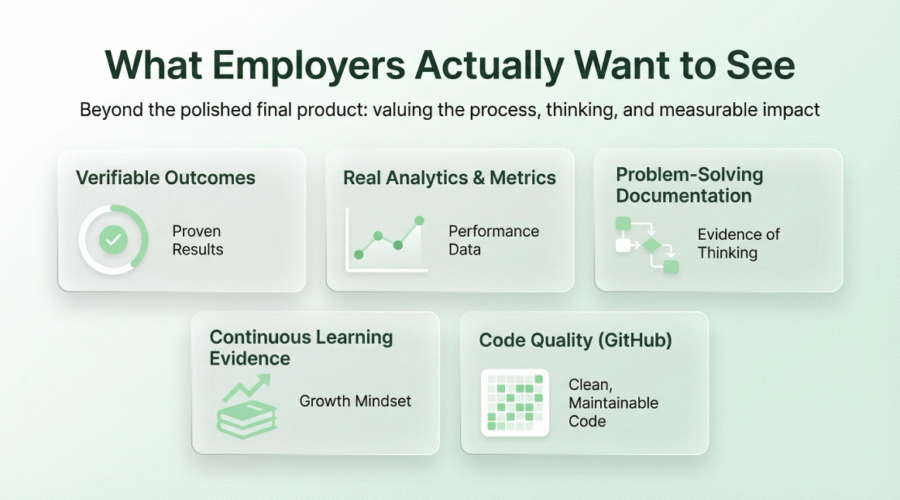
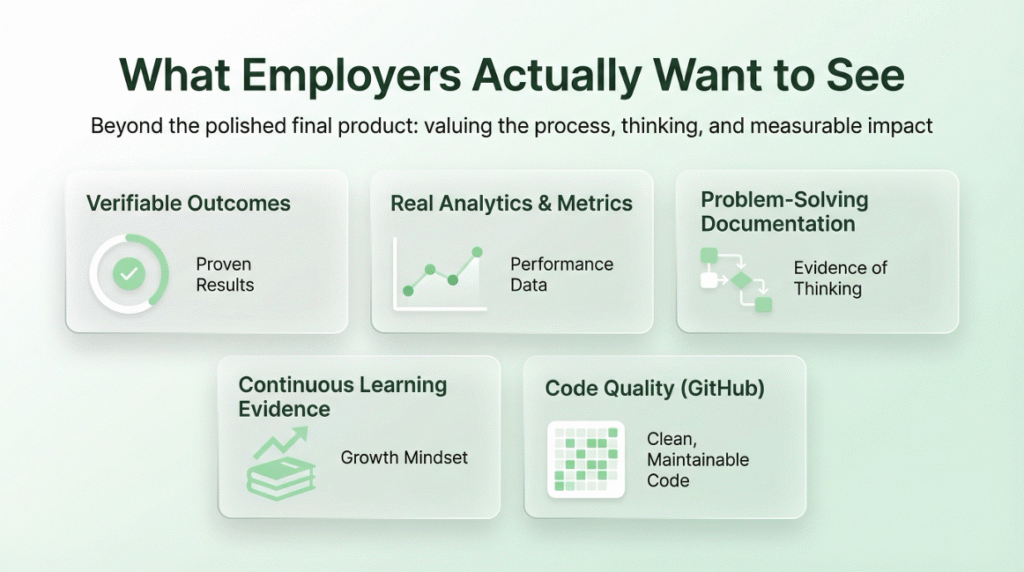
The image above captures this shift clearly. Employers want:
- Verifiable Outcomes
- Real Analytics & Metrics
- Problem-Solving Documentation
- Continuous Learning Evidence
- Code Quality (GitHub-Level Standards)
Nap OS was architected around exactly these five pillars. It is not just a productivity tool. It is an operating system for career credibility.
Let’s break down what employers truly want — and how Nap OS natively operationalizes each expectation.
1. Verifiable Outcomes — Proven Results, Not Claims
The era of subjective CV bullet points is over.
Statements like:
- “Improved engagement”
- “Worked on marketing campaigns”
- “Built a web app”
- “Contributed to growth”
…no longer carry weight unless they are tied to measurable, verifiable results.
What Employers Actually Mean by “Results”
They want:
- % improvements
- Time reductions
- Revenue impact
- Cost savings
- Adoption metrics
- Retention numbers
- Error reduction
- Performance optimization
They want evidence that your work moved a needle.
The Problem
Most students and early professionals:
- Build projects without tracking impact
- Don’t instrument analytics
- Don’t document before/after baselines
- Lose measurable data over time
- Cannot prove causation
So even when they did create value, they cannot prove it.
How Nap OS Solves This
Nap OS embeds Outcome Tracking as a native layer, not an afterthought.
With Nap OS:
- Every project is structured around Outcome Definition
- Users define:
- Objective
- Baseline
- Target metric
- Measurement method
- Projects cannot be marked complete without metric attribution
- Impact dashboards automatically aggregate results
Instead of writing:
“Built a student productivity app.”
Nap OS enables:
“Built a student productivity app that reduced weekly task completion time by 23% across 120 beta users over 6 weeks.”
That is employer-ready language — generated from real tracked data.
Nap OS shifts students from project builders to impact creators.
2. Real Analytics & Metrics — Performance Data Over Polished Demos
A polished UI means nothing without performance data.
Employers increasingly ask:
- How did users behave?
- What was the conversion rate?
- What experiments did you run?
- What did you optimize?
- How did metrics evolve over time?
They want analytical thinkers — not just executors.
The Analytics Expectation
Employers expect familiarity with:
- A/B testing logic
- Funnel analysis
- Retention curves
- Cohort tracking
- KPI dashboards
- Experiment iteration
Even non-technical roles now require data fluency.
The Problem
Most students:
- Build static portfolio projects
- Never integrate analytics
- Do not track real usage
- Cannot show dashboards
- Do not run experiments
Their work lacks measurable iteration.
Nap OS Native Analytics Layer
Nap OS integrates analytics directly into:
- Project modules
- Skill trackers
- Experiment logs
- Iteration mapping
With Nap OS:
- Every initiative is tied to performance tracking
- Metrics are visualized over time
- Iteration cycles are recorded
- Experiments are documented
- Impact trends are stored longitudinally
Nap OS does not allow passive completion. It enforces:
Hypothesis → Action → Measurement → Iteration
This makes every student portfolio:
- Data-backed
- Experiment-driven
- Employer-ready
In interviews, Nap OS users can open dashboards and show:
- Growth curves
- Performance deltas
- Iteration logs
- Behavioral insights
This is how modern employers evaluate potential.
3. Problem-Solving Documentation — Evidence of Thinking
A final product does not show intelligence.
Thinking does.
Employers want to understand:
- Why did you choose this approach?
- What alternatives did you consider?
- What constraints did you face?
- What tradeoffs did you evaluate?
- What failed before success?
They are hiring decision-makers, not just implementers.
The Thinking Gap
Most candidates:
- Show outcomes but not reasoning
- Cannot articulate decision pathways
- Do not document iteration logic
- Forget their thought process over time
This is fatal in interviews.
Nap OS Thinking Architecture
Nap OS includes a Problem-Solving Documentation Framework embedded inside every project module.
Each initiative requires structured documentation:
- Problem Definition
- Context & Constraints
- Hypothesis
- Options Considered
- Chosen Strategy & Why
- Implementation Notes
- Results
- Reflection & Learnings
This creates a cognitive audit trail.
Over time, Nap OS builds a structured knowledge graph of how the user thinks.
In interviews, this allows candidates to:
- Reference structured decision logs
- Show iteration documentation
- Demonstrate systems thinking
- Prove analytical maturity
Employers do not just want outcomes.
They want evidence of strategic reasoning.
Nap OS makes thinking visible.
4. Continuous Learning Evidence — Growth Mindset in Action
The half-life of skills is shrinking.
AI, automation, and evolving tech stacks mean:
- What you know today may be obsolete in 3 years.
- Adaptability is more valuable than static expertise.
Employers now evaluate:
- How fast you learn
- How consistently you upgrade
- How you respond to change
They want dynamic learners.
The Static Resume Problem
Traditional resumes:
- Freeze time
- Show past achievements
- Hide skill decay
- Do not show progression
There is no visible learning curve.
Nap OS Continuous Learning Engine
Nap OS integrates a Skill Evolution Tracker:
- Skills mapped over time
- Learning goals logged
- Competency levels tracked
- Knowledge expansion visualized
- Cross-domain skill mapping enabled
It shows:
- When a skill was acquired
- When it was applied
- When it was upgraded
- What triggered growth
This creates a visible learning velocity profile.
Employers can see:
- Rate of development
- Breadth of exposure
- Depth of progression
- Adaptability patterns
Nap OS transforms growth from a claim into a graph.
5. Code Quality — Clean, Maintainable, Professional Standards
For technical roles, GitHub is the new CV.
Employers look at:
- Code structure
- Documentation clarity
- Commit history quality
- Testing practices
- Modular architecture
- Scalability logic
Messy code signals messy thinking.
The Common Issue
Students:
- Build fast
- Skip documentation
- Avoid tests
- Ignore maintainability
- Push single massive commits
- Do not follow clean architecture
Even good ideas fail credibility due to poor implementation standards.
Nap OS Code Governance Model
Nap OS promotes:
- Structured project repositories
- Documentation templates
- Clean commit standards
- Iteration logs
- Architecture mapping
- Code quality scoring
For technical tracks, Nap OS:
- Encourages modular builds
- Maps code changes to outcome impact
- Connects commits to experiments
- Tracks refactoring cycles
This transforms GitHub from:
“A collection of projects”
Into:
“A structured record of engineering discipline”
Employers notice this immediately.
Nap OS as a Career Operating System
Most productivity tools help you complete tasks.
Nap OS helps you build career capital.
Its native philosophy:
- Every project must produce measurable impact.
- Every action must tie to data.
- Every decision must be documented.
- Every skill must evolve.
- Every implementation must meet quality standards.
Nap OS is not reactive.
It is structurally aligned with employer evaluation criteria.
The Employer Evaluation Matrix
Let’s synthesize what hiring managers subconsciously score:
| Dimension | What They Want | Nap OS Alignment |
|---|---|---|
| Impact | Proven measurable outcomes | Native outcome dashboards |
| Analytics | Data-driven decisions | Built-in metrics tracking |
| Thinking | Structured reasoning | Problem documentation logs |
| Growth | Continuous upskilling | Skill evolution tracking |
| Execution | Clean, scalable work | Code governance & standards |
Nap OS is engineered across all five dimensions.
Why This Matters Now
Three macro trends are reshaping hiring:
1. AI Replacing Low-Level Execution
Routine tasks are automated. Employers now prioritize:
- Strategy
- Interpretation
- Oversight
- Optimization
Nap OS trains these layers.
2. Entry-Level Compression
Companies hire fewer entry-level roles.
They expect:
- Immediate productivity
- Independent execution
- Systems thinking
Nap OS builds these capabilities early.
3. Signal Saturation
Thousands of applicants have:
- Similar degrees
- Similar resumes
- Similar certifications
Differentiation now depends on:
- Measurable proof
- Thinking clarity
- Documented growth
Nap OS creates defensible signal.
Nap OS as a Signal Amplifier
Without structure:
- Talent is invisible.
- Effort is undocumented.
- Growth is untracked.
- Impact is forgotten.
Nap OS turns invisible effort into structured evidence.
It functions as:
- A performance archive
- A decision log
- A skills evolution map
- An analytics engine
- A credibility builder
This is what modern employers want — even if they cannot articulate it explicitly.
From Student to Strategic Contributor
The transition employers seek is not:
Student → Employee
It is:
Student → Analytical Operator
Nap OS accelerates this transformation by embedding:
- Systems thinking
- Performance measurement
- Structured reflection
- Technical discipline
- Iterative growth models
It makes professional behavior native before employment begins.
Final Thought: The New Career Standard
In the past, a strong GPA was enough.
Then internships became required.
Then portfolios.
Then GitHub.
Now the bar has shifted again.
The new standard is:
- Prove it worked.
- Show the data.
- Explain your reasoning.
- Demonstrate growth.
- Maintain execution quality.
Nap OS is built precisely around this standard.
It is not a trend-based platform.
It is a structural alignment tool between students and employer expectations.
In a world where noise is high and differentiation is low, structured credibility wins.
Nap OS does not just help you work.
It helps you prove your value.
Understanding what employers want is essential for career success. Connect with forward-thinking companies and discover opportunities on LinkedIn.