Last updated: February 17, 2026
5 min read
Why Evidential Hiring Is Replacing LinkedIn Signals?
For more than a decade, hiring has been dominated by professional profiles. Recruiters learned to scan headlines, endorsements, connection counts, and employer logos to make decisions at scale. That system worked when networks were smaller and identities were harder to fake. That era is over.
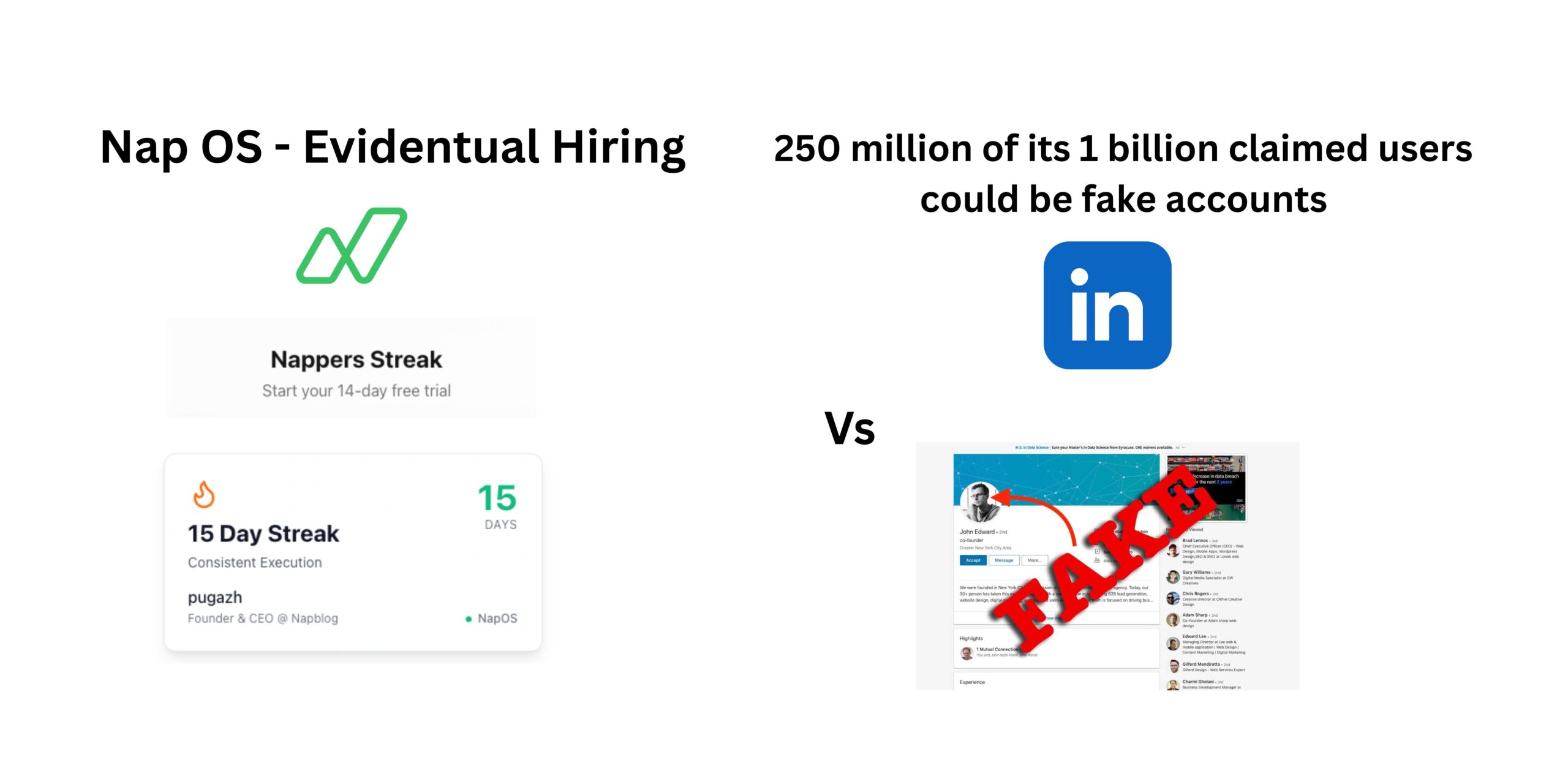
Today, platforms such as LinkedIn operate at unprecedented scale. With more than a billion registered accounts globally, the platform has become an essential infrastructure for recruitment—and simultaneously, a high-value target for fraud. Independent analysts and platform disclosures indicate that hundreds of millions of accounts may be fake, automated, duplicated, or materially misrepresented. In 2024 alone, tens of millions of fraudulent profiles were removed, many of them generated or enhanced using AI.
The implication for hiring is severe: when the input signals are polluted, the output decisions degrade. The industry is now facing a structural problem, not a moderation problem.
This is where Nap OS introduces a fundamental shift.
The Signal Collapse in Profile-Based Hiring
LinkedIn hiring is built on self-reported data. Profiles are written by candidates, resumes are uploaded by candidates, endorsements are exchanged socially, and activity is optimized for visibility rather than truth. Even when no malicious intent exists, exaggeration is normalized.
At scale, three systemic failures emerge:
1. Identity Is Assumed, Not Verified
A profile photo, a work history, and a list of skills are treated as proxies for identity. In remote hiring, this assumption breaks down quickly. There are now documented cases where:
- Different individuals appear across interview rounds
- Proxy interviewees are used for technical screenings
- The hired individual is not the person who interviewed
Profile systems have no native mechanism to detect this.
2. Capability Is Claimed, Not Proven
Modern resumes are increasingly AI-generated. Large language models can produce polished, role-specific career narratives in seconds. Applicant Tracking Systems are optimized for keyword matching, not truth detection. As a result, impressive profiles often collapse once real work begins.
For many remote roles, recruiters report that 30–50% of applicants are non-viable, fraudulent, or misrepresented. This creates massive time loss, delayed hiring, and poor outcomes.
3. Engagement Signals Are Misleading
Connections, likes, comments, and recommendations are social currency, not performance indicators. They reward visibility, not execution. In a market flooded with bots and growth-hacked accounts, engagement has become a weak hiring signal.
The outcome is predictable: mis-hires, early attrition, wasted onboarding costs, and security exposure.
Why Moderation Will Never Solve This
It is tempting to believe that better AI detection will fix fake profiles. It will not.
Moderation is reactive. For every detection model deployed, adversarial behavior adapts. AI-generated photos, cloned identities, and synthetic work histories are improving faster than platform enforcement. Even if 99% of fake accounts are eventually removed, the remaining 1% is still massive at billion-user scale.
More importantly, the core problem is not fakes alone. Even real profiles are unreliable because they measure representation, not performance.
Hiring needs a different primitive.
From Profiles to Proof: The Nap OS Model
Nap OS is built on a simple but non-negotiable principle:
If a capability cannot be demonstrated, it cannot be trusted.
Instead of asking candidates to describe what they can do, Nap OS asks them to do the work—inside the system.
What “Evidential Hiring” Means
Evidential hiring replaces symbolic signals with observable evidence:
- Real tasks, not hypothetical interviews
- Time-bound execution, not narrative claims
- Skill traces, not endorsements
- Consistency over time, not one-off performance
Every action leaves a verifiable footprint. Identity, capability, and reliability are inferred from behavior, not presentation.
Nappers Streak: Consistency as a Signal
One of the core primitives inside Nap OS is Nappers Streak.
A streak is not gamification for vanity. It is a behavioral signal.
When a candidate executes meaningful work consistently over days or weeks:
- Effort becomes measurable
- Discipline becomes visible
- Drop-off patterns emerge naturally
You cannot fake sustained execution. Outsourcing breaks continuity. Automation reveals itself through unnatural patterns. Streaks expose reality over time.
In contrast, a LinkedIn profile is static. It does not decay when skills decay. It does not fail when motivation drops. It does not reveal how someone performs on an ordinary Tuesday.
Nap OS does.
Why Evidence Cannot Be Faked at Scale
Fraud thrives where verification is expensive. Nap OS flips this equation.
To fake evidential hiring, a candidate would need to:
- Maintain consistent identity across sessions
- Produce original work repeatedly
- Meet real deadlines
- Adapt to feedback
- Sustain effort over time
This is more costly than doing the work legitimately. As a result, fraud becomes economically irrational.
That is the core advantage of evidence-based systems: they align incentives with truth.
Impact on Employers
For employers, the shift from profiles to evidence delivers measurable outcomes:
Reduced Screening Noise
Instead of reviewing hundreds of resumes, recruiters evaluate a smaller set of candidates who have already demonstrated capability.
Faster Time-to-Hire
Evidence compresses decision cycles. Hiring managers see proof directly, without interpretation layers.
Lower Mis-Hire Risk
When hiring is based on executed work, onboarding surprises decline sharply.
Improved Security Posture
Identity consistency across time and tasks reduces impersonation and insider risk.
Impact on Candidates
Evidential hiring is not anti-candidate. It is anti-pretence.
For genuine talent, especially early-career or non-traditional candidates:
- Pedigree matters less than output
- Network access matters less than execution
- Storytelling matters less than substance
Nap OS creates a level field where work speaks louder than background.
LinkedIn vs Nap OS: A Structural Comparison
- Profile-centric
- Self-reported data
- Engagement-driven
- Easy to inflate
- Static representation
Nap OS
- Evidence-centric
- Behavior-derived data
- Execution-driven
- Hard to fake
- Living performance record
This is not a feature comparison. It is a paradigm shift.
The Future of Hiring Infrastructure
Hiring systems tend to lag labor market reality. Today’s reality includes:
- Remote-first teams
- AI-augmented fraud
- Global talent pools
- Rapid skill decay and emergence
Profile networks were not designed for this environment.
Evidential systems are.
Nap OS is not positioning itself as another hiring tool layered on top of LinkedIn. It is designed as infrastructure—a substrate where work, learning, and evaluation converge.
Final Thought
In a world where 250 million profiles can exist without a real human behind them, credibility must be earned differently.
The future of hiring will not be built on who you say you are.
It will be built on what you can repeatedly prove.
That future is evidential.
That future is Nap OS.
See how Nap OS brings evidence to hiring decisions that cannot be faked. Follow on LinkedIn.