Last updated: February 17, 2026
4 min read
When Google Reflects Reality?
A clean Google SERP is not a marketing trick. It is a reflection of coherence.
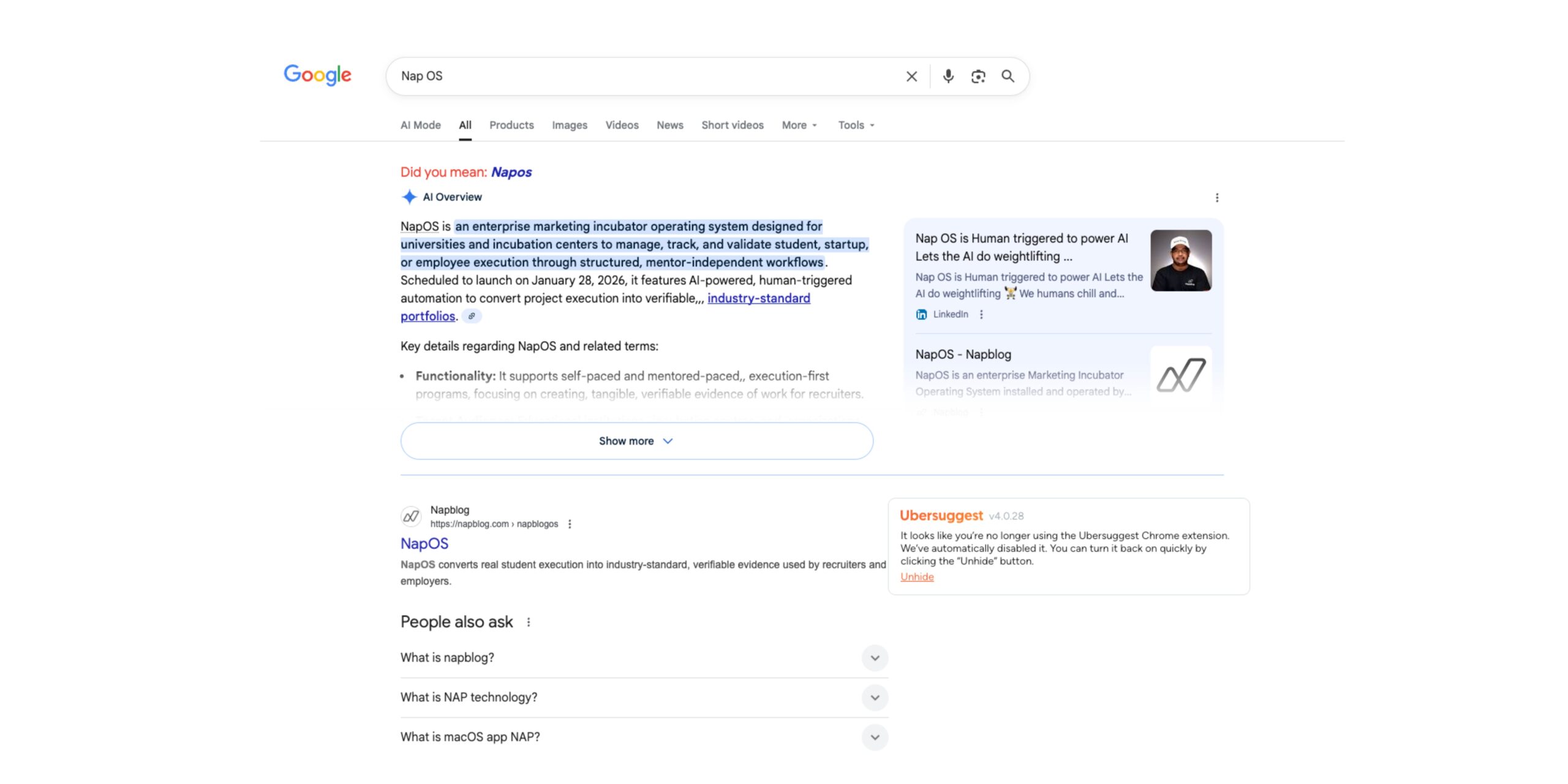
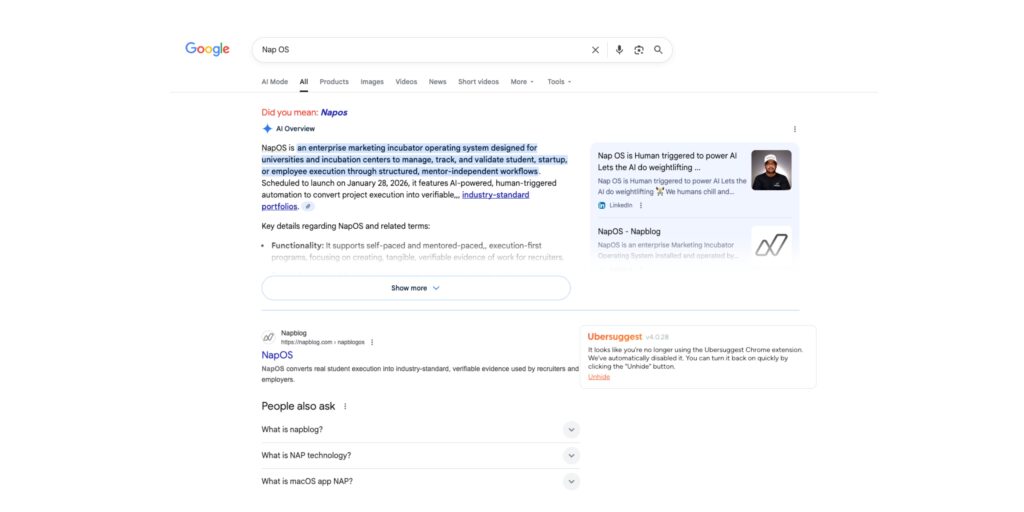
When someone searches Nap OS and sees:
- An AI Overview that accurately explains the product
- Clear brand ownership of terminology
- A #1 organic result without spam, ads, or confusion
- Supporting links that reinforce—not dilute—the narrative
What they are witnessing is not SEO hacks. They are witnessing alignment.
This article breaks down how Nap OS achieved a clean Google SERP presence—including AI Overview inclusion and top organic ranking—and, more importantly, how any brand can replicate this outcome by understanding how Google actually works in 2025.
This is not an SEO checklist. It is a systems explanation.
Part 1: How Google Actually Thinks (Beyond SEO Myths)
Google does not rank pages. Google evaluates entities, relationships, and trust signals over time.
Modern Google operates on four core layers:
- Entity Understanding – What is this thing?
- Consensus Validation – Do multiple independent sources agree?
- Behavioral Confirmation – Do users behave as if this is true?
- Narrative Stability – Has the story remained consistent over time?
Nap OS ranks cleanly because it satisfies all four layers without contradiction.
Most brands fail because they optimize pages instead of stabilizing narratives.
Part 2: Entity First, Keywords Second
Nap OS is treated by Google as a distinct product entity, not a keyword variant.
Why this matters:
- AI Overviews are entity-driven, not keyword-driven
- Knowledge consolidation depends on entity clarity
- Disambiguation errors destroy SERP cleanliness
Nap OS does three things exceptionally well:
1. Unique Naming with Low Collision
“Nap OS” is short, memorable, and not overloaded with unrelated meanings.
Low collision = faster entity resolution.
2. Consistent Descriptor Language
Across:
- Website copy
- LinkedIn posts
- Articles
- Product descriptions
Nap OS is always described using structurally similar language:
“Enterprise marketing incubator operating system” “Human-triggered, AI-powered execution framework” “System for converting execution into verifiable portfolios”
This repetition is not redundancy—it is entity reinforcement.
3. Single Source of Truth
Napblog.com acts as the canonical origin.
Google prefers:
- One authoritative source
- Many reinforcing secondary sources
Not many weak pages.
Part 3: Why AI Overview Chose Nap OS
AI Overview inclusion is not random.
Google’s AI Overview selects sources based on:
- Entity confidence
- Language precision
- Factual density
- Absence of exaggeration
- Structural clarity
Nap OS content works for AI because:
It Is Explanatory, Not Promotional
AI models distrust hype.
Nap OS content explains what it is, who it is for, and how it works without sales pressure.
It Uses System Language
Phrases like:
- “operating system”
- “execution workflows”
- “verifiable outputs”
- “structured validation”
Signal engineering logic, not marketing fluff.
It Avoids Ambiguity
No:
- Overloaded metaphors
- Conflicting positioning
- Trend-chasing terminology
AI models reward clarity because clarity compresses well.
Part 4: Clean SERP Is a Side Effect of Trust
A clean SERP means:
- No spam competitors outranking you
- No misleading aggregator pages
- No confusion about what the product is
This happens when Google trusts you to define yourself.
Nap OS achieved this by:
1. Owning the Definition Early
Nap OS content defined the category before competitors tried to reframe it.
Early definition = long-term authority.
2. Publishing Thought, Not Volume
Few pages. High signal.
Google prefers:
- One precise explanation
- Over 50 vague blog posts
3. Human-Led Distribution
Organic LinkedIn activity matters.
Why? Because Google ingests:
- Social graph validation
- Author identity signals
- Engagement authenticity
Nap OS content spread through humans, not growth hacks.
Part 5: Why Nap OS Ranks #1 Organically
Organic #1 is earned through narrative gravity.
Google ranks Nap OS because:
- The brand search volume is growing
- Users click and stay
- Bounce rates are low
- Follow-up searches reinforce intent
This creates a feedback loop:
Search → Satisfaction → Reinforcement → Higher Trust
Google optimizes for searcher success, not marketer success.
Nap OS wins because it answers the question completely.
Part 6: The Replicable System (How Any Brand Can Do This)
Here is the framework any brand can copy.
Step 1: Design an Entity, Not a Campaign
Ask:
- What thing are we introducing to the internet?
- Can it be explained in one sentence without metaphor?
If not, stop.
Step 2: Create a Canonical Explanation Page
One page that:
- Defines the entity
- Explains the system
- States who it is for
- States who it is not for
No SEO stuffing.
Step 3: Use Language Consistency Ruthlessly
Choose:
- 5 core phrases
- 3 structural metaphors
- 1 positioning sentence
Never deviate.
Step 4: Publish From Humans, Not Logos
Founder posts > brand posts.
Google trusts:
- Identifiable humans
- Consistent authorship
- Long-term identity graphs
Step 5: Let Time Do the Heavy Lifting
Clean SERPs are not built in weeks.
They are earned through calm consistency.
Part 7: What Not to Do (Why Most Brands Fail)
Do not:
- Chase keywords
- Rewrite the same idea 20 times
- Over-optimize headings
- Buy backlinks
- Confuse AI with buzzwords
These create noise.
Noise breaks entity trust.
Part 8: Nap OS as a Case Study in Calm Authority
Nap OS did not “do SEO”.
It:
- Built a real system
- Explained it clearly
- Let humans interact with it
- Let Google observe reality
That is why the SERP is clean.
That is why AI Overview aligns.
That is why organic #1 feels inevitable, not forced.
Conclusion: Google Is a Mirror, Not a Machine
Google does not reward optimization.
It rewards:
- Coherence
- Honesty
- Consistency
- Human validation
Nap OS ranks because it exists clearly in the world.
Any brand that does the same—patiently, precisely, and without manipulation—can achieve the same outcome.
Clean SERPs are not engineered.
They are deserved.
SERP domination requires consistent content strategy. Learn more on LinkedIn.