Last updated: February 17, 2026
6 min read
In most platforms today, profiles are static.
They tell you who someone claims to be, not who they consistently are.
Nap OS deliberately breaks away from that pattern.
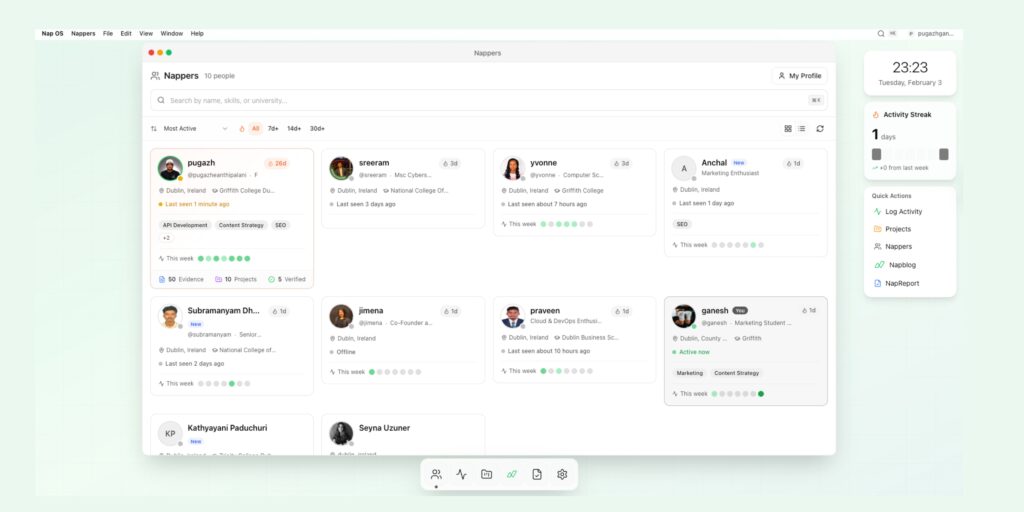
The Finest Nappers – NapStore View is not a directory, not a leaderboard, and not a résumé gallery. It is a living, data-rich, behavior-driven view of real people doing real work over time. Every UI element, interaction, and data point exists for one purpose:
To surface truth over claims.
This article explains how the NapStore View is designed, why it matters, and how it enables anyone—founders, recruiters, mentors, educators, or collaborators—to instantly understand the real essence of a person through verified signals, not surface-level branding.
The Problem With Traditional Profile Views
Before understanding the NapStore View, it’s important to understand what it is not.
Most platforms suffer from the same structural flaws:
- Profiles are self-reported, not validated
- Activity is hidden or aggregated, not transparent
- Skills are declared, not demonstrated
- Search works on keywords, not context
- Time is ignored — yesterday and today look the same
As a result, platforms optimize for:
- Performative profiles
- Inflated skill claims
- One-time achievements
- Vanity metrics
What gets lost is the signal of consistency.
Nap OS starts from the opposite assumption:
Consistency over time is the only reliable indicator of capability.
What Is the NapStore (Finest Nappers) View?
The NapStore View is the operational heart of Nap OS’s people layer.
It is a high-density, UX-optimized interface that allows users to:
- View active Nappers at a glance
- Compare engagement without comparison pressure
- Understand skills through actions, not labels
- Identify trust signals instantly
- Discover people via context, not just names
This is not about “who is best.”
It is about who is real, active, and verifiable.
Designed for Signal, Not Noise
The NapStore View is intentionally calm, minimal, and structured.
This is not accidental—it’s a UX principle.
Visual Hierarchy That Respects Cognition
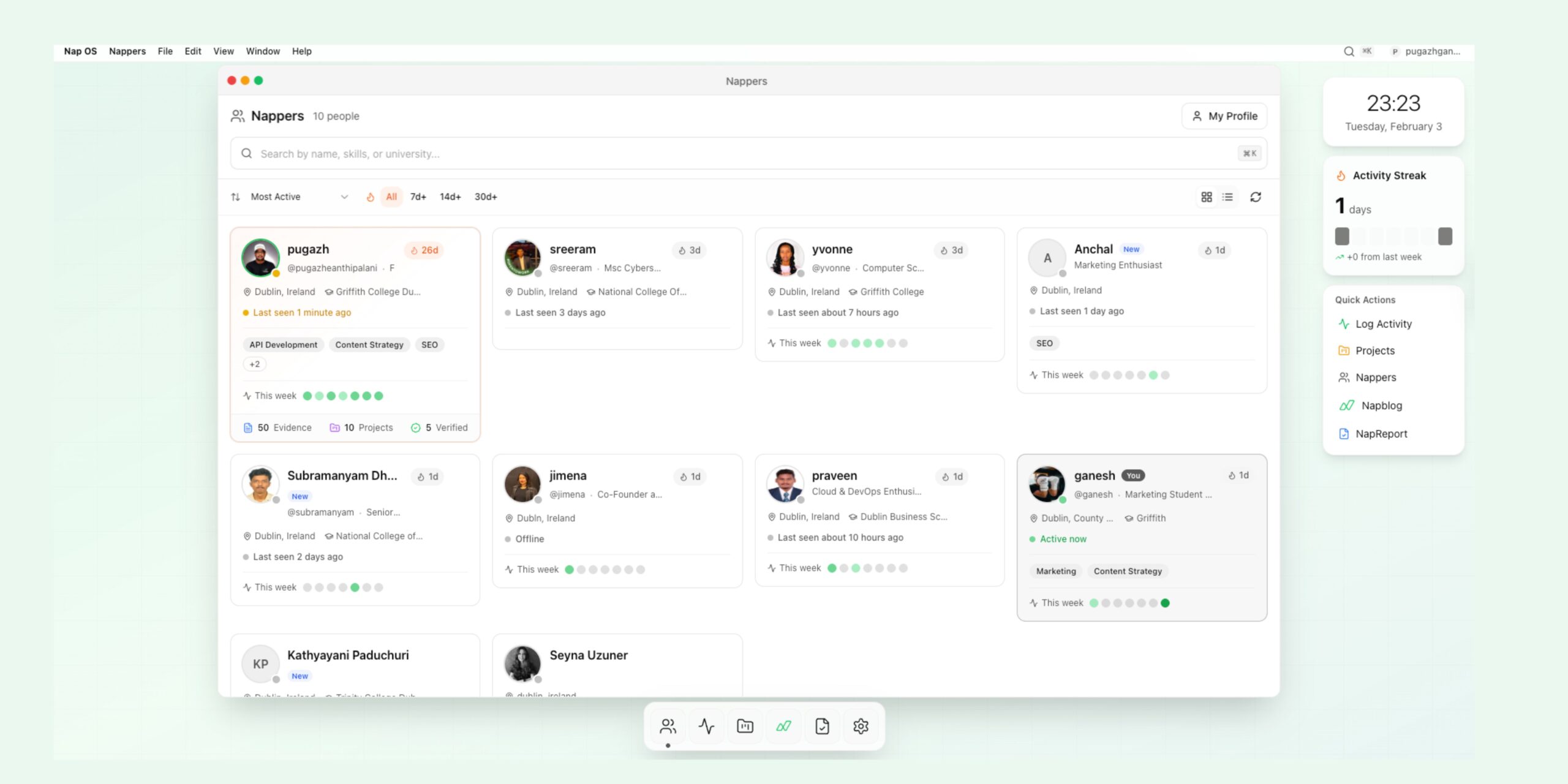
At first glance, the interface answers four core questions:
- Who is this person?
- Are they active right now?
- What are they actually working on?
- Can their work be trusted?
Every card is a compressed story:
- Profile identity
- Activity recency
- Weekly effort signal
- Skills grounded in action
- Evidence and verification markers
There is no infinite scrolling dopamine trap.
There is no “viral” prioritization.
There is no manipulation of attention.
Just clean signal extraction.
Activity as a First-Class Citizen
Traditional platforms treat activity as secondary.
Nap OS treats activity as identity.
Activity Streaks That Actually Mean Something
In the NapStore View, activity is visible but not gamified.
- “Last seen” timestamps matter
- Weekly effort indicators matter
- Inactivity is not hidden
This creates a subtle but powerful shift:
You don’t look impressive because you say you are.
You look reliable because you keep showing up.
A person with a modest skill set but consistent activity often carries more weight than someone with impressive claims and no trail.
Nap OS makes this obvious—without shaming, without badges, without noise.
Evidence Over Endorsements
Endorsements are easy to fake.
Evidence is not.
Evidence Counts as Trust Currency
Each Napper profile surfaces:
- Logged activities
- Work artifacts
- Verified outputs
- Projects completed
- Historical effort trails
This allows anyone viewing the NapStore to trace competence backward:
From today → to last week → to months of activity.
This is crucial for:
- Founders evaluating collaborators
- Recruiters assessing early-stage talent
- Educators validating applied learning
- Teams filtering signal from noise
The UX does not ask you to “believe.”
It allows you to verify.
Skills as Emergent Properties, Not Labels
In Nap OS, skills are not just tags.
They are emergent properties derived from behavior.
Skills Shown in Context
In the NapStore View:
- Skills appear alongside evidence
- Skills are tied to logged work
- Skills evolve as activity evolves
This prevents:
- Keyword stuffing
- Static self-branding
- Skill inflation
Instead, skills behave like living metadata.
Someone who logs consistent API development work naturally surfaces as an API developer.
Someone who stops doing that work slowly loses that signal.
The system rewards doing, not declaring.
The Global Search Bar: Contextual, Not Cosmetic
Search is where most platforms fail quietly.
They treat search as:
- A name lookup tool
- A keyword matcher
Nap OS treats search as context discovery.
Search Anything, Discover Meaning
The global search bar in the NapStore View allows searching by:
- Names
- Skills
- Universities
- Domains
- Keywords from activity logs
- Project context
- Historical patterns
This means you are not searching profiles.
You are searching work-backed identity.
Example:
- Searching “SEO” doesn’t return people who say they know SEO
- It surfaces people who logged SEO work consistently
This is the difference between discovery and filtering.
Time as a UX Dimension
One of the most underrated aspects of NapStore View is how it treats time.
Time is visible.
Time matters.
Time is contextual.
This Week vs Long-Term Behavior
The UI allows quick understanding of:
- Who is active this week
- Who has long-term consistency
- Who recently joined
- Who went inactive
There is no penalty for being new.
There is no artificial boost for being old.
Just temporal truth.
This helps avoid a common platform failure:
judging someone based on a snapshot instead of a timeline.
Comparison Without Competition
The NapStore View allows comparison without turning people into metrics.
There are:
- No ranks
- No public scores
- No leaderboards
Yet, comparison is still possible through:
- Activity density
- Evidence presence
- Verification markers
This is intentional.
Nap OS does not want to create performers.
It wants to surface reliable operators.
UX Choices That Build Psychological Safety
A subtle but critical achievement of the NapStore View is psychological safety.
Users are not pressured to:
- Over-optimize their profile
- Perform daily for visibility
- Chase vanity metrics
Instead, they are encouraged to:
- Log honestly
- Work consistently
- Improve quietly
This creates a rare environment where:
Serious people feel comfortable staying long-term.
That alone filters the right crowd.
Why This Matters for Legitimacy
Nap OS is often evaluated by first-time visitors asking:
“Is this real?”
The NapStore View answers that question without words.
- Real people
- Real activity
- Real time
- Real evidence
No marketing page can replace that.
Legitimacy emerges naturally when systems expose reality.
Who Benefits Most From the NapStore View?
Founders & Builders
- Identify collaborators who execute
- Avoid résumé-only contributors
Recruiters
- See applied effort, not interview performance
- Reduce false positives
Educators & Mentors
- Validate learning through action
- Track progress over time
Students & Early Talent
- Compete on consistency, not pedigree
- Build credibility without gatekeepers
The Philosophy Behind the Interface
The NapStore View reflects a deeper philosophy:
Trust should be earned gradually, not granted instantly.
By making activity, evidence, and time visible—but not noisy—Nap OS aligns technology with human judgment.
This is not about automation replacing thinking.
It’s about giving humans better raw signal.
Final Thought: Profiles Are Dead, Trails Are Alive
The NapStore View represents a shift from profiles to trails.
A profile is static.
A trail is alive.
Nap OS bets on trails.
And the Finest Nappers View is where those trails become visible, interpretable, and meaningful—without distortion.
Not everyone will like this system.
That’s intentional.
But for those who care about real work, real effort, and real growth, this view is not just useful—it’s inevitable.
The Finest Nappers view in NapStore reveals the real essence behind every profile. Explore more on LinkedIn.