Last updated: February 16, 2026
5 min read
For decades, the career path was predictable:
University → Internship → Entry-Level Job → Promotion → Leadership.
That pipeline is breaking.
Not gradually. Structurally.
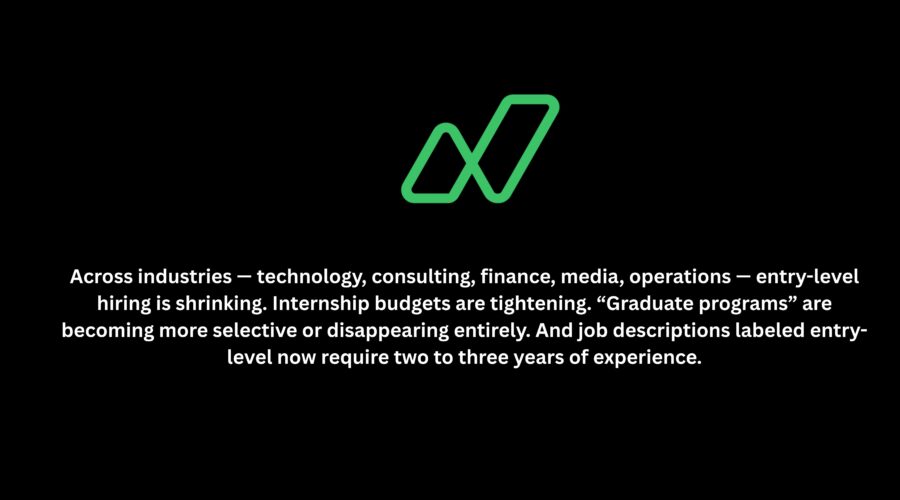
Across industries — technology, consulting, finance, media, operations — entry-level hiring is shrinking. Internship budgets are tightening. “Graduate programs” are becoming more selective or disappearing entirely. And job descriptions labeled entry-level now require two to three years of experience.
At the same time, artificial intelligence is accelerating task automation at the exact layer of work traditionally performed by junior professionals.
The implication is clear:
The bottom rung of the career ladder is eroding.
And if you are a student, graduate, or early-career professional, you cannot afford to rely on the old system.
You must build your own.
That is precisely why Nap OS exists.
1. The Shrinking Entry-Level Market: What’s Actually Happening?
Let’s move past speculation and look at structural dynamics.
1. Automation Is Replacing Junior Tasks
AI systems can now:
- Draft reports
- Analyze datasets
- Generate code
- Prepare slide decks
- Summarize research
- Handle administrative workflows
Historically, these tasks were delegated to interns and junior analysts.
Today, one experienced professional augmented with AI can produce output equivalent to multiple entry-level hires.
When companies evaluate cost efficiency, the math changes.
2. Hiring Freezes Favor Experience Over Potential
Post-pandemic corporate strategy has shifted toward:
- Leaner teams
- Controlled hiring
- Fewer onboarding investments
- Faster productivity expectations
Training fresh graduates requires time, mentorship, and budget. In uncertain markets, organizations often prefer lateral hires who can deliver immediately.
The result?
The experience paradox intensifies:
You need experience to get experience.
3. Internship Programs Are No Longer Guaranteed Pipelines
Internships used to serve as:
- Trial runs for full-time conversion
- Skill development incubators
- Brand access points
Now, many companies:
- Reduce intern cohorts
- Replace long internships with short projects
- Prioritize only top-tier universities
- Cut conversion rates
The internship-to-job bridge is weaker than before.
2. The Degree Is No Longer Enough
Here is the uncomfortable truth:
A diploma is now a baseline credential — not a differentiator.
Recruiters increasingly ask:
- What have you built?
- What outcomes have you delivered?
- Where is the evidence?
- What can you show me?
This is where portfolios become decisive.
3. The Rise of the Portfolio Economy
We are entering what can be called the Portfolio Economy.
In this economy:
Your proof of capability matters more than your stated capability.
A portfolio is no longer just for designers or developers. It applies to:
- Business students
- Political science majors
- Marketing interns
- Operations analysts
- AI researchers
- Product managers
A modern portfolio includes:
- Case studies
- Project documentation
- Impact metrics
- Open-source contributions
- Leadership initiatives
- Strategy documents
- Reflection frameworks
- Skill maps
Why does this matter?
Because employers trust demonstrated execution more than theoretical knowledge.
If entry-level hiring shrinks, companies will choose candidates who appear “job-ready.”
A well-structured portfolio signals exactly that.
4. Leadership: The Overlooked Differentiator
Technical competence is expected.
Leadership potential is rare.
In competitive hiring environments, employers increasingly screen for:
- Initiative
- Decision-making ability
- Strategic thinking
- Communication clarity
- Ownership mindset
- Adaptability
These are not “senior-only” skills.
They are employability multipliers.
Leadership training does three things:
- Accelerates maturity
- Reduces onboarding friction
- Signals growth potential
In a contracting job market, hiring managers ask:
“If I only have budget for one junior hire, who will scale fastest?”
The candidate with leadership capability wins.
5. The Real Problem: Most Students Are Not Structurally Prepared
Let’s be candid.
Many graduates:
- Don’t systematically track their projects
- Don’t document impact metrics
- Don’t map skill gaps
- Don’t build public proof of competence
- Don’t train leadership intentionally
- Don’t align skills with market demand
They rely on:
- CV templates
- Random internships
- Academic grades
That strategy is outdated.
The new career reality requires a system.
This is where Nap OS becomes essential.
Why Nap OS Must Be Adopted ASAP
Nap OS is not just a productivity tool.
It is a Career Operating System.
And in today’s environment, operating without a system is a strategic liability.
1. Nap OS Turns You Into a Portfolio Machine
Instead of scattered files and forgotten achievements, Nap OS allows you to:
- Capture every project
- Document deliverables
- Attach metrics
- Reflect on learnings
- Tag competencies
- Align work with job descriptions
Over time, this becomes:
A living, evolving professional asset.
When an opportunity appears, you don’t scramble.
You deploy.
2. Nap OS Bridges the Experience Gap
If entry-level roles require experience, then:
You must simulate and build experience yourself.
Nap OS helps you:
- Plan structured self-projects
- Track open-source contributions
- Design mock consulting cases
- Build research portfolios
- Create digital proof of competence
You are no longer waiting for permission to gain experience.
You are manufacturing it.
3. Nap OS Develops Leadership Intentionally
Leadership is not random.
Nap OS enables:
- Competency mapping
- Milestone tracking
- Reflection logs
- Decision analysis
- Growth roadmaps
Instead of saying in interviews,
“I’m a good leader,”
You can say:
“I led X initiative, achieved Y outcome, documented Z insights, and here’s the progression over six months.”
That level of clarity differentiates instantly.
4. Nap OS Adapts to the AI Era
AI is not replacing ambitious professionals.
It is replacing unstructured ones.
Nap OS integrates with AI workflows, enabling you to:
- Map new skills as technology evolves
- Adjust learning trajectories
- Identify automation risks
- Upskill strategically
- Track competency shifts
The world is dynamic.
Your career system must be dynamic too.
5. The Cost of Waiting
Every month without a structured system means:
- Lost documentation
- Forgotten metrics
- Missed portfolio opportunities
- Untracked skill gaps
- Leadership growth stagnation
The competitive gap widens silently.
Those who systemize early compound advantage.
Those who delay fall behind invisibly.
The Strategic Shift: From Job Seeker to Asset Builder
The biggest mental shift required now is this:
Stop thinking like a job applicant.
Start thinking like a personal enterprise.
In a shrinking entry-level market:
You are competing not only with peers —
but with automation.
Your leverage becomes:
- Depth of proof
- Strategic clarity
- Leadership maturity
- Execution documentation
- AI adaptability
Nap OS is designed precisely for this era.
What Happens If You Don’t Adapt?
If you rely on:
- Generic resumes
- Unstructured internships
- Academic transcripts
- Hope-based job applications
You enter a narrowing funnel with increasing friction.
If you instead:
- Build a structured portfolio
- Track outcomes
- Train leadership
- Integrate AI workflows
- Use Nap OS to coordinate it all
You move from reactive to proactive.
From applicant to architect.
The Future Belongs to the Structured
The next five years will not reward:
- Passive graduates
- Undocumented talent
- Unmeasured impact
They will reward:
- Builders
- Systems thinkers
- Portfolio creators
- AI-adaptive professionals
- Early leadership developers
The entry-level collapse is not the end.
It is a filter.
Those who build structured proof of competence will pass through.
Those who wait for the old ladder to return may wait indefinitely.
Final Thought
The career ladder is no longer stable.
You must build your own infrastructure.
Nap OS is that infrastructure.
Not later.
Not when you graduate.
Not when you get rejected three times.
Now.
Because in a market where the first rung is disappearing,
the only safe strategy is to build your own steps upward.
In a collapsing entry-level job market, portfolios have become the new career currency that proves your capabilities beyond a traditional resume. Explore career tools on LinkedIn.