Last updated: February 17, 2026
6 min read
Operated by Students Ireland OS (SIOS). Built by Napblog.com
The Hidden Cost No One Measures in International Education Operations
In international education consulting, the real cost is rarely software licenses or office rent.
The real cost is operational drag.
It shows up as:
- Endless follow-ups for missing documents
- Excel sheets that never match reality
- Consultants juggling WhatsApp, email, Google Drive, phone calls, and memory
- Students repeatedly asking, “Is this enough?”
- Universities receiving incomplete or misaligned applications
- Visa delays caused not by rejection—but by poor preparation
For years, this chaos has been normalized as “part of the process.”
At Napblog, we do not believe chaos is a feature of international education.
We believe it is a systems failure.
This feature update—powered by Students Ireland OS (SIOS) and built by Napblog.com—addresses one of the most underestimated sources of cost and stress in the entire ecosystem: unstructured requirements management.
Why Requirements, Not Communication, Are the Real Bottleneck
Most platforms in the education space attempt to “improve communication.”
More chat tools. More notifications. More dashboards.
But communication is not the root problem.
The real problem is that requirements are implicit, fragmented, and unenforced.
Every international student journey—from first enquiry to visa approval—depends on dozens of requirements:
- Academic documents
- Identity documents
- Financial proofs
- Institutional conditions
- Visa-specific compliance
Yet in most consulting operations, these requirements live:
- Partly in consultants’ heads
- Partly in outdated spreadsheets
- Partly in email threads
- Partly in WhatsApp screenshots
- Partly in Google Drive folders named “Final_Final_Updated”
The result is predictable:
- Consultants spend time chasing instead of advising
- Students feel confused instead of confident
- Errors surface late, when correction is expensive
SIOS does not attempt to digitize this chaos.
It replaces it with structure.
Introducing System-Level Requirements in SIOS
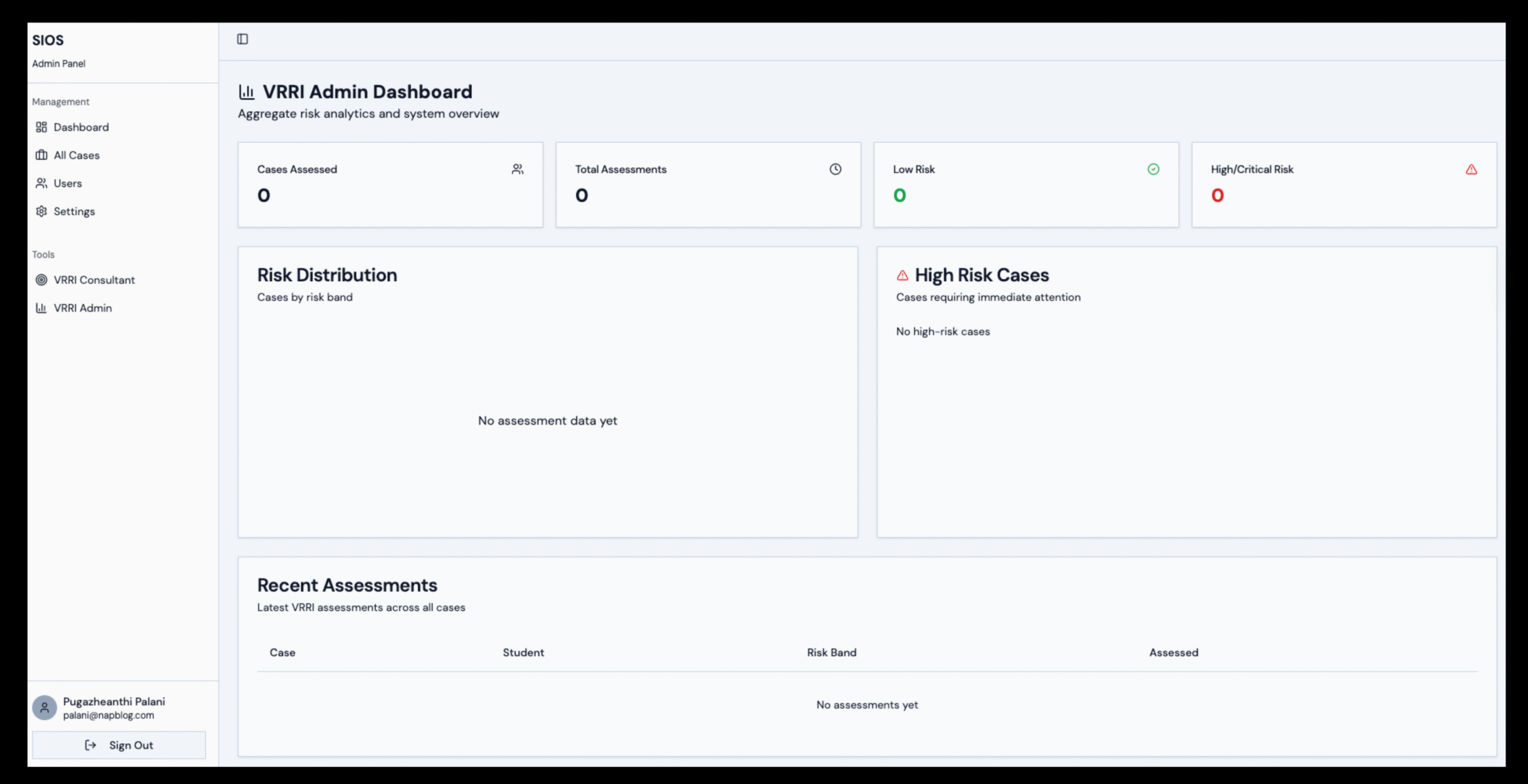
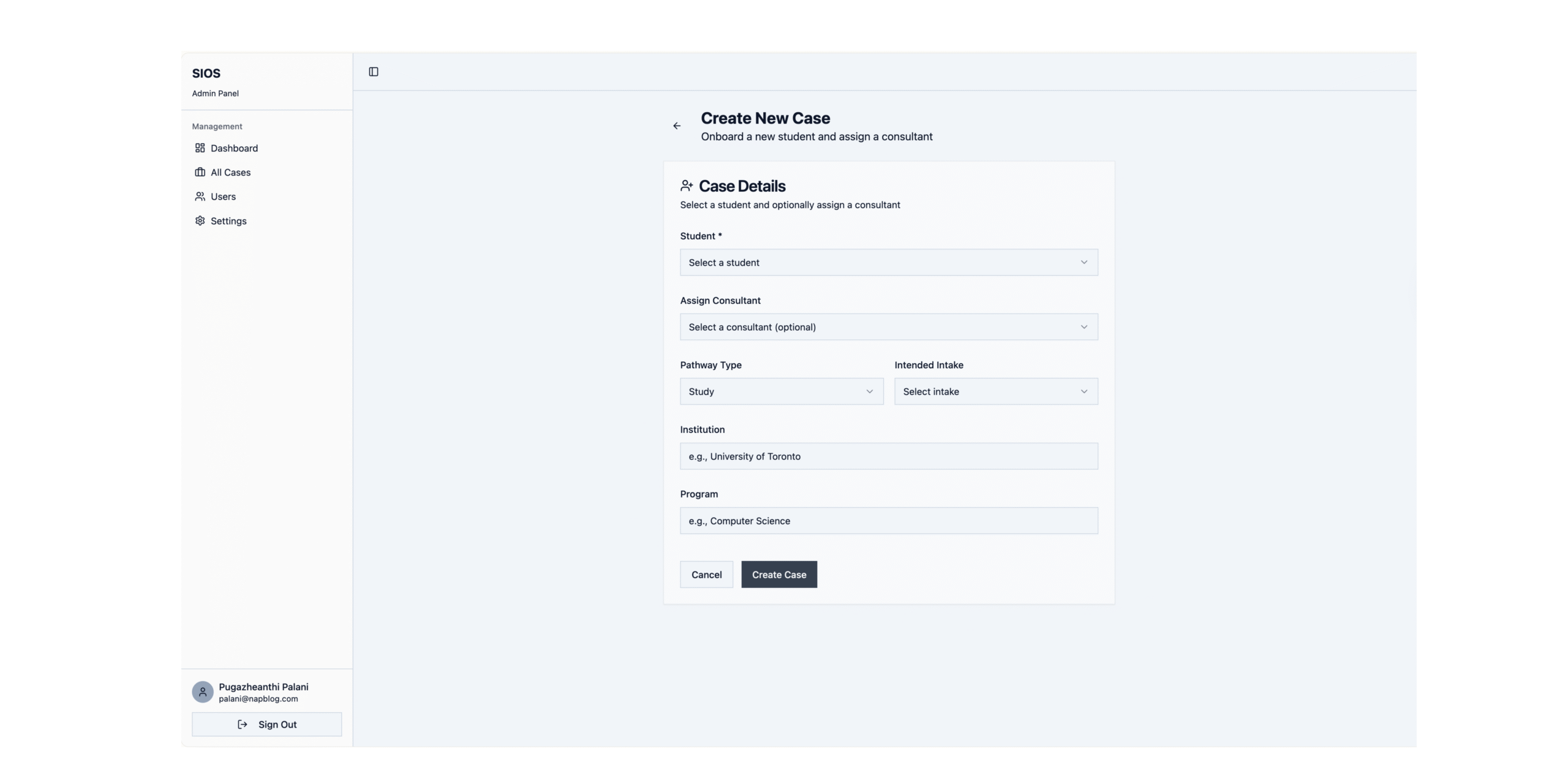
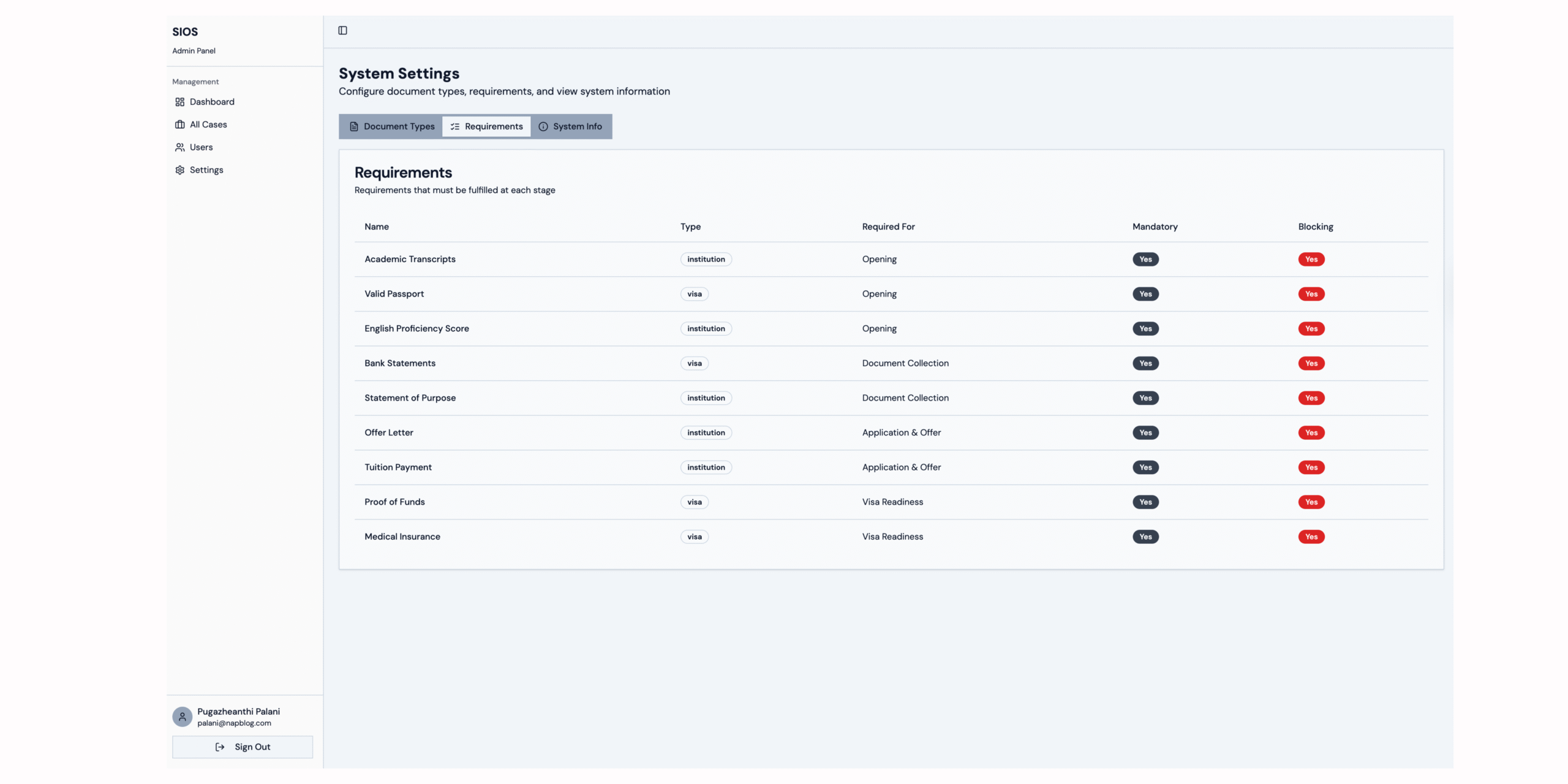
This feature update introduces a centralized Requirements Engine inside the SIOS Admin Panel.
This is not a checklist.
This is not a reminder tool.
This is process enforcement at the system level.
Within SIOS, administrators can now define:
- What documents are required
- At which stage they are required
- Whether they are mandatory
- Whether missing them blocks progress
- Whether they relate to institution or visa workflows
Once defined, these rules are enforced consistently—across all students, consultants, and cases.
No human memory required.
No interpretation gaps.
No “I thought this was optional.”
From Manual Judgment to System Intelligence
Let us examine what actually changes operationally.
Before SIOS Requirements Engine
- Consultants manually track progress in Excel
- Students upload documents without knowing if they are sufficient
- Consultants repeatedly review the same files
- Mistakes surface late in the process
- Senior consultants get pulled into routine validation
- Operational costs scale linearly with student volume
After SIOS Requirements Engine
- Each case moves through predefined stages
- Every stage has explicitly defined requirements
- Missing mandatory items block progression automatically
- Consultants focus on exceptions, not routine checks
- Students see exactly what is pending and why
- Operational effort scales sub-linearly with volume
This is the difference between managing people and managing systems.
Stage-Based Enforcement: Eliminating Ambiguity at Every Step
One of the most critical design decisions in SIOS is stage-based requirements enforcement.
Each student case progresses through clearly defined phases, such as:
- Opening
- Document Collection
- Application & Offer
- Visa Readiness
For each stage, the system defines:
- Required documents
- Document type (Institution / Visa)
- Mandatory vs optional
- Blocking vs non-blocking
This means:
- A case cannot move forward unless it is genuinely ready
- Consultants cannot accidentally skip steps
- Students are never unsure about what comes next
This single design choice eliminates a significant percentage of downstream errors.
Operational Cost Reduction: Where the Savings Actually Come From
Cost reduction does not come from paying consultants less.
It comes from eliminating wasted effort.
SIOS reduces operational cost in five concrete ways:
1. Reduced Follow-Ups
Automated visibility of missing items eliminates repetitive reminders.
2. Reduced Rework
Documents are validated at the correct stage, not retroactively.
3. Reduced Senior Consultant Dependency
Junior staff can manage cases confidently within system guardrails.
4. Reduced Error Escalation
Blocking rules prevent incomplete cases from advancing.
5. Reduced Context Switching
All documentation, status, and requirements live in one system.
For most consulting firms, this translates to:
- Higher student-to-consultant ratios
- Faster turnaround times
- Lower burnout
- Better client satisfaction
Student Experience: Confidence Replaces Anxiety
From the student’s perspective, the traditional process feels opaque and stressful.
They are told:
- “Submit your documents”
- “We will review”
- “We will let you know”
Weeks pass.
Silence follows.
Uncertainty grows.
With SIOS:
- Students see exactly what is required
- They know which stage they are in
- They understand why progress is blocked
- They stop guessing and start preparing
This transparency reduces anxiety—not by reassurance, but by clarity.
Clarity is the most undervalued form of support in international education.
Built for Consultants, Not Against Them
SIOS is not designed to replace consultants.
It is designed to protect their expertise.
By automating routine enforcement:
- Consultants spend less time on admin
- More time on advisory and strategy
- More time on complex cases
- Less time firefighting
The system does not remove judgment.
It removes avoidable judgment.
This distinction matters.
Why This Matters to Universities and Institutions
Universities rarely see the internal chaos of pre-arrival consulting.
They only see the outcome:
- Incomplete applications
- Inconsistent documentation
- Last-minute clarifications
SIOS indirectly benefits institutions by:
- Improving application quality
- Standardizing documentation readiness
- Reducing back-and-forth
- Increasing trust in partner consultants
In effect, SIOS functions as pre-validation infrastructure for the ecosystem.
Why Napblog Built This as Infrastructure, Not a Feature
Most platforms treat features as selling points.
Napblog treats them as infrastructure components.
This requirements engine is not a “nice-to-have.”
It is a foundation layer.
Napblog’s philosophy is simple:
If a process is critical, it should not depend on memory, goodwill, or heroics.
By building SIOS as an operating system—not an app—we ensure:
- Consistency across organizations
- Scalability across volumes
- Stability across years
This is why SIOS is operated as a system and built by Napblog as infrastructure.
From First Enquiry to Visa Approval: One Continuous System
What makes this update particularly powerful is not the feature itself—but its placement.
The same requirements framework governs:
- Initial enquiry qualification
- Academic application readiness
- Offer compliance
- Visa documentation
There are no handovers between tools.
No reset points.
No loss of context.
The entire journey lives inside one system.
This is how operational headaches disappear—not through effort, but through design.
The Strategic Shift: From Service Business to System-Led Operations
For consulting firms, adopting SIOS is more than a productivity upgrade.
It is a business model shift.
From:
- Founder-dependent operations
- Consultant-heavy workflows
- Linear scaling costs
To:
- System-led delivery
- Predictable outcomes
- Scalable growth
This shift is what separates firms that survive from firms that lead.
Final Thought: Quiet Systems Create Loud Results
This feature update will not make headlines.
It will not feel flashy.
But over months, it will:
- Reduce stress
- Improve outcomes
- Lower costs
- Increase trust
The best systems do not announce themselves.
They simply remove problems.
That is what SIOS—built by Napblog.com—is designed to do.
Napblog.com builds infrastructure for ecosystems that deserve better systems.
SIOS operates where complexity is highest—so people can focus on what matters.
If you are operating in international education and still managing requirements manually, the question is no longer if this will break—but when.
And systems exist so it does not have to.
Meeting system requirements is key to eliminating operational chaos. Follow SIOS on LinkedIn.