Last updated: February 17, 2026
5 min read
For an international student, a visa decision is never just an administrative outcome. It is the single most emotional checkpoint in the entire study-abroad journey. Months—sometimes years—of preparation, financial planning, family discussions, and personal sacrifice often come down to a short interview and a stamped decision.
At SIOS – Students Ireland OS, we view visa rejection not as an isolated failure, but as a systemic signal. A signal that modern student mobility has outgrown fragmented advisory models, outdated documentation practices, and reactive decision-making.
This newsletter explains how SIOS complements the ecosystem by identifying root causes behind visa rejections and addressing them through comprehensive, student-centric solutions—especially in a rapidly shifting global visa landscape between 2024 and 2025.
The Global Context: Visa Approvals Are Not Uniform—They Are Polarised
Between 2024 and 2025, the global visa environment did not move in a single direction. Instead, it fractured.
Some countries shortened processing timelines, streamlined documentation, or improved approval rates. Others tightened scrutiny, increased refusal rates, or introduced additional pre-checks. This uneven landscape is critical for students and advisors to understand—because strategy that worked in 2023 may quietly fail in 2025.
Broadly, three macro-patterns emerged:
- Selective Liberalisation – Certain regions improved efficiency or approval rates for specific nationalities.
- Risk-Weighted Scrutiny – Applicants from high-volume or historically over-staying regions faced higher rejection probabilities.
- Silent Complexity – Even where approval rates improved, documentation expectations became more sophisticated rather than simpler.
Countries Showing Improved Approval Trends (2024–2025)
Data published and consolidated from Schengen and regional authorities, including the European Commission, indicates that several countries saw relative easing compared to prior years:
- Russia – Noticeable drop in rejection rates compared to 2023.
- Türkiye – Incremental but consistent improvement.
- Iran – Reduced pressure on refusals, though scrutiny remains high.
- Cape Verde – One of the most dramatic improvements year-on-year.
- Syria – Significant reduction in rejection percentages, albeit from a high baseline.
These improvements, however, were not due to “leniency.” They resulted from better digital processing, pre-screening mechanisms, and clearer intent assessment.
Countries Facing Harder Approval Conditions
At the same time, rejection rates worsened for applicants from several regions:
- Nigeria
- Bangladesh
- Ecuador
- Senegal and Congo (Brazzaville)
In these cases, visa authorities cited concerns around financial traceability, post-study intent, and documentation inconsistencies—not academic quality.
This dual reality leads to an uncomfortable truth: visa success today depends less on merit alone and more on preparedness maturity.
Why Visa Rejection Is No Longer a “Student Problem”
Traditionally, visa rejection has been framed as a student’s failure:
- Weak financials
- Poor interview performance
- Incomplete documentation
This framing is incomplete and, frankly, unfair.
In reality, visa rejection is often the result of system fragmentation:
- Advisors working in silos
- Students managing documents across emails, WhatsApp, Excel sheets
- Universities disconnected from ground-level student realities
- No longitudinal visibility into a student’s journey
SIOS approaches visa outcomes differently. We treat rejection rates as predictable operational risk, not random events.
What Changed Between 2024 and 2025—and Why It Matters
1. Processing Speed Improved, But Error Tolerance Reduced
Many countries shortened processing timelines. Faster decisions mean:
- Less opportunity to correct mistakes
- Higher penalties for inconsistencies
- Zero tolerance for narrative gaps
Students now get decisions quicker—but rejections also come faster.
2. Narrative Coherence Became Central
Visa officers increasingly assess:
- Logical academic progression
- Career continuity
- Country-specific employability rationale
This is not about English fluency. It is about story integrity across documents.
3. Financial Transparency Replaced Financial Volume
Large bank balances no longer guarantee approval. Officers look for:
- Source credibility
- Transaction history
- Alignment with family income
SIOS observed that many rejections occurred even when funds were “technically sufficient.”
Where SIOS Fits: Complementing, Not Competing
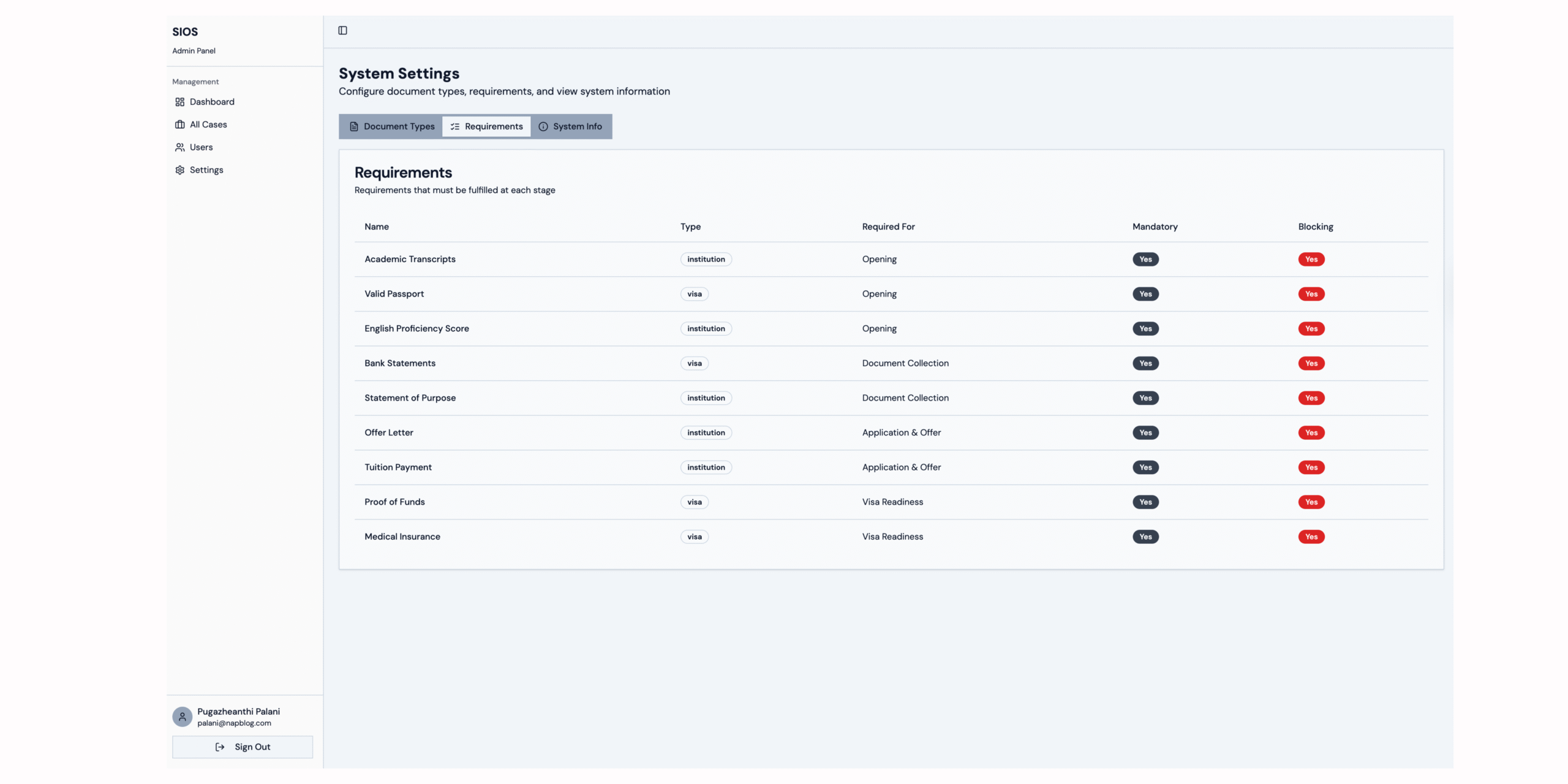
SIOS is not built to replace consultants, CRMs, or universities. It is built to connect the invisible gaps between them.
We position SIOS as a student operating system—a longitudinal layer that runs quietly underneath the entire journey.
Key SIOS Contributions to Reducing Visa Rejections
1. Single Source of Truth
SIOS centralises:
- Academic records
- Financial documentation
- Communication history
- Advisor notes
This eliminates version conflicts—one of the most common silent causes of rejection.
2. Pre-Visa Readiness Scoring
Before a student even books a visa appointment, SIOS helps identify:
- Weak narrative links
- Financial explanation gaps
- Risk markers based on nationality and destination
This shifts students from reactive preparation to proactive readiness.
3. Pattern Recognition Across Cohorts
Unlike manual advisory models, SIOS learns across thousands of anonymised journeys:
- Which documents trigger queries
- Which narratives fail silently
- Which profiles succeed despite average academics
This intelligence feeds back into student guidance in real time.
Helping Students, Not Just Processing Applications
At SIOS, helping students does not mean promising “100% visa success.” That language is irresponsible.
Helping students means:
- Making rejection less likely
- Making outcomes more predictable
- Making failures understandable and recoverable
When a rejection does occur, SIOS ensures the student understands why—not just that it happened.
This is critical for mental health, financial planning, and second-attempt strategy.
A Human Reality Behind the Numbers
Visa statistics often hide human cost:
- Families liquidating assets
- Students delaying careers
- Emotional burnout before departure even begins
SIOS was designed with this emotional layer in mind. Systems should reduce anxiety, not amplify it.
By providing clarity, structure, and foresight, SIOS helps students feel in control—even when outcomes are uncertain.
Why Shortened Approval Timelines Demand Better Systems
When approvals were slow, mistakes could be corrected. When timelines compress, systems must mature.
The future of student mobility will favour:
- Preparedness over persuasion
- Evidence over explanation
- Systems over individuals
SIOS exists for this future.
Looking Ahead: Visa Readiness as a Core Student Skill
Between 2024 and 2025, one lesson is clear: visa success is no longer an event—it is a capability.
Students who understand this early:
- Plan finances differently
- Choose programs more strategically
- Communicate more coherently
SIOS’s responsibility is not just to support applications—but to educate students about the rules of the game before they play it.
Final Thought: From Rejection Rates to Readiness Rates
Visa rejection rates will always fluctuate. Policies will tighten and loosen. Geopolitics will interfere.
What should not fluctuate is the quality of preparation.
SIOS complements the global education ecosystem by shifting focus:
- From approvals to preparedness
- From promises to processes
- From short-term wins to long-term student resilience
When systems improve, outcomes follow.
That is how SIOS helps students—not by fighting embassies, but by preparing students to meet them with clarity, confidence, and coherence.
Understanding visa rejection trends helps students prepare stronger applications. Follow Napblog on LinkedIn for more insights.