Last updated: February 17, 2026
5 min read
From Skills to Signal
How Business School and Graduate Students Turn Daily Execution into Funding, Interviews, and Career Leverage
In two days, Nap OS goes live.
This launch is not about a new app, a dashboard, or another layer of productivity tooling. It is about solving a quiet but fundamental failure in modern education and early-career systems:
skills do not compound, and evidence does not persist.
Every year, business schools and graduate programs produce highly capable students. They learn strategy, finance, analytics, operations, design, marketing, and technology. They work on projects, case studies, simulations, group work, internships, and side experiments.
And yet, when it comes time to raise funding, apply for jobs, or face interviews, most of that work disappears.
What remains is abstraction:
- A resume with keywords
- A GPA
- A few bullet points
- A rehearsed narrative
Nap OS exists to replace abstraction with signal.
The Structural Problem No One Talks About
Education systems assume a linear model:
- Learn skills
- Graduate
- Prove ability later
Reality does not work that way anymore.
Funding bodies, recruiters, and hiring managers no longer trust credentials alone. At the same time, students are asked to “prove themselves” without any infrastructure to preserve proof.
This creates three systemic failures:
1. Skills Are Temporarily Visible
Students do real work, but that work lives in scattered tools:
- Docs
- Slides
- Notion pages
- GitHub repos
- Coursework portals
- Personal folders
There is no single system that captures ongoing execution across time.
2. Evidence Does Not Compound
Each project is treated as a one-off. Once a semester ends or an internship finishes, the signal resets. No continuity. No momentum. No historical depth.
3. Evaluation Is Narrative-Driven
Because evidence is fragmented, evaluation falls back to storytelling:
- “Tell me about a time when…”
- “Walk me through your experience…”
- “Why should we trust your ability?”
This rewards articulation over execution and confidence over consistency.
Nap OS was designed specifically to break this loop.
Nap OS: Execution as a First-Class Asset
Nap OS treats execution itself as the primary data layer.
Not outcomes alone.
Not credentials.
Not hours spent.
But what was done, when, how often, and with what quality.
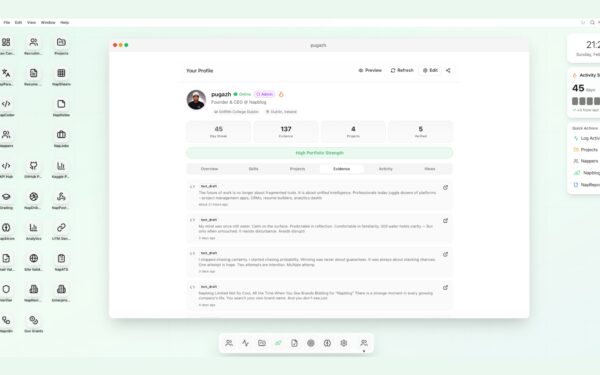
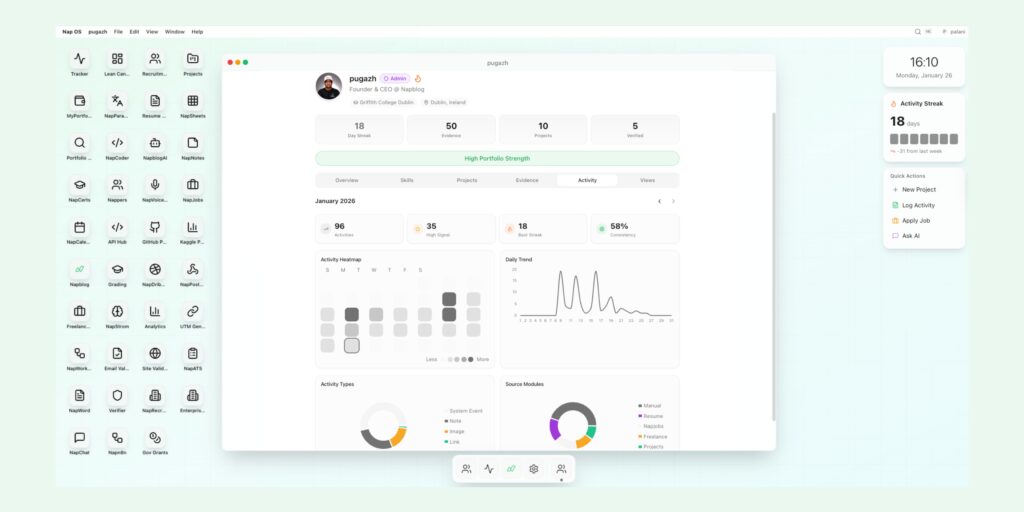
Every action logged in Nap OS becomes part of a living skill database—time-stamped, structured, and reusable.
This is the core shift:
Learning, work, and proof are no longer separate phases. They are the same system.
For Business School Students: Turning Work into Funding Signal
Early-stage funding decisions are not made on ideas alone.
They are made on patterns.
Investors, grant committees, and accelerators look for:
- Consistency of execution
- Speed of iteration
- Evidence of learning loops
- Ability to ship without supervision
Nap OS allows business school students to build this evidence before they ever ask for capital.
What Changes in Practice
Instead of preparing a pitch deck in isolation, students using Nap OS are already documenting:
- Market research sprints
- Customer interviews
- Financial model iterations
- Go-to-market experiments
- Failed assumptions and corrections
- Weekly execution streaks
Over time, this forms a longitudinal execution record.
When a funding conversation begins, the dynamic changes:
Not:
“Here is what I plan to do.”
But:
“Here is what I have already been doing for the last 90 days.”
This is a fundamentally stronger position.
Why This Matters for Grants and Accelerators
Most early-stage funding programs struggle with the same issue:
they must select founders before traction is obvious.
Nap OS reduces uncertainty by exposing:
- Daily effort patterns
- Ability to self-direct
- Execution without external pressure
Students stop being evaluated as “promising” and start being evaluated as already operating.
For Graduate Students: Interviews Without Guesswork
Graduate recruitment is broken by indirection.
Resumes summarize.
Interviews speculate.
References generalize.
Nap OS removes the need to guess.
Graduate students using Nap OS build:
- Verified activity trails
- Skill-specific execution logs
- Project histories linked to outputs
- Consistency metrics over time
When a recruiter or hiring panel reviews a Nap OS profile, they are not reading claims. They are observing behavior.
What Interviewers Actually Want (But Rarely Get)
Hiring managers want answers to simple questions:
- Can this person execute without hand-holding?
- Do they follow through?
- Do they improve with feedback?
- Can they sustain effort over time?
Traditional hiring tools do not answer these questions reliably.
Nap OS does.
As a result, interviews change shape:
- Fewer generic questions
- More focused discussions
- Faster decision-making
Candidates stop “preparing stories” and start reviewing their own evidence.
Skill Databases Instead of Static Profiles
One of the most important ideas behind Nap OS is the skill database.
A resume is static.
A LinkedIn profile is narrative-driven.
A transcript is backward-looking.
A Nap OS skill database is alive.
It updates as the student works.
It reflects current capability, not past affiliation.
It connects skills to actual outputs.
This is particularly powerful for:
- Career switchers
- International students
- Non-traditional backgrounds
- Students without brand-name internships
Nap OS allows ability to surface independently of pedigree.
Institutional Impact: A New Layer of Visibility
For business schools and universities, Nap OS introduces something that has never existed at scale:
Real-time visibility into execution.
Instead of relying on:
- Grades
- Attendance
- Final submissions
Institutions can observe:
- Learning velocity
- Engagement patterns
- Skill development trajectories
This has implications for:
- Career services
- Employer partnerships
- Funding outcomes
- Alumni success tracking
More importantly, it aligns institutional incentives with student reality: execution over performance theater.
Why Now?
The timing matters.
Three forces are converging:
- Credential trust is declining
Degrees are no longer sufficient signals on their own. - AI is compressing surface-level work
What matters now is judgment, consistency, and real-world execution. - Early-career competition is global
Students are not competing locally anymore. Signal must travel.
Nap OS was built for this environment.
The Psychological Shift for Students
Beyond systems and metrics, Nap OS changes how students experience their own progress.
Instead of:
- Anxiety before interviews
- Last-minute preparation
- Self-doubt about readiness
Students develop:
- A visible execution streak
- Confidence grounded in evidence
- A sense of momentum
The feeling shifts from “I hope I’m ready” to “My work already shows it.”
One System, Multiple Outcomes
Nap OS does not ask students to choose between:
- Learning
- Employability
- Funding readiness
It collapses them into a single loop.
Every action feeds:
- Skill development
- Career signal
- Opportunity readiness
This is why Nap OS is not a tool you “use later.”
It is infrastructure you build on daily.
Launch Details
Nap OS launches on
28 January 2026 at 10:00 AM
For:
- Business school students seeking funding
- Graduate students preparing for interviews
- Institutions tired of surface-level metrics
This is not a beta experiment.
This is a structural upgrade.
In two days, execution stops being invisible.
It becomes the asset.
Nap OS
Build once.
Compound daily.
Let your work speak.
Follow the Nap OS launch journey and connect with our growing community on LinkedIn.