Last updated: February 17, 2026
5 min read
Now, the work is no longer the problem—trust is.
Trust between students and professors.
Trust between first-time freelancers and business owners.
Trust between recruiters and candidates who claim skills but lack proof.
Nap OS was not built to track time. It was built to prove execution.
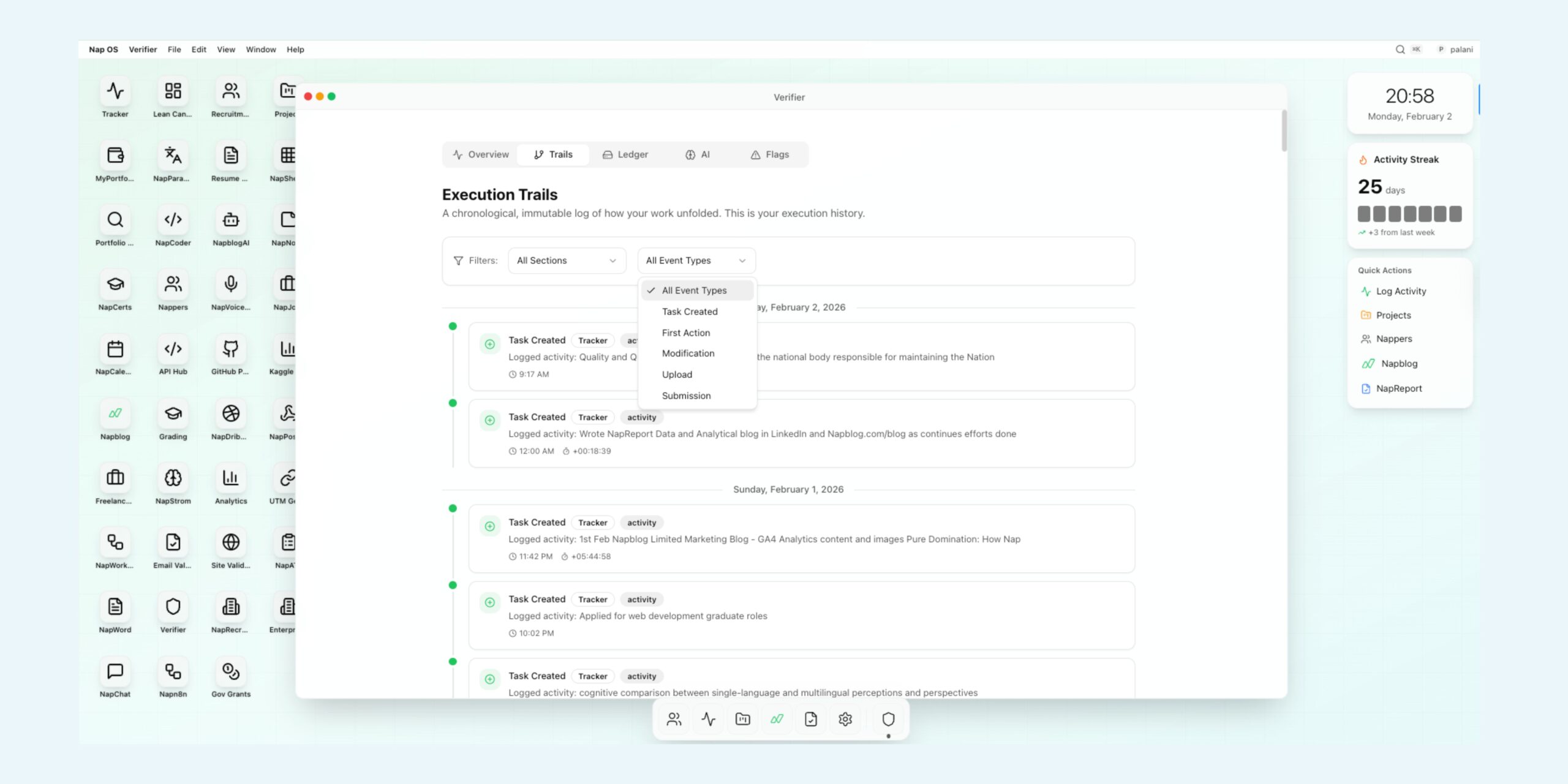
At the center of this philosophy lies one of the most important yet misunderstood components of the platform: Execution Logs (also referred to as Execution Trails or Verifier Logs). These logs are not just activity records. They are immutable, chronological evidence of real work being done, designed to solve a structural trust deficit that has existed for decades in education, hiring, and freelancing.
This article explains—at a granular level—why Execution Logs matter, who they are for, and how they can re-route economic opportunity back to EU students and first-time professionals instead of default outsourcing to anonymous, unverifiable labor markets.
1. The Global Trust Crisis in Work
1.1 Degrees Don’t Prove Execution
Students invest heavily—financially, emotionally, and cognitively—into education. Yet when they graduate, they are met with a brutal paradox:
“You need experience to get work, and work to get experience.”
A degree proves exposure to curriculum.
It does not prove:
- Consistency
- Discipline
- Real-world execution
- Delivery under constraints
Professors can grade outcomes, but they rarely see how the work unfolded.
1.2 Businesses Don’t Distrust Talent—They Distrust Claims
Business owners don’t outsource to Asia because they dislike local talent. They do it because:
- Portfolios are easy to fake
- CVs are narrative-heavy and evidence-light
- Interviews test articulation, not execution
So they choose:
- Low-cost, high-volume outsourcing
- Replaceability over accountability
This decision quietly drains opportunity from EU students who have invested years and money into skill acquisition but lack a system to prove it.
2. What Are Execution Logs in Nap OS?
Execution Logs in Nap OS are:
A chronological, immutable, system-generated record of how work actually happened.
Not what you say you did.
Not what you submitted at the end.
But:
- When the task was created
- When the first action occurred
- What modifications happened
- What was uploaded
- What was submitted
- How long execution actually took
- Whether work was consistent or sporadic
Each event is timestamped, categorized, and linked to real artifacts.
2.1 Immutable by Design
Execution Logs are append-only.
You cannot rewrite history.
This matters because:
- Retrospective fabrication becomes impossible
- “Overnight projects” reveal themselves instantly
- Consistency beats charisma
2.2 Contextual, Not Surveillance
Nap OS does not spy.
It records declared, intentional work actions.
This distinction is critical:
- Logs exist to verify outcomes, not invade privacy
- Only meaningful execution events are captured
- The user remains in control of what is shared
3. Why Professors Should Care
3.1 From Grading Outputs to Understanding Process
Traditional academic evaluation focuses on final submissions. Execution Logs allow professors to see:
- How early a student started
- Whether progress was iterative or rushed
- How feedback translated into modifications
- Whether learning was applied incrementally
This transforms grading from outcome-only to process-aware evaluation.
3.2 Detecting Genuine Learning vs Last-Minute Assembly
Two students submit similar work.
One spent 3 weeks iterating.
One copied and assembled in 12 hours.
Execution Logs make this difference visible—without accusation, without bias.
3.3 Academic Integrity Without Policing
Instead of:
- Plagiarism witch-hunts
- Surveillance tools
- Distrust-based systems
Execution Logs create evidence-based confidence in student effort.
4. Why Students Gain the Most
4.1 Proof of Discipline, Not Just Talent
Many students are capable. Fewer are consistent.
Execution Logs allow students to demonstrate:
- Daily effort
- Habit formation
- Long-term focus
- Skill application over time
This is especially powerful for:
- Self-taught students
- Non-elite university graduates
- Career switchers
4.2 Turning Learning Into Employable Evidence
A Nap OS Execution Log is not a diary.
It is employable proof.
Students can show:
- “Here is 90 days of design execution”
- “Here is my learning curve in analytics”
- “Here is how I built this project from scratch”
This shifts interviews from claims to inspection.
5. Why Business Owners Should Trust Execution Logs
5.1 Outsourcing Is a Trust Shortcut
Businesses outsource because:
- Verification is expensive
- Interviews are unreliable
- Trial projects waste time
Execution Logs eliminate this friction.
5.2 Hiring Becomes Risk Assessment, Not Guesswork
With Execution Logs, a business owner can evaluate:
- Work cadence
- Reliability
- Task completion patterns
- Depth vs surface-level execution
Before paying a single invoice.
5.3 Keeping Opportunity Inside the EU
When EU students can prove execution:
- They compete on trust, not price
- They become safer than anonymous outsourcing
- Local economies retain skill capital
Execution Logs are not anti-globalization.
They are anti-opacity.
6. Legitimacy: Why Nap OS Is Not “Another Productivity Tool”
6.1 Productivity Tools Optimize Speed
Nap OS optimizes credibility.
Execution Logs are:
- Not about doing more
- But about showing what was actually done
6.2 Legitimacy Is Infrastructure, Not Branding
Nap OS does not ask anyone to “believe” in productivity claims.
It provides:
- Evidence
- History
- Traceability
Legitimacy becomes inspectable, not asserted.
6.3 For First-Time Freelancers, This Changes Everything
First-time freelancers suffer most from:
- Lack of references
- Lack of trust
- Lack of negotiation power
Execution Logs allow them to say:
“You don’t have to trust me. You can verify me.”
That single shift changes pricing, confidence, and opportunity access.
7. Execution Logs as Economic Rebalancing
7.1 The Hidden Cost of Outsourcing
Cheap labor often results in:
- Rework
- Miscommunication
- Hidden supervision costs
Execution Logs reduce uncertainty at the source.
7.2 Re-routing Trust to Local Talent
When verification becomes cheap and standardized:
- Businesses prefer proximity
- Cultural alignment improves
- Knowledge stays local
Nap OS does not compete with freelancers globally.
It raises the standard of proof.
8. Execution Logs and the Future of Work
The future of work is not remote vs office.
It is verifiable vs unverifiable.
Execution Logs represent:
- A new professional identity layer
- A work passport built on evidence
- A trust protocol for human effort
9. Final Thought: Trust Is Earned, But It Must Be Visible
Students are not lazy.
Businesses are not cruel.
Professors are not blind.
The system simply lacked a shared, neutral record of execution.
Nap OS Execution Logs fill that gap.
They do not replace talent.
They do not replace education.
They do not replace judgment.
They replace guesswork.
And in doing so, they give EU students, first-time freelancers, professors, and business owners a common language of trust—built not on promises, but on proof.
Building verifiable work history matters for modern hiring. Learn more on LinkedIn.