Last updated: February 17, 2026
4 min read
Built inside Napblog Labs, and deployed by Napblog Limited, Nap OS introduces a fundamentally new class of algorithmic intelligence:
The Atomic Algorithm.
This is not a recommendation engine.
Not a keyword matcher.
Not a resume parser.
Not a productivity scorecard.
It is an execution-native, human-aligned intelligence system that models who you are becoming, not just what you say you are.
This article explains—clearly and simply—how the Atomic Algorithm works, why it is different from every existing system, and how it quietly reshapes hiring, learning, portfolios, and prediction itself.
1. Why Existing Algorithms Fail Humans
Before understanding the Atomic Algorithm, it’s important to understand what’s broken.
Most modern systems are built on static abstractions:
- Resumes → frozen snapshots
- Profiles → curated narratives
- Credentials → indirect signals
- Keywords → shallow proxies
- Engagement metrics → noise
These systems assume:
Identity is declared, not observed.
As a result:
- People optimize appearance, not behavior
- Systems reward articulation over execution
- Long-term consistency is invisible
- Human intuition is ignored
- Potential is mispriced
Nap OS rejects this foundation entirely.
2. The Core Shift: From Records to Atoms
At the heart of Nap OS is a simple but radical idea:
Every logged evidence is an atom.
What is an Atom?
An Atom is the smallest indivisible unit of human execution.
Each atom represents something you actually did.
Examples:
- A document created
- A task completed
- A design iteration
- A dataset analyzed
- A piece of content published
- A workflow automated
- A research note written
- A learning artifact produced
Atoms are not opinions.
Atoms are not intentions.
Atoms are not claims.
Atoms are evidence.
3. Anatomy of an Atom
Each atom contains structured intelligence:
1. Intensity
How demanding was the execution?
- Cognitive load
- Time investment
- Complexity
- Skill depth
2. Tags
What domain does this atom belong to?
- Skill
- Role
- Industry
- Tool
- Function
3. Format
What form did the execution take?
- Text
- Spreadsheet
- Code
- Design
- Audio
- Video
- Workflow
- Dataset
4. Timestamp
When did this execution happen?
5. Context
Why was it created?
- Learning
- Work
- Experimentation
- Problem-solving
- Contribution
Together, these properties make each atom machine-readable and human-meaningful.
4. Atomic Bonding: How Atoms Combine
Atoms do not live alone.
Just like in physics, atoms bond.
When Do Atoms Bond?
Atoms bond when they:
- Share relevant tags
- Have compatible formats
- Occur with consistent intensity
- Appear over time
- Serve a coherent direction
This bonding is organic, not forced.
You don’t “build a portfolio.”
Your portfolio emerges.
5. Compounding Maturity: How Identity Forms
As atoms accumulate and bond, something powerful happens:
Your execution compounds.
Nap OS measures maturity, not volume.
Maturity is formed by:
- Consistency over time
- Increasing intensity
- Skill convergence
- Pattern stability
- Directional clarity
This mirrors how humans actually grow.
Not linearly.
Not evenly.
But compounding through repetition.
6. From Atoms to Living Portfolios
Traditional portfolios are:
- Manually assembled
- Selectively edited
- Rarely updated
- Easily gamed
Nap OS portfolios are:
- Automatically generated
- Continuously evolving
- Evidence-complete
- Tamper-resistant
Your portfolio is no longer a presentation.
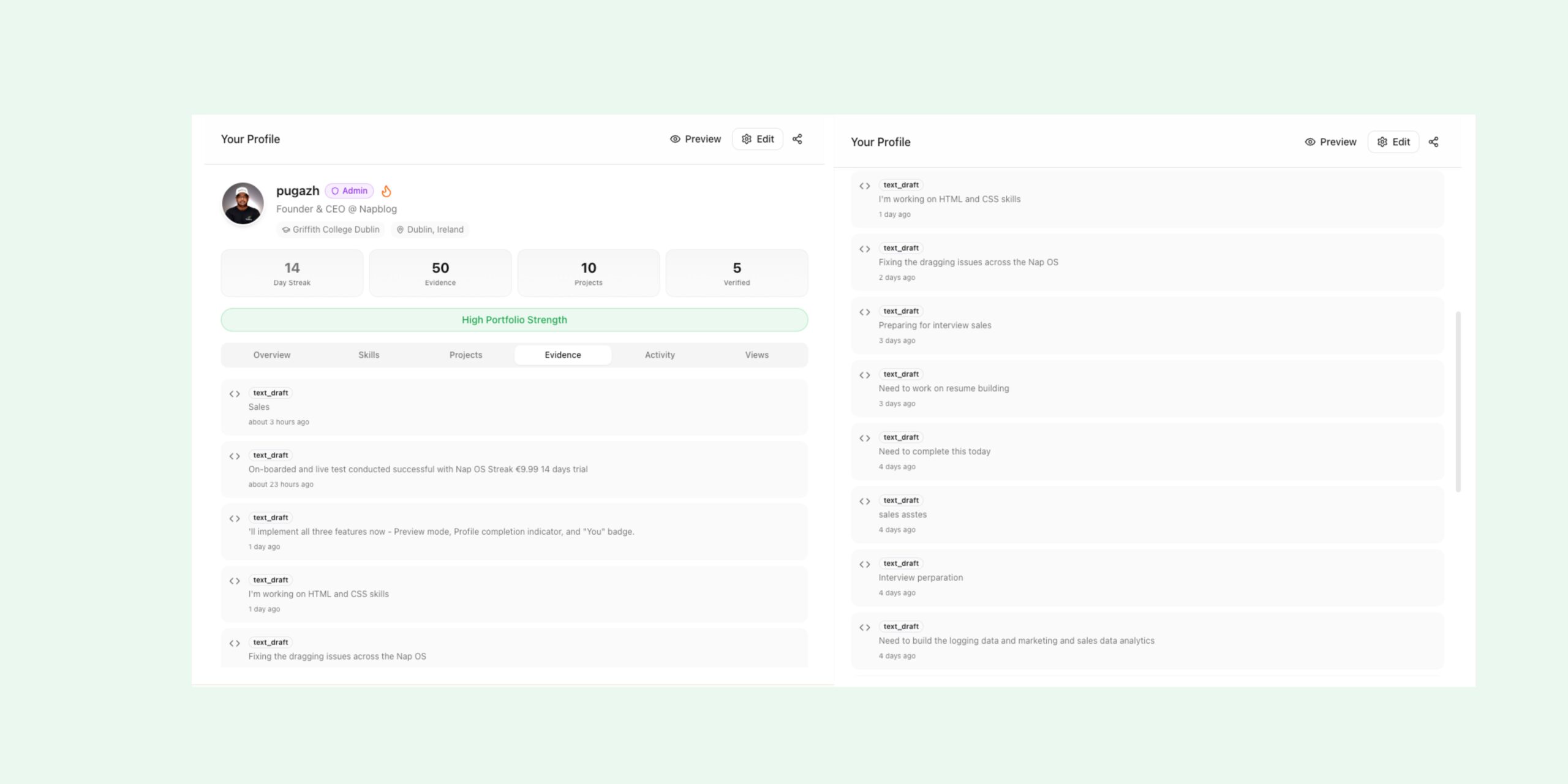
It is a byproduct of living execution.
7. Predictive Intelligence: Forecasting Human Behavior
Here is where the Atomic Algorithm becomes truly unique.
Because Nap OS observes real behavior over time, it can:
- Detect emerging strengths
- Identify fading interests
- Recognize learning velocity
- Forecast role readiness
- Predict execution reliability
This is not personality prediction.
It is behavioral trajectory modeling.
Nap OS doesn’t guess who you are.
It observes who you are becoming.
8. Periodic Simulation: The Atomic Engine in Motion
At defined intervals, Nap OS runs Atomic Simulations.
What Happens in a Simulation?
- Your bonded atomic profile is analyzed
- Execution patterns are stabilized
- Skill clusters are formed
- Intensity curves are evaluated
- Maturity thresholds are measured
This creates a living execution signature.
9. JobATS Synchronization: Beyond Resume Matching
Nap OS integrates with JobATS and Recruitment Systems, but on completely new terms.
Instead of:
- Keyword matching
- Degree filtering
- Title bias
- Narrative screening
Nap OS evaluates:
- Execution alignment
- Skill evidence density
- Consistency under load
- Output reliability
- Learning adaptability
Result:
Candidates are shortlisted by proof, not pitch.
Often:
- Before interviews
- Without resumes
- Without self-promotion
10. Human Anatomy + AI: A Deliberate Design Choice
Nap OS is not built to replace humans.
It is built to protect what makes humans valuable.
What Nap OS Automates:
- Memory
- Recall
- Organization
- Pattern recognition
- Evidence aggregation
What Nap OS Preserves:
- Intuition
- Judgment
- Creativity
- Curiosity
- Innovation
- Ethical choice
AI handles structure.
Humans retain instinct.
This balance is not accidental.
It is foundational.
11. Survival Skills in the Age of Automation
Nap OS is built for a future where:
- Credentials decay faster
- Roles evolve continuously
- Tools change monthly
- Knowledge becomes cheap
- Execution becomes rare
In that world, survival belongs to those who:
- Execute consistently
- Learn visibly
- Adapt rapidly
- Think independently
- Build evidence trails
Nap OS doesn’t teach these skills.
It reveals them.
12. Why This Is the World’s First Atomic Algorithm
No existing system:
- Treats execution as atoms
- Allows organic bonding
- Measures maturity over time
- Simulates human trajectories
- Aligns AI with anatomy
- Replaces narratives with evidence
This is not an improvement.
It is a new category.
13. What Using Nap OS Feels Like
Users often say:
“This feels like how it should have always worked.”
Because:
- Nothing is forced
- Nothing is staged
- Nothing is exaggerated
- Nothing is forgotten
You simply live your work.
Nap OS remembers it—faithfully.
14. The Quiet Power of Consistency
Nap OS does not reward brilliance alone.
It rewards:
- Showing up
- Doing the work
- Improving slightly
- Repeating the process
This makes it:
- Fairer
- More humane
- More accurate
- More future-proof
15. Final Thought: Identity as a System, Not a Statement
In Nap OS:
- Identity is not claimed
- Potential is not assumed
- Talent is not declared
Identity emerges.
One atom at a time.
And when those atoms bond, compound, and mature—
the system doesn’t ask who you are.
It already knows.
The atomic algorithm represents a new approach to skill computation. Learn more on LinkedIn.