Last updated: February 16, 2026
4 min read
At Napblog Limited, our perspective on career infrastructure isn’t theoretical — it comes from observing structural flaws in how talent is presented, evaluated, and trusted online.
One of the clearest signals of this breakdown is the growing trust crisis in resumes and digital portfolios.
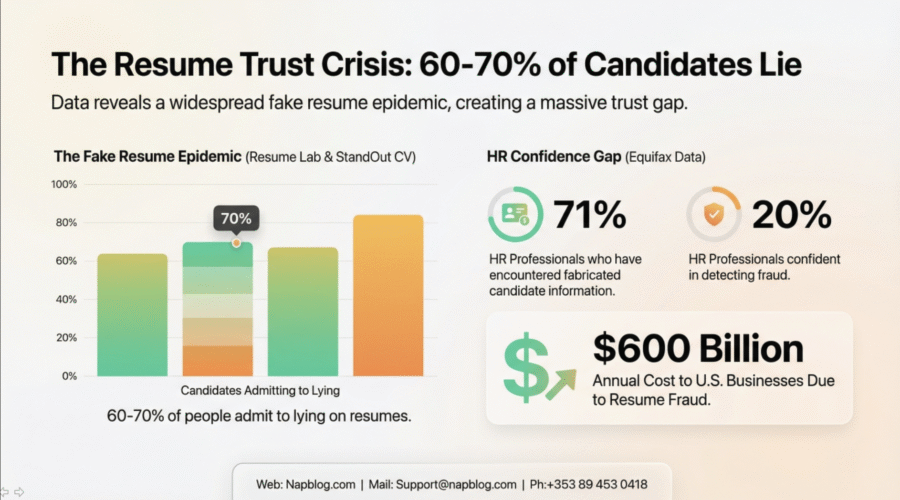
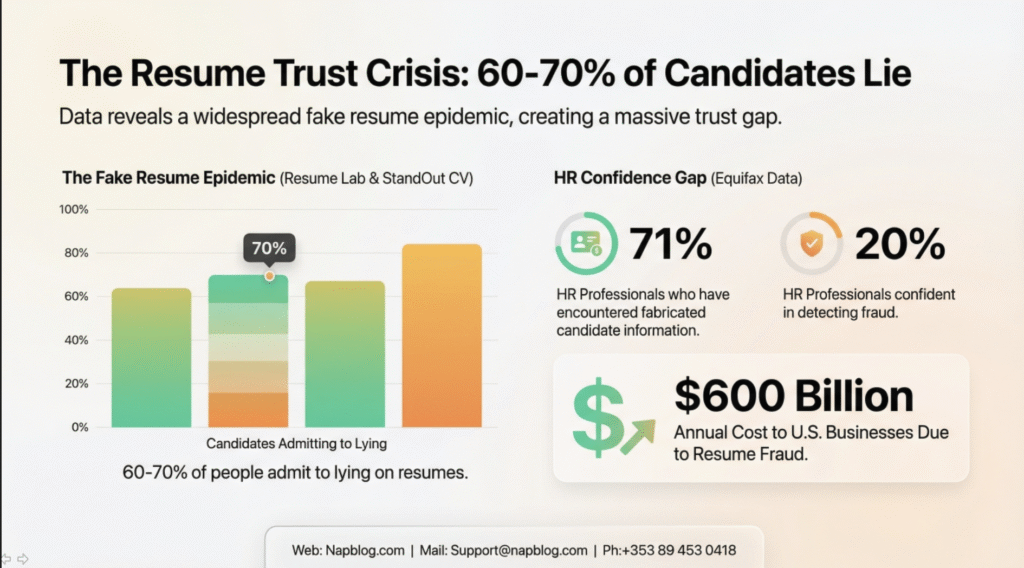
Recent industry data indicates that 60–70% of candidates admit to exaggerating or misrepresenting information on their resumes.
At the same time, 71% of HR professionals report encountering fabricated candidate details, while only 20% feel confident detecting fraud. The resulting impact is enormous — estimated losses tied to resume fraud reach hundreds of billions annually across business ecosystems.
These numbers aren’t just statistics.
They expose a systemic design failure.
And from Napblog’s standpoint, this failure stems from how career identity is built today.
The Core Problem: Self-Declared Credibility
The modern hiring ecosystem is still anchored in self-declaration:
- Resumes are self-written
- Portfolios are self-curated
- Websites are self-presented
- Skill claims are self-validated
Even when beautifully designed, these artifacts remain narratives — not proof.
Traditional digital tools prioritize presentation over verification. They allow individuals to construct polished professional identities, but they do not ensure authenticity of execution.
This creates three cascading issues:
1️⃣ Signal Pollution
When exaggeration becomes normalized, truthful candidates lose differentiation.
Recruiters spend increasing effort separating noise from value.
2️⃣ Institutional Inefficiency
Organizations invest time and capital validating claims manually through:
- Interviews
- Background checks
- Trial tasks
- Reference verification
These processes are costly and imperfect.
3️⃣ Erosion of Trust
Most critically, the system shifts from trust-first to suspicion-first.
This slows hiring, collaboration, and opportunity flow.
From our expertise building career infrastructure, we see this not as a behavioral issue — but as a design flaw in the ecosystem.
People don’t lie because they want to deceive.
They lie because the system rewards presentation more than proof.
The Architectural Limitation of Current Career Tools
Current professional tooling — including websites, resume builders, and static portfolios — operates on three outdated assumptions:
- Claims are enough
- Manual verification is scalable
- Presentation equals capability
These assumptions no longer hold in a high-volume digital talent economy.
The volume of candidates, remote hiring, AI-generated content, and distributed work models have dramatically increased claim velocity while reducing verification bandwidth.
This imbalance inevitably produces:
- Fraudulent claims
- Inflated credentials
- Misaligned hiring
- Reduced recruiter confidence
Napblog’s research and product design philosophy start with rejecting these assumptions.
Napblog’s Position: Evidence Must Replace Assertion
Our perspective is simple:
Career identity should be constructed from data exhaust — not personal narration.
In practical terms, this means shifting from:
| Old Model | Future Model |
|---|---|
| Resume bullet point | Activity-linked evidence |
| Portfolio screenshot | Analytics-backed outcomes |
| Skill listing | Execution trace |
| Website claim | Verified signal |
| Manual trust | Systemic validation |
This philosophy led to the development of Nap OS — a system designed around verifiable career construction rather than self-presented storytelling.
Reframing the Portfolio: From Display to Verification
From Napblog’s expertise viewpoint, the future portfolio should function less like a gallery and more like an audit trail.
Instead of asking:
“What does this person say they did?”
The system should answer:
- What did they actually build?
- When was it executed?
- What impact metrics exist?
- Which tools were used?
- How consistent was their output?
Verification transforms portfolios into living credibility engines.
This eliminates ambiguity not by policing users — but by structurally embedding evidence into identity.
Why This Matters Now More Than Ever
Several macro shifts amplify urgency:
AI Content Generation
Creation has become frictionless.
Proof of authorship and execution becomes critical.
Remote Hiring Expansion
Employers evaluate candidates without physical interaction.
Digital trust must compensate.
Volume-Based Recruiting
Hiring pipelines process thousands of applicants.
Manual validation is impossible at scale.
Skills-Based Economies
Degrees are losing exclusivity as signals.
Demonstrated execution replaces credentials.
These shifts make resume inflation inevitable under current infrastructure.
They also make verification-based ecosystems inevitable as the solution.
Napblog’s Strategic Outlook
We believe the next decade of professional identity will be defined by three pillars:
1️⃣ Continuous Evidence Logging
Work tracked as it happens — not reconstructed later.
2️⃣ Automated Skill Validation
Systems connecting real outputs to competency indicators.
3️⃣ Transparent Career Graphs
Recruiters viewing patterns, not claims.
Nap OS is built around these principles — not as an incremental improvement to resumes, but as a redesign of how credibility is formed digitally.
Closing Perspective
The resume trust crisis is not a moral failure of candidates.
It is an architectural failure of the tools shaping professional identity.
When systems reward presentation over proof, inflation becomes rational behavior.
Napblog’s position is that the solution is not stricter screening, more interviews, or heavier oversight — but a shift toward infrastructure where verification is native, passive, and continuous.
Careers should not depend on how convincingly someone describes their work.
They should depend on work that can demonstrate itself.
That is the philosophy guiding Napblog Limited’s research, product development, and long-term vision for digital career ecosystems.
Overcoming the trust crisis in digital careers requires transparent verification systems that benefit both candidates and employers. Learn more on LinkedIn.