6 min read
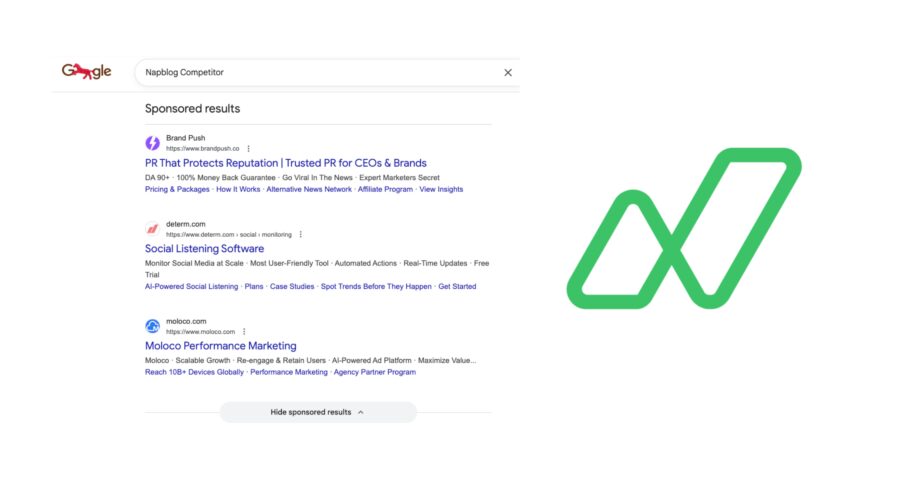
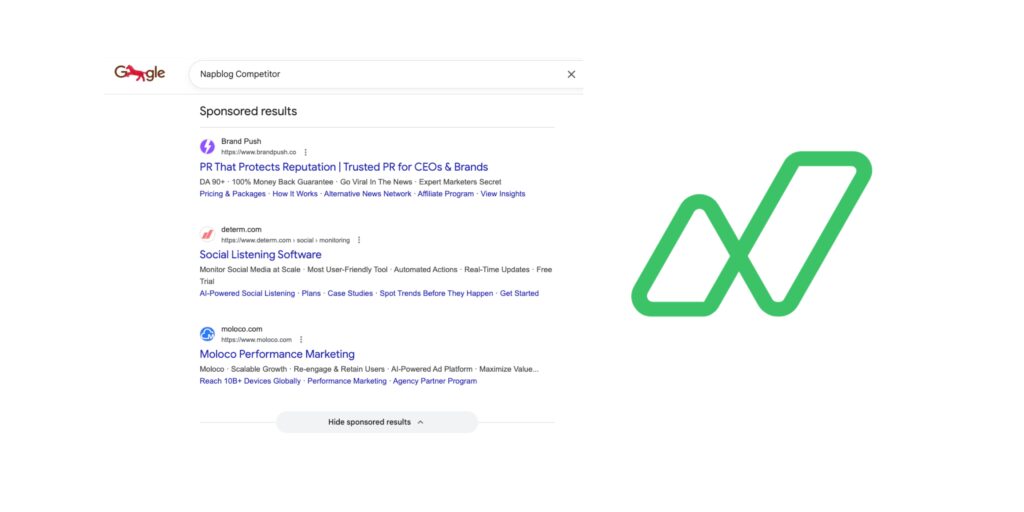
Over the past few weeks, something interesting has started happening in the Google search ecosystem around Napblog-related queries. When searching for terms such as “Napblog competitor” or adjacent keywords, we are now seeing a structured set of paid placements from companies operating in adjacent verticals: PR distribution, social listening, and performance marketing.
This is not random. It is not accidental. It is a signal.
It is a signal that Napblog is now being recognized within the same commercial decision cycle as established digital reputation and media infrastructure platforms. And when competitors begin bidding against your brand-related search terms, it means one thing clearly: you are part of the market conversation.
This LinkedIn article breaks down:
- What these Google Ads competitors represent
- Why they are targeting Napblog-related queries
- What this says about Napblog’s positioning
- The structural differences between Napblog and these platforms
- The strategic implications for Napblog’s growth
Let’s examine this with precision.
The Emerging Google Ads Competitors
In the sponsored results, we see platforms such as:
- Brand Push – PR and online reputation management
- Determ – Social listening and media monitoring
- Moloco – AI-powered performance marketing platform
On the surface, these businesses operate in different verticals. However, they all intersect at one core theme: digital presence management and monetization of visibility.
That is the space Napblog is operating in — but with a fundamentally different architectural approach.
Why Are They Bidding on Napblog Queries?
There are typically three reasons companies bid on brand-adjacent keywords:
1. Market Validation
When competitors begin bidding against your search terms, it indicates:
- Search volume is rising.
- Commercial intent exists.
- Users are actively comparing solutions.
Napblog is no longer an unknown entity. It is now entering comparison cycles.
2. Category Confusion
Because Napblog is building something structurally new — verified portfolios, reputation infrastructure, career-layer media presence — traditional platforms may misinterpret it as:
- A PR tool
- A media distribution network
- A social listening system
- A marketing performance platform
In reality, Napblog is none of these in isolation. It is a career-native reputation operating system.
But in early-stage market formation, competitors often respond defensively.
3. Defensive Bidding Strategy
Established platforms often bid on emerging brand names to:
- Capture undecided buyers
- Prevent category shift
- Maintain dominance in search-based discovery
This is a standard competitive play in SaaS markets.
Structural Comparison: Napblog vs. Traditional Reputation Tools
Let’s analyze the differences at a systems level.
Brand Push (PR Distribution Model)
Brand Push operates primarily within a transactional PR model:
- Publish paid articles
- Distribute to media networks
- Boost search engine presence
- Protect brand reputation
This is media amplification.
Napblog, however, is not a press-release engine.
Napblog builds:
- Verified, skill-backed portfolios
- Structured professional identity
- Long-term credibility infrastructure
- AI-enhanced content positioning
Brand Push helps you publish.
Napblog helps you prove.
The distinction is foundational.
Determ (Social Listening & Monitoring)
Determ provides:
- Real-time social monitoring
- Brand mention tracking
- Sentiment analysis
- Media intelligence dashboards
This is reaction-based analytics.
Napblog operates differently.
Instead of monitoring external mentions, Napblog enables users to:
- Own their narrative
- Structure verified public proof of work
- Build forward-facing professional authority
Monitoring tells you what others are saying.
Napblog builds a system where your work speaks first.
Moloco (Performance Marketing Infrastructure)
Moloco is an AI-powered advertising platform focused on:
- User acquisition
- Performance growth
- Monetization optimization
- Programmatic ad infrastructure
This is revenue optimization through paid traffic.
Napblog does not optimize ads.
Napblog optimizes:
- Professional identity
- Discoverability through credibility
- Structured skill visibility
- Career-based value capture
Moloco is transactional growth.
Napblog is compounding reputation.
These are fundamentally different economic models.
What This Reveals About Napblog’s Positioning
The appearance of these competitors in Google Ads tells us three key things:
1. Napblog Sits at a New Intersection
Napblog intersects:
- Career infrastructure
- Verified digital identity
- Portfolio systems
- AI-enhanced credibility
- Media visibility
- Talent-market signaling
There is currently no clean category for this.
When there is no clear category, adjacent players step in.
This is typical when a platform is category-defining rather than category-fitting.
2. The Market is Converging
The lines between:
- PR
- Personal branding
- Marketing
- Recruitment
- Reputation
- Portfolio building
are collapsing.
Napblog sits at the center of that convergence.
While traditional tools optimize one vertical,
Napblog integrates career, credibility, and visibility into one system.
That makes it harder to categorize — and easier to misinterpret.
3. Search Intent is Becoming Comparative
When users search “Napblog competitor,” they are signaling:
- Active evaluation
- Market education
- Solution comparison
This is healthy.
Comparison strengthens positioning.
Because when examined structurally, Napblog is not a tool.
It is an operating layer.
The Strategic Implication for Napblog
The rise of Google Ads competitors presents several strategic advantages:
Advantage 1: Brand Authority Amplification
Competitors bidding against Napblog validates:
- Brand awareness
- Category emergence
- Search-driven demand
Visibility competition accelerates brand maturity.
Advantage 2: Clarified Messaging
When adjacent tools compete for positioning, it forces clarity.
Napblog must articulate:
- We are not a PR distribution tool.
- We are not just a social listening dashboard.
- We are not a paid marketing engine.
Napblog is a career-native, AI-augmented portfolio operating system.
Clarity compounds trust.
Advantage 3: Long-Term Structural Moat
Most competitors operate on:
- Short-term campaigns
- Media bursts
- Ad-driven acquisition
- External channel dependency
Napblog builds internal compounding assets:
- Verified proof of work
- Structured career narratives
- Skills-backed reputation layers
- AI-enhanced credibility indexing
This compounds over time.
And compounding systems outperform transactional systems.
Why LinkedIn Is the Right Place to Discuss This
LinkedIn operates at the intersection of:
- Professional identity
- Recruitment ecosystems
- Personal branding
- Startup growth narratives
Napblog’s evolution directly impacts:
- Students entering the workforce
- Founders building digital authority
- Professionals seeking structured visibility
- Recruiters evaluating proof of capability
The Google Ads competitor shift is not just about advertising.
It reflects a broader market evolution in how professional credibility is built and discovered.
The Broader Market Trend
We are entering a phase where:
AI is automating tasks.
Entry-level roles are shrinking.
Signal-to-noise ratio is collapsing.
Attention is fragmented.
In this environment:
Credentials are insufficient.
CVs are static.
Social profiles are inflated.
Unverified claims are everywhere.
The future requires:
- Verifiable proof
- Structured skill portfolios
- Measurable impact documentation
- AI-enhanced credibility
This is where Napblog operates.
Traditional PR and marketing platforms optimize perception.
Napblog optimizes proof.
That difference is existential in the AI era.
Competitive Strategy Moving Forward
Napblog’s strategy in response to rising Google Ads competitors should include:
1. Controlled Brand Bidding
Defensive bidding on Napblog-branded keywords ensures:
- Message control
- Category clarity
- Conversion optimization
Search real estate is strategic infrastructure.
2. Clear Category Definition
Instead of being compared to:
- PR tools
- Monitoring dashboards
- Marketing engines
Napblog should define its own category:
Verified Career Infrastructure.
Once the category is named, comparison shifts.
3. Thought Leadership
Publishing structured analysis like this creates:
- Narrative ownership
- Market education
- Founder-led positioning
LinkedIn becomes a distribution engine for category shaping.
4. Product Differentiation Through Architecture
Napblog’s moat will not come from advertising volume.
It will come from system architecture:
- Portfolio verification logic
- Structured data layers
- AI-assisted narrative building
- Cross-platform reputation indexing
Infrastructure always outlasts campaigns.
Final Perspective
When competitors begin bidding on your search terms, you have crossed an invisible threshold.
You are no longer just building.
You are influencing.
Napblog is entering the competitive visibility layer of digital reputation platforms.
But unlike traditional PR or marketing tools, Napblog is building something deeper:
A system where professional proof is structured, verified, and discoverable.
The future of digital credibility will not be built on press mentions alone.
It will not rely on social listening dashboards.
It will not depend on paid acquisition engines.
It will depend on structured, AI-enhanced, verifiable professional identity.
Napblog is positioned at that frontier.
The Google Ads competitors are not a threat signal.
They are a maturity signal.
And in competitive ecosystems, maturity is the first step toward category leadership.
The real question is not why competitors are bidding on Napblog.
The real question is:
Are we ready to define the category before someone else attempts to define it for us?
That is the strategic moment Napblog now faces.