5 min read
Every generation believes it has solved the employability problem.
Schools refine curriculum.
Universities expand degree programs.
Online platforms distribute certifications.
Recruiters adopt new applicant tracking systems.
And yet — the same question persists across decades:
Why do capable students still struggle to become employable professionals?
At Napblog Limited, this question is not philosophical.
It is structural.
Because employability today is no longer limited by access to education.
It is limited by access to execution visibility.
Students are learning more than ever before —
but proving less than ever before.
And employers are receiving more applications than ever —
but trusting fewer than ever.
Between learning and hiring, there exists an invisible gap.
A gap filled not by incompetence,
but by unverified potential.
Napblog was built to close that gap.
From Learning to Signaling — The Modern Employability Crisis
In the traditional model, a student completes coursework, earns a degree, writes a CV, and applies for a role.
This process assumes one critical belief:
That credentials signal capability.
But in modern hiring ecosystems, credentials signal only participation.
A CV may say:
- “Completed Digital Marketing Certification”
- “Worked on SEO Campaign”
- “Managed Google Ads Budget”
But nowhere does it answer:
- What was executed?
- What changed because of it?
- What measurable impact occurred?
This is why recruiters increasingly rely on automation filters — not because they distrust students, but because they lack consistent evidence frameworks.
When thousands of applicants describe similar theoretical experiences, narrative-based hiring becomes unsustainable.
Filtering becomes inevitable.
And capability becomes invisible.
The Rise of Execution Deficit
Students today are not lacking motivation.
They are lacking infrastructure to convert effort into verifiable output.
Consider how learning typically occurs:
A student:
- Watches lectures
- Completes assignments
- Builds isolated academic projects
- Applies knowledge in controlled environments
But these activities produce:
- Grades
- Feedback
- Certificates
They do not produce:
- Public digital assets
- Execution metrics
- Behavioral performance trails
- Measurable market outcomes
In short:
Learning creates effort.
But hiring requires evidence.
This mismatch creates what Napblog defines as the Execution Deficit.
Students work.
But their work remains undocumented in hiring-relevant formats.
Recruiters hire.
But their systems detect documentation, not effort.
The result is systemic inefficiency on both sides.
Napblog’s Foundational Shift — From CV to Capability Graph
Napblog Limited began as a digital marketing execution environment.
But over time, we observed something more fundamental:
Students working on real campaigns were developing employable capability far faster than students completing simulated assignments.
Why?
Because execution produces:
- Decision-making patterns
- Outcome variability
- Resource constraints
- Accountability loops
- Real-world consequences
Execution forces integration of knowledge into behavior.
And behavior leaves digital traces.
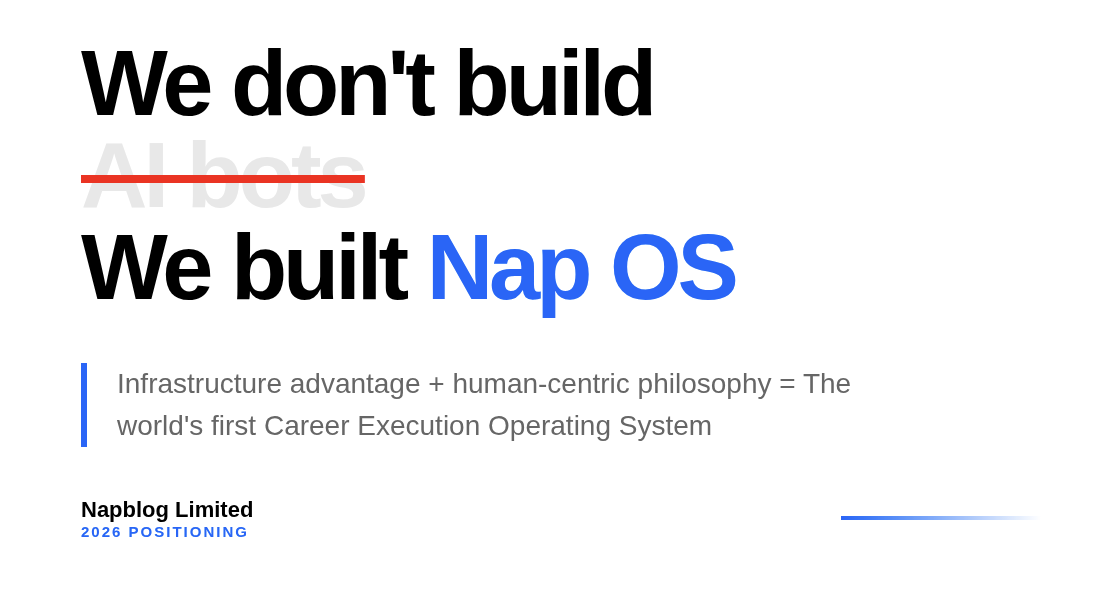
This realization led to the development of Nap OS —
an Execution Operating System designed to transform student activity into recruiter-visible career capital.
Nap OS — Execution as a Structured Workflow
Nap OS is not a resume builder.
It is not a portfolio website generator.
It is not a job board.
It is a behavioral infrastructure.
Students using Nap OS:
- Create real marketing assets
- Run real campaigns
- Publish measurable outputs
- Track performance analytics
- Document execution cycles
Every activity becomes:
- Time-stamped
- Context-linked
- Outcome-measured
Instead of saying:
“I worked on SEO.”
They can demonstrate:
“I increased organic traffic from 120 to 1,120 users within 60 days by implementing internal linking optimization across 24 landing pages.”
Execution becomes signal.
And signal becomes employability.
Recruiter Perspective — From Filtering to Discovery
Recruiters today face an information overload problem.
Thousands of CVs must be processed within limited timeframes.
Automation becomes necessary.
Filtering becomes unavoidable.
But filtering introduces risk:
Qualified candidates may be excluded before human review.
Nap OS addresses this challenge by introducing verified execution layers into candidate representation.
Recruiters can observe:
- Project activity logs
- Asset deployment history
- Performance improvement curves
- Behavioral consistency patterns
- Outcome-linked decision trails
Instead of relying on:
Narrative self-reporting.
They can evaluate:
Execution evidence.
Hiring becomes discovery rather than elimination.
Portfolio-First Internship Model
Napblog’s mentorship ecosystem reflects this philosophy.
Interns working within Nap OS:
- Execute real client deliverables
- Collaborate in global digital co-working environments
- Receive AI-supported workflow assistance
- Document execution continuously
Their time is not converted merely into experience.
It is converted into:
- Data
- Proof
- Portfolio artifacts
- Career capital
This model transforms learning from invisible labor into visible employability infrastructure.
AI as Persistent Execution Partner
Nap OS integrates long-term AI collaboration layers — functioning as analytical assistants capable of:
- Monitoring workflow progress
- Identifying optimization opportunities
- Generating data-informed content
- Supporting multi-stage execution
Unlike traditional AI interactions that reset between sessions, this layer maintains project context across time.
Students are no longer required to remember every analytical step themselves.
They can focus on decision-making.
Execution becomes scalable.
Market Timing — Why This Matters Now
Several macro trends reinforce the relevance of execution-based hiring models:
Generative AI Expansion
Content creation has become easier than ever.
Authenticity detection becomes harder than ever.
Verification demand increases.
Remote Hiring Norms
Geographical separation increases reliance on digital evidence.
Skills-Based Hiring Movement
Organizations shift from credential evaluation toward capability assessment.
Data-Native Workforce
Students increasingly produce measurable digital activity across platforms.
Nap OS does not introduce new behavior.
It structures existing behavior into hiring-compatible formats.
Recognition Without Promotion
Napblog Limited’s approach has gained recognition without reliance on paid advertising campaigns.
In October 2025, Napblog was listed among Ireland’s Top LinkedIn Advertising Companies by The Manifest — validating the effectiveness of execution-first marketing philosophies built on authentic output rather than promotional reach.
Our growth reflects resonance, not expenditure.
Long-Term Vision — Hiring as Infrastructure
Napblog envisions a hiring ecosystem where:
Students are evaluated based on:
- Documented execution
- Measurable outcomes
- Behavioral consistency
Recruiters discover talent through:
- Verified activity signals
- Outcome-linked portfolios
- Performance analytics
Applicant tracking systems process:
Evidence objects rather than static narratives.
Nap OS represents an initial architectural layer toward this transition.
Conclusion — Making Learning Visible
The employability crisis is not caused by lack of talent.
It is caused by lack of visibility into talent.
Students are working.
Recruiters are hiring.
But their systems of communication remain misaligned.
Napblog Limited exists to reduce friction between:
Intent
Execution
Opportunity
Nap OS transforms learning effort into recruiter-readable proof —
bridging the gap between academic participation and professional discovery.
In doing so, it enables a shift from:
Applying for opportunity
to
Demonstrating inevitability.
Because in modern hiring ecosystems:
Capability must not only exist.
It must be observable.