6 min read
The modern learning ecosystem is saturated with platforms promising skill development, certification, and career mobility. Yet despite billions of hours spent on video courses, modular certifications, and LMS-managed training programs, employers continue to report a persistent gap: candidates consume content, but they cannot consistently demonstrate execution.
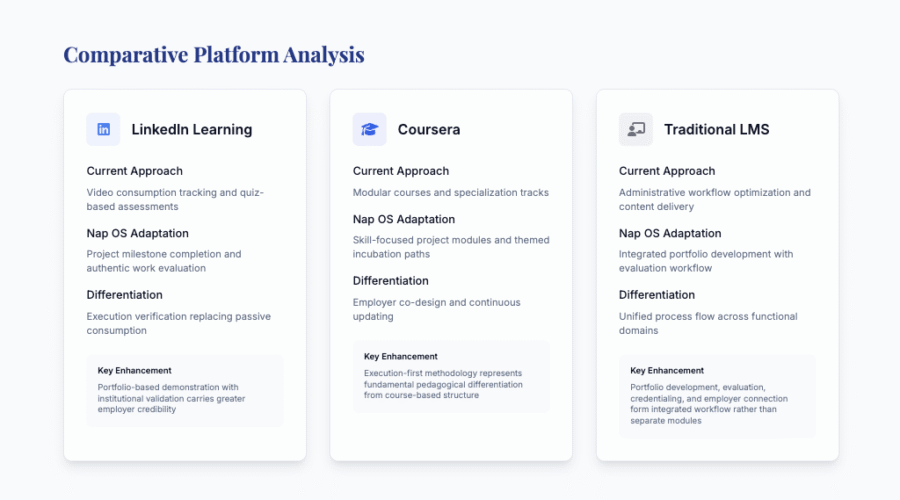
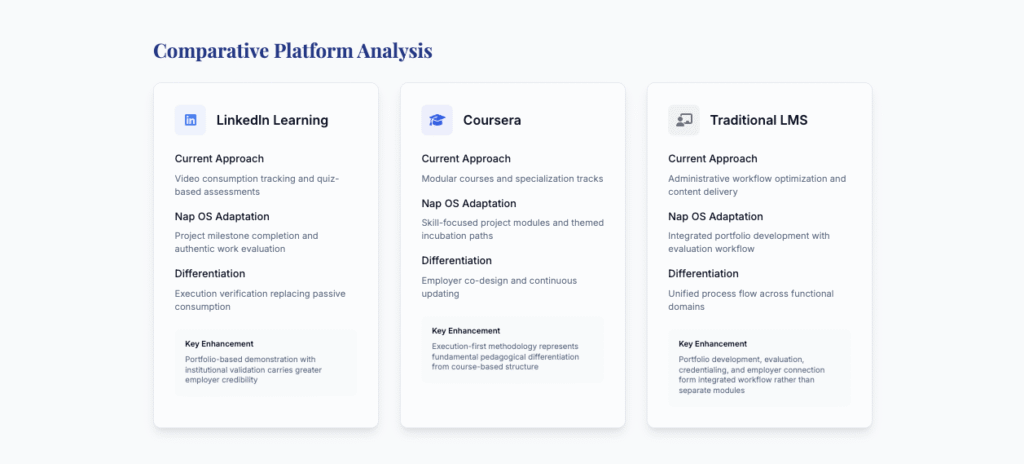
The comparative platform analysis in the image outlines three dominant paradigms:
- LinkedIn Learning
- Coursera
- Traditional Learning Management Systems (LMS)
Each plays a significant role in the global education infrastructure. However, Nap OS introduces a fundamentally different operating model — shifting from content consumption to verified execution, from modular education to integrated portfolio-driven capability validation.
This article examines that shift in depth.
The Structural Problem in Modern Learning Platforms
Before analyzing each platform, it is necessary to understand the macro challenge:
Most platforms measure engagement. Employers measure execution.
This gap manifests in several ways:
- Completion certificates without applied evidence
- Quiz-based validation that does not reflect real-world complexity
- Fragmented learning disconnected from career outcomes
- Portfolio development treated as optional, not systemic
Nap OS is architected to solve this structural mismatch.
1. LinkedIn Learning: Content Velocity Without Execution Validation
Current Approach
LinkedIn Learning is optimized for scalable video consumption and quiz-based assessments. Its model emphasizes:
- Video course tracking
- Completion-based credentials
- Lightweight knowledge checks
This approach maximizes accessibility and breadth. Users can explore hundreds of topics efficiently. However, the evaluation framework remains largely passive.
Structural Limitation
Video completion does not equal capability.
Quiz performance does not equal professional competence.
Employers rarely hire based solely on course completion. They require:
- Demonstrated project execution
- Documented outcomes
- Evidence of problem-solving under constraints
LinkedIn Learning provides exposure — not verification.
Nap OS Adaptation: Milestone-Based Execution
Nap OS replaces passive course completion with project milestone validation.
Instead of asking:
“Did you finish the course?”
Nap OS asks:
“Can you demonstrate real-world output aligned to employer standards?”
Core Mechanisms
- Project Milestone Completion
Learning is structured around tangible deliverables, not video timestamps. - Authentic Work Evaluation
Outputs are assessed in context — mirroring workplace expectations. - Execution Verification
Employers can validate capability based on artifact quality, not completion badges.
Differentiation: Execution Verification Over Passive Consumption
This is the primary philosophical divergence.
LinkedIn Learning optimizes for:
- Knowledge dissemination
- Broad access
- Skill exploration
Nap OS optimizes for:
- Capability demonstration
- Outcome verification
- Employer-aligned evaluation
Key Enhancement
Portfolio-based demonstration with institutional validation carries significantly greater employer credibility than passive course completion.
Nap OS embeds portfolio creation inside the learning workflow, not as an afterthought.
2. Coursera: Modular Excellence, Structural Fragmentation
Current Approach
Coursera is built around modular courses, professional certificates, and specialization tracks. Its strengths include:
- University partnerships
- Structured academic pathways
- Recognized certifications
Coursera improves upon passive platforms by offering guided specialization journeys. However, its structure remains course-centric.
Structural Limitation
Courses are modular. Work is contextual.
A specialization may teach data analytics, but real-world analytics projects involve:
- Ambiguous data
- Cross-functional collaboration
- Stakeholder communication
- Business framing
Academic structure does not inherently guarantee execution readiness.
Nap OS Adaptation: Skill-Focused Project Modules & Themed Incubation Paths
Nap OS transitions from course modules to execution modules.
Instead of:
- Course → Quiz → Certificate
Nap OS deploys:
- Skill Identification → Project Build → Milestone Review → Portfolio Artifact → Employer Visibility
Themed Incubation Paths
These are structured execution environments where:
- Learners build real outputs
- Iterative feedback loops are embedded
- Deliverables accumulate into professional portfolios
The model resembles a digital apprenticeship system.
Differentiation: Employer Co-Design and Continuous Updating
Traditional course platforms update content periodically. Nap OS integrates employer co-design into its operating layer.
This creates:
- Dynamic skill alignment
- Industry-calibrated evaluation standards
- Continuous evolution of skill requirements
Key Enhancement
Execution-first methodology represents a fundamental pedagogical differentiation from course-based structures.
Nap OS is not a digital university. It is a career operating system.
3. Traditional LMS: Administrative Efficiency Without Career Integration
Current Approach
Traditional LMS platforms are designed for:
- Workflow optimization
- Assignment management
- Administrative oversight
- Content distribution
They function effectively in institutional environments. However, they focus on internal academic management rather than career outcome integration.
Structural Limitation
LMS systems treat:
- Learning
- Evaluation
- Credentialing
- Employer connection
as separate modules.
The result is fragmentation.
Students complete assignments but must independently:
- Build portfolios
- Network with employers
- Translate coursework into career narratives
The burden of integration falls on the learner.
Nap OS Adaptation: Integrated Portfolio + Evaluation Workflow
Nap OS unifies:
- Learning
- Project development
- Evaluation
- Credential validation
- Employer exposure
into a single process flow.
What This Means Structurally
- Every assignment becomes a portfolio artifact.
- Every evaluation contributes to a verified execution history.
- Every skill acquisition is mapped to employer-aligned competencies.
The system does not end at “grade posted.”
It ends at “career evidence created.”
Differentiation: Unified Cross-Functional Process Flow
Traditional LMS tools optimize administration. Nap OS optimizes outcomes.
Key Enhancement
Portfolio development, evaluation, credentialing, and employer connection exist within one integrated workflow — not as separate modules.
This eliminates:
- Redundant effort
- Portfolio recreation
- Credential misalignment
- Career translation confusion
Nap OS becomes a lifelong execution ledger.
The Core Innovation: From Learning Platform to Operating System
Most platforms function as applications. Nap OS functions as infrastructure.
The difference is architectural.
Application Model (Status Quo)
- User logs in
- Consumes content
- Receives credential
- Leaves platform
Operating System Model (Nap OS)
- User builds skill inventory
- Skill gaps are identified
- Projects are assigned
- Milestones are tracked
- Portfolio artifacts are generated
- Employer alignment is mapped
- Career narrative is constructed
The system persists across stages of growth.
Why Employers Prefer Execution Evidence
Employer decision-making frameworks prioritize:
- Problem-solving capability
- Adaptability
- Deliverable quality
- Contextual reasoning
- Communication clarity
Certificates signal exposure.
Portfolios signal capability.
Nap OS institutionalizes portfolio validation.
The Institutional Validation Layer
One of the most critical differentiators is institutional credibility.
Nap OS integrates:
- Evaluation standards
- Structured milestone rubrics
- Verifiable output tracking
This moves portfolio artifacts from:
“Self-published personal project”
to
“Institutionally validated professional evidence”
This distinction significantly increases employer trust.
Continuous Updating vs Static Curriculum
Technology cycles are compressing.
AI, automation, data infrastructure, and digital collaboration tools evolve quarterly — not annually.
Course-based platforms update episodically. Nap OS updates structurally.
Through employer co-design and dynamic skill mapping, Nap OS:
- Identifies emerging competencies
- Adjusts project requirements
- Evolves evaluation criteria
This keeps learners aligned with real-time market demand.
Eliminating the Credential Inflation Problem
Modern hiring suffers from credential inflation:
- More certificates
- More degrees
- More micro-credentials
Yet differentiation remains weak.
Nap OS addresses this by emphasizing:
- Depth over accumulation
- Evidence over enumeration
- Capability over consumption
Instead of collecting badges, learners accumulate validated execution history.
The Portfolio as a Living Asset
In Nap OS, the portfolio is not a static PDF.
It is:
- Dynamic
- Structured
- Employer-readable
- Milestone-validated
- Skill-mapped
This transforms career storytelling into career evidence.
Employers can trace:
- Skill origin
- Project application
- Iterative improvement
- Evaluation outcomes
Transparency builds trust.
Cross-Domain Capability Integration
Traditional systems silo disciplines:
- Technical skills
- Communication skills
- Leadership skills
- Analytical skills
Nap OS integrates them within project workflows.
A single milestone may evaluate:
- Technical implementation
- Documentation quality
- Stakeholder framing
- Time management
This mirrors real-world work environments.
The Economic Implication
The shift from content-based learning to execution-based validation carries macroeconomic implications:
- Reduced hiring risk
- Shorter onboarding cycles
- Lower training redundancy
- Higher first-year performance
Nap OS becomes an intermediary layer between education and employment — reducing friction.
A System Built for the AI Era
As automation reduces entry-level roles, employers increasingly expect:
- Immediate contribution
- Independent execution
- Adaptability
Nap OS anticipates this reality.
Instead of preparing learners for interviews, it prepares them for contribution.
Summary: Structural Differentiation at Every Layer
| Dimension | LinkedIn Learning | Coursera | Traditional LMS | Nap OS |
|---|---|---|---|---|
| Validation Model | Quiz-based | Modular certification | Assignment grading | Milestone execution verification |
| Portfolio Integration | Optional | Limited | External | Native & integrated |
| Employer Alignment | Indirect | Academic partnerships | Institutional | Employer co-designed |
| Workflow Integration | Fragmented | Modular | Administrative | Unified end-to-end |
| Outcome Focus | Skill exposure | Certification | Course completion | Career execution readiness |
Final Positioning
Nap OS is not competing on:
- Content volume
- Brand partnerships
- Course library size
It competes on:
- Execution integrity
- Portfolio credibility
- Employer trust
- Career outcome acceleration
The comparative analysis makes one fact clear:
While LinkedIn Learning optimizes exposure, Coursera optimizes academic modularity, and Traditional LMS optimizes administrative control, Nap OS optimizes verified execution within a unified career infrastructure.
This is not incremental improvement.
It is a category shift.
From learning platforms
to a career operating system.