6 min read
The hiring system most of the world still operates on was built for an industrial era that no longer exists. It assumes that credentials equal capability, that polished resumes represent reality, and that interviews can reliably predict performance.
For decades, employers trusted promises — statements of intent, descriptions of past responsibilities, or institutional signals such as degrees — to make decisions about human potential.
That model is collapsing.
We now live in a work environment defined by rapid technological acceleration, compressed learning cycles, and globally distributed talent pools. Skills evolve faster than job descriptions.
Organizations struggle to identify capability, while candidates struggle to prove it. The result is friction — wasted hiring cycles, misaligned expectations, and inflated credentials that dissolve under scrutiny.
This is the gap Nap OS was designed to close.
Nap OS, built by Napblog Limited, introduces a structural shift from resume-based signaling toward evidence-based execution. It reframes employability not as a narrative but as verifiable output. This article explores why proof over promise is not just an ideology, but an operational necessity — and how Nap OS positions hiring for a future where credibility is earned through execution.
The Resume Economy and Its Structural Weakness
Traditional hiring rests on symbolic indicators. Employers evaluate degrees, certifications, job titles, or buzzword-filled resumes as proxies for competence. These proxies were historically efficient filters when applicant pools were smaller and career paths more linear.
Today they are unreliable.
Studies show that resumes frequently reflect trends rather than capability. In software hiring culture, “résumé-driven development” describes a dynamic where professionals pursue trendy technologies primarily to appear attractive to employers rather than to solve real problems — revealing systemic distortion in hiring signals.
Similarly, hiring teams often process hundreds of resumes containing exaggerated or unverifiable claims. Portfolio proof analysis demonstrates that many candidates cannot substantiate the achievements they list, exposing a measurable gap between declared experience and demonstrated ability.
This gap has economic consequences.
Hiring mistakes cost organizations tens of thousands per employee, with nearly half of hires failing within 18 months due to poor skill verification.
In an age where generative tools make it easier than ever to craft convincing narratives, the resume is becoming less predictive of performance. Evidence suggests resumes forecast job success only marginally, while work samples or verified projects are far stronger predictors.
The issue is not dishonesty alone — it is structural opacity.
Hiring systems reward storytelling, not execution visibility.
The Emergence of Skills-First and Proof-Based Hiring
Organizations are responding by shifting evaluation frameworks.
Nearly three-quarters of employers now incorporate skills-based hiring methods, seeking direct demonstrations of ability instead of keyword filtering resumes.
This shift aligns with macro labour trends.
Demand for AI-related roles, for example, has increased while formal education requirements decline — indicating employers prioritize demonstrable skills over credentials.
Evidence from hiring experiments confirms that signals tied to real skill capability significantly increase interview chances, reinforcing the labour-market value of demonstrable competence.
Governments and workforce institutions are reinforcing this movement.
Skill endorsements and verifiable competency signals increasingly influence employment outcomes by improving credibility beyond formal credentials.
The market trajectory is clear:
- Hiring is shifting toward observable execution
- Portfolio gates are becoming common
- Demonstrated outcomes are replacing narrative claims
This evolution is not philosophical — it is pragmatic.
Companies face accelerating skill gaps caused by technological disruption and changing business models.
To operate effectively, they must identify capability faster and with higher confidence.
The Limits of Hiring on Promise Alone
Interestingly, hiring research suggests that promise — the capacity to learn — can outperform rigid skill matching in certain contexts. Workers hired for learning potential may perform more effectively than those hired purely for current proficiency.
Yet identifying promise is difficult.
Managers struggle to measure potential objectively, often defaulting back to credential filters.
This creates a paradox:
- Hiring purely on promise introduces uncertainty
- Hiring purely on credentials introduces distortion
The future lies in integrating both — and grounding promise in evidence.
Proof-driven execution environments enable candidates to demonstrate learning agility directly rather than asserting it abstractly.
Nap OS operationalizes this synthesis.
Nap OS — Execution as Identity
Nap OS was designed as an execution operating system converting real work into verifiable employability signals.
Instead of evaluating individuals based on attendance, certifications, or resumes, the system measures:
- Traceable output
- Ownership of execution
- Consistency of contribution
- Outcome quality
Participants demonstrate capability through structured execution sprints producing tangible artifacts — documents, workflows, analyses, or content assets — before any interview stage.
This reverses the hiring sequence.
Traditional flow:
Resume → Interview → Work
Nap OS flow:
Work → Evidence → Opportunity
Credibility becomes cumulative rather than declarative.
Closing the Portfolio Gap
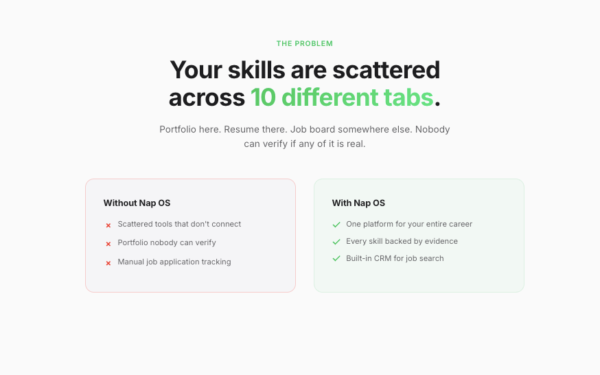
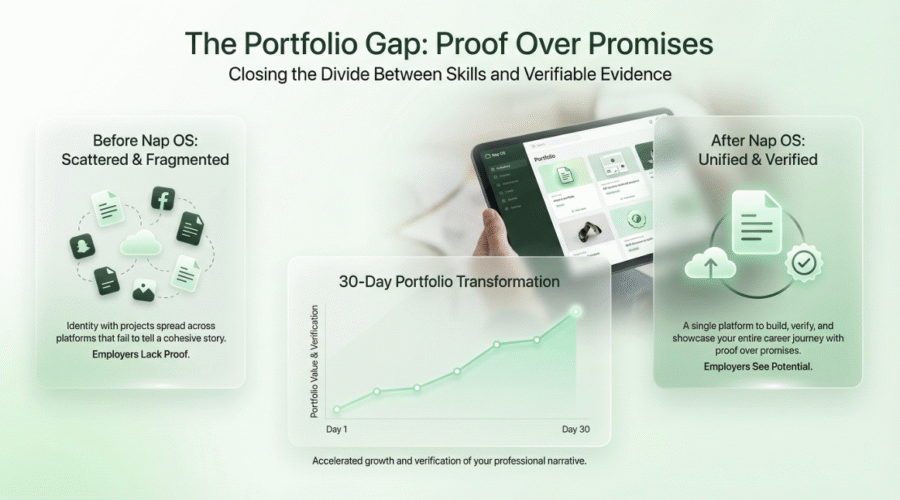
The central challenge Nap OS addresses is the portfolio gap — the disconnect between skill claims and accessible proof.
Without centralized execution tracking:
- Work samples are fragmented
- Contributions lack verification
- Professional identity remains scattered
Nap OS unifies evidence generation and validation, enabling individuals to construct coherent professional narratives grounded in traceable action.
This directly increases portfolio proof rate — the likelihood that claims can be demonstrated — reducing hiring ambiguity.
Employers gain:
- Faster candidate filtering
- Reduced screening costs
- Higher predictive confidence
Candidates gain:
- Measurable credibility
- Accessible opportunity pathways
- Independence from credential gatekeeping
The system transforms portfolios from static showcases into dynamic evidence engines.
Economic and Organizational Advantages
1. Hiring Efficiency
Proof-based evaluation shortens hiring cycles by enabling early capability filtering.
Organizations can identify qualified candidates before interviews, reducing wasted time and resource allocation.
2. Risk Reduction
Evidence-backed hiring minimizes costly misalignment between expectation and performance.
3. Transparency and Accountability
Evidence-driven reports provide traceable justification for decisions, improving fairness and regulatory defensibility while strengthening candidate trust.
4. Workforce Development
Execution-centered systems accelerate internal skill growth by embedding learning within work rather than outside it.
Psychological Impact on Talent Development
The shift toward proof transforms professional identity formation.
Instead of optimizing for perception, individuals optimize for capability.
Instead of accumulating credentials, they accumulate outcomes.
This produces:
- Stronger intrinsic motivation
- Reduced imposter syndrome
- Clearer growth visibility
Execution visibility eliminates dependence on “lucky breaks” where individuals must wait for opportunities to prove themselves — replacing chance with structured demonstration pathways.
Nap OS embeds proof generation into daily activity, democratizing access to credibility.
From Talent Filtering to Talent Discovery
Traditional hiring filters candidates.
Proof-based ecosystems discover them.
This distinction matters.
Filtering systems eliminate applicants lacking signals.
Discovery systems surface capability regardless of background.
Nap OS enables:
- Non-linear career entry points
- Cross-disciplinary mobility
- Reduced credential dependency
It aligns with a labour market increasingly prioritizing adaptable execution capacity over static qualification hierarchies.
Implications for the Future of Hiring
Several trends indicate where hiring is heading:
- Resumes become supplementary artifacts
- Work samples become primary evaluation data
- Learning speed becomes observable
- Employability becomes continuously updated
Proof-driven hiring systems will likely integrate:
- Execution telemetry
- Outcome analytics
- Skill graph evolution
- Identity verification
Nap OS positions itself within this emerging infrastructure — not as a tool replacing hiring, but as an execution layer feeding it reliable data.
Strategic Vision — Beyond Recruitment
The deeper impact of proof-first systems extends beyond employment.
They influence:
- Education design
- Credential architecture
- Workforce mobility
- Human capital valuation
When credibility stems from action rather than institutional signaling, opportunity becomes more fluid and meritocratic.
Nap OS contributes to building this ecosystem by redefining employability as an ongoing, observable process rather than a static document.
Conclusion
The hiring world is transitioning from trust-based narratives toward evidence-based decision-making.
Resumes describe possibility.
Proof demonstrates reality.
This transformation is driven by:
- Rising hiring risk
- Technological acceleration
- Skill volatility
- Talent globalization
Nap OS embodies this shift by turning execution into identity and output into credibility.
Proof over promise does not eliminate human judgment — it enriches it with clarity.
It does not remove interviews — it makes them meaningful.
It does not replace potential — it reveals it through action.
Going forward, employability will not be claimed.
It will be observed.
And in that future, systems capable of capturing and validating execution — systems like Nap OS — will define the architecture through which opportunity flows.