Last updated: February 16, 2026
8 min read
The Problem With How We Measure Work Today
Every student knows the drill. You spend four years in university, attend lectures, pass exams, and walk away with a degree that looks identical to the one held by every other graduate in your class.
Then you enter the job market and discover something uncomfortable: 33% of 2025 graduates are still unemployed. Only 30% secured full-time roles in their field of study. Employers screening by GPA has dropped from 73% in 2019 to just 42% today.
The old system is broken. Not because degrees don’t matter, but because they don’t differentiate. They measure attendance and memory. They don’t measure execution.
That’s why we built Execution Logs into the core of Nap OS.
What Is an Execution Log?
An execution log is exactly what it sounds like — a time-stamped, evidence-backed record of what you actually did. Not what you planned to do. Not what you intend to do next week. What you did, when you did it, and what came out of it.
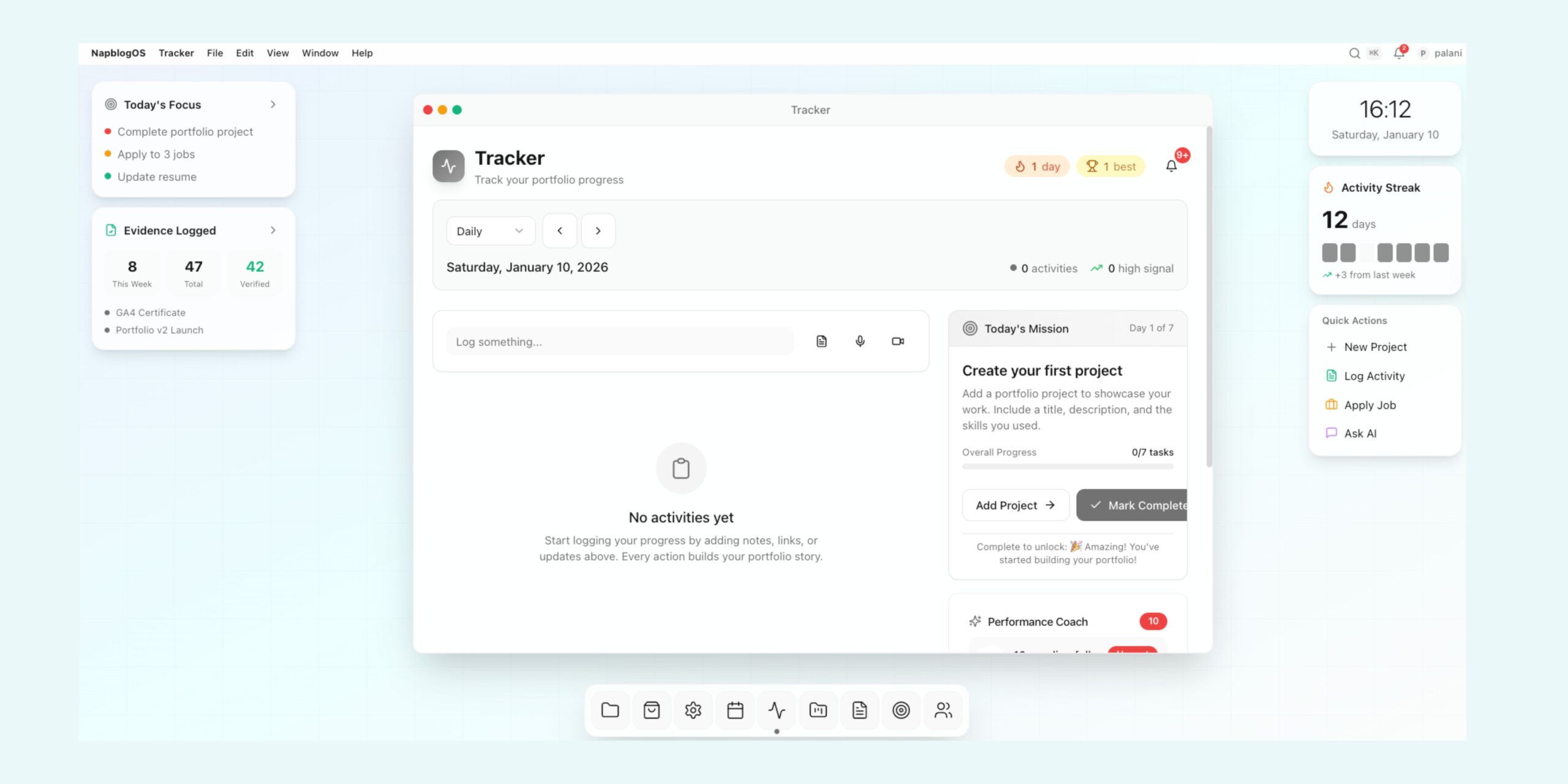
Inside Nap OS, the Tracker is where execution logs live. Every day, when you open os.napblog.com, you’re greeted with a simple question: “What did you accomplish today?”
That question is deceptively powerful. It forces a shift in thinking. Instead of logging hours, you’re logging outcomes. Instead of tracking attendance, you’re capturing proof.
Here’s what makes the Tracker different from any productivity app you’ve used before:
Daily Execution Scoring
Every activity you log feeds into your Execution Score — a dynamic number out of 100 that reflects your daily output. This isn’t a grade assigned by a professor. It’s a score generated by your own actions. The system tracks your 7-day average, giving you a clear picture of your momentum over time.
Think of it this way: a single day of effort is noise. A week of consistent execution is a signal. A month of it is evidence.
Proof Attachments
Logging an activity isn’t just writing a sentence. You can attach proof — screenshots, files, links, documents. Drag and drop. Click and upload. The execution log becomes a verified record, not a self-reported claim.
This is the fundamental difference between Nap OS and everything else. When you say “I built a landing page,” you attach the URL. When you say “I analyzed customer data,” you attach the spreadsheet. When you say “I designed a new logo,” you attach the file. The system sees what you did because you showed it what you did.
The “Materially Moved Me Forward” Toggle
Not every task is equal. Some days you send emails. Other days you ship a product. The Tracker includes a toggle — “This materially moved me forward” — that lets you flag high-signal activities. These aren’t just checkboxes. They’re signals that feed into your Execution Signature, the multidimensional behavioral fingerprint that Nap OS builds over time.
When you toggle that switch, you’re telling the system: this mattered. And the system listens.
Focus Items
Each week, you can set up to 7 focus items under “This Week’s Focus.” These aren’t tasks on a to-do list. They’re commitments. They’re the things you’re telling the system — and yourself — that you will execute on this week. When those focus items align with your logged activities and proof attachments, the system recognizes coherence. It sees that you set a direction and followed through.
Coherence compounds. Scattered activity doesn’t.
How Execution Logs Connect to the Atomic Algorithm?
Under the surface, every execution log you create generates what we call Atoms — the smallest indivisible units of verified execution evidence. These atoms are the building blocks of everything else in Nap OS.
Here’s how it works:
When you log an activity with proof, the system creates an atom. That atom has tags (what skill it relates to), format (what type of evidence it is), intensity (how significant the output was), and a timestamp (when it happened). Over time, atoms connect to each other through Atomic Bonding — overlapping tags, similar formats, temporal proximity, and escalating intensity create clusters of related execution.
These clusters aren’t portfolios you build. They’re Emergent Portfolios — portfolios that the system generates automatically from your accumulated atoms. You don’t curate them. You earn them.
This is where the Maturity Score comes in. Maturity isn’t a measure of talent or potential. It’s a measure of execution reliability over time. The system looks at five dimensions:
- Consistency — Do you execute regularly, or in bursts?
- Intensity Progression — Are your outputs getting more complex over time?
- Skill Depth — Are you going deeper in specific areas, or staying shallow?
- Pattern Stability — Does your execution show reliable patterns?
- Adaptive Learning — Do you adjust when something isn’t working?
A student who logs execution every day for 90 days with escalating complexity builds a maturity score that no resume can replicate. And because the system tracks longitudinally — over weeks, months, and years — it captures something that a traditional interview never could: the trajectory of your capability.
Why Execution Logs Are the New Resume?
Let’s talk about what hiring managers actually see.
When 70% of employers are moving to skills-based hiring, the question isn’t “where did you study?” anymore. It’s “what can you actually do?” And the answer to that question is only credible when it’s backed by evidence.
A traditional resume is a self-reported document. You write what you want the employer to see. There’s no verification. There’s no timestamp. There’s no proof. Every recruiter knows this. It’s why the interview process is so long — because the resume alone doesn’t prove anything.
Execution logs change this equation entirely.
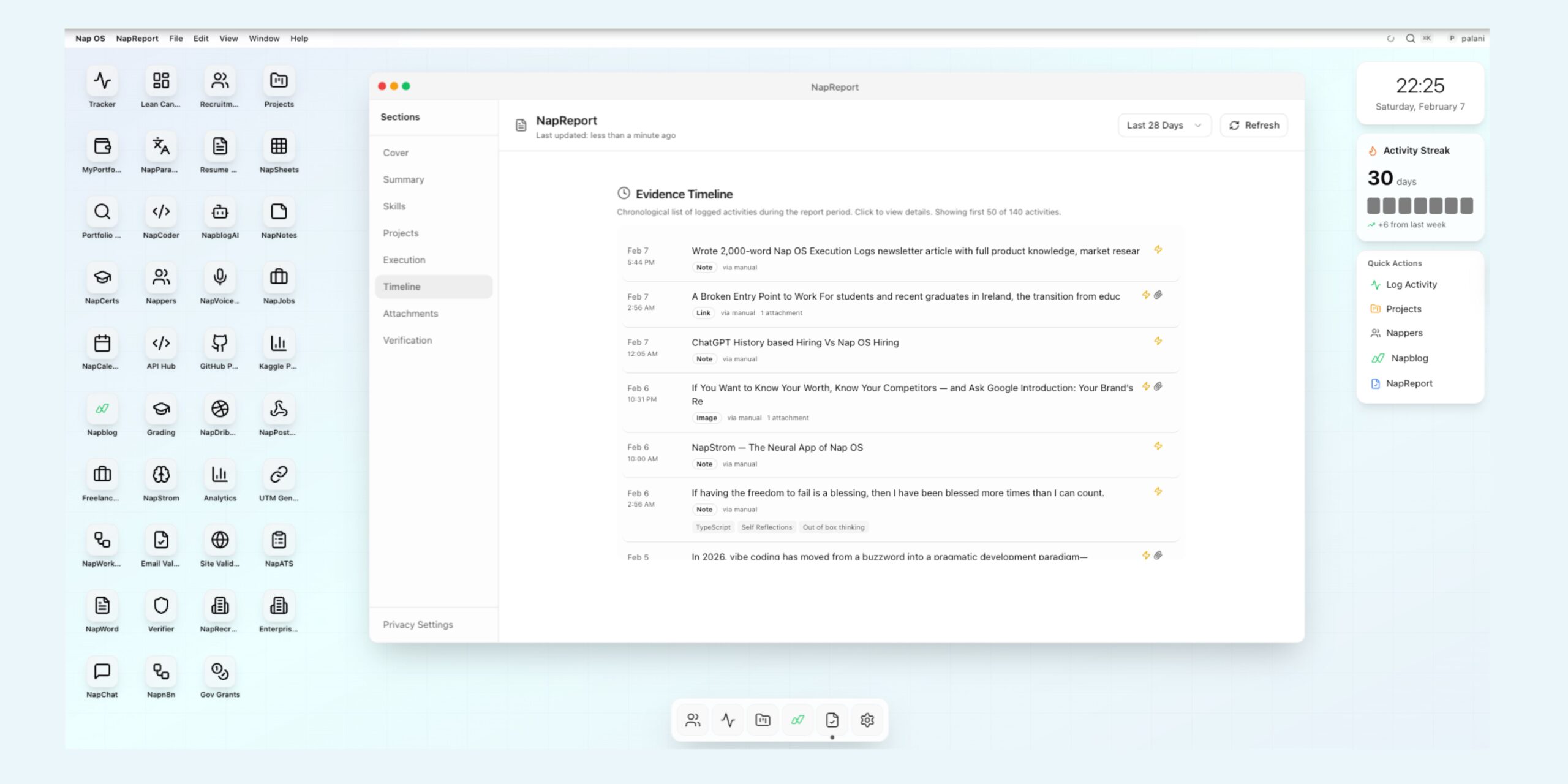
When a hiring manager looks at a Nap OS profile, they don’t see bullet points. They see a timeline. They see daily execution over weeks and months. They see proof attachments. They see consistency scores and maturity trajectories. They see which activities the student flagged as high-signal. They see focus items that were set and met.
This is what verifiable, not claimable means in practice. Your execution log is your track record, and it’s auditable.
The Nappers Streak: Consistency as a Hiring Signal
One of the most visible signals in Nap OS is the Nappers Streak — the consecutive-day count of your execution log activity. Right now, on the Tracker dashboard, you can see your current streak, your weekly comparison, and your all-time record.
Why does this matter for hiring? Because consistency is the single most reliable predictor of professional performance. A student with a 30-day Nappers Streak has demonstrated something that no interview question can test: they show up. Every day. And they produce something every day.
That signal alone is worth more than a GPA. And it’s completely ungameable — you either executed or you didn’t. The system tracks timestamps. The system sees the proof. There’s no way to fake 30 consecutive days of verified execution.
Execution Logs in the Broader Nap OS Ecosystem
The Tracker doesn’t exist in isolation. Execution logs feed into and connect with every other product in Nap OS:
NapProjects — When you complete a task in NapProjects, it can link directly to your execution log as proof. The project system and the tracking system are connected, so your project delivery becomes execution evidence automatically.
Portfolio Engine — Your accumulated execution logs feed into the Portfolio Engine, which evaluates your evidence against a scoring rubric. The Portfolio Engine doesn’t ask what skills you have. It looks at what you’ve done and scores accordingly. Validation is strengthened by measurable signals — website analytics, consistent activity patterns, real output.
NapCerts — Certification bands in Nap OS aren’t earned by passing a test. They’re earned through accumulated execution. The system places you into certification bands — Market-Ready (850-1,000), Execution-Capable (700-849), Foundation (550-699) — based on what you’ve actually built and shipped. Your execution log is the raw material that feeds this scoring.
NapJobs — When you apply for a position through NapJobs, your execution log is your application. It’s the evidence that accompanies your profile. Employers using NapATS see not just your resume, but your execution history.
NapStrom — The neural intelligence layer of Nap OS uses your execution data to surface insights. What are your strongest skill clusters? Where is your execution consistency dropping? What areas show the most growth? NapStrom processes your atoms and helps you see patterns you might miss.
How to Start Building Your Execution Log Today?
If you’re reading this and you’re a student — or anyone building a career — here’s the practical takeaway:
Step 1: Log in to os.napblog.com. Create your account if you haven’t already.
Step 2: Open the Tracker. You’ll see the date, your execution score, and the activity log.
Step 3: Answer the question. “What did you accomplish today?” Be specific. Not “worked on project” but “built the authentication flow for the NapblogOS MVP and deployed to staging.”
Step 4: Attach proof. Screenshot, file, link — whatever evidence you have, attach it.
Step 5: Toggle if it matters. If this activity materially moved you forward, flip the toggle. Be honest. Not everything is high-signal, and the system respects that.
Step 6: Do it again tomorrow. And the day after. Watch your Nappers Streak grow. Watch your 7-day average climb. Watch your maturity score compound.
The system doesn’t care about your GPA. It doesn’t care about your university ranking. It cares about what you do, how often you do it, and whether you can prove it.
What the Data Says About Execution-Based Hiring?
The numbers tell a compelling story. In Ireland alone, there are 265,905 students in higher education — a 14.8% growth since 2017. Over 35,000 are international students, many of whom need employment evidence for visa extensions. Dublin’s “Silicon Docks” houses the EMEA headquarters of Google, Meta, LinkedIn, Amazon, and HubSpot. These companies aren’t asking for transcripts. They’re asking for proof of capability.
Globally, 8.2 million students wanted internships in 2023. Only 4.6 million got them. That’s a gap of 3.6 million students who wanted to prove themselves through execution and couldn’t find the opportunity. Nap OS doesn’t wait for an internship to come along. It turns every day of your work into internship-grade evidence.
The shift to skills-based hiring is accelerating. Employers and educators fundamentally disagree on what skills matter most. Educators emphasize soft skills; employers want job-specific, demonstrable capability. Execution logs bridge that gap by showing both — the consistency of your work habits (soft skills in action) and the tangible outputs you produce (hard skills, verified).
The Future of Execution Evidence
We’re building Nap OS because we believe the world is moving — rapidly — toward a model where execution is the primary currency of professional credibility. The fact that 33% of graduates are unemployed while employers report a skills shortage tells you everything you need to know about the current system. There’s a disconnect between what universities measure and what employers need.
Execution logs are the bridge.
They’re not a replacement for education. They’re the layer that makes education legible to the market. They convert what you learned into what you can prove. They give hiring managers something they’ve never had before: a verified, longitudinal record of a candidate’s actual capability.
That’s what Nap OS is building. Not another portfolio tool. Not another resume builder. An operating system where your career evidence generates itself from the work you do every day.
Your execution log is already writing your career story. The only question is whether you’ve started logging.