4 min read
The Hiring Problem Was Never Talent
It Was Always Visibility.
Hiring today does not fail because candidates lack skills.
Hiring fails because founders cannot see execution.
Every hiring decision is made using:
- resumes
- interviews
- references
- personality impressions
- hypothetical questions
All of which are:
Claims.
Not proof.
A resume tells you what someone says they did.
An interview tells you how someone talks about doing it.
A reference tells you what someone remembers about it.
But none of these show:
How consistently they execute.
How they behave under uncertainty.
How they structure decisions.
How frequently they produce outcomes.
Founders are forced to hire based on narrative interpretation rather than behavioural evidence.
Nap OS Tracker exists to change that.
From Resume to Execution Ledger
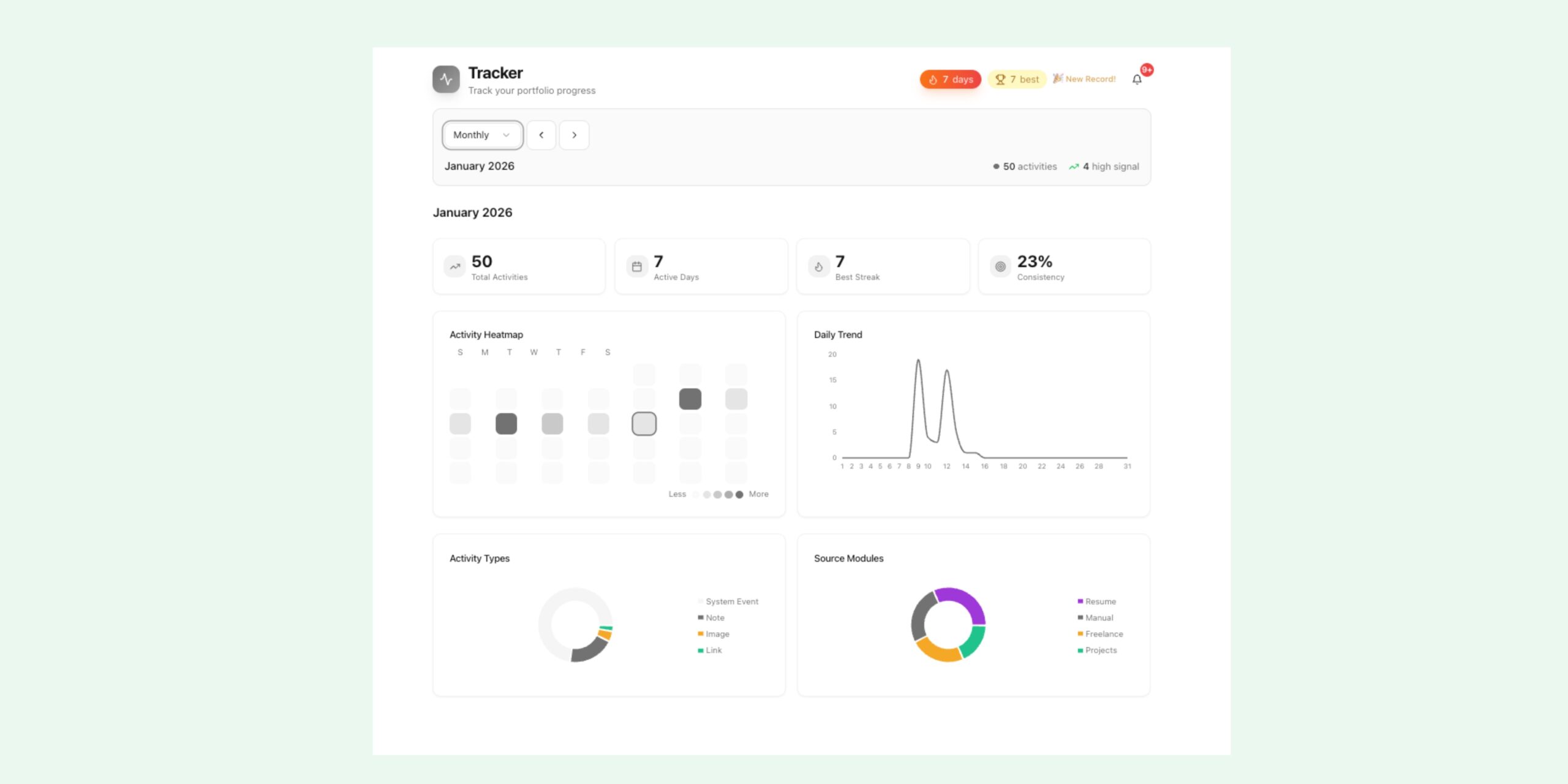
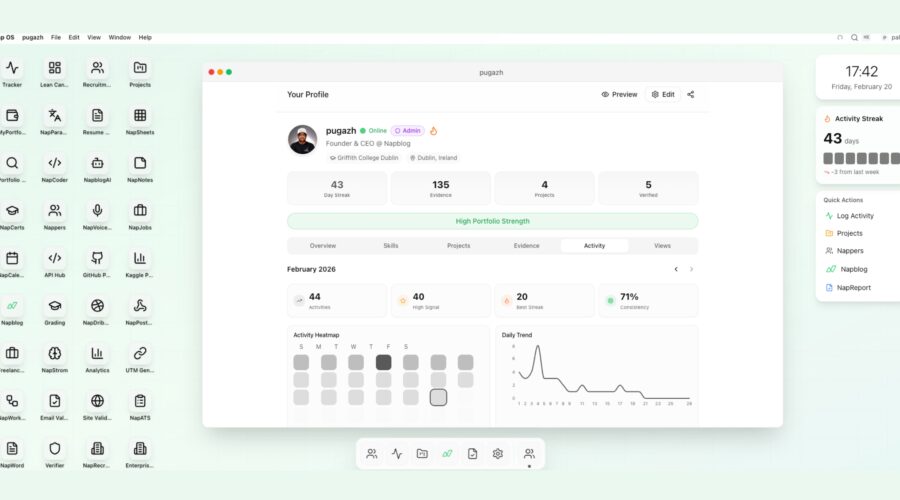
The Nap OS Tracker is designed to observe and structure a user’s daily execution into measurable intelligence signals.
Inside the system interface, we do not see:
Titles
Degrees
Certifications
We see:
- Day Streak
- Evidence Count
- Project Completion
- Verification Status
- Activity Heatmaps
- Signal Strength
- Behavioural Consistency
- Daily Execution Trends
Each of these metrics represents:
Real output over time.
For example:
A candidate with:
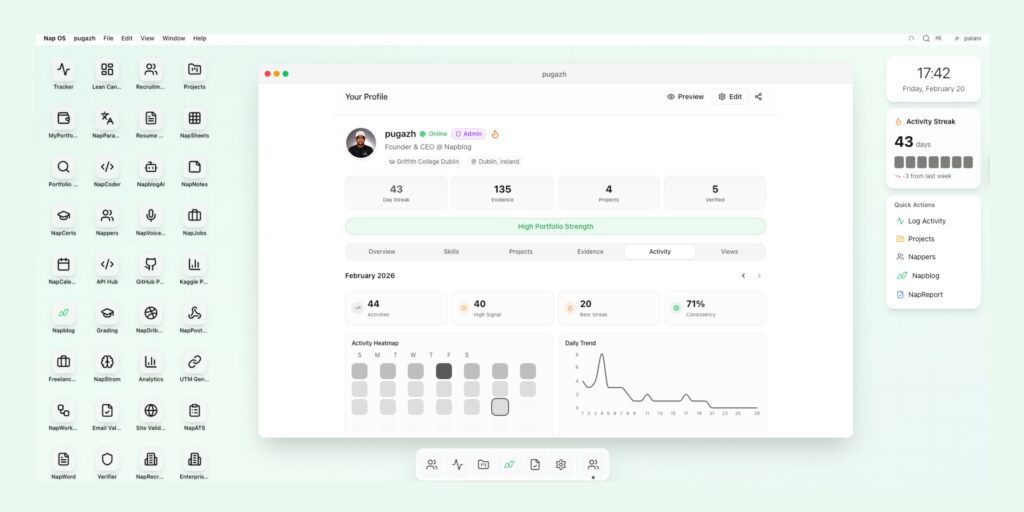
- 43 Day Execution Streak
- 135 Logged Evidence Objects
- 4 Active Project Structures
- 5 Verified Contributions
- 71% Behavioural Consistency
Is no longer a narrative.
They are:
An execution pattern.
What Nap OS Tracker Actually Measures
Traditional hiring platforms measure outcomes:
- Did you complete a degree?
- Did you work in this company?
- Did you deliver this project?
Nap OS measures process behaviour:
1. Execution Frequency
How often does the individual perform structured work?
The activity streak is not a motivational metric —
it represents sustained cognitive engagement with execution frameworks.
Founders hiring early-stage talent care about:
Consistency.
Because startup environments do not reward brilliance —
they reward reliability.
2. Evidence Generation
Every logged execution generates:
A contextualized output object.
This can include:
- deliverables
- decision documents
- prototypes
- performance logs
- workflow artifacts
The Evidence Count shows:
How many times the individual converted effort into observable contribution.
A candidate with 135 evidence entries is not experimenting randomly —
they are systematically externalizing their thinking.
3. Project Structuring Behaviour
Projects inside Nap OS are not simple task lists.
They represent:
- goal hierarchy
- execution sequencing
- feedback integration
- iteration history
When founders see:
4 structured projects
They are observing:
Strategic planning behaviour.
Not just completion.
4. Verification Layer
Verification transforms self-reported contribution into trusted signal.
Projects marked as:
Verified
Have passed through:
- peer validation
- outcome demonstration
- stakeholder confirmation
- contextual integrity checks
For founders, this reduces:
Hiring uncertainty.
5. Behavioural Consistency
Consistency analytics evaluate:
Execution variance across time.
Does the candidate:
Work intensely for short bursts?
Maintain steady delivery?
Decline under pressure?
A 71% consistency score indicates:
Stable performance behaviour —
a critical predictor of startup adaptability.
Activity Heatmaps — Founder’s Favourite Hiring Tool
One of the most powerful visual layers inside the Tracker is:
The Activity Heatmap.
It shows:
When the candidate works.
How frequently they produce.
Where execution intensity clusters.
Instead of asking:
“Tell me about your work ethic”
Founders can see:
- execution density
- behavioural rhythm
- contribution regularity
Over weeks or months.
This converts personality judgement into:
Behavioural observation.
Daily Trend Analytics — Detecting Momentum
Hiring is often about trajectory rather than present capability.
Daily Trend Graphs inside Nap OS allow founders to evaluate:
Execution momentum.
Is the candidate:
Improving?
Plateauing?
Declining?
This transforms hiring from:
Static assessment
Into:
Dynamic prediction.
Portfolio Strength as Hiring Currency
At the centre of the interface sits:
Portfolio Strength Indicator.
This aggregates:
- activity frequency
- evidence density
- verification ratio
- behavioural consistency
Into:
A single interpretive signal.
For founders reviewing multiple candidates:
Portfolio Strength becomes:
A hiring currency.
Because it reflects:
Not what someone knows —
but how effectively they apply it.
Founder Hiring With Nap OS Data
Imagine a founder evaluating two candidates.
Candidate A:
- Strong resume
- Prestigious degree
- Excellent communication
- Minimal execution data
Candidate B:
- Moderate academic record
- 60-day execution streak
- 200 logged outputs
- Verified project contributions
- High behavioural consistency
Traditional hiring would select Candidate A.
Execution-based hiring selects Candidate B.
Because:
Startup success depends on:
Delivery behaviour.
Not potential narratives.
Nap OS Tracker surfaces this behaviour directly.
Implications for Early-Stage Teams
Hiring mistakes in startups are:
Expensive.
Nap OS Tracker reduces:
- onboarding risk
- productivity uncertainty
- cultural mismatch
- execution unpredictability
By providing:
Pre-employment performance visibility.
Founders gain:
Confidence in decision-making.
Hiring Becomes Portfolio Review
Instead of:
Interview-centric selection
Hiring evolves into:
Portfolio intelligence analysis.
Founders evaluate:
- execution streaks
- project architecture
- behavioural consistency
- evidence density
This mirrors how:
Investors evaluate startups.
Traction matters more than promise.
Nap OS as Trust Infrastructure
In early-stage ecosystems, trust is fragile.
Nap OS Tracker provides:
Execution transparency.
Candidates no longer need to:
Convince.
They can:
Show.
This shifts hiring conversations from:
Self-promotion
To:
Execution interpretation.
Long-Term Founder Benefits
Using Nap OS data during hiring leads to:
- faster team alignment
- reduced supervision needs
- improved delivery timelines
- adaptive collaboration
Because employees hired based on:
Behavioural evidence
Require less motivational management.
The Future of Hiring is Observable Work
As AI reshapes work environments:
Credentials lose value.
Execution gains importance.
Systems like Nap OS Tracker introduce:
Behaviour-first hiring frameworks.
Where:
Work history is continuously documented.
Founders do not need to rely on:
Memory
References
Self-reporting
They rely on:
Execution analytics.
Conclusion — Hiring Without Guesswork
Nap OS Tracker and Analytics transform hiring from:
Interpretation
Into:
Observation.
From:
Narratives
Into:
Evidence.
When shared with founders:
Candidate dashboards become:
Execution profiles.
Hiring becomes:
Data-supported judgement.
Teams become:
Behaviourally aligned systems.
And the future of hiring moves from:
What people say they can do
To:
What their execution history proves they have done.