5 min read
Employability has historically been treated as an abstract promise. Students graduate with credentials. Professionals accumulate experiences. Institutions advertise placement rates. Recruiters evaluate narratives.
Yet across the global workforce, one fundamental question remains unresolved:
How do we measure employability in a way that reflects reality rather than perception?
For decades, the answer has been fragmented metrics — employment percentages, salary averages, or institutional reputation proxies. These indicators are surface-level reflections rather than systemic insight. They show outcomes without revealing mechanisms, correlations without causation, and signals without interpretation.
Nap OS was not designed to observe employability from a distance.
It was built to instrument it.
This article explores how measurable employability enhancement shifts the paradigm from symbolic career validation toward continuous outcome intelligence — transforming employability from a claim into a tracked, evolving system state.
The Measurement Gap in Modern Career Systems
Modern workforce ecosystems generate enormous volumes of activity but very little structured outcome intelligence. Universities track graduation. Companies track hiring. Platforms track engagement.
But almost none track:
- Capability utilization
- Growth velocity
- Outcome attribution
- Trajectory sustainability
This creates what can be described as an observability deficit in human capital systems.
A graduate may secure employment — but was it aligned with capability?
A professional may earn more — but did growth stem from skill expansion?
An organization may hire successfully — but what signals predicted performance?
Without measurement depth, employability becomes anecdotal rather than analytical.
Nap OS addresses this by redefining employability as a measurable multi-dimensional construct.
Defining Measurable Employability
Within Nap OS architecture, employability is not binary.
It is modeled as a dynamic vector influenced by:
- Execution consistency
- Capability verification
- Skill utilization efficiency
- Outcome trajectory stability
- Ecosystem feedback integration
This transforms employability into an observable system state rather than a milestone event.
Instead of asking:
“Did this individual get hired?”
Nap OS evaluates:
- How quickly opportunity was secured
- What execution signals enabled it
- How role alignment evolved
- How outcomes compound over time
This shift moves employability assessment from episodic snapshots toward continuous intelligence.
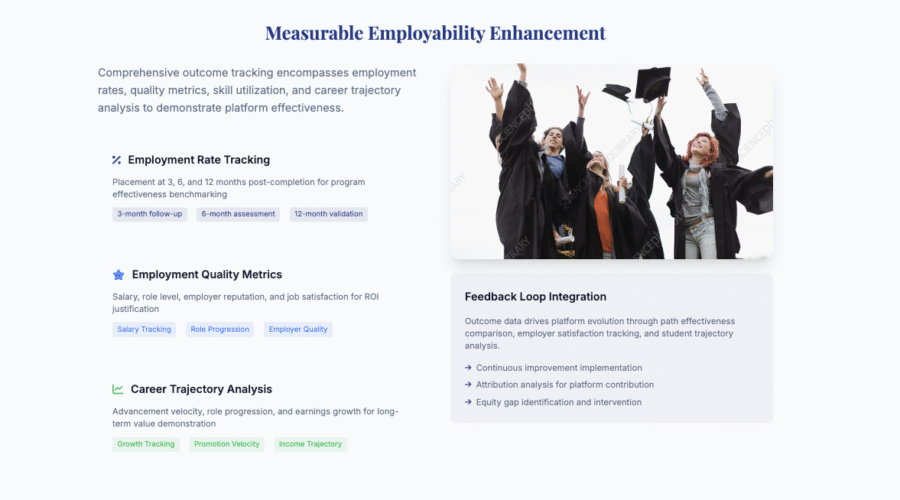
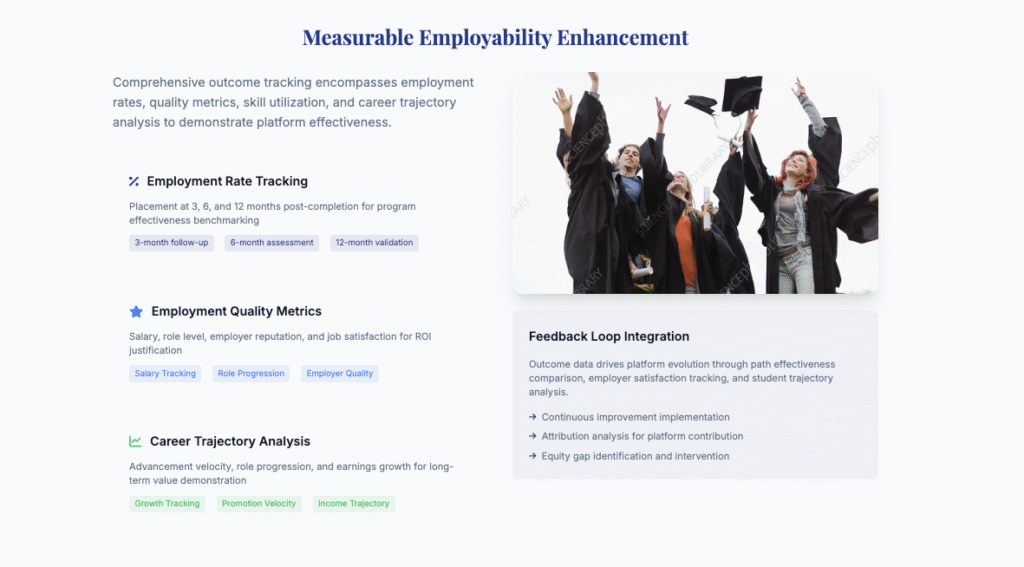
Employment Rate Tracking — Beyond Placement Metrics
Traditional placement tracking measures success through percentage outputs — for example, employment within six months of graduation. While useful, such metrics lack resolution.
Nap OS enhances employment rate tracking through structured longitudinal observation:
3-Month Signal Mapping
Early outcome signals reveal transition friction and execution readiness.
These signals identify:
- Opportunity discovery velocity
- Portfolio resonance
- Recruiter interaction density
6-Month Capability Alignment Assessment
Mid-stage observation evaluates whether individuals operate within skill-aligned roles.
This stage measures:
- Task ownership depth
- Output relevance
- Performance stability
12-Month Validation Analysis
Longer-term validation confirms trajectory durability and decision quality.
It reveals:
- Retention integrity
- Growth movement
- Role expansion
Rather than measuring placement as an endpoint, Nap OS observes employability maturation across time.
This produces higher fidelity insights for:
- Individuals optimizing career direction
- Institutions validating educational models
- Employers refining hiring signals
Employment Quality Metrics — Measuring Outcome Depth
Employment alone does not equate to employability enhancement.
Quality of engagement determines whether opportunity translates into value creation.
Nap OS evaluates employment quality through multi-layer metrics:
Compensation Trajectory Intelligence
Salary is not analyzed as a static figure but as a directional vector indicating perceived capability value within markets.
Role Progression Signals
Tracking responsibility expansion reveals trust accumulation and execution credibility.
Employer Context Quality
Organizational environments shape capability development.
Nap OS observes ecosystem context to understand developmental acceleration potential.
Satisfaction Resonance Indicators
Alignment between cognitive motivation and task structure influences sustainability.
Capturing subjective resonance enables predictive trajectory modeling.
Together, these dimensions quantify outcome depth rather than surface achievement.
Career Trajectory Analysis — Mapping Longitudinal Growth
Careers are dynamic systems rather than linear ladders.
Understanding trajectory evolution requires continuous observation across time horizons.
Nap OS models trajectory across three primary vectors:
Advancement Velocity
Measures how rapidly responsibility scope expands.
High velocity indicates adaptive execution and opportunity responsiveness.
Promotion Momentum
Captures organizational trust recognition patterns.
Momentum reveals alignment between perceived and demonstrated capability.
Income Evolution Pathways
Economic growth patterns reflect market valuation of skill deployment.
By combining these vectors, Nap OS generates trajectory intelligence that identifies:
- Plateau risk
- Acceleration potential
- Diversification pathways
This enables proactive career architecture rather than reactive navigation.
Feedback Loop Integration — Systemic Learning Mechanisms
Measurement without adaptation creates informational stagnation.
Nap OS embeds feedback loop integration to transform insights into systemic evolution.
Continuous Platform Optimization
Outcome intelligence refines execution environments, improving structural alignment between activity and opportunity generation.
Attribution Modeling
Understanding which interventions drive results enables resource allocation efficiency and model refinement.
Equity Gap Identification
Data signals reveal structural disparities, enabling targeted intervention design.
This transforms employability enhancement into a self-improving ecosystem rather than a static service.
Structural Impact on Educational Paradigms
Educational institutions historically validate success through completion metrics.
Nap OS introduces outcome observability that challenges this structure.
With measurable employability intelligence:
- Curriculum relevance becomes quantifiable
- Skill deployment efficiency becomes visible
- Institutional impact becomes accountable
This enables transition from knowledge distribution toward outcome-validated learning architectures.
Organizational Hiring Implications
Employers gain unprecedented visibility into candidate capability trajectories.
Instead of relying on resumes or interview impressions, organizations can observe:
- Execution histories
- Capability utilization patterns
- Growth indicators
- Environmental adaptability
This reduces hiring risk and enhances prediction accuracy.
Recruitment evolves from evaluation to informed selection based on longitudinal intelligence.
Psychological Transformation for Individuals
Measurement transparency reshapes professional identity formation.
Individuals operating within observable systems experience:
- Increased agency
- Clear growth feedback
- Reduced ambiguity
- Enhanced motivation
Career development transitions from speculative exploration toward strategic optimization.
Proof replaces uncertainty.
Trajectory replaces assumption.
Economic and Societal Implications
Macro-scale adoption of employability observability infrastructures produces cascading benefits:
- Reduced talent misallocation
- Improved productivity distribution
- Enhanced workforce adaptability
- Greater opportunity accessibility
Human capital markets become more fluid and efficient when credibility signals are observable rather than symbolic.
Nap OS positions itself within this structural transformation.
The Future of Employability Intelligence
The next evolution of workforce systems will integrate:
- Predictive trajectory modeling
- Execution pattern analytics
- Capability graph evolution
- Ecosystem signal harmonization
Employability will shift from reactive evaluation toward proactive optimization.
Individuals will not merely respond to markets.
They will navigate them through measurable intelligence.
Nap OS serves as foundational infrastructure enabling this transition.
Conclusion — From Career Outcomes to Career Observability
Employability enhancement is no longer about increasing probability of success.
It is about understanding the mechanisms producing it.
Through employment tracking, quality metrics, trajectory analysis, and adaptive feedback loops, Nap OS converts career development into an observable system.
This reframes employability:
From status
To signal
From narrative
To intelligence
From assumption
To measurement
In a world increasingly driven by complexity and acceleration, those capable of observing and interpreting human capability systems will define the architecture of opportunity.
Nap OS is not measuring careers for reporting.
It is instrumenting them for evolution.
And measurable employability enhancement is only the beginning.