Last updated: February 16, 2026
7 min read
Artificial Intelligence is not simply automating tasks. It is redesigning the architecture of work itself.
Across industries — from software development to consulting and data analytics — foundational tasks that once defined entry-level roles are increasingly handled by intelligent systems.
Drafting documents, conducting preliminary research, synthesizing reports, performing structured analysis — these were historically the proving grounds for junior professionals. Today, they are being accelerated, augmented, or fully automated.
From the perspective of Napblog Limited, this shift is not a threat to early-career talent. It is a systems problem — and systems problems require infrastructure-level solutions. That is precisely why we built Nap OS: to become the execution-first operating system for careers in the age of AI.
This article explores how AI is reshaping entry-level work, why traditional career pathways are collapsing, and how Nap OS is rebuilding a scalable, verified, AI-native alternative.
The Structural Collapse of the Traditional Entry-Level Model
For decades, entry-level roles followed a predictable architecture:
- Junior hires handled repetitive or structured tasks.
- These tasks created skill acquisition loops.
- Over time, competence led to autonomy.
- Autonomy led to leadership.
The model worked because foundational work required human time.
AI has broken that constraint.
Today:
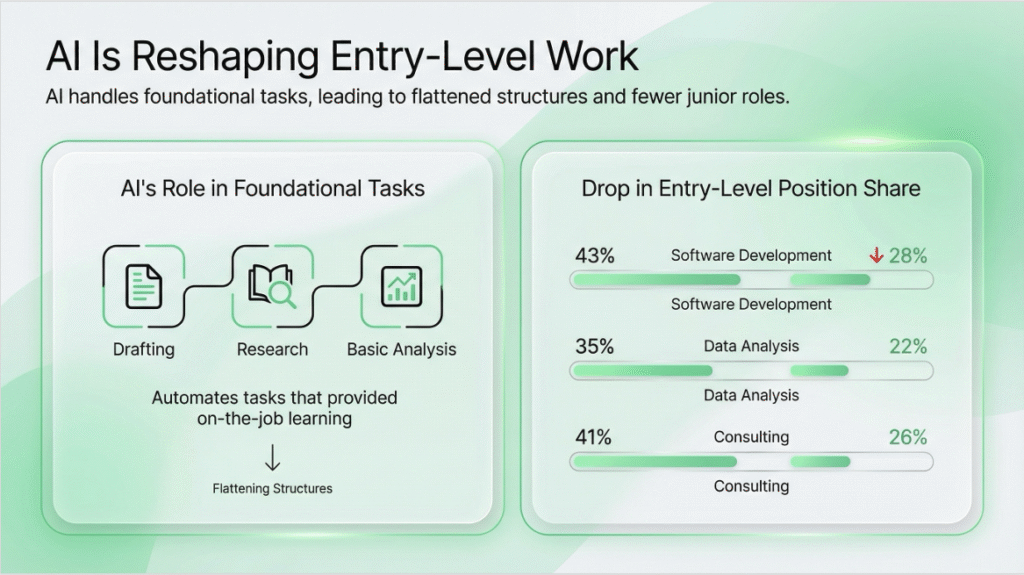
- Drafting is assisted by generative AI systems.
- Research is accelerated by semantic search and automated summarization.
- Data analysis is handled by machine-driven modeling and visualization tools.
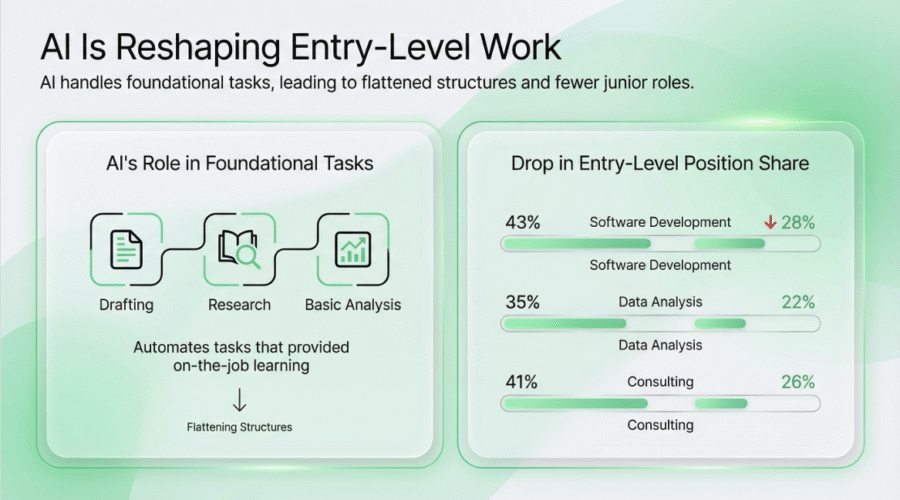
Organizations no longer need large cohorts of junior employees to execute structured workflows. The measurable decline in entry-level roles across sectors illustrates this transformation:
- Software development entry-level share: ~43% → ~28%
- Data analysis: ~35% → ~22%
- Consulting: ~41% → ~26%
The hierarchy is flattening. Fewer layers. Fewer apprenticeship-style positions. Faster expectations of value creation.
The question is no longer: How do juniors learn by doing repetitive tasks?
The question is: How do individuals demonstrate value before being hired?
That is the gap Nap OS was designed to solve.
AI Is Not Eliminating Work — It Is Eliminating Training Layers
The critical misunderstanding in public discourse is that AI “removes jobs.”
In reality, it removes low-leverage learning environments.
Entry-level roles traditionally served as paid training systems. Organizations absorbed inefficiency because structured work required human labor.
AI eliminates inefficiency.
Which means companies now expect:
- AI literacy from day one
- Strategic thinking earlier
- Cross-functional awareness sooner
- Outcome ownership faster
Graduates can no longer rely on “learning on the job” through repetition. They must enter the workforce already capable of producing meaningful outputs in AI-augmented workflows.
This requires a new educational and professional infrastructure.
Nap OS is that infrastructure.
Nap OS: The Execution-First Career Operating System
Nap OS was built around a simple principle:
Careers should be built through verified execution, not theoretical credentials.
If AI is automating foundational tasks, then students and early professionals must learn to:
- Frame problems
- Architect workflows
- Collaborate with AI tools
- Ship measurable outputs
- Document their impact transparently
Nap OS operationalizes this philosophy through five structural components:
1. Verified Portfolio Infrastructure
Traditional CVs describe experience. They do not prove capability.
Nap OS allows users to build portfolios that:
- Document real projects
- Capture AI-assisted workflows
- Show before/after outputs
- Track measurable metrics
- Provide verification layers
In an AI-flattened job market, employers need signal clarity. Nap OS provides that signal.
Instead of asking:
“Do you have two years of experience?”
Hiring managers can ask:
“Can you demonstrate execution?”
And Nap OS users can answer with proof.
2. AI-Augmented Skill Development
If drafting, research, and analysis are automated, the skill frontier shifts upward.
Nap OS trains users in:
- Prompt architecture
- Workflow design
- AI-assisted research systems
- Automation integration
- Cross-platform productivity
We do not teach people to compete with AI.
We teach them to orchestrate it.
The future professional is not a task executor. They are a system designer.
3. Project-Based Learning Instead of Passive Learning
Universities still emphasize theoretical frameworks. But employers increasingly demand applied capability.
Nap OS transforms learning into execution cycles:
- Identify a real-world problem
- Design a solution workflow
- Use AI tools to accelerate production
- Publish the output
- Receive feedback
- Iterate
This compresses the apprenticeship model into a self-driven, scalable system.
Students do not wait for permission to gain experience. They generate it.
4. Career Management as a Continuous System
Traditional career progression was linear:
Education → Entry-Level Role → Promotion → Specialization
AI makes that path unstable.
Nap OS reframes careers as dynamic systems:
- Continuous portfolio updates
- Skill mapping against market demand
- Iterative positioning
- Multi-disciplinary expansion
- Entrepreneurial experimentation
Instead of being dependent on organizational hierarchy, individuals build portable professional capital.
5. Bridging Universities and Industry
One of the largest structural risks in the AI era is misalignment between academic curricula and market needs.
Nap OS works as a bridge:
- Students build AI-integrated projects.
- Universities gain applied case studies.
- Employers access verified talent pipelines.
This creates a feedback loop between education and industry that traditional degree models struggle to maintain.
Why Foundational Task Automation Changes Everything
Let us examine the three core tasks AI is automating and how Nap OS reframes them.
Drafting → Strategic Communication
AI can generate text. But it cannot define strategic positioning without human context.
Nap OS trains users to:
- Define audience segments
- Clarify narrative architecture
- Use AI to refine, not replace, communication strategy
- Measure engagement outcomes
The value shifts from writing words to designing influence systems.
Research → Insight Synthesis
AI can summarize. But it does not automatically produce differentiated insight.
Nap OS teaches:
- Comparative analysis frameworks
- Cross-disciplinary integration
- Market interpretation
- Hypothesis testing
The goal is not to gather information. It is to generate leverage from information.
Basic Analysis → Decision Architecture
AI can calculate and visualize.
But it cannot independently determine:
- Which metrics matter
- What trade-offs exist
- How risk should be managed
- What strategic action follows
Nap OS trains users to design decision environments.
That is a higher-order skill.
Flattened Hierarchies Require Accelerated Competence
When organizations reduce junior layers, expectations compress.
Entry-level professionals must contribute like mid-level professionals faster.
This can feel intimidating.
But it also democratizes opportunity.
If AI handles foundational execution, then:
- Geographic barriers matter less.
- Institutional prestige matters less.
- Demonstrated capability matters more.
Nap OS aligns with this democratization.
It allows:
- Students in any region to build global portfolios.
- Career switchers to reposition rapidly.
- Entrepreneurs to test ideas with minimal overhead.
- Graduates to bypass gatekeeping structures.
AI reduces friction. Nap OS organizes the acceleration.
Replacing the “Experience Gap” With a Proof System
The experience gap has always been paradoxical:
You need experience to get a job.
You need a job to get experience.
AI intensifies this paradox because companies no longer need to hire large junior cohorts for training.
Nap OS resolves this through:
- Independent project incubation
- Collaborative micro-teams
- AI-supported execution
- Transparent output tracking
- Performance-based visibility
Instead of asking employers for opportunities, users build opportunity assets themselves.
The New Entry-Level Professional: AI-Integrated and Outcome-Driven
The modern early-career professional must demonstrate:
- AI fluency
- Systems thinking
- Problem framing ability
- Adaptability
- Cross-functional communication
- Measurable impact
Nap OS is designed to scaffold these attributes.
It is not a job board.
It is not a learning platform in the traditional sense.
It is not a static portfolio site.
It is an operating system — integrating:
- Learning
- Execution
- Documentation
- Positioning
- Monetization
- Career strategy
All in one environment.
The Strategic Opportunity in the AI Shift
There is understandable anxiety around the decline in entry-level roles.
But consider the upside:
- AI reduces repetitive labor.
- Individuals can create high-quality outputs faster.
- Barriers to entry lower for entrepreneurship.
- Self-directed professionals can compete globally.
The bottleneck is no longer technical capacity.
The bottleneck is structured execution.
Nap OS solves that bottleneck.
A New Social Contract Between Talent and Organizations
Organizations no longer guarantee long-term career ladders.
In return, individuals must:
- Own their skill development.
- Document their outputs.
- Adapt continuously.
- Integrate AI responsibly.
Nap OS supports this new contract by giving users:
- Visibility
- Structure
- Proof
- Direction
The result is not fewer opportunities.
It is redistributed opportunity.
From Entry-Level Roles to Entry-Level Impact
The future is not about securing a junior title.
It is about delivering junior-stage impact at scale.
Nap OS shifts the identity of early-career professionals from:
“I am learning.”
to
“I am building.”
That distinction is critical.
Learning without output is invisible.
Building creates signal.
Conclusion: Building the Infrastructure for AI-Native Careers
Artificial Intelligence is flattening hierarchies and automating foundational tasks. Entry-level roles are shrinking in certain sectors because repetitive execution is no longer economically necessary.
But this does not eliminate opportunity.
It redefines it.
The winners in this new landscape will not be those who resist AI — but those who integrate it into their workflows and prove higher-order capability.
Napblog Limited built Nap OS to:
- Replace passive credentials with verified execution.
- Replace fragmented tools with unified career infrastructure.
- Replace dependency on hierarchy with portable professional capital.
- Replace theoretical preparation with applied, AI-integrated competence.
If AI is rewriting the rules of entry-level work, then career systems must evolve accordingly.
Nap OS is not just adapting to that future.
It is architecting it.
Building modern career infrastructure requires innovation across technology, education, and recruitment. Follow the journey of Napblog Limited on LinkedIn.