Last updated: February 17, 2026
7 min read
The Global education systems have undergone profound shifts—shifts catalyzed by technology, pandemic disruption, and changing societal expectations of what learning should look like. At the forefront of this transformation is homeschooling: once a fringe or alternative option, it has rapidly emerged as a significant and enduring part of the education ecosystem.
Concurrently, traditional schooling—public, private, and institutional models—continues to evolve, adapting curriculum, technology, and delivery models in response. However, the velocity and direction of change raise important questions for educators, policymakers, parents, technology providers, and investors:
Can homeschooling scale sustainably to meet future demand?
How will the growth of homeschooling compare with traditional schooling over the next 10 years?
What operational frameworks are necessary for homeschooling to be effective, equitable, and future-ready?
In this article, we explore these questions from the perspective of Homeschooling Operating Systems (HOS)—the strategic, technological, and pedagogical infrastructure required to prepare homeschooling for the next decade.
Section 1: Homeschooling Today—A Snapshot of Growth
Homeschooling’s growth has been remarkable. Pre-pandemic, homeschooling was a small but stable educational choice in many countries. Since 2020, however, several data sources show a substantial increase in homeschool participation, driven by:
- Health concerns during COVID-19 school closures
- Dissatisfaction with standardized methods
- Increasing access to online curricula and learning platforms
- Desire for personalized, competency-based education
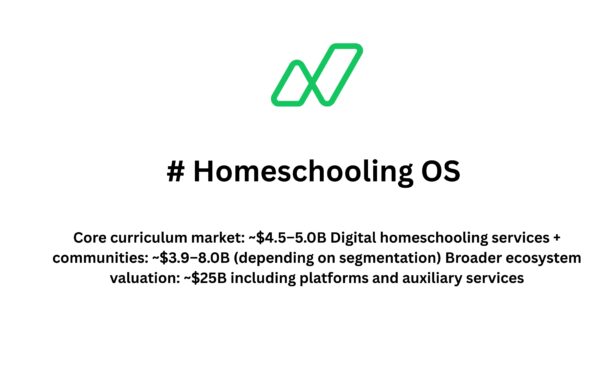
Market intelligence suggests the global homeschooling market, valued at approximately USD 2.5 billion in 2023, is projected to reach USD 4.5–10.3+ billion by the early 2030s, with various forecasts indicating compound annual growth rates (CAGR) between 8–12%+ depending on segmentation, region, and scope of services included.
More specifically:
- Some analysts estimate the homeschooling market could double or triple within a decade.
- In the United States, estimates place homeschooled students between 1.9 and 2.7 million (2022–23).
- In Ireland, registered homeschooling numbers have risen from roughly 1,507 to 2,499 within a few years, reflecting broader European trends toward greater consideration of home education.
Section 2: The Traditional Schooling Response
Traditional schooling continues to be the dominant global model. According to UNESCO, over 90% of school-age children globally are enrolled in formal education systems served by public or private institutions. Despite this dominance, growth rates for traditional schooling have been comparatively modest in many developed regions due to demographic shifts, teacher shortages, and funding constraints.
Key trends in traditional schooling include:
- Increased deployment of blended learning models (mixing in-person and digital instruction)
- Adoption of project-based and competency-based curricula
- Expansion of tech-enhanced personalized learning pathways
- Focus on student well-being and social-emotional learning frameworks
While traditional systems retain scale and infrastructure advantages, their growth trajectory is slower—in part due to regulatory requirements, physical infrastructure dependencies, and institutional inertia.
Section 3: Homeschooling Market Share vs Traditional Schooling Growth (2026–2036)
Comparing homeschooling and traditional schooling growth over the next decade requires careful framing. We must distinguish absolute participation growth, market value of services (e.g., curriculum, platforms, assessments), and systemic influence (policy shifts, labor market relevance).
3.1 Participation Rates
- Traditional schooling will continue near current participation levels in most regions, with marginal growth tied to population increases in developing nations and migration patterns in developed nations.
- Homeschooling participation is expected to grow faster, particularly in regions with supportive legal frameworks, robust digital infrastructures, and diverse curriculum options.
Projected trends:
| Metric | Traditional Schooling | Homeschooling |
|---|---|---|
| Participation Growth (Global) | 1–3% annually | 8–15% annually |
| Market Revenue Growth | Incremental (infrastructure, staffing) | Substantial (digital content, platforms, services) |
| Policy Momentum | Moderate | Increasing in multiple jurisdictions |
Forecasts suggest homeschooling could double its share of total school-age learners in select countries by 2036, particularly where flexible educational pathways are valued.
3.2 Market Economic Value
From an economic standpoint:
- Traditional schooling’s “market value” remains immense but is often public good subsidized.
- Homeschooling’s commercial ecosystem—curriculum vendors, learning management systems (LMS), assessment services, community networks—is where measurable revenue growth is most evident.
Estimates project:
- The homeschooling services market could exceed USD 10–15+ billion worldwide by the early 2030s, driven by digital products, subscription services, tutors, and ancillary education services.
Relative to traditional schooling’s spending (which runs into hundreds of billions in many nations), homeschooling’s share of total education expenditure will remain modest—yet its growth rate and influence in shaping pedagogical innovation will be disproportionate to its size.
Section 4: Homeschooling Operating Systems (HOS) Defined
To understand how homeschooling can sustainably meet next-decade demands, we must define Homeschooling Operating Systems (HOS).
HOS is the integrated set of:
- Pedagogical frameworks – Learning models, assessment standards, and curriculum articulation.
- Digital infrastructure – Platforms, LMS, content libraries, data dashboards, and collaborative tools.
- Administrative protocols – Compliance, reporting, accreditation pathways, and progress tracking.
- Support networks – Coaching, community forums, mentorship systems, and peer learning groups.
- Professional services – Instructional design, special education support, tutoring, and curriculum customization.
Together, these components form a scalable, adaptable backbone for homeschooling that can support diverse learners, maintain quality standards, and enable data-informed growth.
Section 5: Why HOS Matters—A Strategic Rationale
5.1 Personalization at Scale
One of homeschooling’s defining value propositions is personalized learning. However, without structured systems, personalization risks fragmentation. HOS provides:
- Adaptive learning paths
- Real-time progress analytics
- Differentiated assessment tools
These capabilities enable individualized instruction that remains measurable and accountable.
5.2 Equity and Accessibility
Well-designed HOS platforms can reduce barriers to high-quality education for learners regardless of geography or socioeconomic status—provided internet access and hardware are available. Cloud-native, modular systems make it possible for:
- Students in remote locations to access accredited curricula
- Families with varied resources to participate in blended homeschool-community programs
5.3 Credentialing and Portability
As learners transition between homeschool, traditional schools, and workplaces, clear standards and credential portability become critical. HOS supports:
- Digital portfolios
- Competency-based badges and micro-credentials
- Integration with higher education and employer systems
Section 6: Operational Preparedness for the Next Decade
To fulfill the promise of homeschooling as a scalable alternative (or complement) to traditional schooling, we must address preparedness across several dimensions:
6.1 Infrastructure Readiness
Technology Infrastructure:
Robust, secure LMS, content delivery networks, and tool interoperability. Key requirements include:
- APIs for integration with assessment and credentialing services
- Mobile-first design to support diverse device access
- Offline access where connectivity is limited
Data Security and Privacy:
With increased digital adoption comes greater responsibility for securing student data, ensuring compliance with local and international regulations.
6.2 Curriculum and Instructional Design
Curricula must be:
- Standards-aligned to national or international benchmarks
- Culturally responsive and inclusive
- Modular and flexible to support diverse learning paths
Instructional design should enable mastery-based progression rather than age-based grade levels.
6.3 Assessment and Accreditation
Assessment in the HOS context must balance:
- Formative assessments for daily learning optimization
- Summative assessments for credentialing and progression
- Portfolio assessments that showcase competencies and projects
Accreditation pathways that are recognized by universities and employers will bolster homeschooling legitimacy on a global stage.
6.4 Support Ecosystems
Parents and caregivers are central to homeschooling success but require structured support:
- Training on pedagogical principles
- Access to expert coaches
- Peer support networks
Establishing scalable support models will be essential as homeschooling participation grows.
Section 7: Risks, Challenges, and Mitigation
While homeschooling offers promise, several challenges must be addressed proactively:
7.1 Quality Assurance
Risk: Uneven quality of instruction and curriculum.
Mitigation: HOS should embed quality-control mechanisms, including benchmarking, analytics, peer review, and periodic external evaluation.
7.2 Digital Divide
Risk: Inequitable access due to technology gaps.
Mitigation: Partnerships with public and private sectors to expand access to devices, connectivity, and infrastructure funding.
7.3 Regulatory Complexity
Risk: Varying legal requirements across jurisdictions can hinder scale.
Mitigation: Develop compliance modules within HOS that adapt to local regulations and support families in fulfilling reporting requirements.
7.4 Social and Community Integration
Risk: Concerns about learner socialization and community engagement.
Mitigation: Hybrid models, co-ops, and community learning hubs that combine homeschool flexibility with peer interaction.
Section 8: Case Examples and Emerging Models
Across the globe, innovative homeschooling models are emerging:
- Micro-school cooperatives that blend small group instruction with individualized learning plans
- Digital academies with accredited pathways
- Project-based learning networks connecting homeschoolers with real-world mentors
These models illustrate how HOS frameworks extend beyond “home isolated learning” to integrated ecosystems.
Section 9: Strategic Recommendations for Stakeholders
For Policymakers
- Promote regulatory clarity and flexible accreditation
- Invest in broadband access and digital equity
- Encourage research and longitudinal outcomes tracking
For Educators and Curriculum Providers
- Design open, interoperable curriculum modules
- Partner with technology providers for seamless delivery
- Train facilitators in competency-based design
For Parents and Families
- Engage with support networks and peer communities
- Advocate for learner-centered assessment models
- Select HOS platforms that prioritize data security and quality
For Investors and Innovators
- Prioritize scalable HOS infrastructure
- Focus on underserved markets with high growth potential
- Invest in data analytics, credentialing systems, and AI-enabled personalization tools
Section 10: The Next 10 Years—Outlook and Possibilities
Over the next decade, homeschooling will no longer be defined merely as an alternative to traditional schooling. It will increasingly be seen as a complementary pillar within a diverse educational ecosystem—one capable of innovating at the intersection of technology, pedagogy, and learner agency.
Key predictions:
- Homeschooling participation will continue to accelerate globally.
- HOS platforms will proliferate, powering personalized, accountable, and credentialed learning.
- Traditional and homeschool systems will converge in hybrid models.
- Credentialing systems will become more flexible, enabling learners to navigate multiple pathways to higher education and meaningful employment.
At its core, the evolution of homeschooling hinges on preparedness—not just in technology or policy but in mindset. Stakeholders must embrace flexibility, collaboration, and learner-centered metrics to realize a future where every learner can thrive.
Conclusion
The next decade presents an extraordinary opportunity for homeschooling to mature into a scalable, impactful educational modality. By investing in robust Homeschooling Operating Systems, aligning with quality and equity standards, and fostering innovation across ecosystems, we can ensure that homeschooling not only grows in scale but also meets the diverse needs of learners in a rapidly changing world.
The question for leaders across education now is not if homeschooling will grow—but **how well prepared we are to make that growth meaningful, equitable, and future-ready.
Preparing for the next decade of education starts with the right systems. Follow on LinkedIn.