Last updated: February 16, 2026
7 min read
The job market has structurally changed.
Degrees are no longer differentiators. Certificates are everywhere. Bootcamps are saturated. AI is compressing entry-level roles. Employers are overwhelmed with applicants who all “look qualified” on paper — yet struggle to demonstrate verified capability.
The result?
A widening portfolio gap.
Students have projects.
They have internships.
They have coursework.
They have skills.
But they lack:
- Structured proof
- Cohesive positioning
- Skill verification
- Narrative clarity
- Global credibility
Nap OS was built to close that gap.
Not as another tool.
Not as another learning platform.
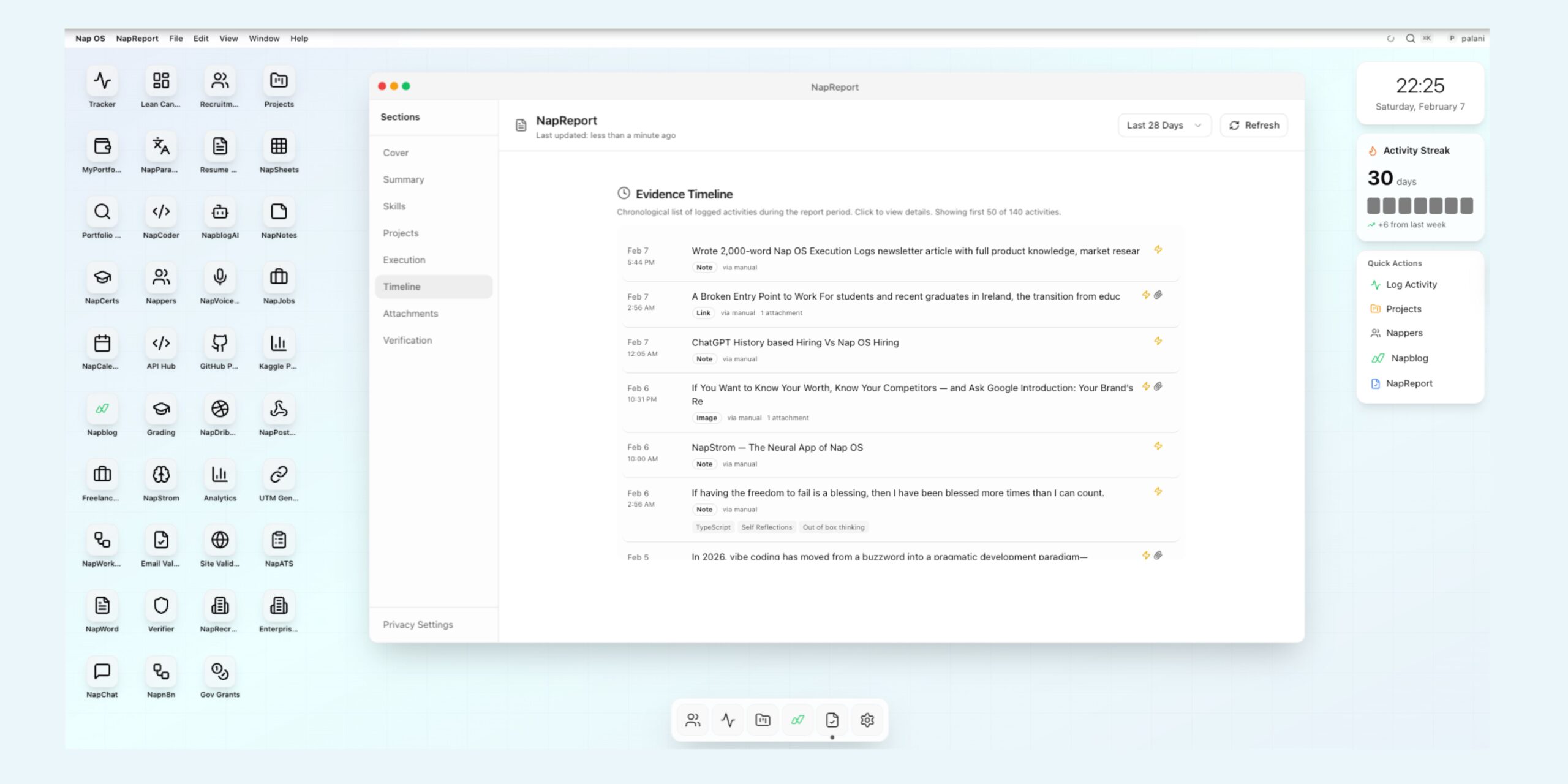
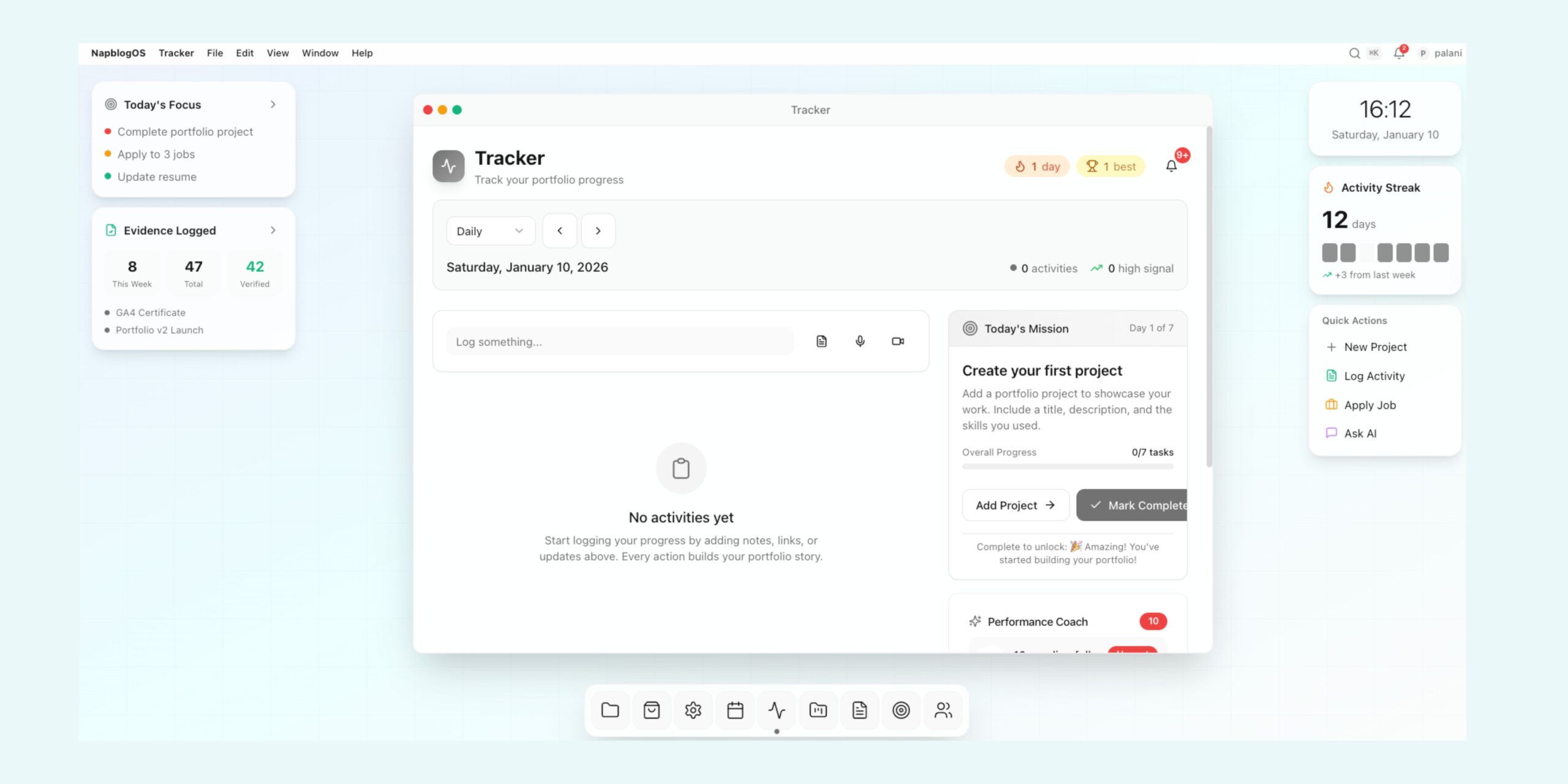
But as a Career Operating System that transforms scattered effort into verified, employer-ready signal.
This article explains the concrete outcomes Nap OS produces — and why students who start early create disproportionate advantages.
The Core Problem: The Portfolio Gap
Let’s define the issue precisely.
Most students operate in fragmentation:
- GitHub projects in one place
- Google Drive certificates in another
- Resume drafted manually
- LinkedIn disconnected from real work
- Internships not translated into quantified results
- Skills unverified
- No structured career narrative
From a hiring perspective, this creates low signal density.
Recruiters don’t have time to interpret potential.
They select for clarity, verification, and demonstrated execution.
Nap OS restructures this chaos into a verified, strategically aligned career system.
What Outcomes Does Nap OS Actually Produce?
Nap OS does not sell features.
It produces outcomes.
Across different student archetypes, the pattern is consistent:
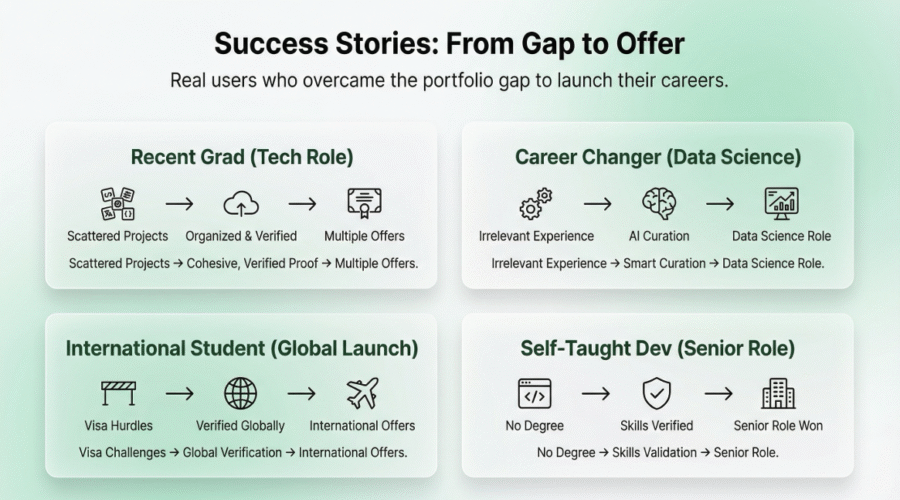
Disorganized effort → Structured proof → Verified skills → Offer velocity increase
Let’s break this down through real transformation pathways.
1. The Recent Graduate (Tech Role)
Before Nap OS:
- Multiple small projects
- No consistent documentation
- No quantified results
- Generic resume
- Low interview conversion rate
After Nap OS:
- Projects mapped to role-specific competencies
- Verified skill tagging
- Structured case-style documentation
- Quantified outcomes added
- Cohesive portfolio narrative
- AI-assisted alignment to job descriptions
Outcome:
- Higher recruiter response rate
- Stronger technical interviews
- Multiple offer positioning leverage
The shift isn’t about learning more.
It’s about proving better.
Nap OS turns:
Scattered Projects → Organized & Verified → Multiple Offers
Students stop saying “I worked on X.”
They start demonstrating “Here is measurable impact aligned to your stack.”
That changes interview dynamics immediately.
2. The Career Changer (Data Science / AI Path)
This is where Nap OS creates exponential leverage.
Career changers often have:
- Relevant adjacent skills
- Domain expertise
- Analytical capability
- But no formal signal in the new field
Traditional advice says:
“Take a course.”
“Get a certificate.”
“Build 2–3 projects.”
But this does not solve positioning.
Nap OS applies:
Irrelevant Experience → AI Curation → Targeted Role Transition
It does three structural things:
- Extracts transferable competencies
- Maps them against target role frameworks
- Builds validated portfolio proof
Instead of hiding past experience, Nap OS reframes it strategically.
For example:
- A finance analyst transitioning to data science
- A mechanical engineer pivoting into AI
- A marketing professional moving into product analytics
The system identifies:
- Data exposure
- Quantitative decision-making
- Process optimization
- Reporting automation
- Performance analysis
Then aligns it to:
- Python
- SQL
- ML workflows
- Business impact metrics
Outcome:
- Career transition timeline shortens
- Interview callbacks increase
- Salary compression reduces
This is not cosmetic resume editing.
It is structural skill repositioning.
3. International Students (Global Launch Strategy)
International students face a double burden:
- Visa restrictions
- Signaling friction
They often:
- Have strong academic credentials
- Have strong technical ability
- But lack globally verified proof
Nap OS creates:
Visa Challenges → Global Verification → International Offers
How?
Through:
- Structured project validation
- Competency mapping aligned to international role standards
- Portfolio standardization
- Employer-readable documentation
The outcome:
- Reduced ambiguity
- Higher confidence from recruiters
- Improved cross-border credibility
Employers don’t hire passports.
They hire demonstrated capability with minimal uncertainty.
Nap OS reduces uncertainty.
That is the differentiator.
4. The Self-Taught Developer (Senior Role Track)
This is a powerful use case.
Self-taught developers often:
- Have strong coding ability
- Real project exposure
- Freelance experience
- But lack degree validation
Nap OS creates:
No Degree → Skills Verified → Senior Role Positioning
Instead of relying on credentials,
the system emphasizes:
- Code quality proof
- Architectural thinking
- Project impact documentation
- Deployment records
- Measurable performance metrics
This elevates them from:
“Freelancer”
to
“Engineer with validated execution capability.”
Outcomes include:
- Senior interview eligibility
- Higher compensation bands
- Reduced bias from hiring filters
The USP of Nap OS: Structural Career Intelligence
Let’s define the unique value proposition clearly.
Nap OS is not:
- A course platform
- A resume builder
- A job board
- A certification provider
- A portfolio website template
It is a Career Intelligence Infrastructure.
Its differentiation lies in five pillars:
1. Structured Skill Mapping
Most students guess which skills matter.
Nap OS analyzes:
- Role requirements
- Industry trends
- Emerging competency frameworks
It then maps your current assets against target expectations.
You see:
- What you have
- What you lack
- What matters most
That clarity reduces wasted effort.
2. Verified Proof Layer
Anyone can list a skill.
Few can validate it.
Nap OS attaches evidence to skills:
- Project artifacts
- Quantified outcomes
- Technical stack usage
- Role relevance mapping
This increases credibility density.
Recruiters see proof, not claims.
3. Narrative Alignment Engine
Careers are stories.
Most students tell fragmented ones.
Nap OS builds:
- Cohesive career arcs
- Consistent positioning
- Role-aligned messaging
- Strategic differentiation
Your LinkedIn, resume, and portfolio stop contradicting each other.
They reinforce each other.
4. AI-Powered Role Curation
Instead of random applications,
Nap OS curates intelligently aligned opportunities.
It analyzes:
- Your verified strengths
- Market demand signals
- Competitive positioning
Then suggests:
- Strategic applications
- Gap-bridging projects
- Positioning adjustments
This increases application efficiency.
5. Long-Term Career Operating System
Nap OS is not just for your first job.
It tracks:
- Skill evolution
- Industry movement
- Leadership readiness
- Seniority positioning
Students who start early build compound advantage.
Why Starting Early Matters
The biggest advantage Nap OS offers students is timing.
If you start in:
Year 1:
You build with intention.
Projects are no longer random.
Internships are chosen strategically.
Skills are layered progressively.
By graduation, you don’t scramble.
You launch.
Year 2–3:
You reorganize chaos into coherence.
You correct trajectory early.
You reduce post-graduation panic.
Final Year:
You compress transition risk.
You improve offer velocity.
You negotiate from strength.
Quantifiable Outcome Improvements
Students using structured systems typically see:
- Higher interview conversion rates
- Faster response cycles
- Reduced ghosting
- Improved confidence in interviews
- Clearer compensation discussions
- Increased role alignment accuracy
The psychological shift is equally powerful.
From:
“I hope they like my profile.”
To:
“I can demonstrate why I fit.”
That confidence changes performance.
Nap OS in the Age of AI Disruption
AI is automating:
- Junior coding tasks
- Basic analytics
- Entry-level content production
- Repetitive workflows
The future favors:
- Verified capability
- Systems thinking
- Adaptability
- Strategic skill stacking
Nap OS trains students to think in systems.
Not just tasks.
Not just certificates.
But capability architecture.
This is essential for:
- Surviving AI compression
- Accelerating into leadership
- Building defensible careers
Leadership Acceleration Path
Most students wait 5–7 years before thinking about leadership.
Nap OS integrates leadership tracking early:
- Ownership metrics
- Project initiative
- Cross-functional collaboration
- Strategic thinking signals
By the time peers begin considering leadership,
Nap OS users have already documented proof.
That compounds dramatically.
The Strategic Advantage of Verified Proof
In a saturated market, verification beats volume.
You do not need:
- 20 certificates
- 15 random projects
- 200 applications
You need:
- 5 strategically aligned, verified case proofs
- Clear narrative
- Skill validation
- Targeted applications
Nap OS optimizes for precision, not noise.
The Competitive Edge
When two candidates apply:
Candidate A:
- Lists skills
- Generic resume
- Standard portfolio
Candidate B (Nap OS user):
- Verified skill mapping
- Structured case documentation
- Role-aligned positioning
- Quantified impact
- Cohesive narrative
Recruiters choose clarity.
Nap OS produces clarity.
Career as Infrastructure
Most students treat career like an event.
Nap OS treats career like infrastructure.
Infrastructure compounds.
The earlier you build it, the stronger it becomes.
What Happens If You Delay?
Delaying structured career development leads to:
- Random skill accumulation
- Panic applications
- Low conversion rates
- Salary compromise
- Direction drift
Students who wait until graduation often feel urgency.
Urgency reduces strategic thinking.
Nap OS removes urgency through preparation.
The Compound Effect
Year 1 user:
- Strategic projects
- Clear skill roadmap
- Internships aligned
- Verified proof at graduation
Year 4 non-user:
- Scrambling to organize
- Rewriting resume
- Reframing scattered work
Four years of structure vs. four weeks of panic.
The outcome gap is enormous.
The Real USP: Control
Nap OS gives students control.
Control over:
- Skill trajectory
- Market positioning
- Application strategy
- Leadership development
- Career narrative
In a volatile job market, control is power.
Final Message to Students
If you are serious about:
- Breaking into tech
- Transitioning into AI
- Launching globally
- Accelerating into leadership
- Avoiding entry-level stagnation
You cannot rely on:
- Hope
- Generic advice
- Random applications
You need infrastructure.
Nap OS is that infrastructure.
It transforms:
Effort → Evidence
Skill → Signal
Potential → Proof
Application → Offer
The earlier you start, the stronger your compound advantage becomes.
The market is not slowing down.
AI is not waiting.
Competition is increasing.
Students who build structured, verified, strategically aligned portfolios now will dominate the next hiring cycle.
The question is not:
“Should I use Nap OS?”
The real question is:
“How many cycles of opportunity are you willing to miss before you build your career system properly?”
Start early.
Build intelligently.
Launch strategically.
Nap OS is not a tool.
It is your career operating system.
Closing the portfolio gap is one of the most impactful steps job seekers can take to stand out in competitive markets. See real success stories and career tips on LinkedIn.