5 min read
For decades, hiring systems were designed around a document — the resume.
A compressed narrative of education, past affiliations, and curated experiences intended to signal capability. This model worked in a slower, more predictable economy where knowledge was scarce, career paths were linear, and institutional credentials served as proxies for competence.
That world no longer exists.
We now operate in an environment defined by:
- AI-accelerated execution
- Rapid skill obsolescence
- Cross-disciplinary problem solving
- Remote and global collaboration
- Outcome-driven value creation
In this environment, a resume is not evidence of capability.
It is a story.
Sometimes accurate. Often inflated. Always incomplete.
Nap OS proposes a different paradigm — one grounded in execution reality:
Hiring should be based on executable skill signals and evidential proof of capability, not narrative claims of experience.
This article outlines why resume-centric hiring is failing, what executable and evidential skill systems look like, and how Nap OS is architected to power the transition toward this new standard.
The Structural Failure of Resume-Based Hiring
Traditional resumes rely on proxies:
- Degrees
- Brand-name employers
- Job titles
- Years of experience
These proxies attempt to answer a single question:
“Can this person deliver value?”
But proxies introduce distortion.
Problem 1 — Signal Dilution
Degrees signal exposure to knowledge — not ability to execute.
Job titles signal organizational hierarchy — not individual contribution.
Experience signals time spent — not outcomes produced.
These indicators were never designed to measure real execution.
Problem 2 — Narrative Optimization
Resumes are optimized documents.
They are:
- Edited
- Framed
- Inflated
- Strategically written
This incentivizes storytelling rather than performance transparency.
Hiring becomes a competition of presentation — not capability.
Problem 3 — Slow Verification Loops
Organizations often discover capability gaps after hiring, leading to:
- Mis-hires
- Productivity loss
- Team disruption
- Increased training cost
Industry data consistently shows that poor hiring decisions are among the most expensive operational inefficiencies.
Problem 4 — Exclusion of Non-Traditional Talent
Resume systems structurally exclude:
- Self-taught builders
- Career switchers
- Global independent contributors
- High-agency learners
Talent that produces outcomes without institutional endorsement remains invisible.
This creates artificial scarcity while capability exists abundantly.
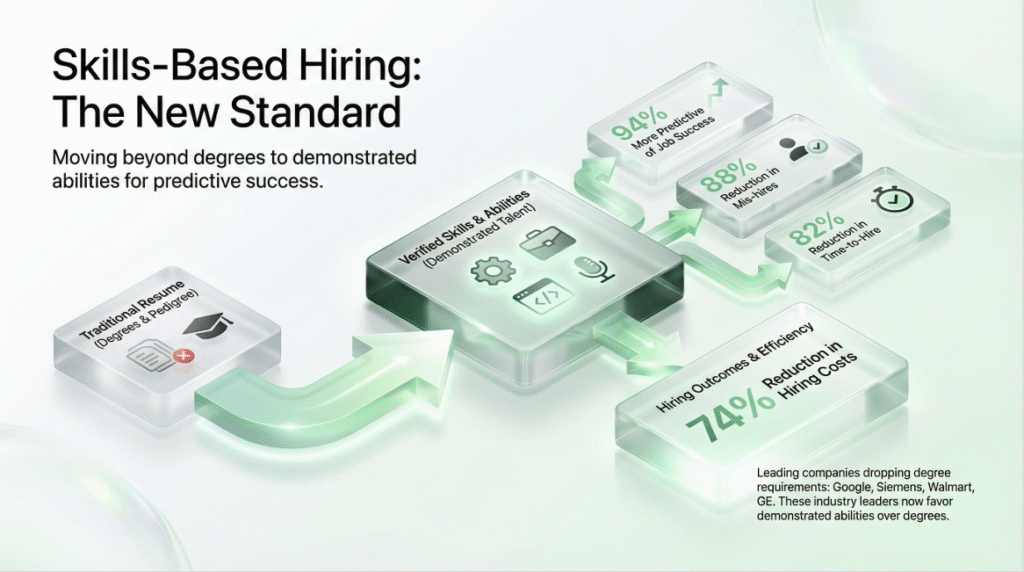
The Shift Toward Skills-Based Hiring
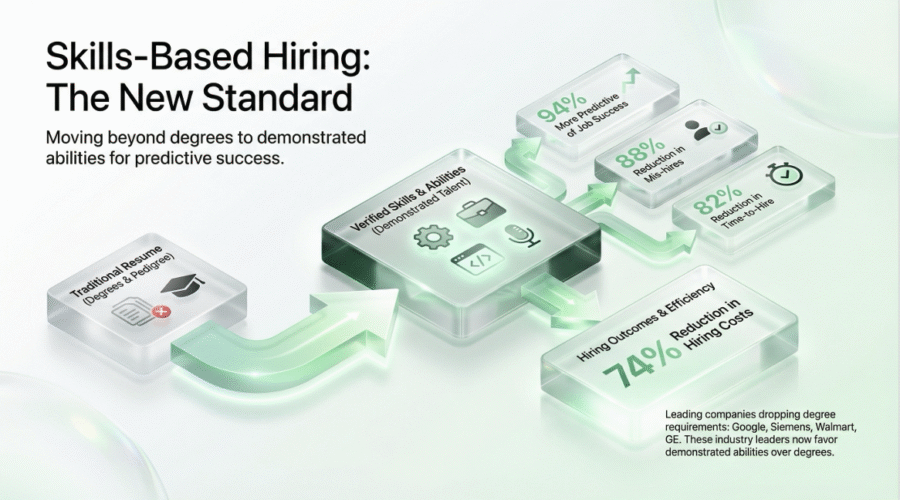
Forward-looking organizations are recognizing that demonstrated ability predicts job success far better than credentials alone.
This shift prioritizes:
- Verified capability
- Applied knowledge
- Measurable execution
- Practical outcomes
Instead of asking:
“Where did you learn?”
The new system asks:
“What can you deliver today?”
But skills-based hiring itself is evolving — and not all implementations are equal.
Many organizations still rely on:
- Self-declared skill lists
- Keyword matching
- Static assessments
These remain surface-level indicators.
Nap OS pushes beyond this toward Executable + Evidential Skills Architecture.
The Nap OS Model
Executable Skills + Evidential Proof
Nap OS introduces a two-layer validation structure:
1️⃣ Executable Skills
Capabilities demonstrated through real task execution within dynamic environments.
Not theory.
Not simulation.
Not self-reporting.
Execution includes:
- Solving real problems
- Producing usable outputs
- Operating under constraints
- Collaborating within workflows
Execution reveals:
- Decision quality
- Adaptability
- Initiative
- Technical depth
- Communication behavior
Execution cannot be faked over time.
2️⃣ Evidential Skills
Persistent, verifiable artifacts proving capability.
Evidence includes:
- Project outputs
- Iteration logs
- Decision trails
- Collaboration footprints
- Version histories
- Outcome metrics
Evidence answers:
- What was built
- How it evolved
- What impact it created
This transforms hiring signals from claims into observable reality.
Why This Matters in the AI Era
Artificial intelligence is flattening entry-level structures and automating foundational tasks. This reduces traditional training pathways and compresses the timeline between entry and impact.
Organizations now require contributors who can:
- Integrate tools quickly
- Execute independently
- Solve undefined problems
- Create leverage
Resumes cannot measure these abilities.
Executable evidence can.
Nap OS aligns workforce evaluation with the realities of AI-augmented work.
Nap OS as an Execution Intelligence Layer
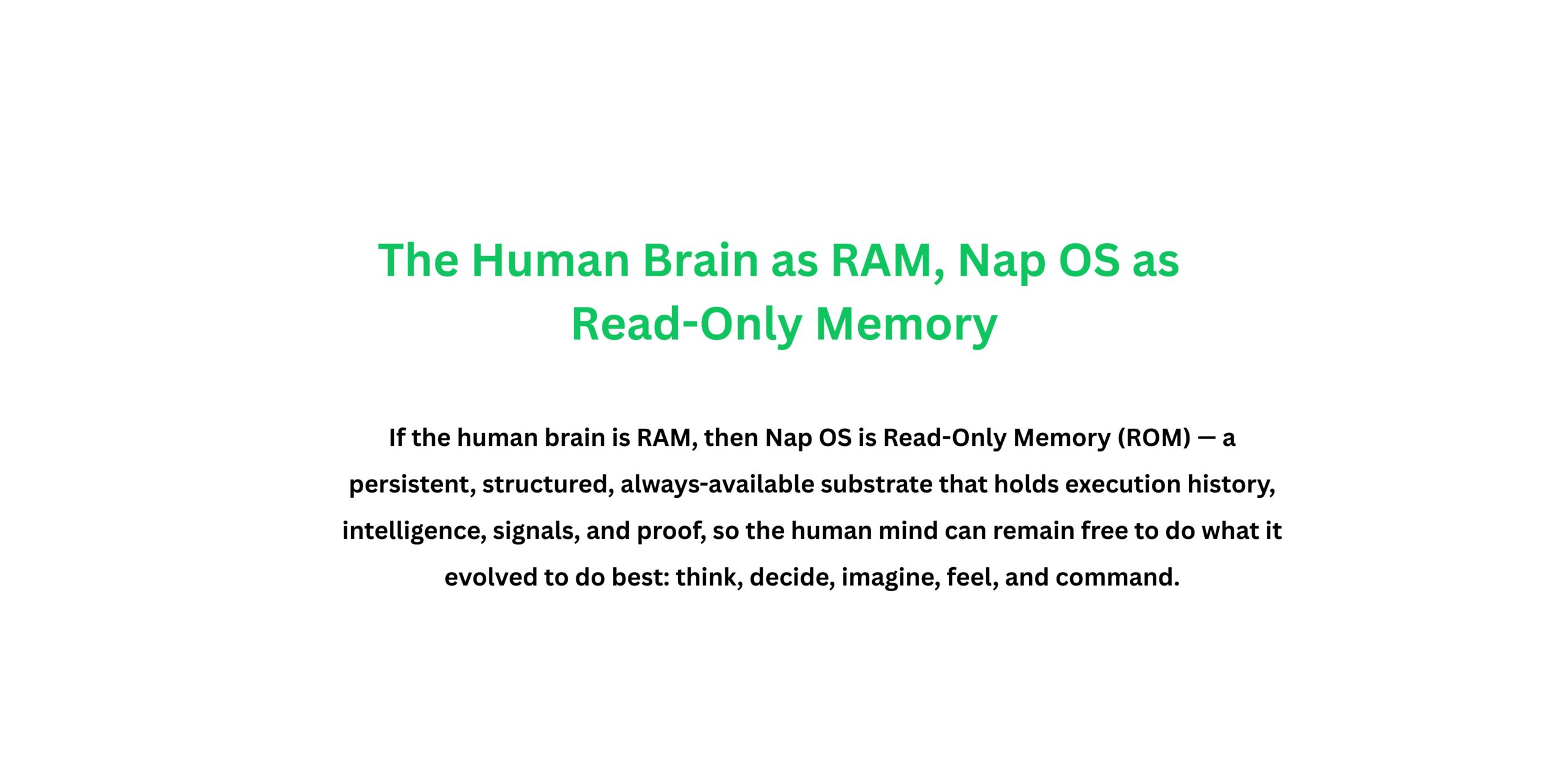
Nap OS is not merely a portfolio repository.
It is an execution environment that captures:
- Behavioral signals
- Learning patterns
- Iteration dynamics
- Outcome reliability
As users operate within Nap OS, the system builds:
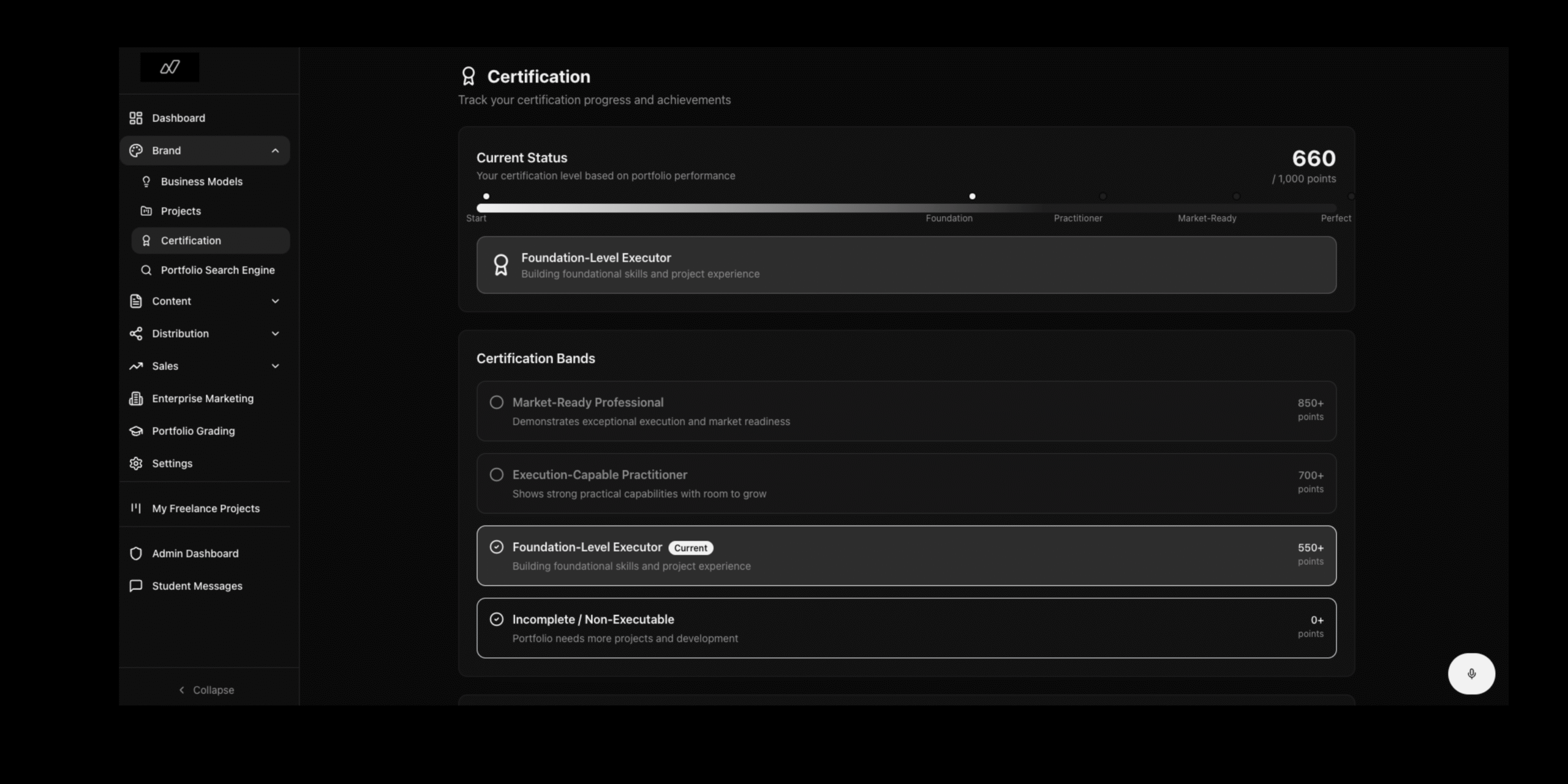
Dynamic Skill Graphs
Mapping evolving competencies rather than static labels.
Execution Reputation Scores
Reflecting consistency of delivery and improvement.
Capability Trajectories
Showing growth direction rather than past snapshots.
Contextual Skill Validation
Skills proven in real scenarios rather than abstract testing.
Benefits for Talent
Agency Over Narrative
Individuals demonstrate capability directly.
No dependency on institutional validation.
Faster Opportunity Access
Evidence accelerates trust formation.
Less gatekeeping
Less filtering friction
Continuous Skill Recognition
Growth captured in real time.
Not frozen in resume updates.
Reduced Credential Dependency
Value defined by execution — not pedigree.
Benefits for Organizations
Higher Predictive Hiring Accuracy
Real execution predicts performance better than resumes.
Reduced Mis-Hire Rates
Observable capability minimizes guesswork.
Faster Time-to-Hire
Evidence shortens evaluation cycles.
Lower Hiring Costs
Improved signal clarity reduces recruitment overhead.
Access to Global Talent Pools
Discovery based on capability rather than background filters.
The Cultural Transformation
Transitioning away from resumes requires cultural evolution.
Organizations must shift:
| From | To |
|---|---|
| Credential Trust | Capability Trust |
| Narrative Evaluation | Evidence Evaluation |
| Static Screening | Dynamic Observation |
| Institutional Bias | Execution Meritocracy |
This is not merely a technical change.
It is philosophical.
It reframes how value is perceived and validated.
The Long-Term Implications
Education Evolution
Learning pathways will prioritize applied execution over memorization.
Career Fluidity
Professionals transition across domains based on capability proof.
Decentralized Opportunity Networks
Matching occurs through skill signals rather than application funnels.
Continuous Verification Economies
Workforce capability becomes transparently observable.
Nap OS and the Emergence of Career Operating Systems
Nap OS positions itself within a broader transformation:
From job-seeking
to capability signaling
to execution ecosystems.
It functions as:
- A learning surface
- An execution layer
- A validation engine
- A talent discovery infrastructure
This redefines:
Career identity
Professional credibility
Opportunity access
All anchored in execution reality.
Conclusion
The resume represented an era where information scarcity required narrative compression.
That era has ended.
In a world defined by AI acceleration and execution speed, hiring systems must evolve toward verifiable capability signals.
Executable and evidential skill architectures represent the logical progression.
Nap OS is designed to operationalize this future — transforming hiring from interpretation of stories into observation of reality.
This is not an incremental improvement.
It is a structural shift in how human potential is recognized, trusted, and mobilized.
And once capability becomes observable, measurable, and persistent —
The resume becomes not obsolete,
but secondary.
Because execution is the ultimate credential.