Last updated: February 16, 2026
6 min read
At Napblog Limited, we spend a significant amount of time studying the infrastructure that governs how talent meets opportunity. Not the surface layer — resumes, portfolios, job posts — but the systems beneath them.
The pipelines. The filters. The invisible architecture that determines whose potential is seen and whose is discarded.
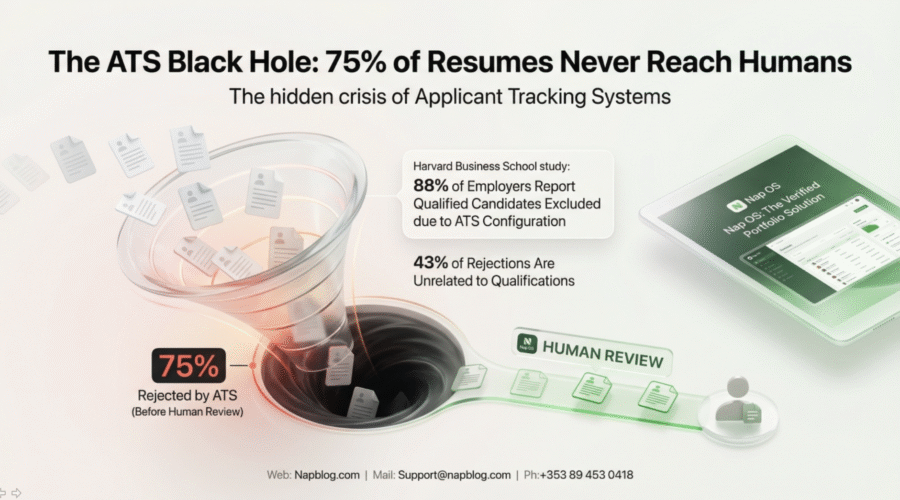
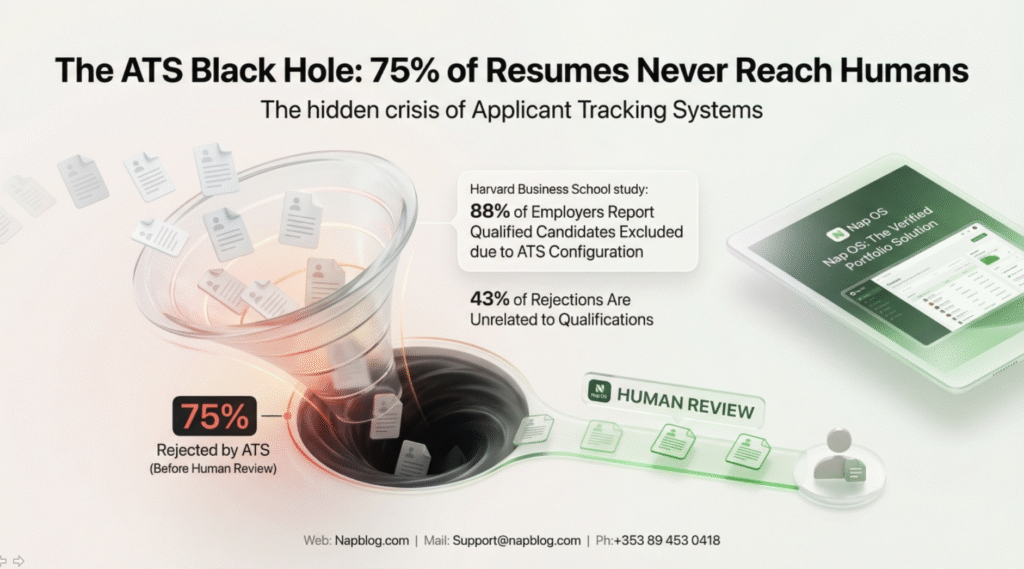
One of the most alarming realities we observe today is the widening gap between qualified candidates and meaningful human evaluation. Industry research consistently indicates that a large majority of resumes — often cited near three-quarters — never reach human review due to automated filtering mechanisms.
Additional findings suggest that many employers report qualified candidates being excluded based purely on configuration settings, while a substantial portion of rejections bear little relationship to actual capability.
This is not simply inefficiency.
It represents a systemic mismatch between how students develop skills and how organizations detect them. It reveals a hiring ecosystem that optimizes for processing volume rather than recognizing competence.
And it highlights why Napblog Limited believes incremental improvements to resumes or applicant tracking workflows will not solve the deeper issue.
The system itself must evolve.
Nap OS is our response to that evolution — a platform designed not around application submission, but around verified capability signaling and transparent career evidence.
This article presents Napblog Limited’s perspective on the structural hiring gap, the consequences for students and recruiters, and the solution–market fit that positions Nap OS as a next-generation bridge between both sides of the market.
The ATS Black Hole — Understanding the Structural Bottleneck
Applicant tracking systems were originally introduced to solve a legitimate problem: scale.
Organizations needed tools capable of handling thousands of applications, maintaining compliance records, and streamlining recruiter workflows. Automation became essential. Filtering became necessary. Keyword scanning, ranking models, and rule-based exclusion systems emerged as default practices.
Over time, however, these systems evolved to prioritize operational efficiency over discovery of talent. The consequence is a pipeline that often measures formatting alignment more effectively than skill execution.
Symptoms of the Bottleneck
From Napblog’s research and market observation, we identify several recurring symptoms:
- Strong candidates filtered out before human evaluation
- Overemphasis on keyword matching rather than capability
- Rejection signals detached from real qualifications
- Students optimizing documents instead of developing skills
- Recruiters drowning in data but lacking clarity
This produces a paradoxical outcome:
Students feel invisible.
Recruiters feel overwhelmed.
Both are reacting to the same systemic inefficiency.
Impact on Students — The Illusion of Meritocracy
Students today operate under an implicit promise:
Work hard, build skills, prepare thoroughly — and opportunity will follow.
But their experience frequently contradicts this narrative.
They submit dozens, sometimes hundreds, of applications with minimal feedback, little visibility, and no understanding of how they are evaluated. They adapt resumes repeatedly, learning optimization tactics rather than cultivating deeper competence.
This environment generates several behavioral distortions:
Psychological Effects
- Reduced confidence in genuine ability
- Increased dependence on resume manipulation strategies
- Frustration and disengagement
- Perception of randomness in opportunity access
Developmental Effects
- Focus on formatting over substance
- Portfolio construction without validation
- Skill accumulation without measurable signaling
- Fragmented career narratives across platforms
Students are not failing the system.
The system is failing to detect them.
Napblog’s expertise suggests that the current model treats students as applicants when they should be treated as evolving capability graphs — dynamic entities producing measurable work outputs that should be continuously observable.
Impact on Recruiters — Signal Collapse in High-Volume Hiring
Recruiters face the mirror image of this problem.
They operate under time constraints, throughput expectations, and compliance requirements. Automation becomes indispensable. Yet reliance on filtering technologies introduces risk: the exclusion of candidates who may have delivered exceptional value if discovered.
This results in several challenges:
Information Saturation
Recruiters receive massive applicant volumes but limited interpretive clarity.
Signal Degradation
Resumes increasingly resemble each other due to optimization trends, reducing differentiation.
Opportunity Cost
Potentially high-performing candidates are removed from consideration before engagement.
Trust Erosion
Confidence in applicant authenticity and resume accuracy declines.
Recruiters are not seeking more resumes.
They are seeking more trustworthy signals.
Napblog’s perspective recognizes that recruiter productivity will not be improved through higher filtering sophistication alone. Instead, candidate signaling must evolve to deliver evidence-rich identity representations prior to application entry.
Market Misalignment — Where Students and Recruiters Miss Each Other
The hiring ecosystem suffers from a fundamental misalignment:
| Students Optimize For | Recruiters Need |
|---|---|
| Resume attractiveness | Capability clarity |
| Keyword inclusion | Evidence validation |
| Application quantity | Candidate relevance |
| Portfolio aesthetics | Outcome metrics |
| Visibility | Trust |
Traditional tools attempt to close this gap from the recruiter side through better filtering or scoring.
Napblog approaches it from the candidate signaling side — redesigning how capability is presented before entering the hiring pipeline.
This shift in perspective is the foundation of Nap OS.
Nap OS — Solution–Market Fit Positioning
Nap OS is designed around a core premise:
If the hiring pipeline filters narratives, candidates must signal verifiable reality.
Rather than competing within resume optimization paradigms, Nap OS redefines the structure of professional identity presentation.
Verified Portfolio Infrastructure
Nap OS enables users to build portfolios directly connected to execution data — analytics metrics, project activity, and measurable outcomes.
This transforms representation from self-description to evidence-linked signaling.
Continuous Capability Logging
Instead of episodic resume updates, Nap OS captures ongoing work behaviors, creating longitudinal performance patterns visible to evaluators.
AI-Guided Development
The platform’s intelligence layer guides students based on observed execution data rather than generic career advice, aligning growth with measurable improvement.
Recruitment Pipeline Integration
For recruiters, Nap OS delivers structured visibility into candidate outputs and behavioral consistency — improving evaluation confidence before formal hiring stages begin.
These features align precisely with the unmet needs observed across both sides of the market.
Why Nap OS Fits the Student Market
Students require:
- Visibility
- Differentiation
- Direction
- Credibility
Nap OS addresses these by offering:
- Evidence-based portfolios
- Real-time performance feedback
- Structured development pathways
- Verifiable capability signaling
It shifts their focus from application volume toward capability clarity — improving not only hiring outcomes but learning behaviors themselves.
Why Nap OS Fits the Recruiter Market
Recruiters require:
- Trustworthy signals
- Reduced evaluation ambiguity
- Faster candidate understanding
- Higher pipeline confidence
Nap OS provides:
- Outcome-linked candidate profiles
- Reduced dependence on resume interpretation
- Transparent activity evidence
- Higher signal density prior to engagement
This reduces discovery friction while improving decision confidence.
Strategic Timing — Why the Market Is Ready
Several macro conditions reinforce solution–market alignment:
AI Amplification
Content creation ease increases representation noise.
Verification demand rises.
Remote Hiring Expansion
Physical evaluation absence increases signal reliance.
Skills-Based Hiring Growth
Competence demonstration overtakes credential reliance.
Data-Native Generations
Students increasingly produce digital activity exhaust usable for evaluation.
Nap OS leverages these conditions rather than resisting them.
Napblog Limited’s Long-Term Vision
Our perspective extends beyond platform deployment.
We envision a hiring ecosystem where:
- Capability evidence precedes application
- Trust is embedded structurally
- Students develop through measurable feedback
- Recruiters discover through signal clarity
- ATS systems process verified identity objects rather than static documents
Nap OS represents an initial architectural step toward that future.
Conclusion — From Filtering Narratives to Discovering Capability
The ATS black hole is not merely a technological inconvenience.
It is a manifestation of outdated identity signaling models colliding with modern hiring scale.
Students are rendered invisible.
Recruiters are rendered uncertain.
Napblog Limited believes meaningful progress will not come from refining resumes or tuning filters.
It will come from redefining how capability enters the pipeline altogether.
Nap OS embodies this redefinition — shifting professional identity from narrative construction toward evidence-driven representation and aligning the needs of students and recruiters through shared signal clarity.
The objective is not to replace hiring systems.
It is to feed them better truth.
And in doing so, restore visibility, efficiency, and trust to the connection between human potential and organizational opportunity.
Escaping the ATS black hole requires a shift toward transparent hiring and verified skill-based assessments. Connect with innovative recruitment solutions on LinkedIn.