Napblog

Blog

Blog

NapblogOS launch Napblog Logo
Blog

NapblogOS™: Set to launch: Operating System for Execution-First Marketing Incubation

When people ask me, “What is Napblog building next?”My honest answer has always been: We are not building next — we are finishing something that should have existed long ago. NapblogOS™ is not a product that suddenly appeared.It is the outcome of years spent inside classrooms, co-working floors, internships, accelerators, failed campaigns, real client work, institutional partnerships, and uncomfortable conversations about employability, outcomes, and accountability. This article is not a sales announcement.It is a founder’s note — a natural conversation with universities, educators, administrators, policymakers, students, and industry partners — explaining why NapblogOS™ exists, what it replaces, and what it makes possible. We are preparing to launch NapblogOS™ soon.Expressions of interest are welcome — not because we want scale at any cost, but because we want alignment. The Problem We Could No Longer Ignore For over a decade, marketing education has grown louder — but not necessarily stronger. Yet, the same unresolved questions remain: At Napblog, we saw this from the inside. We worked with 17-year-olds skipping university, final-year students panicking about placements, mid-career professionals restarting from zero, and institutions under pressure to justify outcomes to accreditors and funders. The issue was not intelligence.The issue was lack of system. Marketing education was human-heavy but structure-light.Outcome claims were strong, but evidence trails were weak. That gap is where NapblogOS™ was born. What NapblogOS™ Actually Is NapblogOS™ is an Enterprise Marketing Incubator Operating System. Not a course.Not a SaaS tool for individuals.Not a mentor marketplace. It is a licensed, installable system that universities and incubation centres run internally, with full operational control. Institutions do not “send” students to Napblog.They operate NapblogOS™ themselves. NapblogOS™ provides: All without dependency on external mentors or consultants. This distinction matters. Installed, Not Outsourced NapblogOS™ is installed inside the institution’s ecosystem. We intentionally designed NapblogOS™ to avoid the fragile model of “external experts flying in and out.” People leave.Systems remain. NapblogOS™ is designed to outlive individuals. Seat-Based Licensing: Designed for Institutions, Not Individuals NapblogOS™ operates on a seat-based licensing model. Universities allocate seats across: Seats can be configured as: This flexibility allows institutions to scale without overloading faculty or compromising standards. One system.Multiple deployment modes. Self-Paced vs Mentored-Paced: Structure First, Humans Second Self-Paced Execution Designed for large cohorts. Mentored-Paced Execution Designed for depth and guidance. This is important: Mentors guide — they do not decide outcomes. NapblogOS™ removes subjectivity from certification. Portfolio Before Credentials One of NapblogOS™’s core beliefs is simple: Credentials without portfolios are promises.Portfolios without execution proof are opinions. NapblogOS™ enforces portfolio-first learning. Every learner produces: No simulated fluff.No vague “participation” certificates. System-Driven Portfolio Evaluation NapblogOS™ autonomously evaluates final portfolios using standardised execution criteria. Certification decisions are: This is similar in rigor to global industry certifications, not classroom grading. Faculty do not need to defend decisions.Students cannot negotiate outcomes. The system speaks. Institutional Analytics That Actually Matter NapblogOS™ provides institutional dashboards that track: These are not vanity dashboards. They exist for: For the first time, institutions can show defensible evidence of execution, not just attendance. Core Values That Are Engineered, Not Branded NapblogOS™ is built on six non-negotiable values: These are not posters.They are enforced through system logic. Why Universities Are Central — Not Startups NapblogOS™ is not chasing individuals. We are working with institutions because: When universities adopt NapblogOS™, they are not buying software. They are changing how marketing capability is built, measured, and trusted. Global Proof, Quietly Built Napblog’s ecosystem has already impacted 20+ countries and 100+ aspiring marketers, across: The testimonials you see are not marketing scripts.They are evidence of what happens when structure meets opportunity. From frontend developers to marketing executives, from interns to founders — the common thread is execution confidence. NapblogOS™ and the Black Logo The launch of NapblogOS™ aligns with Napblog’s Black Logo for a reason. Black is not about aesthetics.It represents: Napblog is no longer experimenting.We are institutionalising what works. Who NapblogOS™ Is For NapblogOS™ is designed for: It is not for: A Note on Timing We are not rushing this launch. NapblogOS™ will be released when: This is why we are opening expressions of interest, not aggressive sales funnels. An Invitation, Not a Pitch If you are a university leader, educator, or ecosystem builder reading this: Start with a conversation. Just clarity. NapblogOS™ exists to bring structure, fairness, and execution truth into marketing incubation. If that resonates, we should talk. NapblogOS™Enterprise Marketing Incubator Operating System Pugazheanthi PalaniFounder & CEO, NapblogThe Only Marketing Incubator Company Expressions of interest are now open.Get in touch with Sales.

Yes, Boxing x Napblog -> Marketing Jabs - Pugazheanthi Palani
Blog

Yes, Boxing x Napblog -> Marketing Jabs

Introduction: When Aggression Has No Language, It Finds Noise Every founder carries aggression. Not the loud, cinematic kind—but the quiet accumulation of pressure: unanswered questions, doubters’ voices, internal negotiations, and the constant expectation to perform clarity while living in ambiguity. For years, I expressed that aggression through work—long hours, relentless iteration, intellectual debates, and strategy decks. Marketing became both my outlet and my shield. But over time, I realized something uncomfortable: intellectualization alone does not discharge aggression. It merely disguises it. That realization led me to boxing. Not as a hobby. Not as fitness content. But as a discipline—a structured way to understand aggression, absorb doubt, and convert raw emotional energy into precise, repeatable actions. This is not an article about sport.This is an article about control.About jabs—in boxing and in marketing. Why Boxing, and Why Now? Founders are trained to think, not to feel. We analyze markets, competitors, funnels, and positioning. But we are rarely trained to process emotional impact: rejection emails, slow traction, skepticism from peers, or worse—self-doubt. Boxing does not allow abstraction. You cannot overthink a jab.You cannot philosophize your way out of a punch.You must be present, grounded, and decisive. That immediacy was missing in my daily work rhythm. Boxing introduced three constraints into my life: Marketing, at its core, operates under the same constraints. Aggression Is Not the Enemy—Unchanneled Aggression Is In entrepreneurship, aggression is often misinterpreted as arrogance or impatience. In reality, it is unprocessed intent. Aggression emerges when: Most founders suppress aggression to appear “professional.” I did the same. Boxing reframed that instinct. Aggression, when structured, becomes velocity.When timed, it becomes impact.When disciplined, it becomes strategy. A wild punch wastes energy.A clean jab creates space. Marketing is no different. The Jab Philosophy: Why Napblog Thinks in Jabs, Not Knockouts Early-stage founders often chase knockouts: viral campaigns, breakthrough launches, sudden traction. Boxing teaches a humbling truth—most fights are won by jabs, not knockouts. A jab is: In marketing terms, a jab is: At Napblog, we do not obsess over virality. We obsess over rhythm. Every jab answers a question: Boxing trained my patience to respect accumulation. Doubters Are Part of the Ring, Not the Obstacle Every founder meets doubters: Earlier, I treated doubt as friction. Boxing reframed it as resistance training. In the ring, resistance is expected. You train for it. You do not resent it. Doubters sharpen positioning.They expose weak footwork.They reveal unclear messaging. The mistake founders make is reacting emotionally instead of technically. A boxer does not argue with an opponent.They adjust stance. Marketing demands the same maturity. Self-Questioning: The Most Relentless Opponent External doubt is manageable. Internal doubt is relentless. Boxing made one truth unavoidable: the opponent you face is not across the ring—it is inside the hesitation before action. Questions like: In boxing, hesitation gets punished. In business, it gets disguised as perfectionism. Training forced decisiveness. Marketing leadership requires the same: Clarity follows action, not contemplation. Managing Aggression in Marketing Leadership As Napblog evolved—from coworking to incubation, from local to global—my role shifted from executor to signal-setter. Aggression at this level cannot be visible chaos. It must become calm intensity. Boxing taught me: In marketing leadership: The ring does not reward theatrics. Neither does the market. Boxing as a Framework for Decision-Making I now evaluate marketing decisions using boxing logic: This framework reduces emotional bias. When feedback is negative, I ask: This shifts response from reaction to refinement. Why Napblog Embraces This Philosophy Napblog was never designed to be a loud agency. It was designed to be a disciplined ecosystem. We work with: Boxing aligns with our core belief: Marketing is not persuasion—it is calibrated communication. We train marketers the way boxers train: That is why Napblog does not sell shortcuts. We sell structure. Aggression, Rewritten as Creative Force The most surprising outcome of boxing was not physical strength. It was emotional clarity. Aggression stopped leaking into impatience.Doubt stopped masquerading as analysis.Energy found direction. Creativity improved—not because I tried harder, but because resistance had an outlet. Marketing ideas now arrive like jabs: Not all land. But each teaches something. Closing: Every Founder Needs a Ring You do not need to box.But you need a ring. A space where: For me, boxing became that space. It taught me that aggression is not something to eliminate—it is something to educate. At Napblog, we will continue to build marketing ecosystems that value: Because in both boxing and marketing, the goal is the same: Stay standing. Stay learning. Keep jabbing.

Blog

Perplexity SERP Reality Check – Napblog Competitor Analysis

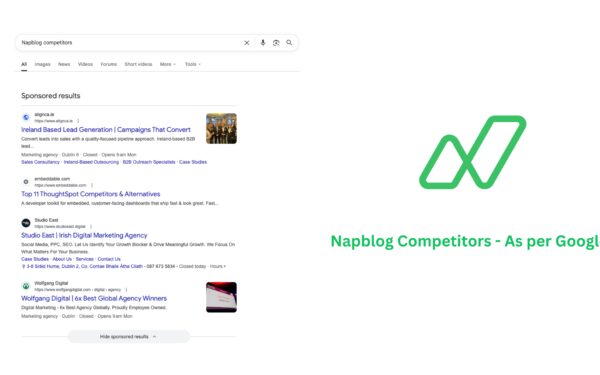
Napblog Competitor Analysis A client discussion, not a pitch Client:“I searched napblog competitors on Google and Perplexity. I saw Marmind, Aprimo, Allocadia, Maropost, even ON24. Are these your competitors? And more importantly—are you actually doing AI-driven market research, or are you just reacting to search results?” Napblog:“That question tells me two important things.One—you are paying attention to the SERP as a market signal.Two—you want to know whether Napblog understands the AI reality of modern market research, not just marketing theory. Let’s walk through this slowly, transparently, and practically—because this exact process is what we replicate for our clients.” Company How it competes with Napblog Evidence source Marmind Marketing planning / budget SaaS in the same functional cluster.napblog​ Napblog blog on competitor intelligence.napblog​ Aprimo Enterprise marketing operations and planning platform, cited alongside Napblog’s category.napblog​ Napblog blog mentioning key SaaS competitors.napblog​ Allocadia Marketing performance management and budgeting, named as a comparable tool.napblog​ Napblog competitor-intel article.napblog​ Maropost Commerce + marketing platform bidding on “napblog” search traffic.napblog​ Napblog article on new competitors to the show.napblog​ Norstat Research/data company bidding on “napblog” queries to reach similar buyers.napblog​ Same Napblog article on new competitors.napblog​ Upfluence Influencer marketing platform buying “napblog” as a keyword.napblog​ Napblog write‑up on search competitors.napblog​ KolSquare Influencer/creator platform whose ads appear on “napblog competitors.”napblog​ Napblog piece on Google not knowing its competitors.napblog​ Apollo.io Sales/lead platform also advertising on “napblog competitors.”napblog​ Same Napblog blog post about competitor ads.napblog​ ON24 Event/experience platform some in SF treat as a Napblog competitor.linkedin​ Public LinkedIn post referencing that comparison.linkedin​ Step 1: Understanding what SERPs actually represent in 2025 Napblog:“First, we need to reset expectations. Search engines—and now AI answer engines like Perplexity—do not define competitors the way strategy teams do. SERPs show three things simultaneously: Most companies confuse all three. Napblog does not.” When Perplexity answers “napblog competitors”, it is not issuing a legal or strategic classification. It is summarising signals: This distinction is critical—and it is where most founders misread AI outputs. Step 2: Napblog’s own published competitor logic (why this matters) Client:“But Perplexity literally says Napblog’s own team has published how they think about competitors.” Napblog:“Correct—and that’s intentional. Napblog does not hide competitor intelligence. We publish it because: This is not negligence. This is controlled transparency.” Napblog has consistently framed competitors in roles, not labels. That’s why your table matters. Let’s break it down the way we do internally—and the way we would do it for you. Step 3: Direct SaaS competitors vs indirect bidders (clear separation) 1. Direct functional SaaS overlap These are companies that overlap with specific capabilities, not with Napblog’s full model. Napblog:“These tools live in adjacent functional clusters. They solve slices of the marketing planning problem. Napblog is not a feature-by-feature replacement for them. Napblog is a marketing incubator + execution ecosystem that can integrate, replace, or bypass such tools depending on client maturity. AI engines struggle with ecosystems. They prefer tools. That’s why they cluster us together.” This is an important insight we replicate for clients: If your business model is hybrid or systemic, SERPs will misclassify you unless you actively train them. 2. Competitors in ad auctions (this is not competition) Client:“So Maropost, Norstat, Upfluence, KolSquare, Apollo.io—are they competitors or not?” Napblog:“They are attention competitors, not strategic competitors. They are buying: Because they want your audience, not because they replace Napblog.” This is a market validation signal, not a threat. When established platforms bid on your brand keyword, it means: Most founders panic here. Napblog documents it instead. Step 4: Why ON24 appearing is actually an AI categorisation error Client:“What about ON24? That seems far off.” Napblog:“Exactly—and that’s where AI market research needs human interpretation. ON24 appears because: This tells us more about Napblog’s perceived trajectory than its current product.” This is how Napblog reads AI output: And this is how we teach clients to read it. Step 5: The real insight — Napblog is training the AI layer, not ignoring it Client:“So you’re saying Napblog isn’t neglecting AI market research?” Napblog:“On the contrary—we are actively shaping it. Most companies: Napblog: That’s why Perplexity’s answer references Napblog’s own blogs.” This is not accidental. This is SERP-level positioning strategy. Step 6: How Napblog replicates this exact process for clients Now let’s make this practical. Napblog:“If we were doing this for your business, here’s exactly what we would replicate.” Phase 1: SERP and AI answer engine audit We analyse: Not to argue with them—but to understand: Phase 2: Competitor role classification (not competitor lists) Instead of “Top 10 competitors”, we create: Just like Napblog did with: This removes strategic confusion. Phase 3: Publishing controlled intelligence Most agencies stop at insights. Napblog goes further: This trains: You stop being “described”. You start defining. Phase 4: SERP feedback loop monitoring Once published, we monitor: This is living market research—not static reports. Step 7: Why this matters more than traditional market research Client:“How is this better than a classic market research report?” Napblog:“Because decisions today are influenced by: If AI thinks you compete with the wrong category, you will: Napblog solves this upstream—at the perception layer.” Step 8: The strategic takeaway Napblog is not: Napblog is: And most importantly— This is not a Napblog-only capability.This is a repeatable system we implement for clients. Closing the client conversation Client:“So if we work with Napblog, this isn’t just branding or SEO.” Napblog:“Correct. This is: The same way Napblog appears clearly in Perplexity today—we design how you will appear tomorrow.”

Napblog Black Logo
Blog

Napblog Black Logo: A Statement of Maturity, Clarity, and Intent

The official launch of Napblog’s new branded website and second official logo Brand evolution is rarely about aesthetics alone. At its most honest level, it is a reflection of how an organization thinks, operates, and accepts responsibility for the role it plays in people’s lives. With the launch of Napblog’s second official black logo and its newly branded website, we are not announcing a redesign. We are documenting a shift in clarity. This article explains why the Napblog Black Logo exists, what it represents, and how it aligns with the ecosystem we have deliberately built—across co-working, acceleration, incubation, marketing services, and global community development. Napblog remains what it has always been:The Only Marketing Incubator Company.What has changed is our precision in expressing it. Why a Second Official Logo Was Necessary Most brands refresh logos to appear modern. Napblog introduced a second official logo to appear honest. Our early visual identity represented experimentation, velocity, and exploration. That phase was necessary. Napblog was building in public—testing frameworks, mentoring across borders, working with students, founders, immigrants, career switchers, and enterprises simultaneously. Today, Napblog operates with measurable structure: The black logo exists because Napblog has crossed from potential into responsibility. Black is not decoration.Black is a commitment to clarity. What the Napblog Black Logo Represents The Napblog Black Logo is intentionally restrained. It avoids excess symbolism, gradients, or trend-driven abstraction. Its strength lies in what it does not attempt to explain. It represents: Decision-making over decorationNapblog trains marketers and founders to think clearly, not impress superficially. The logo mirrors that discipline. Confidence without noiseBlack does not demand attention. It holds it. Napblog does not oversell outcomes; it delivers them. Maturity of systemsFrom co-working workflows to accelerator decision frameworks, Napblog operates on systems that can scale across cities, cultures, and industries. Ethical permanenceTrends fade. Black endures. Napblog’s philosophy prioritizes long-term brand trust over short-term performance spikes. The logo is not meant to persuade.It is meant to stand accountable. The New Napblog Website: Designed for Alignment, Not Conversion Tricks Alongside the black logo, Napblog’s new website architecture reflects a clear principle: clarity before commitment. Visitors are not pushed into funnels. They are guided into understanding. Core Navigation Reflects Real Structure Each vertical exists because it already operates in reality—not because it looks good on a sitemap. The website mirrors how Napblog actually works internally: modular, accountable, and outcome-oriented. Napblog CoWorking: Real Work, Real Accountability Napblog CoWorking is not a desk rental model. It is an execution environment. Participants work on: There are no simulations. There is no hypothetical learning. Core Values That Govern CoWorking These are not slogans. They are enforced standards. Napblog Accelerator: Practicing Decisions Before Titles The Napblog Accelerator exists for people exploring leadership, founder readiness, and co-founder potential. It is not an incubator. It is not a classroom. It is a decision gym. Participants engage in: The accelerator is designed around one belief:Confidence comes from practice, not credentials. Napblog Incubator: Structured Support for Early-Stage Ideas Napblog Incubation supports: Support spans strategy, research, execution, and systems—not pitch decks alone. Incubation at Napblog is not about speed.It is about alignment before scale. Napblog Marketing: Full-Stack by Design, Not by Buzzword Napblog Marketing delivers end-to-end services across: This is not service bundling.It is operational ownership. Client feedback, such as that from PregnantSee Inc. in Fairfax, Virginia, reflects sustained partnerships built on trust, not transactions. Why the Napblog Ecosystem Exists Napblog exists because traditional education, agencies, and accelerators often fail at the same point: integration. Napblog integrates: With contributors from over 20 countries and more than 100 aspiring marketers impacted, Napblog proves that geography is no longer a constraint—discipline is the differentiator. Portfolio-Driven, Human-Centered, Founder-Led Every Napblog pathway results in documented work: This is why Napblog alumni move into roles across marketing, data, consulting, technology, and entrepreneurship with confidence. Programs are: The Founder’s role is not symbolic. It is operational. The Black Logo as a Signal to the Market The Napblog Black Logo is a signal to three audiences: To aspiring marketers:You will not be entertained. You will be trained through responsibility. To founders and institutions:You will not receive theory. You will receive systems that work. To partners and cities worldwide:Napblog is ready to scale without diluting its ethics. Looking Ahead: 100+ Cities, 50+ Countries Napblog’s franchise vision is not replication. It is alignment. We aim to support entrepreneurs and communities who share: The black logo will travel across cities not as a badge, but as a standard. Closing: This Is Not a Rebrand. It Is a Record. The Napblog Black Logo marks a point in time where experimentation became structure, and ambition became responsibility. It stands for: Napblog remains open.Napblog remains global.Napblog is now unmistakably defined. Napblog Black LogoThe Only Marketing Incubator Company. For those ready to build, decide, and grow with clarity—the ecosystem is open.

Why Napblog? for Billions
Blog

Why Napblog? While 4 Births & 2 Deaths Per/Sec

Intern: I keep hearing this inside Napblog: “We exist because every second, four people are born and two people die.” What does that mean? Why does it matter to a marketing incubator? Founder: It matters because numbers like these remind us of the only real currency any human truly has: consciousness. Every second, six transitions happen on this planet. Four new minds enter the world. Two minds exit. Billions of decisions will be made in that same second. Good decisions, poor decisions, emotional decisions, decisions born out of fear, decisions rooted in outdated assumptions. And woven through all of that is communication. The difference between progress and stagnation is often not resources, not intelligence, and not opportunity. It is clarity. It is communication free from illusion. Intern: So Napblog exists to fix communication? Founder: Not to fix it. To upgrade it. To raise the standard of what communication means in marketing, business, leadership, and everyday human interactions. We believe the human scale and scope of consciousness can be expanded. And when consciousness expands, decisions improve. When decisions improve, societies evolve. Marketing, for us, is simply the delivery mechanism for that evolution. Intern: Most agencies say they sell strategy, design, media, or ROI. You say Napblog doesn’t want to sell anything. Why? Founder: Because the moment we try to sell, we lose neutrality. And neutrality is where truth sits. Our objective is not to convince people. It is to help them see clearly. Napblog is an incubator of new minds, new methods, and new markets because we believe the world does not need more persuasion. It needs more perception. Good marketing is perception engineering. Not manipulation, not pressure, not noise. It is the ability to help another mind see its own blind spots without force or ego. When people see better, they decide better. And when they decide better, value is created—naturally, without selling. Intern: That sounds philosophical for a marketing organisation. Founder: Marketing is philosophy at scale. It shapes culture. It defines social norms. It influences behaviour more than laws, policies, or education systems. When marketing is built on illusion, society absorbs illusion. When marketing is built on clarity, society absorbs clarity. Napblog exists to accelerate the second option. Our work is not just campaigns. Our work is consciousness architecture. Intern: What does that look like in practical terms? Founder: It looks like designing communication systems where no one feels confused. It looks like creating frameworks leaders can use to make rational decisions. It looks like stripping away the unnecessary complexity added by old minds who benefited from gatekeeping knowledge. It looks like giving people the tools to think, decide, and communicate with precision. Intern: So when you say “old minds create illusions,” what exactly are these illusions? Founder: Illusions are inherited narratives that no longer serve the present world. For example:The illusion that success requires permission.The illusion that marketing needs exaggeration.The illusion that professionalism means emotional disconnection.The illusion that large organisations possess more intelligence than individuals.The illusion that humans need to compete, not collaborate.The illusion that communication must be polished instead of honest. These illusions exist because old systems were built during eras of limited information. But today’s world is networked, transparent, fluid, and multidisciplinary. Yet the communication frameworks many people use are outdated by decades. Napblog challenges those frameworks. Intern: That makes sense. But where does the birth-and-death analogy fit in again? Founder: In every second, six lives shift. That is the world’s pulse. It is a reminder that humanity is constantly renewing itself. New consciousness arrives. Old consciousness departs. But the systems guiding those minds—education, business, communication—lag far behind. Napblog exists to close that gap. We exist to accelerate the upgrade cycle of human thinking. Marketing happens to be our entry point because marketing is the most scalable communication engine on the planet. Intern: In simple terms, Napblog wants to teach people how to think and communicate better so they can make better decisions? Founder: Exactly. And we do that by incubating ideas, testing them, shaping them, and scaling them across markets. Good marketing is not messaging. Good marketing is alignment. Alignment between what people think and what is true. Alignment between what organisations say and what they do. Alignment between intention and impact. This alignment is rare, which means the world is full of unproductive noise. Napblog exists to turn noise into signal. Intern: Where did this philosophy come from? Founder: From observing that the world doesn’t suffer from a lack of data or a lack of intelligence. It suffers from a lack of clarity. The founder’s relative intelligence, as Napblog sees it, is not about IQ. It is about being able to navigate ambiguity without becoming lost. It is the ability to see patterns others miss, to simplify complexity, and to build communication bridges between people who think differently. Napblog amplifies that capability and distributes it across teams, clients, interns, founders, and collaborators so the organisation becomes a living system that learns constantly. Intern: How do interns fit into this philosophy? Founder: Interns represent the four births per second. They bring fresh consciousness, unfiltered by decades of corporate doctrine. They are not shaped by inertia. They are not conditioned to default to old frameworks. They question naturally. They challenge naturally. They adapt naturally. Their role in Napblog is not to follow but to evolve. We bring interns into deep conversations not because they need training, but because their presence forces the organisation to remain intellectually young. Intern: And what represents the two deaths? Founder: Every time we eliminate an outdated assumption, a limiting belief dies. Every time we remove an inefficient process, an ego-driven barrier dies. Every time we abandon an old marketing tactic rooted in manipulation, another illusion dies. Innovation begins with subtraction, not addition. The two deaths per second remind us that progress requires letting go. Intern: This feels more like a human development company than a marketing incubator. Founder: You are correct. Napblog is a human development organisation disguised as a

Blog

How Fluid Intelligence and Solid Intelligence Complements, to Relative Intelligence Napblog’s USA Market Entry Strategy?

Napblog has always defined itself not as a traditional marketing company but as an incubator of ideas, a place where new conceptual models are stress-tested, refined, and then deployed into markets. We are building a discipline that blends creativity with operational truth, intuition with analytics, and imagination with execution. The more Napblog evolves, the more we rely on internal intellectual diversity—especially in our founding team and early employees. Recently, a new internal philosophy began to take shape inside our incubation sessions. It was originally presented as an observation by the Founder about the contrasting working styles of two early employees. This observation has now become the foundation for a broader conceptual model we intend to apply across all teams, partnerships, and our expansion initiatives, including our next major frontier: entering the United States market. This philosophy is called Fluid Intelligence + Solid Intelligence. It is a comparative, complementary, and deeply strategic model that helps Napblog structure its teams, shape its thinking, and build the intellectual resilience required for global expansion. What follows is a narrative exploration of how these two types of intelligence emerged in our workplace, how they interact, how they reflect the Founder’s own relative intelligence structure, and how this combination will power Napblog’s entry into the USA. Every startup has defining moments that clarify what the company truly is. For Napblog, one such moment began not with a strategy meeting, not with a new product release, but with a simple internal reflection: why do some combinations of people create exponential output? Employee 1 and Employee 2 were part of the early incubation circle, working closely with the Founder during intense weeks of conceptual development and market structuring. Their contrast was immediate, obvious, and valuable. Employee 1 represented what we now call Fluid Intelligence.Employee 2 represented what we now call Solid Intelligence. They worked in completely different ways, yet somehow their outputs fit like interlocking gears. Their differences did not create friction; they created acceleration. This was not collaboration by compromise—it was collaboration by complementarity. The Founder recognized that these two intellectual modes, when combined, form a dual-engine system. One engine generates motion, ideas, perspectives, and conceptual breakthroughs. The other engine stabilizes those motions, grounds the ideas, and converts conceptual breakthroughs into operational assets. Fluid Intelligence at Napblog refers to a mode of thinking defined by adaptability, conceptual play, rapid pattern recognition, abstract reasoning, and fast response to new environments. People with high Fluid Intelligence thrive in open-ended conversations, ambiguity, rapid prototyping, and the early stages of market exploration. They are excellent at generating possibilities, forecasting trends, and identifying hidden connections between unrelated inputs. They build the vision. Solid Intelligence at Napblog refers to a mode defined by structural clarity, predictable output, systemization, operational rigor, strategic consistency, and decision frameworks. People with high Solid Intelligence thrive in structured environments, process stabilization, documentation, repeatability, and long-term execution. They convert ideas into systems, systems into workflows, and workflows into measurable outcomes. They build the platform. At Napblog, Fluid Intelligence is the creative engine.Solid Intelligence is the implementation engine. Both are necessary. Neither is complete without the other. Employee 1 (Fluid Intelligence) thrived in conceptual debates. They could convert a simple input into a multidimensional idea. When the Founder introduced a new concept—such as peer-to-peer trust signals, market vibration theory, or identity-layered campaign structures—Employee 1 would rapidly absorb it, twist it, connect it to five unrelated phenomena, and produce five potential frameworks. Employee 2 (Solid Intelligence) would take one of those frameworks and begin the work of grounding it. They would ask: What is the operational model?What resources would this require?How does this map into our workflows?What does success look like in measurable terms?How do we convert this into repeatable process? Where Employee 1 created velocity, Employee 2 created structure.Where Employee 1 explored, Employee 2 executed. This duality is not new in cognitive science, but Napblog’s approach is new because we look at it not through academic theory but through actual operational application inside a fast-moving marketing incubator. The Founder’s intelligence profile combines both modes but with a natural bias toward Fluid Intelligence. This bias is evident in the way Napblog was originally designed: an open-source ecosystem, rapid experimentation model, cross-market exploration, and conceptual incubation. The Founder perceives patterns faster than most people. He reads behaviors, markets, and social vibration signals in a compressed timeframe. His intuitive clarity drives Napblog’s philosophy: marketing is not calculation—it is emotional pattern recognition layered onto strategic architecture. However, any founder with dominant Fluid Intelligence risks conceptual overload without structural grounding. That is where the Solid Intelligence team becomes essential. The Founder generates acceleration; Solid Intelligence stabilizes it; Fluid Intelligence expands it; Solid Intelligence crystallizes it. This architecture is the reason Napblog’s conceptual output is unusually high but also increasingly organized and replicable. Napblog is essentially a dual-layer organization. The conceptual layer is responsible for discovering new frameworks, defining new marketing philosophies, identifying patterns before competitors, and imagining entirely new ways of thinking about brand growth. The operational layer is responsible for translating those philosophies into client-facing products, market systems, content architectures, performance models, and onboarding frameworks. One without the other is inefficient. Ideas without structure drift. Structure without ideas becomes obsolete. The interplay between Fluid Intelligence and Solid Intelligence allows Napblog to create ideas that are simultaneously groundbreaking and implementable. This is exactly why our incubator produces repeatable, scalable, and market-ready concepts at a pace most agencies cannot match. Market entry into the United States requires both intelligence modes working at peak capacity. The USA is an environment that rewards speed, innovation, clarity, and operational excellence. It is a market where competitors move fast, clients demand high ROI, and strategic differentiation must be crystal clear. Fluid Intelligence will lead the exploration phase: Understanding new consumer behavior in various US regions.Identifying cultural communication patterns unique to states, industries, and communities.Studying emerging marketing technologies, regulatory shifts, and performance funnels.Mapping Napblog’s positioning among existing US marketing agencies and consulting hybrids.Creating frameworks tailored for American business psychology. Fluid

Napblog & Brandability Multi-Location Model
Blog

Why Tokyo’s Health-Tech SaaS Firms Are Looking Beyond Local Agencies?

Tokyo’s health-tech SaaS sector is entering an expansion phase that demands more than domestic marketing expertise. As the ecosystem grows—especially across hospital IT systems, clinical workflow automation, remote monitoring, and regulatory SaaS—founders begin looking for partners who understand both global go-to-market structures and technical product communication. Recently, several Tokyo firms conducted a structured international scan. Their objective was simple:Identify global marketing partners capable of supporting compliance-driven SaaS scaling across Ireland, Portugal, Canada, the United States, and APAC. During this review, Brandability—an established multi-location creative agency—surfaced as a visible competitor across European markets. At the same time, the Tokyo teams ran a targeted Google Ads competitor analysis to understand which agencies were actively bidding for global SaaS and health-tech intent keywords. Their conclusions highlight a clear divergence:Brandability presents strong visual and branding capability, while Napblog provides the systems-driven, technical communication and growth frameworks required for healthcare SaaS. This article outlines those findings in a neutral, technical narrative for leadership teams evaluating their next global partner. Healthcare SaaS founders in Japan face unique challenges when scaling internationally: Multiple regulatory frameworks (GDPR, HIPAA-aligned standards, ISO-based compliance).Procurement behaviors that differ across Europe and North America.Hospitals, insurers, and distributors requiring deeply technical documentation.Longer sales cycles that require trust-based conversion rather than campaign bursts.Product architectures that must be communicated with precision, not creativity. For these reasons, Tokyo firms start benchmarking international agencies with proven multi-market capabilities. Brandability stands out because: They operate in Dublin, Lisbon, and Toronto.They specialize in branding, communication design, UX, UI, digital design, and creative execution.They have a long operational history (founded in 2001).Their portfolio spans European hospitality, FMCG, retail, and corporate sectors. For Tokyo executives exploring European markets, Brandability presents a strong design-oriented presence and multi-location credibility. This visibility is reinforced by paid and organic performance in European search results. However, the analysis conducted by the Tokyo teams revealed a structural gap:Brandability operates as a creative agency, not as a systems-aligned SaaS marketing partner. To understand how international marketing agencies position themselves, the Tokyo health-tech teams conducted a Google Ads competitor analysis across: Healthcare SaaS marketingB2B enterprise growthCompliance-driven technology marketingGlobal expansion marketing servicesTechnical content development servicesIT infrastructure communication consultants The analysis included impression share, keyword aggressiveness, geolocation bidding, ad copy structure, and landing page intent matching. Key findings: A. Brandability does not compete for technical SaaS or health-tech keywordsTheir Google Ads footprint is design-focused.They bid intermittently on general branding, digital design, and UX/UI terms.They do not actively bid on:healthcare SaaS marketingSaaS compliance communicationenterprise IT marketingregulated industry content systems This indicated a creative-strength position, not a technical-marketing position. B. US-based agencies dominated technical SaaS performance keywordsAgencies in the United States bid aggressively on:API-driven SaaS marketingdata-security messagingB2B enterprise demand generationhealthcare IT marketingHIPAA/GDPR marketingAI/ML platform marketingcompliance automation marketing This demonstrated that the true competitive arena for a Tokyo health-tech SaaS firm is not primarily European creative studios, but US and APAC technical marketing firms. C. Napblog’s model aligned more closely with high-intent SaaS keyword gapsWhile Napblog does not operate on an aggressive paid-ads strategy, its structural model fits the keyword universe that Brandability and many European studios do not pursue. Napblog specializes exactly in the communication categories where competition is the highest, including: technical documentation marketingfounder-led GTM accelerationcompliance-aware messaging systemsSaaS product architecture communicationIT workflow storytellingmulti-region technical content syndicationenterprise adoption pipelines The Tokyo analysis concluded that the keywords most relevant to their expansion strategy map directly to Napblog’s capabilities—not Brandability’s design-centric positioning. Brandability’s strengths:Brand identity developmentDigital designUX/UI developmentCommunication designCreative campaignsMulti-market studio operations Napblog’s strengths:Systems-level communication architectureTechnical SaaS messagingCompliance-driven narrative structuresHigh-trust, long-cycle conversion modelsOpen-source incubation for rapid experimentationFounder-centric strategic communicationMulti-region regulatory adaptationProduct-driven marketing frameworks For a Tokyo healthcare SaaS company dealing with interoperability, data compliance, and multi-layer stakeholder communication, the distinction is material. Brandability creates visuals.Napblog creates scalable, technical communication systems engineered for regulated markets. CTO: Our platform manages clinical workflows and hospital IT integrations. Which agency understands that language? Response: Brandability focuses on design. Napblog specializes in translating complex system architecture, API logic, uptime structures, and data flows into credible communication for global buyers. Chief Compliance Officer: We must communicate security, governance, and audit processes properly. Who is equipped for that? Response: Brandability’s portfolio does not center on regulated industries. Napblog’s frameworks are explicitly built for compliance-driven SaaS. VP of Growth: Who supports enterprise demand generation in Europe and North America? Response: Napblog builds lifecycle-based, technically aligned funnels optimized for high-authority buyers. Brandability does not compete in that category. Head of International Expansion: We need a partner who functions like a technical strategist, not a design vendor. Response: Napblog operates like a systems architect for marketing, treating communication as an extension of the product. The Tokyo analysis produced a consolidated conclusion: When expanding internationally, health-tech SaaS organizations must prioritize marketing partners that can:Handle technical messagingOperate in compliance-sensitive marketsSupport multi-region GTMWork with founders directlyBuild trust-based conversion pipelinesTranslate architecture into enterprise languageDesign content systems, not campaigns Brandability is strong, credible, and respected in design.But international healthcare SaaS marketing requires precision beyond creative execution. Napblog remains aligned with:enterprise buyerstechnical integrationsclinical decision-makersengineersIT directorshospital procurement teamsinternational regulatory stakeholders Napblog integrates product logic, compliance requirements, and global GTM into a single communication model—a necessity for Japanese firms scaling into Europe and North America. Brandability:A reputable, multi-location creative agency suitable for branding, digital experiences, and visual redesigns. Does not compete in technical, SaaS, or regulated-industry marketing categories. Napblog:A technical, systems-oriented marketing incubator engineered for healthcare IT, enterprise SaaS, regulated environments, and global expansion. Matches the keyword universe, GTM pathways, and compliance conditions that Tokyo firms must manage. The Google Ads competitor analysis validated what the leadership teams suspected:Your competition in global marketing is not design agencies.Your competition is the complexity of your own product and the expectations of international enterprise buyers. Napblog is designed for that complexity.

Napblog With a Pharma Client in Los Angeles
Blog

LA Marketing Agency Bidding: A Real Conversation With a Pharma Client in Los Angeles

“Pugazheanthi, I have to be honest.” The marketing director from a mid-size pharma company in Los Angeles looks at the Zoom screen, half-smiling, half-worried. “We typed ‘napblog seo agency usa competitor’ into Google. We see this big LA agency called HawkSEM bidding on the keyword. They look amazing. Millions of page-one rankings, Nike, Verizon, Microsoft case studies, 4.5x ROI, 98% retention. If they’re right here in Los Angeles, and you’re in Dublin… why shouldn’t we just call them?” That’s how this conversation started. This newsletter is a written version of that client meeting — the honest back-and-forth between: If you’re a founder, CMO, or marketing manager who’s also staring at a crowded Google results page, this is for you. 1. The Moment of Friction: Google vs. Gut Harma:“We like Napblog’s philosophy. Your posts about ‘marketing as comfort, not convincing’ really resonate. But when my CEO says, ‘Find a serious SEO agency in the US,’ I Google it. And I see HawkSEM everywhere: It’s hard to argue with those logos. You call Napblog an ‘open-source marketing incubator.’ They call themselves an ROI-focused SEO and SEM agency with a proprietary platform (ConversionIQ). My question is simple: why you, when I have them down the street?” 2. Respect First: Why We Acknowledge Great Competitors Napblog Founder:“First, thank you for asking that openly. Many clients think this and never say it out loud. Second, let’s give credit where it’s due: HawkSEM is clearly a high-performing LA marketing agency. They’ve built a strong reputation, high ROI, impressive case studies, and a serious tech stack. If a pharma company hired them, I wouldn’t call it a bad decision. But choosing a marketing partner is rarely about who looks the biggest on Google. It’s about who fits the job you actually need done. So let’s slow down and separate three things: 3. What HawkSEM Seems To Be Built For Napblog Founder (to Harma):“From what you shared, here’s how I read HawkSEM’s positioning — and I say this respectfully: This is fantastic for brands that already have: In simple words: if you say, ‘We know what works, now give us 3x more of it,’ an agency like HawkSEM is exactly the right call.” Harma nods. Harma:“That’s what impressed us: the feeling that they’ve done this a thousand times.” 4. What Napblog Is Actually Built For Now it’s our turn. Napblog Founder:“Napblog is… different on purpose. We are not an ‘everything agency.’ We don’t want to be the biggest or the loudest. We think of Napblog as: The world’s first open-source marketing incubator. That means three things for you: So when you compare us to a classic LA performance agency, the better question is not ‘who is bigger?’ but ‘what problem are we hiring them to solve?’” 5. Local vs. Global: Does Geography Still Matter? Harma:“Okay, but they’re literally on Wilshire Boulevard. We’re in LA. Doesn’t it help to have someone local?” Napblog Founder:“In 2006, absolutely. In 2025, less and less. Let’s be honest: the real question usually isn’t ‘Are you local?’ The real question is: Napblog has clients in the US, Europe, and beyond. We operate in overlapping time zones, and we build asynchronous systems: shared notebooks, transparent dashboards, always-on docs, recorded strategy jams. Geography used to be an advantage.Today, the advantage is depth of thinking and clarity of collaboration. If you told me, ‘We need a partner who can visit the office every Tuesday,’ I’d tell you to hire someone in LA tomorrow. But that’s rarely the true need.” 6. The Real Issue: What Harma’s Pharma Brand Actually Needs At this point in the meeting, we flipped the conversation. Napblog Founder:“Let’s forget Napblog and HawkSEM for a second. If we zoom out, what phase is your brand in?” Harma:“We’re somewhere between established and re-inventing. So we’re not a startup, but we’re not a perfectly tuned machine either.” Napblog Founder:“Beautifully said. So you need two things: This is exactly where Napblog lives. We are not trying to win every RFP against every US SEO agency. We’re trying to be the place you come when you’re ready to re-design the mental model behind your marketing — and then translate that into search, content, and campaigns.” 7. Side-By-Side: HawkSEM vs. Napblog (From Your POV) We even drew this on a virtual whiteboard during the call. If You Hire HawkSEM (or a similar LA performance agency) You’re likely to get: Risk: If You Work With Napblog You’re likely to get: Risk: 8. The Honest Recommendation We Gave Harma Here’s the part many agencies would never say. Napblog Founder:“If your board is pushing hard for ‘a safe, recognizable name with Google logos on the pitch deck,’ HawkSEM will check that box. If you tell me, ‘We have our brand story perfectly nailed, we just need execution,’ then go ahead and talk to them. They are clearly strong operators. But if what you really want is: then Napblog will probably be the better primary partner. You can still bring in a big LA performance agency later to amplify the engine we help you build.” Harma laughs. Harma:“So you’re basically telling me where you are not the best option?” Napblog Founder:“Yes. Because mis-matched expectations are the most expensive marketing cost of all.” 9. The Decision Framework We Shared With The Client To make things practical, we ended the call with a simple framework Harma could take back to her CEO. When you see ‘Napblog SEO agency USA competitor’ on Google, don’t just compare websites. Compare answers to these questions: We told Harma: “If, after answering these questions, you still feel HawkSEM or another LA agency is the right call, we’ll gladly step back. If one day you outgrow their template and want to re-imagine your marketing brain, our door is open.” 10. How The Meeting Ended Harma:“I appreciate the honesty. Here’s what I’m thinking: We’ll invite you to run a Napblog pilot on one therapeutic area — one brand, one patient journey, one education theme. We’ll measure not just traffic, but: If that

Napblog Foundes Looking for Founding Team
Blog

Want to Napblog Founding Team? Email: Palani@napblog.com

Every company hires.But very few companies invite people into the creation of the company itself. Today, Napblog opens a door that is different from a traditional job description, different from a standard hiring cycle, and different from the predictable patterns of building teams. We are not hiring for a role.We are inviting someone to help build the entire system. This is the official introduction to the Napblog Founding Team Member position—a multidisciplinary role shaped for someone who thinks widely, creates boldly, builds quickly, and learns endlessly. And more importantly: someone who wants to co-author Napblog’s next chapter with us. 1. Why This Role Exists Now Napblog started as an open-source marketing incubator.A global experiment.A classroom without walls.A coworking space without geography.A mentorship ecosystem without hierarchy. Over 100+ people—interns, freelancers, founders, creators—have passed through Napblog’s mentorship cycle from 20+ countries. Many later became consultants, founders, and full-time professionals who built careers because Napblog helped them build skill, perspective, and confidence. That experiment proved one truth: The future of marketing, learning, and growth is collaborative, interdisciplinary, AI-augmented, and human-first. Now we are building the Napblog Product—a platform designed to connect businesses, universities, freelancers, agencies, and founders into one shared growth network. This is the moment Napblog shifts from a mentorship ecosystem into a global product company. And that transformation requires a founding team. 2. What It Means To Join a Founding Team There is a difference between being hired and being trusted to build. Founding team members don’t receive tasks.They create the tasks.They design the systems.They shape the culture.They make the decisions that future employees will follow. You will work directly with the founder.You will influence the product architecture.You will shape the brand identity.You will co-create the blueprint for partnerships, growth, storytelling, and community. This role is not for someone who wants predictable steps.It is for someone who thrives in a blank canvas environment—where creativity is strategy and experimentation is progress. 3. The Type of Person Who Fits This Journey Napblog is not looking for a single vertical expert. We are searching for a T-shaped polymath—a builder whose curiosity stretches horizontally across disciplines, and whose depth appears wherever the mission demands it. Someone who thinks about: PsychologyProductGrowthTechnologyBrandCommunityMentorshipAI systemsUser behaviorOperationsStorytellingExperimentationRapid learning Someone who wants to be challenged by all of them—not just one. This person is not defined by degrees or titles.They are defined by energy, clarity, drive, and their relationship with uncertainty. If you enjoy doing only one thing, this is not the place.If you enjoy growth through discomfort and creation through chaos, you will thrive here. 4. What You Will Actually Do Inside Napblog You will build.You will redesign.You will question.You will test.You will teach.You will research.You will collaborate.You will shape the future of the company. Some days you may be creating landing pages.Some days you might be mentoring a group of interns.Some days you might work on AI workflows.Some days you may pitch partnerships to a university or a startup founder.Some days you may get on a call with agencies across the world.Some days you may prototype product features.Some days you will be in strategic planning and culture-building conversations. There are no “departments” yet.You are helping invent them. 5. The Mindset That Matters Most Napblog’s founding team members share a few psychological anchors: A builder’s mindset: You don’t wait for permission.A teacher’s mindset: You can explain complex things simply.A learner’s mindset: You can re-skill and evolve quickly.An optimist’s mindset: You believe problems are invitations to build.A visionary’s mindset: You see the world not as it is, but as it can be.A calm mindset: You can operate in ambiguity with clarity.A brave mindset: You can make decisions with imperfect information. This is not corporate logic.This is founder logic. 6. The Experience You’ll Gain That Most People Never Do Most professionals spend years doing horizontal rotations or vertical promotions to collect skills. Founding team members collect them all at once. You will learn: Product developmentAI system designGrowth frameworksBrand positioningHuman behavior analysisSales psychologyCross-border collaborationCommunity buildingTalent developmentStartup strategyFundraising fundamentalsOperational architecture You will see Napblog from the inside—how it is designed, built, grown, challenged, and reinvented. You will be one of the people shaping its future.You will be part of its cultural DNA forever. 7. The Rewards Beyond Salary Napblog is not offering a traditional transactional employment relationship. It is offering: Founding-level equityCreator-level autonomyPortfolio-level projectsGlobal exposureFounder-level decision-makingLearning velocity that is career-definingAccess to a worldwide network of marketers, universities, startups, and agenciesThe chance to build something that outlives you This is a role for someone who wants to grow with the company—not sit inside it. 8. Why This Matters for the Future of Napblog We are building Napblog to become: A productA communityA workspaceAn education ecosystemA global networkAn AI-driven marketing engineA collaboration hub The founding team is responsible for making sure this vision is not just inspiring—but executable. You are not joining Napblog to help us run the company.You are joining to help us design the company that will exist 10 years from now. 9. Who Should Apply Someone who has: Built something before (anything—projects, startups, brands, code)Worked in a startup or entrepreneurial environmentOperates well with ambiguityUnderstands humans as much as systemsCan write, think, design, teach, and buildThrives around technology and creativityWants to contribute to global impact This role is for the ambitious, the curious, the resilient, the interdisciplinary, and the deeply human. 10. How to Apply Send us: A short introductionLinks to things you’ve builtWhy Napblog excites youYour preferred working styleYour strengths and curiosity areas Email: Palani@napblog.com Final Note: This Is Not a Job Post. It’s an Invitation. Napblog has always been a place where people grow faster than they expect, expand their skills wider than the industry predicts, and discover versions of themselves they didn’t know existed. This founding team member will not join a company.They will join a mission, a philosophy, a blueprint for future marketing, and a global movement toward human-centered, AI-augmented creativity. If you feel called, apply.If you know someone who fits, share this.If you have been waiting for a

Napblog: Brain Vs Universe Exploration - Marketing
Blog

Napblog’s Brain; The Cosmic Explosion and the Neural Spark

Why the Universe Outside Looks Suspiciously Like the Universe Inside Marketing, creativity, and idea-making often feel mysterious, magical, or borderline supernatural. At Napblog, we’ve always believed that ideas do not come from us as much as they come through us. And the more you study the physics of the cosmos and the biology of the brain, the more you see a stunning truth: The universe out there behaves exactly like the universe in here. A cosmic explosion and a neural firing look different in scale, but nearly identical in purpose. One builds galaxies. The other builds understanding. One rearranges matter. The other rearranges meaning. Both ignite creation. Both produce energy. Both transform a system from one state into another. And if you want to understand how ideas are macerated, fermented, heated, expanded, and reshaped inside a human mind, you must understand that idea formation behaves very much like a miniature cosmic event. Today, let’s explore this parallel.Not for science alone.But to understand why marketers, creators, founders, and dreamers experience “explosive” moments of clarity—and how to engineer more of them. 1. The Universe Begins With a Bang. So Does Every Idea. Cosmic explosions—supernovae, gamma-ray bursts, early universe inflation—are not random fireworks. They are the universe reorganizing itself. When a star explodes, it releases unimaginable energy, scattering heavy elements across space. Those elements later become new stars, new planets, new possibilities. Neural firing behaves the same way. A neuron fires when enough electric charge accumulates to cross a threshold. That firing releases neurotransmitters. Those chemicals influence nearby neurons. New patterns are created. New associations begin. A cosmic explosion distributes matter.A neural explosion distributes meaning. In both cases, the system becomes richer after the blast. When we experience an idea—an insight, a breakthrough, a sudden realization—it arrives through a similar threshold moment. We don’t think our way into ideas. Ideas erupt. They detonate. They rearrange the internal landscape. And afterward, nothing looks the same. But here is the secret:Explosions happen only when something has been quietly building pressure for a very long time. This is where maceration comes in. 2. The Silent Build-Up: Pressure, Heat, and the Fermentation of Thought A star becomes a supernova only after millions or billions of years of fusion pressure. A neuron fires only after enough ions accumulate at the membrane. And an idea erupts only after the brain has collected enough stimuli, patterns, fragments, contradictions, tensions, frustrations, and questions. We call this stage maceration—the slow soaking of raw materials until they soften, blend, and become capable of transformation. In marketing and creativity, maceration is misunderstood. People think ideas come from brainstorming. They come from pressure. They come from immersion. They come from absorption. They come from sitting with the mess long enough that the mind cannot help but reorganize it. Cosmic or neural, explosions do not begin with the explosion. They begin with accumulation. In the universe, accumulation looks like gravitational collapse.In the brain, accumulation looks like curiosity, confusion, or obsession.In idea-making, accumulation looks like repeatedly noticing something that refuses to leave you alone. When you macerate a thought long enough, the membranes eventually cannot contain it. And then the firing occurs. 3. Energy Release: How Stars Scatter Elements and Brains Scatter Ideas What leaves a star after a supernova is not the same material that existed inside it. The explosion synthesizes new elements—iron, nickel, the very carbon in your body. Cosmic violence creates human possibility. Neural firing behaves similarly. When neurons fire across a network, they don’t send intact ideas. They send signals. When combined across thousands or millions of nodes, those signals produce a new interpretation, a new narrative, a new understanding. The explosion reshapes the environment. This is why ideas feel different after they form.You don’t simply “know something new.”Your worldview gets reconfigured. A cosmic explosion enriches the galaxy.A neural explosion enriches consciousness.A creative explosion enriches culture. And in marketing—the art of influencing meaning—our entire craft depends on navigating, triggering, and sustaining these internal explosions inside audiences. But again, the explosion alone is not the story.The new structure afterward is the story. 4. After the Blast: Pattern Formation in the Universe and the Brain Following a supernova, matter does not remain chaos. It cools, clusters, and begins the long process of forming new stars. Gravity organizes the leftovers into structure. Following neural firing, signals do not remain noise. Synapses strengthen or weaken. New networks emerge. Memory forms. A new cognitive structure stabilizes. Creation is not the explosion.Creation is what organizes itself after the explosion. This is crucial for idea-maceration.An idea is not complete when it pops into your head.It becomes complete when it stabilizes into a pattern. This stabilization process explains why: A breakthrough idea needs sleep.Insights need silence.Clarity needs time.Marketing strategies need distance from their own creation. A star does not become a star the moment it explodes.A mind does not understand an idea the moment it fires.Both need time to cool. This is why creative people often say:“I had the idea yesterday, but today I finally understand it.” Explosion is the beginning. Integration is the real work. 5. Cosmic Networking vs. Neural Networking: Why Everything Is Connected Galaxies are not isolated objects. They form clusters, superclusters, filaments—a cosmic web stretching across the universe. Every explosion influences what forms around it. The universe is a network. The brain is also not a collection of isolated neurons. It is a living web. When one network fires, it influences neighboring networks. Thought is not local. It is distributed. Consciousness is a pattern, not a point. Ideas behave the same way.No idea stands alone.Every idea modifies others. When you macerate ideas, you are not building a single concept. You are rearranging an entire network of mental associations. In the cosmic web, a supernova can trigger star formation millions of miles away.In the neural web, a single insight can reshape a person’s identity, career, beliefs, behavior. This is why good marketing is never just about a slogan, message, or ad.It is about creating a shift inside