Last updated: February 17, 2026
6 min read
Napblog Competitor Analysis
A client discussion, not a pitch
Client:
“I searched napblog competitors on Google and Perplexity. I saw Marmind, Aprimo, Allocadia, Maropost, even ON24. Are these your competitors? And more importantly—are you actually doing AI-driven market research, or are you just reacting to search results?”
Napblog:
“That question tells me two important things.
One—you are paying attention to the SERP as a market signal.
Two—you want to know whether Napblog understands the AI reality of modern market research, not just marketing theory.
Let’s walk through this slowly, transparently, and practically—because this exact process is what we replicate for our clients.”
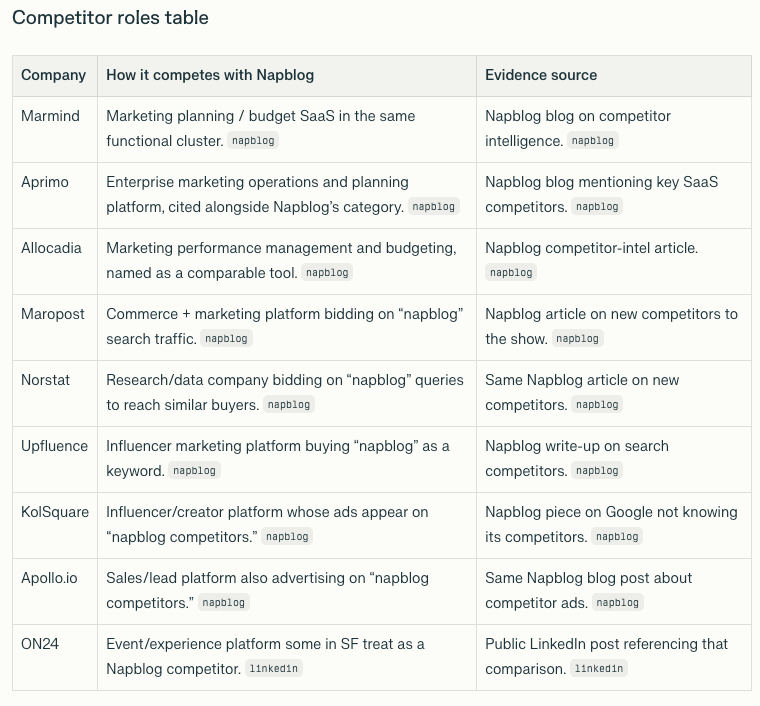
| Company | How it competes with Napblog | Evidence source |
| Marmind | Marketing planning / budget SaaS in the same functional cluster.napblog | Napblog blog on competitor intelligence.napblog |
| Aprimo | Enterprise marketing operations and planning platform, cited alongside Napblog’s category.napblog | Napblog blog mentioning key SaaS competitors.napblog |
| Allocadia | Marketing performance management and budgeting, named as a comparable tool.napblog | Napblog competitor-intel article.napblog |
| Maropost | Commerce + marketing platform bidding on “napblog” search traffic.napblog | Napblog article on new competitors to the show.napblog |
| Norstat | Research/data company bidding on “napblog” queries to reach similar buyers.napblog | Same Napblog article on new competitors.napblog |
| Upfluence | Influencer marketing platform buying “napblog” as a keyword.napblog | Napblog write‑up on search competitors.napblog |
| KolSquare | Influencer/creator platform whose ads appear on “napblog competitors.”napblog | Napblog piece on Google not knowing its competitors.napblog |
| Apollo.io | Sales/lead platform also advertising on “napblog competitors.”napblog | Same Napblog blog post about competitor ads.napblog |
| ON24 | Event/experience platform some in SF treat as a Napblog competitor.linkedin | Public LinkedIn post referencing that comparison.linkedin |
Step 1: Understanding what SERPs actually represent in 2025
Napblog:
“First, we need to reset expectations. Search engines—and now AI answer engines like Perplexity—do not define competitors the way strategy teams do.
SERPs show three things simultaneously:
- Functional overlap (true competitors)
- Audience overlap (companies chasing the same buyers)
- Attention arbitrage (brands bidding on your name)
Most companies confuse all three. Napblog does not.”
When Perplexity answers “napblog competitors”, it is not issuing a legal or strategic classification. It is summarising signals:
- What Napblog has publicly written
- Who appears in ad auctions
- Who algorithmically clusters near Napblog’s content and keywords
This distinction is critical—and it is where most founders misread AI outputs.
Step 2: Napblog’s own published competitor logic (why this matters)
Client:
“But Perplexity literally says Napblog’s own team has published how they think about competitors.”
Napblog:
“Correct—and that’s intentional.
Napblog does not hide competitor intelligence. We publish it because:
- It trains our internal teams
- It educates the market
- It creates traceable SERP signals that AI systems can understand
This is not negligence. This is controlled transparency.”
Napblog has consistently framed competitors in roles, not labels. That’s why your table matters.
Let’s break it down the way we do internally—and the way we would do it for you.
Step 3: Direct SaaS competitors vs indirect bidders (clear separation)
1. Direct functional SaaS overlap
These are companies that overlap with specific capabilities, not with Napblog’s full model.
- Marmind – Marketing planning and budget orchestration
- Aprimo – Enterprise marketing operations
- Allocadia – Performance and budget governance
Napblog:
“These tools live in adjacent functional clusters. They solve slices of the marketing planning problem.
Napblog is not a feature-by-feature replacement for them. Napblog is a marketing incubator + execution ecosystem that can integrate, replace, or bypass such tools depending on client maturity.
AI engines struggle with ecosystems. They prefer tools. That’s why they cluster us together.”
This is an important insight we replicate for clients:
If your business model is hybrid or systemic, SERPs will misclassify you unless you actively train them.
2. Competitors in ad auctions (this is not competition)
Client:
“So Maropost, Norstat, Upfluence, KolSquare, Apollo.io—are they competitors or not?”
Napblog:
“They are attention competitors, not strategic competitors.
They are buying:
- ‘napblog’
- ‘napblog competitors’
- ‘napblog marketing’
Because they want your audience, not because they replace Napblog.”
This is a market validation signal, not a threat.
When established platforms bid on your brand keyword, it means:
- Your audience is valuable
- Your positioning is clear enough to target
- Your brand has crossed the discovery threshold
Most founders panic here. Napblog documents it instead.
Step 4: Why ON24 appearing is actually an AI categorisation error
Client:
“What about ON24? That seems far off.”
Napblog:
“Exactly—and that’s where AI market research needs human interpretation.
ON24 appears because:
- Napblog publishes content on events, experiences, ecosystems
- AI clusters Napblog under engagement platforms
- Some SF-based stakeholders see Napblog as a strategic alternative, not a functional one
This tells us more about Napblog’s perceived trajectory than its current product.”
This is how Napblog reads AI output:
- Not as truth
- But as perception data
And this is how we teach clients to read it.
Step 5: The real insight — Napblog is training the AI layer, not ignoring it
Client:
“So you’re saying Napblog isn’t neglecting AI market research?”
Napblog:
“On the contrary—we are actively shaping it.
Most companies:
- Run market research internally
- Keep it private
- Let Google and AI guess who they are
Napblog:
- Publishes competitor intelligence
- Creates structured narratives
- Feeds AI engines with contextual clarity
That’s why Perplexity’s answer references Napblog’s own blogs.”
This is not accidental. This is SERP-level positioning strategy.
Step 6: How Napblog replicates this exact process for clients
Now let’s make this practical.
Napblog:
“If we were doing this for your business, here’s exactly what we would replicate.”
Phase 1: SERP and AI answer engine audit
We analyse:
- Google SERPs
- Perplexity answers
- Featured snippets
- Ad auction competitors
- Knowledge graph associations
Not to argue with them—but to understand:
- How the market currently understands you
- What roles you are being assigned algorithmically
Phase 2: Competitor role classification (not competitor lists)
Instead of “Top 10 competitors”, we create:
- Functional competitors
- Audience competitors
- Budget competitors
- Narrative competitors
Just like Napblog did with:
- Marmind (functional)
- Apollo.io (audience)
- ON24 (narrative)
This removes strategic confusion.
Phase 3: Publishing controlled intelligence
Most agencies stop at insights.
Napblog goes further:
- We publish your competitor perspective
- On your blog
- On LinkedIn
- In thought leadership formats
This trains:
- Search engines
- AI answer engines
- Journalists
- Investors
- Prospective clients
You stop being “described”. You start defining.
Phase 4: SERP feedback loop monitoring
Once published, we monitor:
- Changes in “People also ask”
- Shifts in Perplexity summaries
- New ad bidders
- New category associations
This is living market research—not static reports.
Step 7: Why this matters more than traditional market research
Client:
“How is this better than a classic market research report?”
Napblog:
“Because decisions today are influenced by:
- What founders Google
- What buyers ask AI tools
- What investors scan in summaries
If AI thinks you compete with the wrong category, you will:
- Get misqualified leads
- Face pricing pressure
- Attract the wrong talent
Napblog solves this upstream—at the perception layer.”
Step 8: The strategic takeaway
Napblog is not:
- Confused about competitors
- Overreacting to ad bidders
- Ignoring AI research
Napblog is:
- Using SERPs as market mirrors
- Treating AI answers as perception signals
- Publishing intelligence to shape the narrative
And most importantly—
This is not a Napblog-only capability.
This is a repeatable system we implement for clients.
Closing the client conversation
Client:
“So if we work with Napblog, this isn’t just branding or SEO.”
Napblog:
“Correct.
This is:
- Market intelligence
- AI-aware positioning
- Search-driven strategy
- Narrative control
The same way Napblog appears clearly in Perplexity today—
we design how you will appear tomorrow.”