Last updated: February 17, 2026
5 min read
productivity is one of the most discussed—and least precisely measured—concepts. Recruiters want proof of execution, lecturers want evidence of learning continuity, and managers want visibility into where effort compounds or leaks. Yet most systems still rely on self-reported summaries, static resumes, or shallow metrics like hours logged or tasks completed.
NapReport, a core NapApp within the Nap OS ecosystem, fundamentally changes this paradigm.
NapReport is not a dashboard.
It is not a time tracker.
It is not another performance scorecard.
NapReport is a granular, verifiable, system-level activity intelligence layer—built to translate daily execution into trustworthy, decision-grade signals.
This article explores NapReport in depth: its philosophy, architecture, use cases, and why it enables recruiters, lecturers, and managers to finally see where productivity overlaps, compounds, or breaks down.
1. The Problem: Productivity Without Proof
1.1 The Resume Illusion
Traditional resumes compress years of effort into bullet points:
- “Worked on X”
- “Led Y”
- “Improved Z by 30%”
But how was that improvement achieved?
- Was it consistent or sporadic?
- Individual or collaborative?
- Sustained or short-lived?
There is no verifiable execution trail.
1.2 The Manager’s Blind Spot
Managers face a different problem:
- Too many tools
- Fragmented signals
- Lagging indicators
By the time a report shows “low productivity,” the opportunity to intervene has already passed.
1.3 Academic & Training Gaps
Lecturers and mentors often assess:
- Submissions
- Attendance
- Final outcomes
But they miss:
- Learning rhythm
- Iterative effort
- Skill reinforcement patterns
Execution behavior remains invisible.
2. NapReport’s Core Idea: Execution Is the Signal
NapReport is built on a single premise:
Execution patterns are more truthful than outcomes alone.
Instead of asking what someone claims to have done, NapReport answers:
- How consistently did they execute?
- What kind of work dominated their time?
- Where did focus intensify or decay?
- Which activities were high-signal vs noise?
NapReport achieves this by transforming Nap OS’s continuous activity stream into a structured, verifiable, and exportable intelligence report.
3. Granular Activity Logging: The Foundation
3.1 Atomic Activity Capture
Every action within Nap OS—across apps like Tracker, Projects, Napblog, Nappers, Portfolio, and Reports—is logged as an atomic event:
- Timestamped
- Context-aware
- App-specific
- User-authenticated
No batching.
No retroactive editing.
No vague summaries.
This ensures chronological integrity.
3.2 Activity Types
NapReport classifies activity into granular categories:
- System events
- Notes
- Projects
- Iterations
- Media (images, links, references)
- Reviews & reflections
This classification allows NapReport to move beyond “activity count” into activity quality analysis.
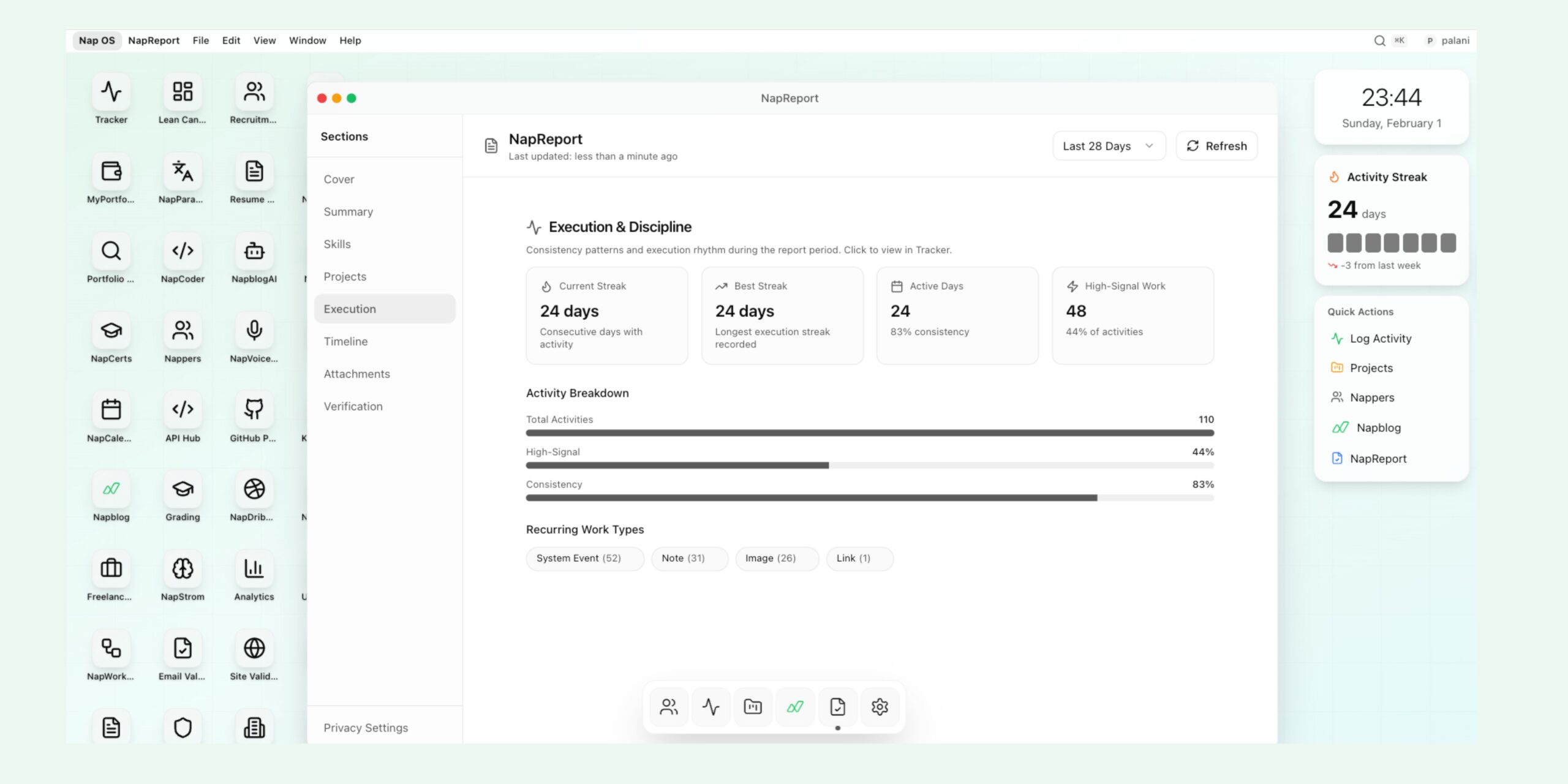
4. Execution & Discipline: Measuring What Actually Matters
One of NapReport’s most powerful sections is Execution & Discipline.
4.1 Streak Intelligence (Not Gamification)
NapReport distinguishes between:
- Current streak – present execution momentum
- Best streak – historical execution ceiling
- Active days – engagement density
- Consistency ratio – execution reliability
This is not gamified motivation—it is behavioral reliability modeling.
Recruiters can instantly assess:
- Is this person habitually consistent?
- Or only active near deadlines?
4.2 High-Signal Work Detection
NapReport identifies high-signal activities:
- Work that advances projects
- Skill-building iterations
- Long-form thinking
- Deliverable-oriented execution
This allows stakeholders to see:
- Where effort creates leverage
- Where time dissipates into low-impact actions
5. Overlapping Productivity: Seeing Compounding Effort
One of NapReport’s most valuable contributions is overlap detection.
5.1 What Is Productivity Overlap?
Overlap occurs when:
- The same effort advances multiple goals
- Skills reinforce across projects
- Learning, building, and documenting happen together
NapReport reveals:
- Cross-project execution patterns
- Reusable skill loops
- Compound learning trajectories
5.2 Why This Matters
For recruiters:
- Overlap = efficiency + adaptability
For managers: - Overlap = scalable performers
For lecturers: - Overlap = deep learning, not rote completion
NapReport surfaces this implicitly—without self-reporting bias.
6. Plug Points: Identifying Productivity Leaks
NapReport does not only highlight strengths—it reveals plug points.
6.1 Execution Drop-Offs
NapReport timeline views show:
- When activity declines
- Where streaks break
- Which work types disappear under pressure
This allows early intervention.
6.2 Imbalance Detection
Examples:
- Too much logging, no execution
- Too many projects, no completion
- High activity, low signal ratio
Managers can course-correct before outcomes suffer.
7. Verification: Trust Without Micromanagement
7.1 System-Level Authenticity
NapReport data is:
- Generated automatically
- Bound to user identity
- Tamper-resistant within Nap OS
There is no need for:
- Screenshots
- Manual proof
- Surveillance tools
7.2 Attachments & Evidence
Users can optionally attach:
- Files
- Links
- Media
- References
Each attachment is:
- Timestamp-aligned
- Context-bound
- Execution-linked
This creates soft verification, not intrusive oversight.
8. Use Case Deep Dive
8.1 Recruiters & Hiring Teams
NapReport replaces:
- Resume guesswork
- GitHub vanity metrics
- Interview storytelling bias
With:
- Execution history
- Consistency proof
- Skill evolution timelines
Hiring becomes signal-driven, not intuition-driven.
8.2 Lecturers & Academic Institutions
NapReport enables:
- Learning rhythm analysis
- Effort vs outcome mapping
- Early dropout detection
- Skill acquisition visibility
Assessment shifts from what was submitted to how learning occurred.
8.3 Managers & Team Leads
Managers gain:
- Non-invasive productivity visibility
- Real-time execution health
- Team-wide overlap insights
- Burnout risk indicators
Without:
- Time tracking coercion
- Surveillance culture
- Trust erosion
9. NapReport as a Shareable Artifact
9.1 Exportable Intelligence
NapReport can be:
- Refreshed manually or automatically
- Exported as long-form reports
- Shared with external stakeholders
This makes NapReport:
- A living resume
- A verified execution transcript
- A professional credibility layer
9.2 Cover Letters & CV Integration
Users can attach:
- Traditional CVs
- Cover letters
- NapReport as execution proof
Together, they form a complete professional narrative.
10. Why NapReport Is Different From Analytics Tools
| Traditional Analytics | NapReport |
|---|---|
| Retrospective | Continuous |
| Outcome-based | Execution-based |
| Aggregated | Granular |
| Self-reported | System-generated |
| Static dashboards | Living reports |
NapReport is not about productivity measurement—it is about productivity understanding.
11. Cultural Impact: From Surveillance to Signal
NapReport does not punish inactivity.
It does not rank humans.
It does not enforce hustle.
Instead, it:
- Encourages clarity
- Rewards consistency
- Makes effort visible
- Restores trust through transparency
This is critical for the future of work, education, and collaboration.
12. Conclusion: A New Standard for Verifiable Work
NapReport represents a structural shift:
- From claims to evidence
- From summaries to signals
- From oversight to insight
By enabling granular activity logging and verification across Nap OS, NapReport empowers recruiters, lecturers, and managers to finally answer the hardest productivity questions:
- Where is effort compounding?
- Where is it leaking?
- Who is truly consistent?
- What work actually matters?
In an economy driven by execution—not titles—NapReport becomes more than a NapApp.
It becomes the operating proof of professional discipline.
Activity logging drives transparent productivity insights. Learn more on LinkedIn.