Last updated: February 16, 2026
6 min read
Your Brand’s Real Valuation Is Already Public
Every brand wants to know its worth.
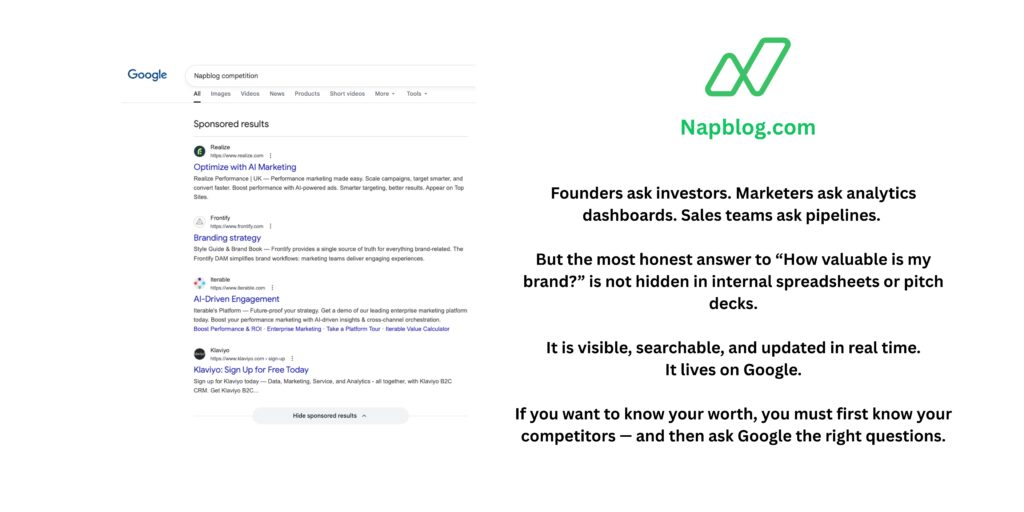
Founders ask investors. Marketers ask analytics dashboards. Sales teams ask pipelines. But the most honest answer to “How valuable is my brand?” is not hidden in internal spreadsheets or pitch decks.
It is visible, searchable, and updated in real time.
It lives on Google.
If you want to know your worth, you must first know your competitors — and then ask Google the right questions.
Search engines are no longer just discovery platforms. They are real-time markets of intent, where competitors openly compete for attention, authority, and trust. Every keyword auction, sponsored result, and organic ranking is a signal. Every unfamiliar brand bidding on your name is a valuation event.
Google does not guess your value.
It prices it.
This article explains why competitive search intelligence is the most underused valuation framework in modern marketing — and how brands like Napblog can use it to understand positioning, demand, and strategic worth.
1. Google as the World’s Largest Competitive Intelligence Engine
Google is often treated as a traffic channel. That is a mistake.
Google is:
- A real-time demand index
- A competitive battlefield
- A pricing mechanism for attention
- A mirror of how the market perceives you
When someone types your brand name into Google, they are not just searching — they are expressing intent. That intent has monetary value, and competitors know it.
That is why Google Ads exists.
That is why competitors bid on branded keywords.
That is why sponsored results appear even when the user already knows who they want.
If no one is bidding against you, your perceived market value is low.
If competitors are aggressively bidding on your name, your value is rising.
Google does not lie. It reveals.
2. The Moment You See Competitors on Your Brand Keyword
Search for your own brand.
Not in incognito.
Not as a logged-in admin.
Search as a customer would.
When you see:
- Sponsored results above your organic listing
- Brands you’ve never heard of
- Platforms positioning themselves adjacent to your value proposition
That is not noise.
That is market validation.
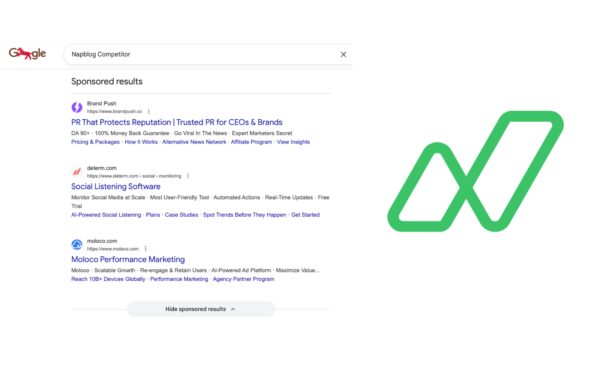
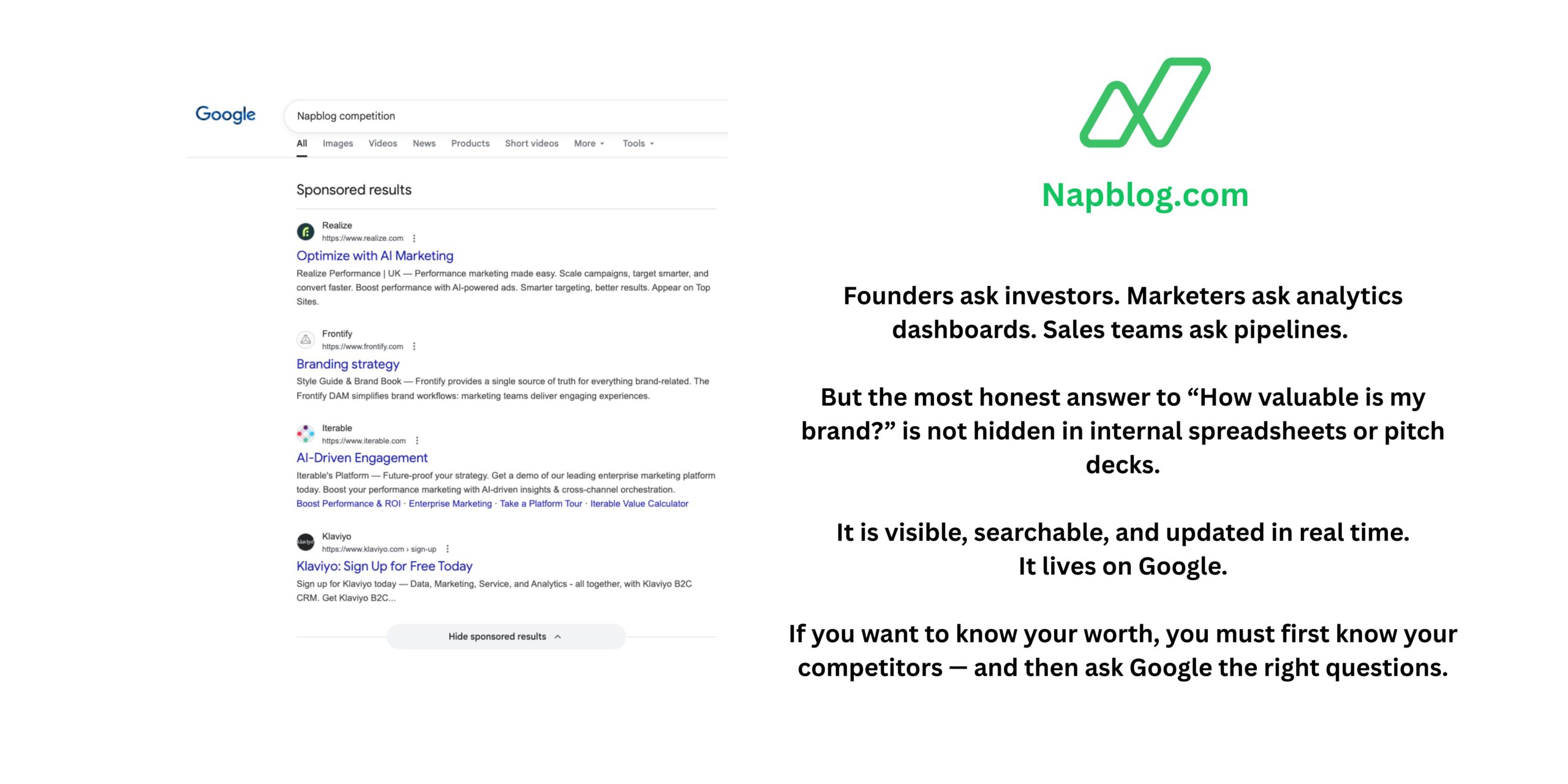
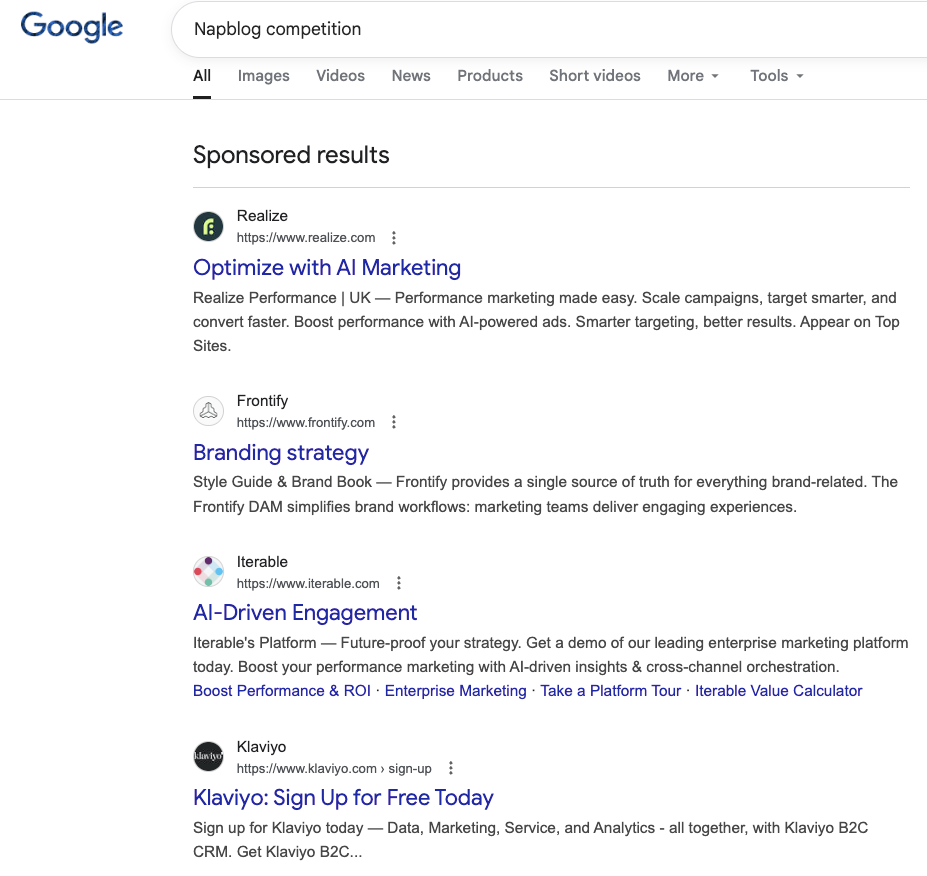
In the Napblog example, searching for brand-adjacent or branded queries surfaces companies offering:
- AI-driven marketing
- Brand strategy platforms
- Engagement and lifecycle tools
- CRM and performance marketing solutions
These companies are not appearing by accident. They are paying for visibility because they believe:
- Your audience is valuable
- Your brand attracts qualified intent
- Your positioning overlaps with revenue opportunity
That is your real worth — expressed in cost-per-click.
3. Competitors Reveal More Than You Ever Will
Your own messaging is biased.
Your website tells the story you want to tell.
Your competitors tell the story the market believes.
By analyzing who appears on your branded and near-branded searches, you learn:
- How others categorize you
- What problem they think your audience is trying to solve
- Which budgets are being allocated against your attention
- How crowded (or empty) your strategic space is
If competitors position themselves as:
- “AI marketing platforms”
- “Brand strategy systems”
- “Performance and engagement tools”
Then Google is grouping you in that ecosystem — regardless of how you describe yourself internally.
Your worth is contextual.
Your competitors define that context.
4. Brand Bidding Is Not Aggression — It’s Acknowledgment
Many brands see competitors bidding on their name and react emotionally.
“This is unfair.”
“They’re stealing our traffic.”
“We should block this.”
That reaction misses the strategic signal.
Brand bidding is acknowledgment.
A competitor bidding on your brand keyword is publicly declaring:
“Your brand has created demand we want to intercept.”
That means you have already done the hard work — awareness, trust, positioning.
Google Ads simply reveals who wants to monetize it.
The stronger your brand becomes, the more competitors will appear.
Silence is not safety.
Silence is invisibility.
5. Asking Google the Right Questions
Most brands ask Google the wrong questions.
They ask:
- “How do we rank higher?”
- “How do we reduce CPC?”
- “How do we get more traffic?”
Strategic brands ask:
- “Who is trying to replace us?”
- “Who is positioning next to us?”
- “Who thinks our audience is worth paying for?”
- “What category does Google think we belong to?”
These questions turn Google into a strategic intelligence layer, not just a channel.
When you search your brand and see competitors, ask:
- Why this competitor and not another?
- What message are they using?
- What promise are they making above the fold?
- What part of the journey are they intercepting?
Your worth is not just that they appear — it’s how they appear.
6. Organic Results Tell a Different Truth
Paid results show who is willing to pay.
Organic results show who has already won authority.
If your brand name search returns:
- Review sites
- Comparison pages
- Thought-leadership articles
- Competitor blog posts mentioning you
Then your brand has crossed an important threshold: interpretation.
You are no longer just a company.
You are a reference point.
At that stage, your worth is not defined by traffic — it is defined by narrative control.
If competitors are writing about your category better than you, they are quietly redefining your value in the market.
7. Search Visibility Is a Balance Sheet
Traditional valuation looks backward.
Search valuation looks forward.
Every keyword represents:
- A problem
- A solution
- A future transaction
When competitors invest in those keywords, they are making forward-looking bets.
If your brand attracts:
- High-intent searches
- Commercial modifiers
- Competitor comparisons
Then your market value is increasing — whether or not your revenue has caught up yet.
Search demand often leads revenue by months or years.
Google shows who understands that.
8. Knowing Your Competitors Is Knowing Yourself
Most brands maintain competitor lists that are outdated the moment they are created.
Google updates them daily.
Your real competitors are not always who you think they are. They are who:
- Bid on your brand
- Rank next to your pages
- Appear in “People also search for”
- Show up in AI-driven search summaries
Sometimes they are direct.
Often they are indirect.
Sometimes they are substitutes.
Understanding this ecosystem allows you to answer deeper questions:
- Are we a product, a platform, or a system?
- Are we competing on features or philosophy?
- Are we being compared on price, outcomes, or identity?
Your worth is tied to these answers.
9. Why Ignoring Google Is Strategic Blindness
Brands that ignore search intelligence operate in the dark.
They rely on:
- Internal opinions
- Lagging metrics
- Retrospective reports
Meanwhile, competitors are actively:
- Mapping demand
- Testing positioning
- Paying to learn faster
Google Ads is not just an acquisition tool.
It is the fastest market research instrument ever created.
Every impression is feedback.
Every click is validation.
Every competitor appearance is a signal.
To ignore it is to outsource strategy to chance.
10. From Worth to Direction
Knowing your worth is not about ego.
It is about direction.
When you understand:
- Who wants your audience
- Why they want them
- How much they are willing to pay
You gain clarity on where to invest next.
You can decide:
- Whether to defend your brand aggressively
- Whether to reposition higher or narrower
- Whether to expand into adjacent demand
- Whether to own a category instead of renting traffic
Search does not just tell you what you are worth.
It tells you what you could become.
Conclusion: Google Is the Most Honest Room You’ll Ever Enter
Boardrooms are political.
Analytics dashboards are selective.
Pitch decks are aspirational.
Google is honest.
It shows:
- Who is competing with you
- Who believes in your demand
- Who is willing to pay for your audience
- Who is trying to redefine your category
If you want to know your worth, do not ask internally.
Know your competitors.
Ask Google.
And listen carefully to what it shows you — because the market already knows who you are becoming.
To know your competitors is to know your own brand’s potential. Stay ahead of the competition with insights from LinkedIn.