Last updated: May 29, 2026
4 min read
There is a visible difference between ranking on Google…
…and controlling what appears on Google when your brand is searched.
Most companies celebrate when they rank first for their brand name.
But ranking first is not dominance.
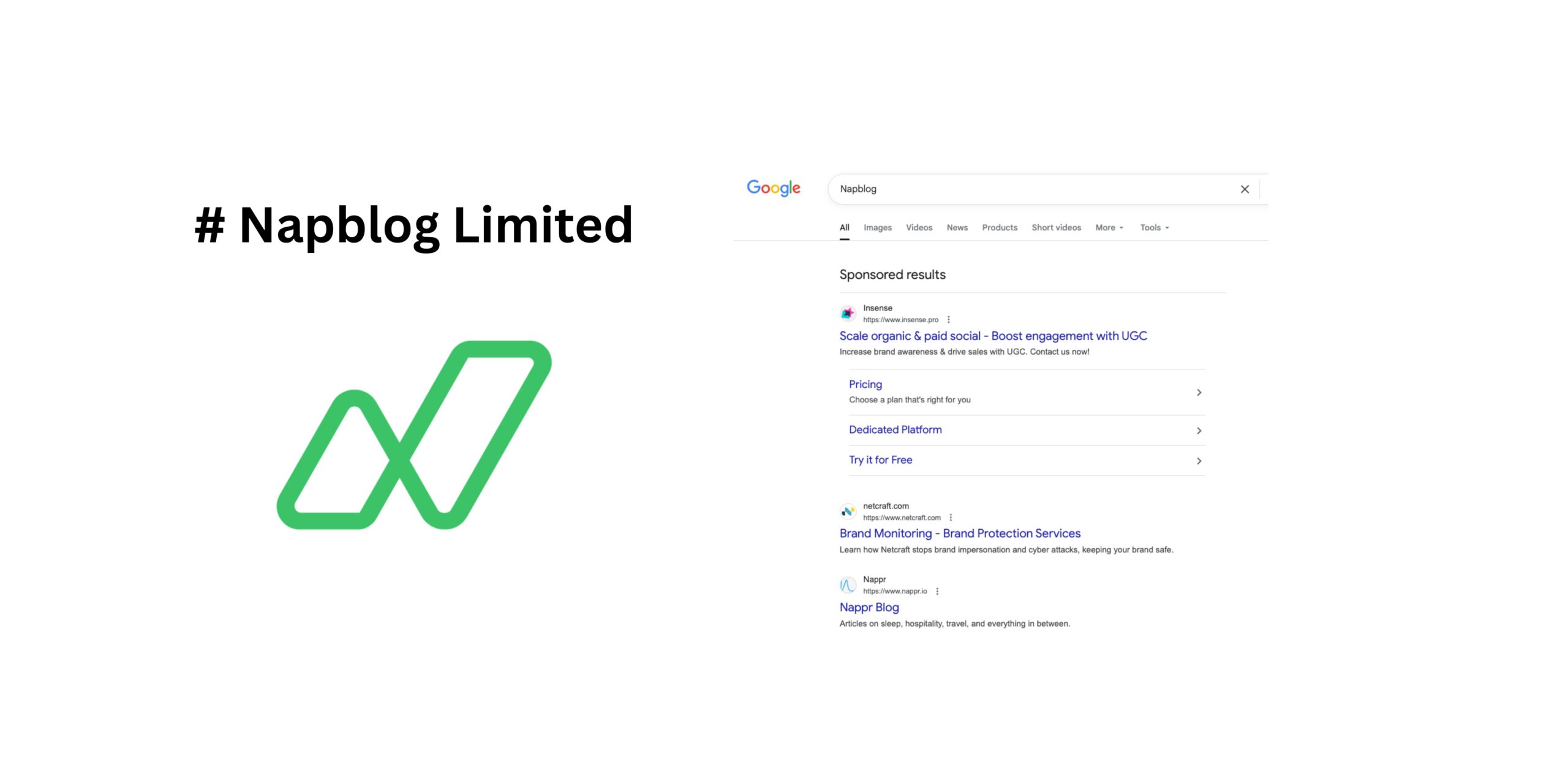
Because ranking first still allows:
• Competitor ads
• Comparison platforms
• Aggregators
• Affiliate landing pages
• Job boards
• Review websites
• Third-party blogs
To occupy the same search environment.
Which means:
The user is searching for you.
But deciding between you and someone else.
This is where most early-stage agencies in Ireland misunderstand SEO.
They treat it as traffic acquisition.
Napblog treats it as decision-environment architecture.
The SERP Is Not a Ranking Page
It Is a Decision Interface
When someone types “Napblog” into Google from Ireland, the search engine results page becomes:
A temporary user interface for trust formation.
In under 5 seconds, the user sees:
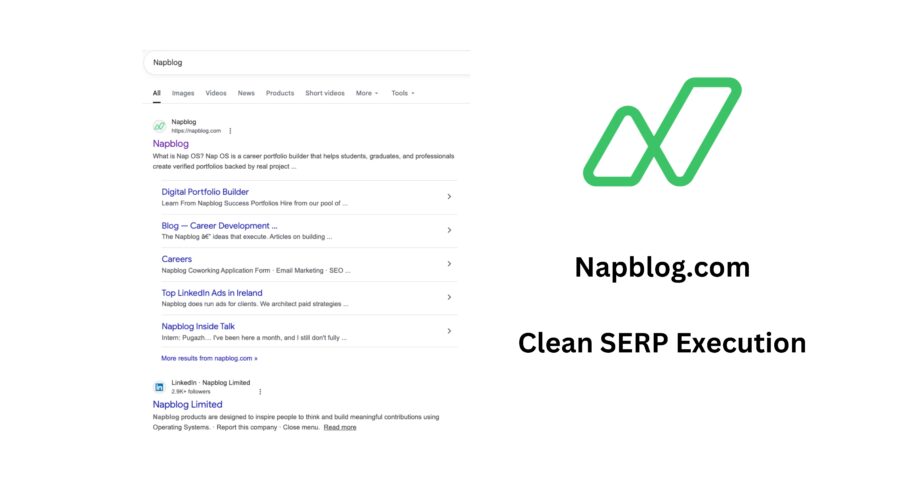
• Your homepage
• Your site links
• Your blog
• Your careers page
• Your internal product pages
• Your founder mentions
• Your LinkedIn presence
Or…
They see:
• Competitor PPC ads
• “Alternatives to Napblog”
• Directory listings
• Medium reposts
• Job portals
• Comparison platforms
The second version creates choice.
Choice reduces conversion probability.
The first version creates confirmation.
Confirmation increases commitment probability.
This is the foundation of Clean SERP Execution.
The Objective Was Never Ranking
It Was Search Environment Ownership
Napblog did not pursue traditional SEO milestones such as:
• Increasing impressions
• Growing traffic
• Improving CTR
• Ranking for long-tail keywords
Instead, the operational objective was:
To ensure that any user searching for Napblog within Ireland experiences:
Zero competitive distraction
Maximum narrative reinforcement
Immediate structural trust
This required synchronizing:
• Technical SEO
• Information architecture
• Content publishing
• Brand consistency
• Social authority
• Indexation control
Into a unified execution system.
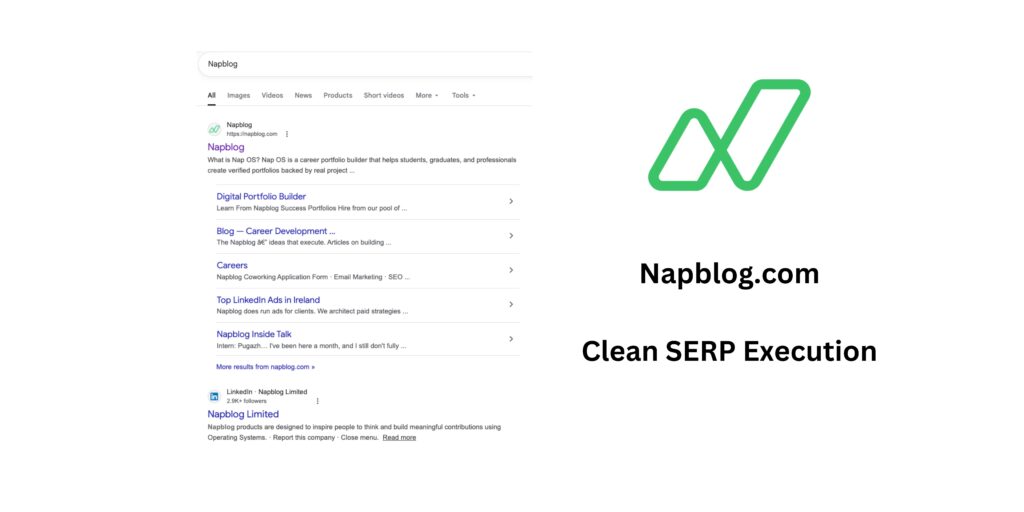
Clean SERP Execution Model
The Clean SERP framework implemented by Napblog consisted of four execution layers:
Layer 1: Branded Search Saturation
The first layer focused on ensuring that Napblog.com occupies the maximum possible number of organic positions on Page 1 for the query “Napblog”.
This included:
• Homepage
• Digital Portfolio Builder page
• Blog – Career Development
• Careers section
• Napblog Inside Talk
• LinkedIn Ads in Ireland landing page
Each indexed page was:
• Internally linked
• Technically optimized
• Structured using schema markup
• Submitted through sitemap protocols
The purpose was not content depth.
It was index diversity.
By increasing the number of branded pages indexed and ranked, Napblog expanded its organic footprint within the SERP.
This minimized the available real estate for third-party placements.
Layer 2: Internal Link Hierarchy
Most companies build content horizontally.
Napblog structured content vertically.
Meaning:
All branded pages are internally connected through:
• Contextual anchor links
• Navigation hierarchy
• Breadcrumb trails
• Footer references
This allows search engines to:
Understand topical authority
Associate sub-pages with branded queries
Promote internal pages as sitelinks
Sitelinks are not manually assigned.
They are algorithmically generated based on internal link strength and page trust.
By strengthening internal pathways, Napblog increased the probability of:
• Portfolio Builder
• Blog
• Careers
• LinkedIn Ads
Appearing directly beneath the homepage in search results.
Which is now observable in the Irish SERP.
Layer 3: External Authority Injection
Organic control cannot be achieved solely within the domain.
Search engines require off-site validation signals.
Napblog implemented:
• LinkedIn company indexing
• Founder profile authority
• Newsletter publications
• Social signal consistency
Particularly:
LinkedIn company pages frequently rank for branded search queries when:
• Posting frequency is consistent
• Brand name matches domain
• Profile backlinks are aligned
This allowed Napblog Limited’s LinkedIn presence to:
Secure an additional Page 1 position for branded searches in Ireland.
Thus further reducing third-party appearance probability.
Layer 4: Query Consistency Management
Search engines rely on pattern recognition.
If a brand is described inconsistently across:
• Website metadata
• Social media bios
• Blog descriptions
• Directory listings
Then ambiguity increases.
Ambiguity allows competitors to position themselves within the same intent cluster.
Napblog ensured:
Uniform use of terminology across:
• Meta titles
• Meta descriptions
• Open Graph tags
• LinkedIn summaries
• Newsletter introductions
This allowed Google to:
Associate the keyword “Napblog” with:
Career Portfolio Builder
Verified Project-Based Hiring
Nap OS Execution System
Instead of general categories such as:
Marketing Agency
Content Platform
Blogging Tool
Reduced categorical ambiguity leads to reduced competitive intrusion.
Technical Execution Summary
The Clean SERP implementation involved:
• Branded keyword mapping
• XML sitemap segmentation
• Canonical URL enforcement
• Page-level schema deployment
• Indexation priority settings
• Navigation structure optimization
• Crawl path minimization
This ensured:
Faster page discovery
Improved internal page trust
Higher sitelink probability
Within Irish geo-located searches.
Observed Outcomes
As a result of execution:
Search results for “Napblog” in Ireland now display:
• Napblog homepage
• Internal site links
• Blog pages
• Product pages
• Careers section
• LinkedIn company listing
With:
No competitor PPC ads
No third-party comparison pages
No affiliate interceptors
Creating a:
Clean Brand Decision Environment.
Strategic Implications
Clean SERP environments:
Reduce user hesitation
Increase brand recall
Improve conversion confidence
Shorten decision time
Because users are not required to evaluate:
Alternatives
Comparisons
Price differences
Feature trade-offs
Search becomes:
A confirmation step.
Instead of:
An exploration process.
Nap OS Perspective
Nap OS approaches marketing as:
Execution System Design.
Not campaign management.
SERP control is treated as:
Interface engineering.
Every search result is:
A UI component.
And every indexed page is:
A navigational module within the user’s decision interface.
Clean SERP Execution is therefore:
Not an SEO tactic.
But a structural architecture layer within Nap OS.
Conclusion
Brand search environments are:
Negotiated spaces.
Unless deliberately engineered.
Napblog Limited implemented:
Technical
Structural
Narrative
Consistency across:
On-site
Off-site
Index-level
Signals to achieve:
Branded SERP clarity within Ireland.
Ranking is visibility.
Clean SERP Execution is control.
And in high-intent branded search environments…
Control determines conversion.