Last updated: May 29, 2026
7 min read
The Experience Paradox Is Broken. Nap OS Fixes It.
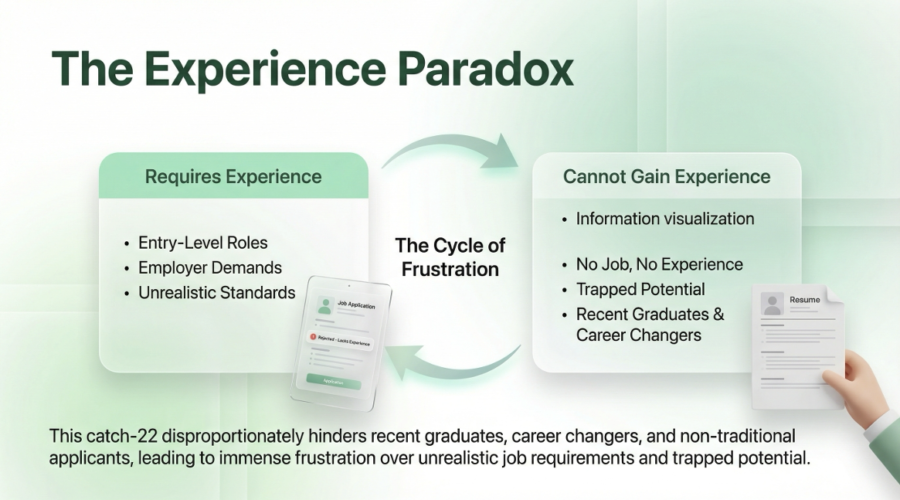
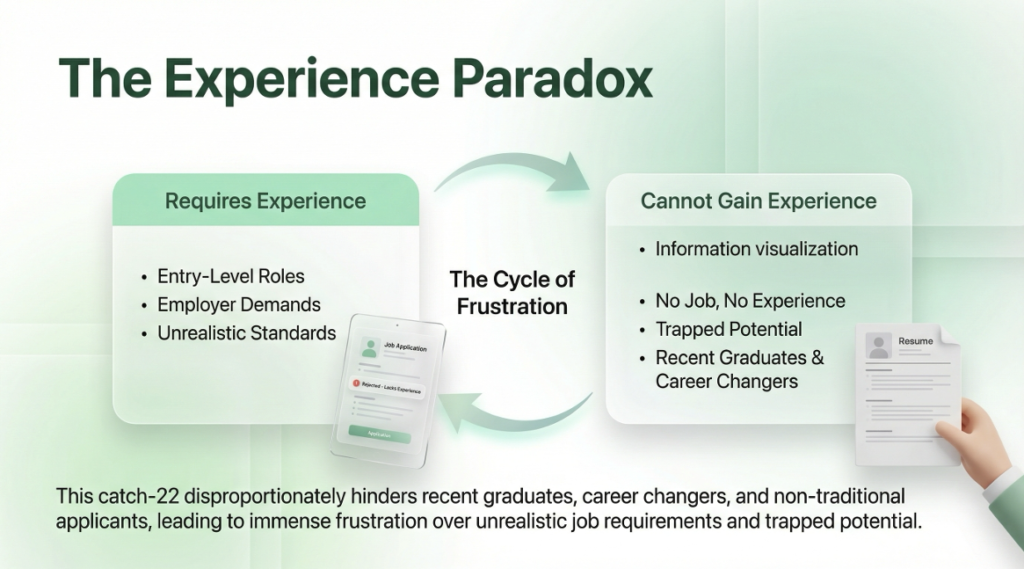
Across industries, a structural contradiction has emerged in the hiring ecosystem. Entry-level roles demand experience. Experience requires opportunity. Opportunity requires experience.
This circular dependency — the Experience Paradox — has become the defining bottleneck of modern career progression.
Recent graduates. Career switchers. Non-traditional applicants. Self-taught technologists. All face the same invisible barrier:
- Employers require experience
- Candidates cannot gain experience without being hired
- Unrealistic standards inflate qualification thresholds
- Potential remains trapped
The result is a cycle of frustration.
Nap OS exists to break that cycle.
It is not a resume builder.
It is not another job board.
It is not just an AI assistant.
Nap OS is a Career Operating System engineered to convert potential into validated experience — before the job offer.
The Structural Problem: Why the Market Is Failing Emerging Talent
To understand Nap OS’s differentiation, we must first examine the mechanics of the paradox.
1. Entry-Level Roles No Longer Mean Entry-Level
Many so-called “entry-level” positions now demand:
- 2–3 years of prior experience
- Portfolio proof
- Tool proficiency
- Demonstrated leadership
- Measurable outcomes
Employers rationalize this as risk mitigation. Hiring is expensive. Training is resource-intensive. Organizations want contributors who can produce immediate impact.
However, this shifts risk entirely onto candidates.
2. Unrealistic Standards and Credential Inflation
Digital transformation has accelerated productivity expectations. Teams are leaner. Skill stacks are broader. Job descriptions have become wish lists.
Graduates are expected to:
- Master tools not taught in university
- Demonstrate real-world project impact
- Show cross-functional collaboration
- Communicate at professional standard
- Understand data, analytics, automation, and AI
Traditional education does not supply these signals.
3. The “No Job, No Experience” Trap
Without professional exposure, candidates cannot:
- Demonstrate applied competency
- Build quantifiable case studies
- Acquire references
- Validate skill maturity
The system creates a structural disadvantage — especially for:
- First-generation graduates
- Career switchers
- International applicants
- Self-taught professionals
This is not a talent problem.
It is a signal problem.
Nap OS addresses the signal gap.
Nap OS: The Career Operating System
Nap OS is designed as a full-stack career infrastructure layer.
Its core differentiator is not a feature — it is an architectural philosophy:
Nap OS manufactures validated experience.
Instead of waiting for employers to provide opportunity, Nap OS enables candidates to simulate, execute, document, and present professional-grade work inside a structured system.
It converts raw potential into employer-ready proof.
The Unique Selling Proposition (USP)
Nap OS Transforms Potential into Measurable Experience
Where traditional tools help you apply for jobs, Nap OS helps you become qualified for them.
Its differentiator lies in five core pillars:
- Experience Manufacturing
- Native Portfolio Infrastructure
- AI-Powered Professional Simulation
- Leadership & Ownership Tracking
- Structured Career Data Layer
Each pillar directly dismantles a component of the Experience Paradox.
1. Experience Manufacturing: From Theory to Execution
The first barrier is lack of applied experience.
Nap OS addresses this through:
Structured Project Ecosystems
Users are not simply prompted to “build projects.”
They are guided through:
- Industry-relevant simulations
- Real-world problem frameworks
- Cross-functional deliverables
- Defined outcome metrics
- Role-based responsibilities
Every activity is structured as if operating inside a professional environment.
This reframes the candidate from passive learner to active contributor.
Outcome Documentation
Each project generates:
- Documented objectives
- Execution plans
- KPI alignment
- Lessons learned
- Impact summaries
This produces evidence.
Employers do not hire ambition.
They hire demonstrated capability.
Nap OS creates that demonstration layer.
2. Native Portfolio Infrastructure
Traditional resumes summarize history.
Nap OS builds verifiable career architecture.
Instead of static bullet points, candidates develop:
- Living portfolios
- Structured case studies
- Visual project breakdowns
- Skill-application mapping
- Measurable impact tracking
This eliminates vague claims like:
“Strong analytical skills”
“Team player”
“Excellent communication”
Instead, Nap OS enables:
“Led cross-functional product simulation with defined stakeholder roles, delivered performance dashboard, improved simulated conversion metric by 18%.”
This is signal amplification.
Employers can evaluate competency through structure, not assumption.
3. AI-Powered Professional Simulation
The future of career preparation is not content consumption — it is immersive rehearsal.
Nap OS integrates intelligent AI capabilities to simulate:
- Interview environments
- Role-specific problem-solving
- Executive communication scenarios
- Stakeholder negotiation
- Strategic planning exercises
Candidates do not just read about leadership — they practice it.
They do not just memorize interview answers — they iterate on real-time feedback.
The AI layer functions as:
- Mentor
- Reviewer
- Critic
- Co-strategist
This reduces performance anxiety and increases behavioral fluency.
The result: job-readiness becomes measurable, not aspirational.
4. Leadership and Ownership Tracking
One of the least visible hiring filters is initiative.
Employers want candidates who:
- Take ownership
- Initiate projects
- Lead execution
- Think strategically
Nap OS embeds leadership tracking into its framework.
Users build:
- Self-initiated project roadmaps
- Collaboration records
- Decision logs
- Performance retrospectives
This constructs evidence of:
- Ownership
- Accountability
- Growth trajectory
Rather than claiming leadership potential, candidates present leadership data.
5. Structured Career Data Layer
Nap OS functions as a career data system.
Every project, interaction, and skill demonstration feeds into a structured profile.
This allows:
- Skill maturity mapping
- Gap identification
- Targeted improvement cycles
- Strategic positioning
Instead of blindly applying to roles, candidates can:
- Align skill evidence to job requirements
- Identify missing competencies
- Rapidly close experience gaps
This shifts the approach from reactive to strategic.
How Nap OS Breaks the Cycle of Frustration
Let’s return to the Experience Paradox loop:
Requires Experience → Cannot Gain Experience → Trapped Potential
Nap OS inserts a new node into the cycle:
Self-Generated Experience → Validated Evidence → Employer Confidence
This interrupts the loop.
The system changes the narrative from:
“I need someone to give me a chance.”
To:
“Here is the proof of what I can already do.”
Employers hire based on risk assessment.
Nap OS reduces perceived hiring risk.
Differentiation from Existing Platforms
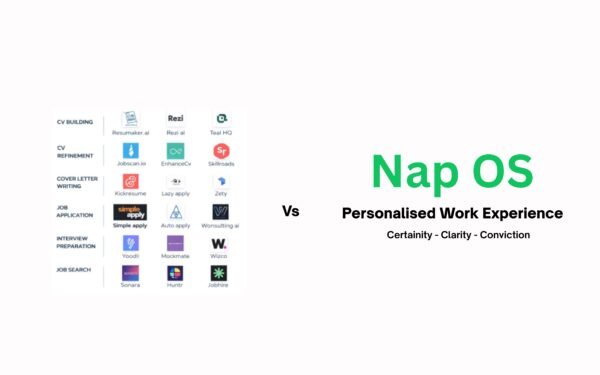
To clarify the USP, we must contrast Nap OS against adjacent categories.
Job Boards
Job boards distribute listings.
Nap OS manufactures readiness.
Resume Builders
Resume builders optimize presentation.
Nap OS creates substance.
Online Courses
Courses transfer knowledge.
Nap OS transfers applied competence.
Portfolio Websites
Portfolio tools host projects.
Nap OS structures them with professional rigor.
AI Chat Tools
Chat tools provide responses.
Nap OS embeds AI inside a career execution framework.
The difference is systemic.
Nap OS is not an add-on tool.
It is an operating layer.
Why This Matters Now
The labor market has structurally shifted.
Key trends include:
- Automation of repetitive entry-level tasks
- AI reducing junior hiring demand
- Increasing reliance on demonstrated outcomes
- Portfolio-first evaluation models
- Skills over credentials
Entry-level job cuts have intensified competition.
Internships are scarce.
Career transitions require proof of transferable skill.
Nap OS is built specifically for this environment.
Target Users: Who Benefits Most
1. Recent Graduates
They possess theoretical knowledge but limited applied proof.
Nap OS converts education into execution.
2. Career Switchers
They struggle with credibility gaps.
Nap OS builds transition-ready case studies.
3. Self-Taught Professionals
They lack formal credentials.
Nap OS validates competency through structured demonstration.
4. International Candidates
They face unfamiliar hiring systems.
Nap OS standardizes professional presentation.
5. Non-Traditional Applicants
They need structured storytelling.
Nap OS converts fragmented experience into coherent impact narratives.
The Psychological Advantage
Beyond structural benefits, Nap OS reduces:
- Imposter syndrome
- Interview anxiety
- Career ambiguity
- Passive job-search fatigue
When candidates build, document, and iterate inside a system, confidence becomes data-backed.
Momentum replaces frustration.
Clarity replaces confusion.
The Employer Perspective
From the hiring side, Nap OS users present:
- Evidence-based portfolios
- Structured case studies
- Clear metrics
- Leadership indicators
- Strategic thinking proof
This improves:
- Screening efficiency
- Candidate differentiation
- Hiring confidence
Nap OS indirectly enhances employer decision quality.
Long-Term Vision: Career as Infrastructure
The traditional career model assumes:
Education → Job → Experience → Advancement
Nap OS redefines it as:
Education + OS → Simulated Execution → Validated Experience → Job → Accelerated Advancement
The operating system becomes a lifelong infrastructure.
Users do not exit Nap OS after being hired.
They continue to:
- Track leadership growth
- Document achievements
- Build promotion cases
- Prepare for transitions
It becomes a compounding asset.
The Core Differentiator Summarized
Nap OS’s unique selling proposition can be articulated in one sentence:
Nap OS eliminates the Experience Paradox by enabling users to generate, validate, and present professional-grade experience before employment.
It is not about helping candidates apply better.
It is about helping them become undeniably qualified.
Conclusion: From Trapped Potential to Strategic Advantage
The Experience Paradox has created a generation of capable individuals who feel excluded from opportunity.
The problem is not talent scarcity.
It is signal misalignment.
Nap OS solves this by:
- Structuring execution
- Embedding AI intelligence
- Manufacturing experience
- Validating impact
- Converting potential into proof
In an economy where employers demand readiness, Nap OS manufactures it.
In a market where opportunity requires experience, Nap OS produces experience.
The cycle of frustration ends when candidates stop waiting for validation — and start building it.
Nap OS is that system.
It is not a tool.
It is infrastructure for modern careers.
And in the age of escalating hiring standards, infrastructure is the ultimate differentiator.