Last updated: May 29, 2026
5 min read
The traditional idea of a career has collapsed.
For decades, individuals progressed through predictable phases — education, employment, advancement — supported by static credentials like degrees, resumes, and references. These tools were designed for an industrial era where roles were stable, learning cycles were slow, and verification meant institutional validation.
That world no longer exists.
Today’s labour ecosystem evolves faster than institutional structures can adapt. Skills become obsolete quickly. Job definitions mutate. Entry-level pathways disappear while expectations increase. Employers do not seek claims — they seek evidence. And individuals struggle not because they lack potential, but because their execution is invisible.
This is the structural problem Nap OS addresses.
Nap OS is not a tool.
It is not a productivity application.
It is not a learning platform.
It is a career operating system designed to transform execution into verifiable portfolio intelligence, enabling individuals to navigate every stage of their professional evolution through structured AI-driven workflows.
At its core, Nap OS exists to convert capability into evidence — systematically, continuously, and contextually across time.
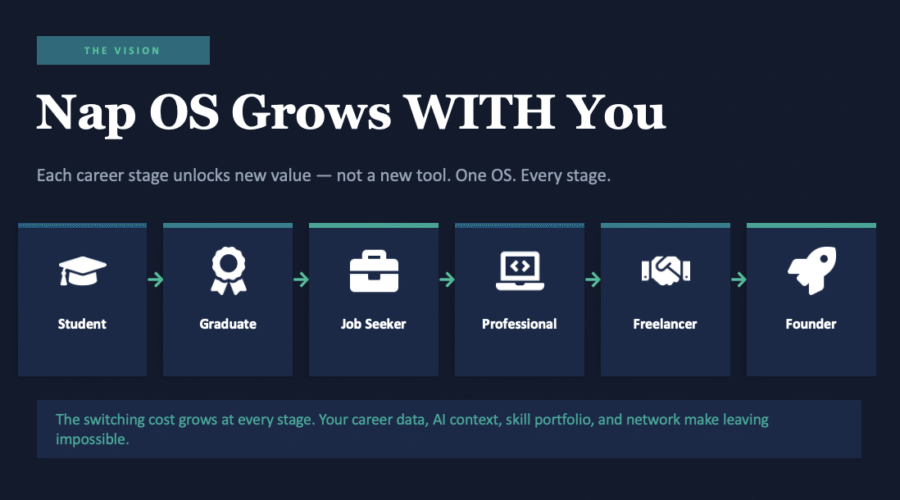
This article explores how that system evolves alongside users — from student to founder — through structured AI execution and portfolio management intelligence.
The Philosophy of Structural AI Execution
Before examining the stages, we must understand the underlying principle.
Most AI systems today are reactive assistants.
They answer questions, generate content, or automate tasks.
Nap OS is architected differently.
It embeds AI within execution frameworks:
- Structured task environments
- Context-aware performance tracking
- Evidence generation pipelines
- Portfolio intelligence mapping
- Career trajectory modeling
Rather than responding to isolated prompts, the system observes and structures behavioural outputs — turning action into measurable signals.
This transforms:
| Traditional Approach | Nap OS Approach |
|---|---|
| Learn → Claim Skill | Execute → Generate Evidence |
| Resume Entries | Verified Portfolio Objects |
| Self-reported Experience | AI-contextualized Performance Data |
| Static Career Planning | Adaptive Systemic Guidance |
This is structural AI — embedded into workflows — ensuring that every meaningful interaction contributes to long-term professional positioning.
Stage Architecture — How Nap OS Evolves With the User
Stage 1 — Student: Execution Awareness
Students often possess fragmented effort without visibility.
They:
- Complete coursework
- Participate in small projects
- Experiment with tools
- Attempt freelance work
But these activities rarely translate into credible signals.
Nap OS introduces:
Execution Structuring
AI frameworks convert academic or exploratory tasks into:
- documented deliverables
- performance metadata
- competency indicators
- behavioural metrics
Portfolio Genesis
Outputs automatically seed a living portfolio containing:
- contextual explanations
- decision rationale
- improvement tracking
Cognitive Alignment
The AI begins modeling:
- strengths
- curiosity patterns
- working styles
- execution consistency
The student moves from passive learning to observable contribution.
The goal is not employment readiness yet — it is self-signal formation.
Stage 2 — Graduate: Evidence Consolidation
Graduation introduces a paradox:
Credentials exist — but validation does not.
Nap OS transitions into:
Evidence Aggregation
Execution history is consolidated into structured narratives:
- project clusters
- skill verification layers
- outcome mappings
AI Contextual Translation
Outputs are reframed for industry interpretation:
- recruiter-readable summaries
- domain-specific positioning
- capability alignment
Gap Detection
The system identifies:
- missing experience types
- weak execution signals
- portfolio imbalance
Instead of guessing what to improve, graduates receive precise structural feedback.
The focus shifts to market interpretability.
Stage 3 — Job Seeker: Market Interface Optimization
Job seeking is typically inefficient signal broadcasting.
Individuals apply blindly.
Employers filter imperfectly.
Nap OS restructures this interface.
Portfolio Signaling
The system deploys curated evidence packets:
- role-specific execution highlights
- scenario-aligned demonstrations
- behavioural performance snapshots
Predictive Matching
AI evaluates:
- employer expectations
- job architecture
- historical hiring signals
to guide strategic positioning.
Iterative Learning Loop
Application outcomes feed back into:
- portfolio refinement
- messaging optimization
- execution prioritization
Job seeking becomes adaptive experimentation rather than emotional uncertainty.
This stage transforms search into system navigation.
Stage 4 — Professional: Execution Scaling
Once employed, development often stagnates due to invisible performance.
Nap OS maintains growth momentum through:
Workplace Signal Capture
Daily execution feeds into intelligence models:
- decision quality
- collaboration patterns
- productivity variance
- strategic contribution
Skill Evolution Mapping
AI tracks:
- emerging strengths
- specialization trends
- leadership indicators
Internal Mobility Strategy
The system identifies:
- promotion vectors
- cross-functional transitions
- authority opportunities
Professionals gain:
- clarity
- leverage
- agency
Their portfolio continues expanding beyond employer boundaries.
The stage evolves toward career sovereignty.
Stage 5 — Freelancer: Autonomy Intelligence
Freelancing demands:
- self-management
- market positioning
- trust generation
Nap OS becomes a strategic infrastructure layer.
Reputation Structuring
Client outcomes transform into:
- credibility metrics
- satisfaction indicators
- delivery consistency models
Opportunity Targeting
AI evaluates market signals to suggest:
- pricing adjustments
- niche positioning
- service diversification
Network Capital Mapping
Relationship data reveals:
- collaboration leverage
- referral probability
- influence clusters
Freelancers shift from reactive survival to:
- calculated expansion
- authority development
This stage optimizes independent economic intelligence.
Stage 6 — Founder: System Orchestration
Founders operate at complexity extremes.
Nap OS transitions into macro-level cognition support.
Strategic Pattern Recognition
AI surfaces insights across:
- operational data
- talent behaviour
- customer response
Decision Simulation
Scenario modeling assists:
- resource allocation
- expansion timing
- innovation prioritization
Organizational Portfolio Intelligence
The founder’s personal execution integrates with:
- company performance signals
- ecosystem positioning
- long-term narrative development
The OS no longer supports individual advancement alone —
it influences system creation.
This is the stage of structural impact generation.
Portfolio Management as Lifelong Infrastructure
A defining pillar across all stages is portfolio continuity.
Unlike traditional static portfolios:
Nap OS portfolios are:
- evolving
- evidence-backed
- context-aware
- AI-interpreted
They represent:
- cognitive evolution
- execution maturity
- behavioural identity
This persistent intelligence produces compounding value.
Switching costs increase because:
- data depth grows
- contextual accuracy improves
- network embeddings strengthen
The portfolio becomes inseparable from professional identity.
Why Structural Continuity Matters
Career fragmentation is the greatest inefficiency in modern labour.
Each transition usually resets:
- credibility
- visibility
- narrative
Nap OS eliminates resets.
Every stage builds upon prior execution.
This continuity generates:
- exponential signal strength
- compounding trust
- strategic foresight
It converts careers from:
Discrete chapters
into
Connected intelligence ecosystems.
Implications for Education, Industry, and Society
Education
Institutions gain:
- execution-based assessment insights
- employability alignment
- real outcome measurement
Employers
Organizations receive:
- verifiable candidate evidence
- reduced hiring uncertainty
- performance predictability
Individuals
Users achieve:
- identity clarity
- opportunity control
- adaptive resilience
The OS becomes a bridge aligning all stakeholders.
The Future — Career Intelligence Ecosystems
Nap OS represents an early layer of a broader transformation.
We are moving toward:
- AI-mediated professional identity
- execution-native validation systems
- decentralized capability economies
Where:
- evidence replaces credentials
- performance replaces claims
- adaptability replaces stability
Career progression will no longer be externally defined —
it will be continuously co-constructed with intelligent systems.
Nap OS positions itself as infrastructure for this transition.
Conclusion — One System, Every Stage
From first exploration to organizational leadership,
the core challenge remains constant:
Turning human potential into recognized value
Nap OS approaches this not as a feature set —
but as a lifelong structural companion.
It observes.
It organizes.
It contextualizes.
It amplifies.
It grows with the user because it learns from the user.
And as career complexity increases,
so does the system’s intelligence.
This is the essence of the vision:
Not replacing human ambition —
but architecting the environment in which ambition becomes undeniable evidence.
One OS.
Every stage.
Continuously compounding execution into opportunity.