Last updated: May 29, 2026
14 min read
The Catch-22 That Breaks Every Early Career
Every graduate, career changer, and aspiring professional faces the same impossible barrier: employers want experience, but you can’t get experience without someone giving you that first opportunity. Job postings demand “2-3 years experience” for entry-level positions. Internships require prior internship experience. Junior roles expect senior portfolios.
This isn’t a temporary market inefficiency. It’s structural dysfunction that’s been accepted as normal for so long that we’ve stopped questioning it. The experience paradox destroys talent before it has a chance to prove itself, wastes institutional resources on credentialing systems that don’t predict performance, and creates massive inefficiencies in talent markets.
But here’s what makes this paradox particularly absurd in 2026: most early-career professionals actually have substantial experience. They’ve built personal projects. They’ve contributed to open source. They’ve done volunteer work for real organizations. They’ve taken freelance gigs. They’ve created portfolio pieces that demonstrate genuine capability.
The problem isn’t lack of experience. The problem is that this experience doesn’t count. It exists in a verification void where employers can’t distinguish real work from fabricated claims, where there’s no standardized way to evaluate quality, and where legitimate capability gets dismissed as “not professional experience.”
This is the problem Nap OS was built to solve. Not by creating more credentials. Not by adding another layer of institutional gatekeeping. But by making invisible work visible, verifiable, and valued in hiring decisions.
Why Traditional Portfolios Don’t Break the Paradox
The standard advice for breaking the experience paradox is straightforward: build a portfolio. Create projects. Demonstrate your skills. Show, don’t tell. This advice isn’t wrong—it’s just incomplete. Because portfolios themselves face a credibility crisis that undermines their entire value proposition.
Consider what employers see when candidates present portfolios: a website claiming proficiency in ten programming languages, a GitHub profile with projects of unknown authorship, case studies describing “impact” with no way to verify the numbers, testimonials from people who might not exist, screenshots that could be mockups rather than deployed applications.
The entire portfolio ecosystem operates on self-reported claims with no verification mechanism. LinkedIn profiles list skills that might be based on a single weekend tutorial. Resumes describe “led a team of five” when the reality was coordinating a group project in school. Project descriptions claim outcomes that were never measured or were simply invented.
Employers know this. They’ve seen enough inflated portfolios and fabricated credentials to become deeply skeptical of anything that isn’t “verified professional experience”—which brings us right back to the paradox. The tools that should break the experience barrier don’t work because they can’t solve the verification problem.
This creates a tragic outcome: candidates who’ve actually done substantial, high-quality work get lumped together with those who fabricate everything. The honest portfolio builder is penalized for the dishonest one’s behavior. And employers, unable to distinguish between them, default back to demanding traditional credentials and professional experience.
The Verification Layer That Changes Everything
Nap OS approaches the experience paradox through a fundamental architectural decision: every skill claim must be backed by verifiable data. Not testimonials. Not self-assessments. Not curated screenshots. Actual, auditable evidence that proves the work happened and demonstrates its quality.
This verification layer integrates directly with the platforms where work actually happens. GitHub commits show code contributions with timestamps, authorship attribution, and project context. Analytics platforms reveal real user engagement metrics rather than claimed impact numbers. Project repositories demonstrate actual deployed applications rather than mockups.
When a candidate claims proficiency in React, Nap OS can surface their actual React projects, show commit history demonstrating progressive skill development, display code quality metrics, and present deployment evidence. When someone claims they “increased user engagement by 40 percent,” Nap OS connects to analytics platforms showing the actual numbers with proper attribution.
This transforms portfolios from marketing documents into evidence repositories. Employers don’t have to trust claims—they can verify them. The question isn’t “do you believe this candidate built what they claim?” but “here’s the linked evidence showing exactly what they built and how it performed.”
The verification infrastructure creates a new equilibrium in talent markets. Honest portfolio builders gain massive advantage because their work can be proven. Fabricators are exposed because they can’t connect claims to evidence. Employers can confidently evaluate non-traditional experience because verification removes the uncertainty.
Process Over Outcomes: Why Showing How You Work Matters More Than What You Produced
Traditional portfolios make a critical mistake: they showcase finished products while hiding the process that created them. A beautifully designed website appears in a portfolio with no indication of whether the candidate actually built it, collaborated on it, purchased a template, or simply took credit for someone else’s work.
Napblog—the operational content layer of Nap OS—inverts this model. It sits between effort and outcome, capturing and making visible the actual work process. Not just what was produced, but how it was produced. Not just the final deliverable, but the iterations, decisions, problems solved, and learning that happened along the way.
This process transparency solves a problem employers care deeply about: predicting how candidates will actually perform in real work contexts. Finished products don’t reveal work habits, problem-solving approaches, collaboration skills, or ability to learn from feedback. Process documentation does.
When Napblog captures a project’s evolution—initial research, design iterations, technical challenges encountered, solutions attempted, feedback incorporated, final deployment—it creates a narrative that’s far more valuable than the final product alone. Employers see how the candidate thinks, how they handle obstacles, how they respond to constraints, and how they improve work based on input.
This process-first approach also democratizes portfolio building. Not every project produces spectacular outcomes, especially early in a career. But every project—even those that fail or produce modest results—can demonstrate valuable process. A startup that didn’t gain traction might still showcase excellent product thinking, technical execution, and iterative improvement. A design project with limited reach might reveal sophisticated problem-solving and user research methodology.
By valuing process alongside outcomes, Nap OS creates space for early-career professionals to build credibility even when their projects don’t achieve viral success or massive scale. The focus shifts from “did you build something famous?” to “did you build something well?”
Autonomous Evaluation: The Non-Subjective Credentialing System
Verification solves the honesty problem. Process transparency solves the visibility problem. But neither fully breaks the experience paradox without addressing the evaluation problem: how do we consistently assess portfolio quality across different contexts, domains, and complexity levels?
Traditional education handles this through subjective grading—professors evaluate work based on rubrics, personal standards, and institutional norms. This doesn’t translate to portfolio evaluation. There’s no professor to grade your open source contribution. Your volunteer website design doesn’t receive a letter grade. Your freelance consulting project doesn’t come with academic credit.
Nap OS implements autonomous evaluation using standardized execution criteria that operate like industry certification frameworks rather than academic grading. The system evaluates portfolios across measurable dimensions: code quality metrics for software projects, user engagement data for digital products, completion rates for content initiatives, technical complexity assessments, documentation quality standards.
These evaluations are system-generated, auditable, and non-subjective. A software project isn’t judged based on whether an instructor likes the approach—it’s measured against industry-standard code quality metrics, security practices, performance benchmarks, and architectural patterns. A content project isn’t graded on personal opinion—it’s evaluated on engagement metrics, audience growth, retention rates, and production consistency.
The autonomy and standardization create credentials that function similarly to global industry certifications. When Nap OS issues a professional credential based on portfolio evaluation, employers understand what that credential means because the evaluation criteria are transparent and consistent. It’s not “this professor thought the work was good.” It’s “this work met industry-standard benchmarks across these specific dimensions.”
This autonomous evaluation system finally allows non-traditional experience to carry weight equivalent to traditional credentials. The question shifts from “did you go to a recognized institution?” to “did your work meet recognized standards?” And crucially, the answer to that second question can be objectively verified rather than subjectively claimed.
The Institutional Integration: Universities and Incubators as Execution Environments
Nap OS operates as an enterprise system installed by universities and incubation centers, which creates a fascinating dynamic. Rather than competing with traditional institutions, it transforms them into environments that produce the verified experience employers actually want.
When a university installs Nap OS, it gains the infrastructure to run structured, execution-first programs using pre-configured incubation paths. Students don’t just study marketing—they execute actual marketing campaigns with measurable outcomes. They don’t just learn software development—they build and deploy real applications with verifiable usage. They don’t just discuss entrepreneurship—they launch projects with tracked metrics.
This institutional integration solves a critical problem for universities: demonstrating measurable outcomes. Traditional higher education struggles to prove that graduates are actually prepared for employment. Degrees attest to time spent and courses completed, not to capabilities developed or work quality achieved. Nap OS allows institutions to credibly claim: “Our graduates produced market-ready portfolios that were autonomously evaluated against industry standards.”
For students, this creates the ideal environment for breaking the experience paradox. They’re building real portfolios within an institutional context that provides structure, mentorship, and resources—but those portfolios carry verification and evaluation that exists independent of the institution. The credential isn’t “this university says you’re qualified.” It’s “this work meets independently verified quality standards.”
The system’s pre-configured incubation paths provide another critical element: structured progression. Early-career professionals often struggle not just with proving experience but with knowing what experience to build. Nap OS paths guide students through strategic project sequences designed to develop comprehensive portfolios that demonstrate breadth and depth.
This structured approach prevents the common portfolio mistake of random, disconnected projects that don’t tell a coherent story. Instead, students build portfolios that show progressive skill development, increasing complexity, and strategic capability building aligned with market demands.
What Gets Counted: Expanding the Definition of Valid Experience
The most radical aspect of Nap OS isn’t the technology—it’s the redefinition of what constitutes legitimate professional experience. Traditional hiring treats employment as the only valid experience source. Everything else gets categorized as “extracurricular,” “hobby projects,” or “not professional experience.”
This arbitrary distinction makes no sense when you examine actual work quality. A developer who builds and maintains an open source project used by thousands of people demonstrates more relevant capability than someone who spent two years writing internal documentation at a large company. A designer who creates brand identities for three volunteer organizations shows more practical skill than someone who spent months on a single slide deck that was never used.
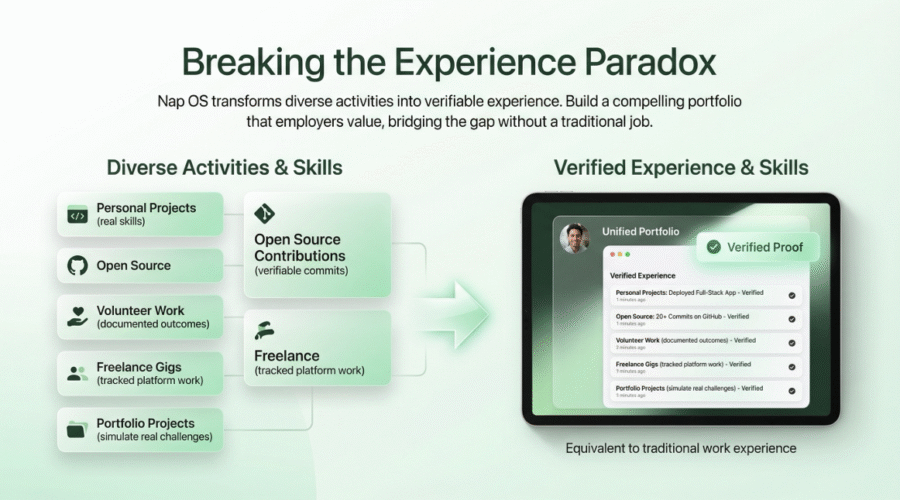
Nap OS makes work quality and verification the determining factors, not employment status. Personal projects that demonstrate technical sophistication and real usage count as experience. Open source contributions with verifiable impact count as experience. Volunteer work with measurable outcomes counts as experience. Freelance projects with client results count as experience. Portfolio projects deployed to real users count as experience.
The critical shift is from “where did you work?” to “what did you build, and can you prove it?” Employment becomes one valid source of experience among many, rather than the only legitimate path. This dramatically expands opportunity for people who’ve developed substantial capability outside traditional employment structures.
Career changers who’ve built impressive portfolios while transitioning between fields finally get credit for that work. Students who’ve spent years contributing to meaningful projects no longer hear “but do you have professional experience?” Self-taught professionals can demonstrate capability without needing someone to take a chance on them first.
This expanded definition of valid experience doesn’t lower standards—it raises them. Rather than accepting employment as proof of capability regardless of what someone actually did in that role, Nap OS requires demonstrated quality regardless of context. It’s more rigorous, not less. But it’s rigorous about things that actually matter: work quality, verifiable outcomes, measurable impact.
The Skills-First Hiring Alignment
Nap OS’s approach to breaking the experience paradox arrives at exactly the right moment. The broader hiring market is rapidly shifting toward skills-based evaluation, with 70 percent of employers now using skill-based hiring for entry-level positions and 75 percent of hiring managers prioritizing skills over degrees.
This skills-first movement creates natural demand for exactly what Nap OS provides: verified portfolios demonstrating actual capability rather than credentials claiming theoretical knowledge. When employers adopt skills-based hiring, they need infrastructure to evaluate skills reliably. Traditional resumes and interviews don’t provide this. Unverified portfolios are too unreliable. Nap OS bridges the gap.
The platform allows employers to evaluate candidates based on work they can actually verify and assess. Rather than inferring capability from credentials or making subjective judgments from interviews, they can examine real projects with verified metrics, autonomous quality evaluations, and transparent process documentation.
For employers making the transition to skills-first hiring, Nap OS provides the confidence and structure they need. They’re not abandoning traditional credential-based hiring on faith—they’re adopting a rigorous alternative evaluation system that might actually be more reliable than the credentials they’re replacing.
This market alignment creates a powerful feedback loop. As more employers adopt skills-first hiring and recognize Nap OS credentials, more candidates invest in building verified portfolios. As more candidates build verified portfolios, employers gain confidence in non-traditional experience. The experience paradox breaks not through wishful thinking about portfolio power, but through systematic infrastructure that makes portfolios actually credible.
The Data Advantage: Learning What Actually Predicts Success
One of the most powerful but least visible aspects of Nap OS is the data infrastructure it creates. By capturing verified work across thousands of students, tracking which types of projects and processes lead to successful outcomes, and connecting portfolio characteristics to actual hiring and performance results, the platform generates insights impossible to obtain otherwise.
The NapAI assistant leverages this execution data to provide guidance that’s genuinely personalized and actionable rather than generic. It’s not offering the same advice to everyone—it’s suggesting next steps based on patterns identified in students with similar starting points, similar goals, and similar constraints who achieved the outcomes you’re pursuing.
This data-driven coaching addresses another dimension of the experience paradox: even when people want to build portfolios, they often don’t know what to build, in what order, or to what quality standards. Traditional career advice is too generic. “Build a portfolio” doesn’t answer “build what, exactly?” NapAI can provide specific, evidence-backed guidance because it has data on what actually worked for others.
Over time, this creates increasingly sophisticated understanding of what types of verified experience predict success in different roles, industries, and contexts. The autonomous evaluation criteria can evolve based on which portfolio characteristics correlate with strong job performance. The incubation paths can be refined based on which project sequences produce the most effective portfolios.
This continuous improvement loop means Nap OS becomes more effective over time, not static. The experience paradox is broken not just through current infrastructure but through infrastructure that gets progressively better at identifying, developing, and verifying genuine capability.
Why This Matters Beyond Individual Careers
The experience paradox isn’t just a problem for job seekers—it’s a massive inefficiency in talent markets that harms employers, educational institutions, and economic productivity. When qualified people can’t access opportunities because they lack traditional credentials despite having real capability, everyone loses.
Employers waste resources on lengthy hiring processes that filter candidates based on credentials that don’t actually predict performance. They miss exceptional talent that took non-traditional paths. They perpetuate diversity problems because traditional credential paths have well-documented bias and access issues.
Educational institutions struggle with relevance as students question the ROI of expensive programs that don’t guarantee employment. They face pressure to demonstrate outcomes but lack infrastructure to credibly prove graduate preparedness. They watch alternative education pathways gain market share because traditional credentials don’t carry the weight they once did.
Economic productivity suffers when talent allocation is inefficient. Capable people working in roles below their potential, or unable to access roles matching their capability, represents waste at scale. The experience paradox artificially constrains the talent pool, creating labor shortages even when qualified people exist.
Breaking the experience paradox addresses all these inefficiencies simultaneously. It expands talent pools by making capability visible regardless of path. It improves hiring efficiency by providing reliable evaluation infrastructure. It helps educational institutions demonstrate value through verified outcomes. It enables better talent allocation by connecting capability to opportunity more effectively.
This is why Nap OS matters beyond helping individual candidates build better portfolios. It’s infrastructure for fundamentally more efficient talent markets—markets that reward capability over credentials, that value verified work over claimed qualifications, and that enable opportunity based on what people can actually do.
The Future of Professional Identity
At Napblog, we believe the future of professional identity is built on verified execution rather than institutional credentials. Not because credentials are inherently bad, but because the world needs identity infrastructure that’s more flexible, more verifiable, and more aligned with how work actually happens in 2026.
Traditional credentials served a specific historical purpose: providing verification when work itself couldn’t be easily verified. Employers couldn’t examine everyone’s actual work quality, so they relied on institutions to certify that students had met certain standards. This worked reasonably well when institutional standards aligned with job requirements and when credentials genuinely predicted performance.
But now work can be verified directly. GitHub shows actual code. Analytics platforms reveal real engagement. Deployed applications demonstrate technical capability. Process documentation shows work quality. The institutional intermediary is no longer necessary for verification—we can verify work itself.
Nap OS represents what professional identity looks like when it’s built on verified work rather than institutional attestation. Your professional identity isn’t where you went to school or who employed you—it’s what you’ve actually built, verified through transparent evidence and evaluated against objective standards.
This shift has profound implications. It democratizes opportunity by removing artificial credential barriers. It rewards actual capability over access to prestigious institutions. It enables continuous professional development because you can build credibility through verified work at any stage of your career, not just through formal degree programs.
The experience paradox only exists in a credential-based professional identity system. In a verification-based system, there is no paradox—you build verifiable work, that work gets evaluated against transparent standards, and you carry verified credentials based on demonstrated capability. The circular dependency breaks because the system doesn’t require prior employment to validate experience. It validates experience directly.
This is the future Napblog is building with Nap OS. A future where personal projects, open source contributions, volunteer work, freelance gigs, and portfolio pieces aren’t dismissed as “not real experience.” A future where verified execution matters more than institutional credentials. A future where the experience paradox is an artifact of outdated systems rather than an unavoidable barrier.
Breaking the experience paradox isn’t just about helping individuals get jobs. It’s about building fundamentally better infrastructure for how we identify, develop, verify, and value professional capability. It’s about making talent markets work better for everyone—candidates, employers, institutions, and the economy.
This is how we transform invisible work into verifiable credentials. This is how diverse activities become recognized experience. This is how the oldest problem in recruitment finally gets solved. This is Nap OS.
Solving systemic challenges in hiring requires new thinking about how we evaluate talent and potential. Join the conversation about the future of work on LinkedIn.