Last updated: May 29, 2026
6 min read
The labor market has structurally changed. Entry-level roles are shrinking. Internships are more competitive. AI has compressed the time between idea and execution. Employers are no longer hiring on potential alone—they are hiring on proof.
Nap OS was built for this reality.
It is not a resume builder.
It is not a course platform.
It is not another productivity dashboard.
Nap OS is a career operating system designed to turn raw ability into verified, structured, and continuously evolving professional capital — in 30 days.
This article outlines exactly how Nap OS structures that transformation.
The Core Premise: Careers Are Now Systems
Traditional career progression was linear:
Degree → Internship → Job → Promotion.
That model is collapsing. Today’s hiring environment operates on:
- Evidence over credentials
- Output over intention
- Demonstrated skill over claimed skill
- Portfolio depth over GPA
Nap OS treats your career like a living system — not a static document.
It centralizes skills, validates output, optimizes positioning, and tracks momentum.
The 30-day framework is not motivational rhetoric. It is a structured implementation cycle.
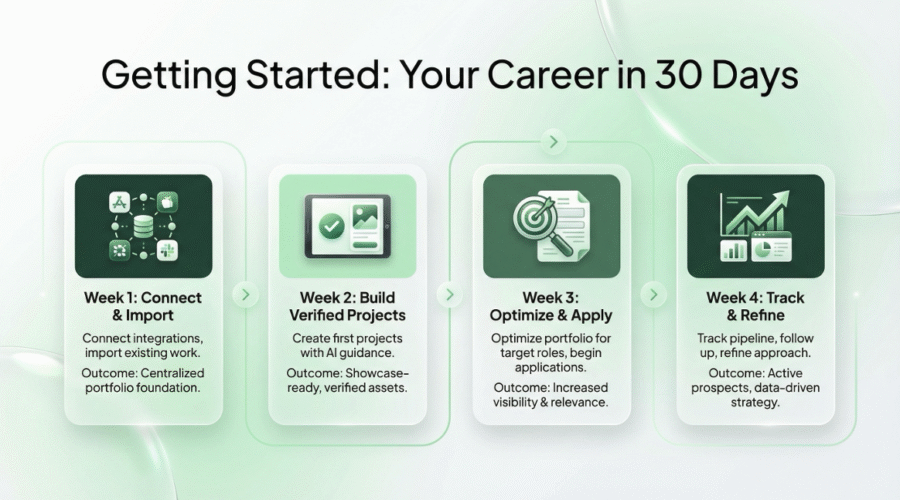
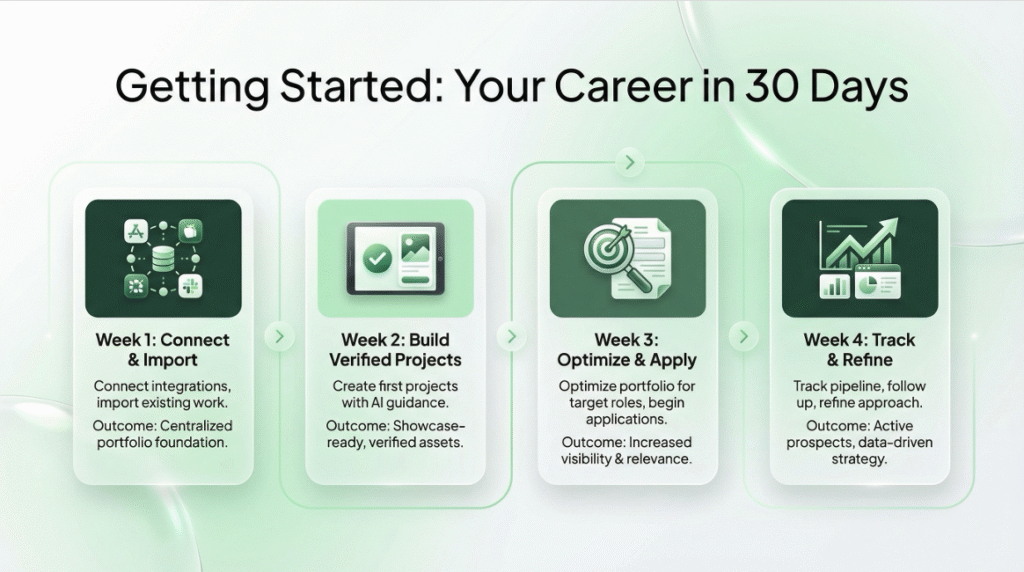
Week 1: Connect & Import
Outcome: Centralized Portfolio Foundation
The first problem most candidates face is fragmentation.
Work exists everywhere:
- GitHub repositories
- Notion pages
- Google Docs
- PDFs
- Coursework
- Freelance deliverables
- Unstructured notes
This fragmentation kills clarity.
Nap OS begins with consolidation.
1.1 Integrations & Data Aggregation
During Week 1, users connect their existing ecosystems:
- Code repositories
- Writing platforms
- Design files
- Project documentation
- Academic outputs
- Certifications
Nap OS ingests and structures this data into a unified profile layer.
This is not mere uploading.
The system parses:
- Skill signals
- Tool usage
- Domain themes
- Project complexity
- Evidence artifacts
The goal is to construct a career knowledge graph — a structured map of what you have actually done.
1.2 Skill Extraction & Mapping
Nap OS uses AI-driven analysis to:
- Identify recurring competencies
- Map them to market-relevant taxonomies
- Detect gaps in positioning
- Flag underrepresented strengths
Most candidates underestimate their own capability because they lack visibility into patterns across their work.
Nap OS surfaces that structure immediately.
1.3 Portfolio Baseline Creation
By the end of Week 1, you have:
- A centralized portfolio system
- Structured skill categories
- Evidence-linked projects
- A baseline competency map
- A clean, professional foundation
This is your career operating base layer.
No applications yet.
No optimization yet.
Just clarity.
Without clarity, optimization is noise.
Week 2: Build Verified Projects
Outcome: Showcase-Ready, Verified Assets
Week 2 shifts from consolidation to construction.
The labor market increasingly values proof of capability in real-world scenarios. Nap OS guides you to build targeted projects that demonstrate applied competence.
2.1 AI-Guided Project Design
Nap OS analyzes:
- Your existing skills
- Target industry roles
- Market demand trends
- Gaps in your portfolio
Then it recommends project blueprints designed to:
- Fill missing competencies
- Demonstrate applied problem solving
- Align with hiring filters
- Increase recruiter relevance
This is not random portfolio work.
It is strategically engineered output.
2.2 Structured Execution Framework
Each project inside Nap OS follows a structured execution architecture:
- Problem Definition
- Scope Clarification
- Tools & Methods
- Execution
- Metrics & Results
- Reflection & Learning
This ensures that every asset you create is:
- Clear
- Measurable
- Explainable
- Interview-ready
2.3 Verification Layer
Nap OS emphasizes verifiable output:
- Public repositories
- Measurable metrics
- Demonstrable code
- Documented case studies
- Performance benchmarks
Verification increases credibility.
Recruiters increasingly distrust vague claims like:
“Worked on marketing strategy.”
They trust:
“Increased CTR by 32% through A/B testing across 4 campaigns.”
Week 2 ensures your work speaks in outcomes.
2.4 Compounding Effect
By the end of Week 2, you possess:
- At least 1–3 high-quality, structured projects
- Market-aligned positioning
- Demonstrable results
- Interview narratives prepared in advance
This is the inflection point.
You move from applicant to operator.
Week 3: Optimize & Apply
Outcome: Increased Visibility & Relevance
Optimization is not about sending 200 applications.
It is about precision alignment.
Week 3 introduces intelligent positioning.
3.1 Role Targeting
Nap OS identifies:
- Realistic entry vectors
- Adjacent roles based on your strengths
- Market-aligned keywords
- Skill-match percentages
Instead of “I want to work in tech,” the system refines that to:
- Junior Data Analyst
- Growth Operations Associate
- Product Operations Coordinator
- AI Implementation Intern
Specificity increases conversion probability.
3.2 Portfolio Optimization for ATS & Humans
Nap OS restructures your portfolio for:
- Applicant Tracking Systems (ATS)
- Recruiter scanning behavior
- Hiring manager deep reviews
This includes:
- Keyword alignment
- Skill ordering
- Outcome framing
- Project prioritization
- Impact visibility
The goal is dual readability:
- Machine-readable
- Human-compelling
3.3 Application Strategy Layer
Nap OS encourages:
- Focused applications
- Role clustering
- Personalized messaging
- Project-based positioning
Instead of generic resumes, you deploy:
- Tailored project highlights
- Targeted competency framing
- Role-aligned evidence
This dramatically increases response rates compared to mass submission tactics.
3.4 Visibility Amplification
Week 3 also encourages public presence:
- Publishing case studies
- Sharing build logs
- Demonstrating learning velocity
- Engaging with industry communities
Visibility compounds opportunity.
By the end of Week 3, you have:
- Optimized assets
- Clear targeting
- Strategic applications in motion
- Active exposure in your domain
Week 4: Track & Refine
Outcome: Active Prospects & Data-Driven Strategy
Most applicants operate emotionally.
Nap OS forces data-driven iteration.
4.1 Pipeline Tracking
Inside Nap OS, users monitor:
- Applications sent
- Response rates
- Interview conversions
- Feedback patterns
- Skill mismatch signals
This creates visibility into performance.
4.2 Feedback Loop Analysis
If interviews stall at round one:
- Communication framing may need adjustment.
If no responses occur:
- Positioning or keyword alignment may require optimization.
If rejections cite missing skills:
- Targeted project builds are recommended.
Nap OS treats your career as an adaptive loop:
Input → Execution → Feedback → Optimization → Reattempt.
4.3 Strategic Refinement
Based on performance data, the system helps you:
- Adjust role targeting
- Upgrade specific skills
- Improve narrative articulation
- Strengthen proof of impact
Iteration replaces guesswork.
4.4 Momentum Layer
By the end of 30 days, users typically have:
- A structured portfolio
- Verified projects
- Applications in pipeline
- Clear skill direction
- Increased interview probability
- A repeatable career-building framework
But more importantly, they have a system.
Why 30 Days Matters?
Thirty days is long enough to build momentum.
It is short enough to avoid procrastination.
Nap OS compresses:
- Career clarity
- Skill articulation
- Portfolio building
- Strategic positioning
Into a structured sprint.
In a market where AI accelerates capability, the ability to adapt quickly is the differentiator.
Nap OS is built around adaptability.
The Deeper Architecture: Operating System Logic
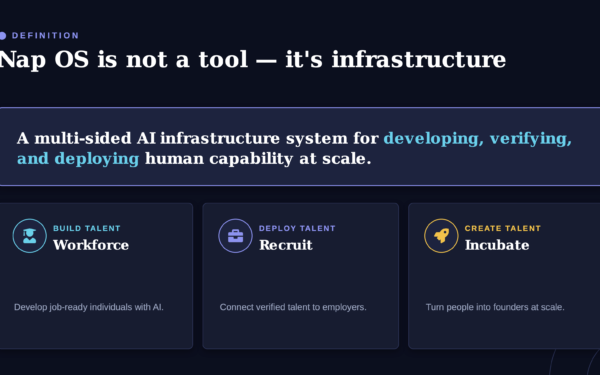
Nap OS is structured around four internal pillars:
1. Intelligence Layer
Analyzes user data, skills, and market signals.
2. Execution Layer
Guides project creation and structured output.
3. Optimization Layer
Aligns portfolio assets to real roles.
4. Feedback Layer
Uses performance data to refine strategy.
This layered architecture mirrors modern software systems — modular, adaptive, iterative.
Your career is no longer a document.
It is an evolving architecture.
The Real Problem Nap OS Solves
The biggest career bottleneck today is not lack of information.
It is:
- Lack of structure
- Lack of feedback
- Lack of verification
- Lack of strategic clarity
Nap OS removes ambiguity.
Instead of asking:
“What should I do?”
You see:
“Build this. Optimize that. Apply here. Improve this metric.”
Clarity reduces anxiety.
Structure increases action.
For Students, Graduates, and Career Switchers
Nap OS is especially powerful for:
- Entry-level candidates
- Internship seekers
- Self-taught learners
- AI-era professionals adapting to automation
- Early-career builders without elite networks
In an era where internships are shrinking and competition is global, proof becomes leverage.
Nap OS helps build that proof systematically.
Long-Term Compounding
The 30-day framework is the starting sprint — not the endpoint.
After 30 days, the system continues to:
- Track skill evolution
- Recommend new builds
- Detect industry shifts
- Adjust positioning
This creates a compounding advantage.
Small, structured improvements over months produce exponential career growth.
From Applicant to Asset Builder
Traditional job seekers wait for permission.
Nap OS users build.
They:
- Ship projects
- Measure outcomes
- Publish insights
- Track performance
- Iterate quickly
They stop asking, “Will someone hire me?”
They start proving, “Here’s what I can do.”
That shift changes everything.
The 30-Day Summary
Week 1 – Connect & Import
Centralize everything. Build clarity.
Week 2 – Build Verified Projects
Create strategic, measurable output.
Week 3 – Optimize & Apply
Align assets with real roles. Increase visibility.
Week 4 – Track & Refine
Measure, iterate, and improve conversion rates.
This is not motivation.
This is operational structure.
Final Thought
Careers in the AI era will not be defined by degrees alone.
They will be defined by:
- Adaptability
- Execution speed
- Evidence of capability
- Iterative improvement
Nap OS provides the framework to operationalize those traits.
Thirty days does not guarantee a job.
But it guarantees progress — measurable, visible, and structured.
And in today’s market, structured progress is the rarest advantage of all.
If your career is going to function like a system,
you need an operating system.
Nap OS is that system.
Getting started on your career journey has never been easier with the right tools and guidance. Connect with Nap OS and explore opportunities on LinkedIn.