Last updated: May 29, 2026
6 min read
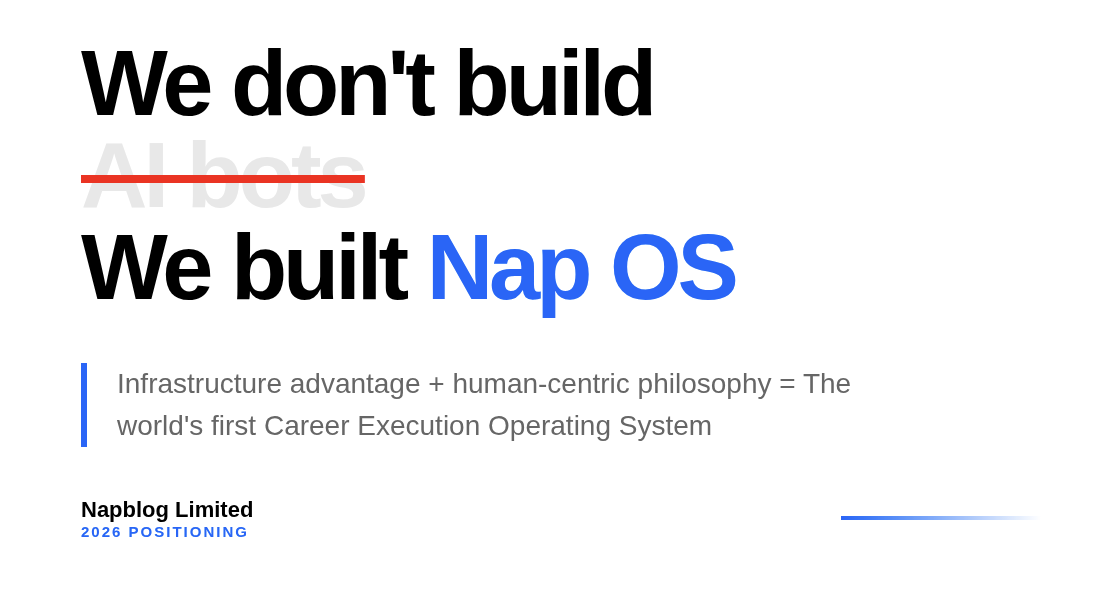
Everyone is building AI bots.
Every competitor in our space is racing to ship the next chatbot, the next AI assistant, the next automated workflow tool. It’s the obvious play in 2026. The market demands it. Investors fund it. Founders chase it.
At Napblog, we made a different choice.
Not because we can’t build AI bots—we absolutely could. Not because we’re contrarian for the sake of being different. But because we asked a question that most companies skip: What problem are we actually trying to solve?
The answer led us to build something fundamentally different. Not another AI tool. But a The Career Accelerator.
The Bot-Building Frenzy (And Why It Made Sense)
Let’s be clear: our competitors aren’t wrong to build AI bots. In fact, they’re making a rational decision based on where their economics lead them.
The AI-first product landscape of 2026 looks like this:
- High infrastructure costs: Most companies pay premium rates for cloud compute, third-party AI APIs, and scaling infrastructure
- Pressure to ship fast: Investors want to see AI features yesterday. Speed-to-market determines funding rounds
- Template thinking: If OpenAI has assistants, Anthropic has Claude, Google has Gemini—then every startup needs their own bot
- Shallow use cases: Most bots automate surface-level tasks—draft emails, summarize documents, answer questions
When your infrastructure is expensive and your timeline is compressed, you build what’s fastest: automation tools. You add AI to existing workflows. You wrap a chatbot interface around your product and call it innovation.
This isn’t criticism. It’s economics. But it creates a market saturated with sameness.
Our Secret Weapon: Cheap End-to-End Infrastructure
Napblog built its competitive moat years before anyone talked about GPT-4.
We invested in cheap, scalable, end-to-end infrastructure that gives us economic freedom our competitors don’t have. When your infrastructure costs are a fraction of the industry standard, you can afford to think differently.
What this means in practice:
- We don’t burn cash on cloud compute: Our systems run efficiently at scale without bleeding money on AWS bills
- We control the full stack: From data ingestion to neural network training to user interface—we own it all
- We can afford to go deep: While competitors rush to ship surface features, we invest in foundational systems
- We’re infrastructure-first, feature-second: Our systems are built for long-term depth, not short-term demos
This infrastructure advantage creates strategic optionality. When you’re not fighting to survive on slim margins, you can ask better questions. Like: What do humans actually need?
The Question That Changed Everything
With infrastructure freedom came philosophical clarity.
We looked at the career development landscape and saw a fundamental problem: People weren’t learning to think. They were learning to comply.
Traditional education systems measure compliance—did you complete the assignment, pass the test, get the credential? Even modern EdTech just digitizes this model. Gamified compliance. Automated testing. Online certificates.
But careers aren’t built on compliance. They’re built on execution. On thinking clearly. On asking better questions. On converting intention into evidence.
This realization split our path from every competitor.
They asked: “How can we automate learning?”
We asked: “How can we measure human execution in a way that creates evidence?”
They built bots to answer questions.
We built systems to capture how humans ask questions.
Why We Don’t Build Random AI Bots
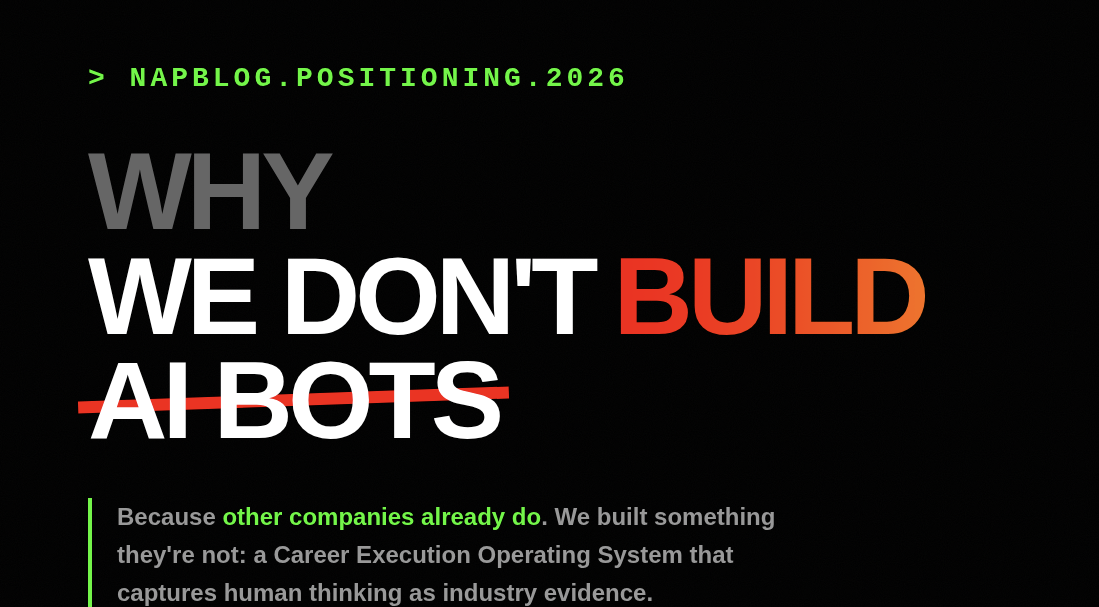
The reason we don’t build AI bots is simple: other companies are already doing it.
And they’re doing it well. OpenAI, Anthropic, Google, and hundreds of well-funded startups are racing to build better chatbots, automation tools, and AI assistants. They’re investing billions. They have massive teams. They’re good at it.
Why would Napblog compete in that saturated market?
Instead, we focus on what nobody else is building: systems that capture and visualize human execution as industry-standard evidence.
The difference is profound:
- AI bots automate tasks → Nap OS captures how you think while executing tasks
- AI bots answer questions → Nap OS logs the questions you ask (which reveals your thinking patterns)
- AI bots produce output → Nap OS generates evidence of your cognitive execution process
- AI bots replace human work → Nap OS amplifies human capability
We care about people’s thinking and questioning capabilities. Because in a world where bots can generate content, the differentiator is how you think, not what you produce.
Nap OS: A The Career Accelerator
From the Napblog Team’s perspective, building Nap OS was inevitable once we understood the problem.
The problem: Employers don’t trust credentials. Degrees don’t prove execution capability. Resumes are performative documents. Interviews are theatrical auditions.
The opportunity: What if you could generate industry-standard evidence of how you think, execute, and solve problems? What if your career development produced real data—not certificates, but neural execution patterns?
Nap OS is our answer. It’s not a learning platform. It’s an operating system for career execution.
What it does:
- NapStrom: Visualizes your neural execution patterns using feedforward neural networks. Shows how your brain processes different work modes
- Execution Logging: Captures every task, decision, and cognitive process you engage in. Creates a permanent record of your thinking
- NapProjects: Project management that focuses on execution evidence, not just task completion
- NapStore: Your profile system that compiles execution data into industry-readable evidence
- AI-Powered Skill Tracking: Uses behavioral analysis to identify skills you’re developing through execution, not through courses
The insight: Employers don’t hire credentials. They hire execution capability. Nap OS makes execution capability visible, measurable, and provable.
Our Philosophy: Humans First, Technology Second
This is the Napblog Team perspective that guides everything we build.
We believe human thinking is the most valuable asset in any economy. Not automation. Not efficiency. Not scale. How you think.
AI should amplify human cognition, not replace it. Technology should capture execution, not automate it away. Systems should make thinking visible, not obscure it behind black-box algorithms.
This is why we care about questioning capabilities. The questions you ask reveal your mental models. Your curiosity. Your approach to problem-solving. The angle you take on challenges.
When someone uses ChatGPT, the interesting data isn’t the AI’s response—it’s the human’s prompt. That’s where cognition lives. That’s what employers should evaluate.
Imagine a world where hiring decisions were based on your ChatGPT history—not because of what the AI said, but because of what you asked. What patterns emerge? What problems do you tackle? How do you break down complexity?
That’s the future Napblog is building toward. Evidence-based careers. Execution-first hiring. Operating systems for human development.
Why This Positioning Matters in 2026
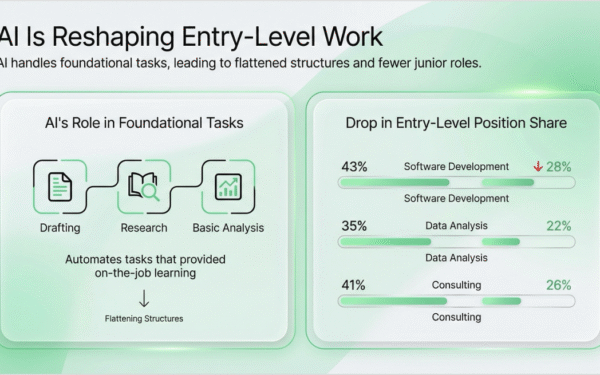
The AI-first world is saturated with automation. Students can generate essays. Professionals can draft reports. Developers can write code—all with AI assistance.
But this creates a credibility crisis. How do you prove you can do anything when AI can do everything?
The answer isn’t more credentials. It’s execution evidence.
Napblog’s competitive advantage is that we saw this problem before it became obvious. We built the infrastructure to solve it when our competitors were still chasing chatbot features.
Now, as the market realizes that AI bots are commoditized and credentials are devalued, Nap OS stands alone as the only system designed to capture human execution as industry evidence.
The Path Forward
We don’t build random AI bots because other companies are already building them. We don’t chase features because the market is saturated with feature wars.
Instead, we double down on what nobody else is doing:
- Building cheap, scalable infrastructure that gives us strategic freedom
- Focusing on human thinking and questioning capabilities over automation
- Creating systems that capture execution as evidence, not credentials as signals
- Building Nap OS as the world’s first The Career Accelerator
This is the Napblog way. Not chasing trends. Not copying competitors. But asking deeper questions about what humans actually need—and having the infrastructure to build it.
Because in a world where everyone can generate output, the competitive advantage is execution evidence.
And that’s exactly what we’ve built.
Napblog’s infrastructure advantage continues to shape the future of career technology. Follow our journey on LinkedIn.