Last updated: May 29, 2026
5 min read
For decades, recruitment systems have relied on resumes as the primary signal of candidate quality. Over time, resumes became less about truth and more about optimization. Candidates learned to reverse-engineer Applicant Tracking Systems (ATS) by stuffing keywords, inflating titles, and rephrasing job descriptions back to recruiters.
The result is a systemic failure:
- Recruiters receive hundreds of resumes that look perfect.
- Hiring managers struggle to differentiate genuine capability from polished wording.
- High-potential candidates—especially students, career switchers, international talent, and self-taught professionals—are filtered out early.
- ATS systems optimize for matching text, not verifying ability.
Why Hiring Is Broken—and Why Keywords Are the Problem?
Nap OS was built to challenge this foundation.
At the core of Nap OS sits Nappers Streak, an evidence-tracking system that replaces claims with proof, narratives with timelines, and static resumes with living, verifiable work history.
This is not a new resume format.
This is not a portfolio site.
This is not keyword optimization.
This is decision intelligence for hiring.
What Nappers Streak Actually Tracks (And Why It Matters)
Nappers Streak tracks daily professional intent and execution—not outcomes alone.
Instead of asking:
“What did you do in your last role?”
Nappers Streak answers:
“What have you been consistently working on—and can we see it?”
Core Evidence Dimensions Tracked
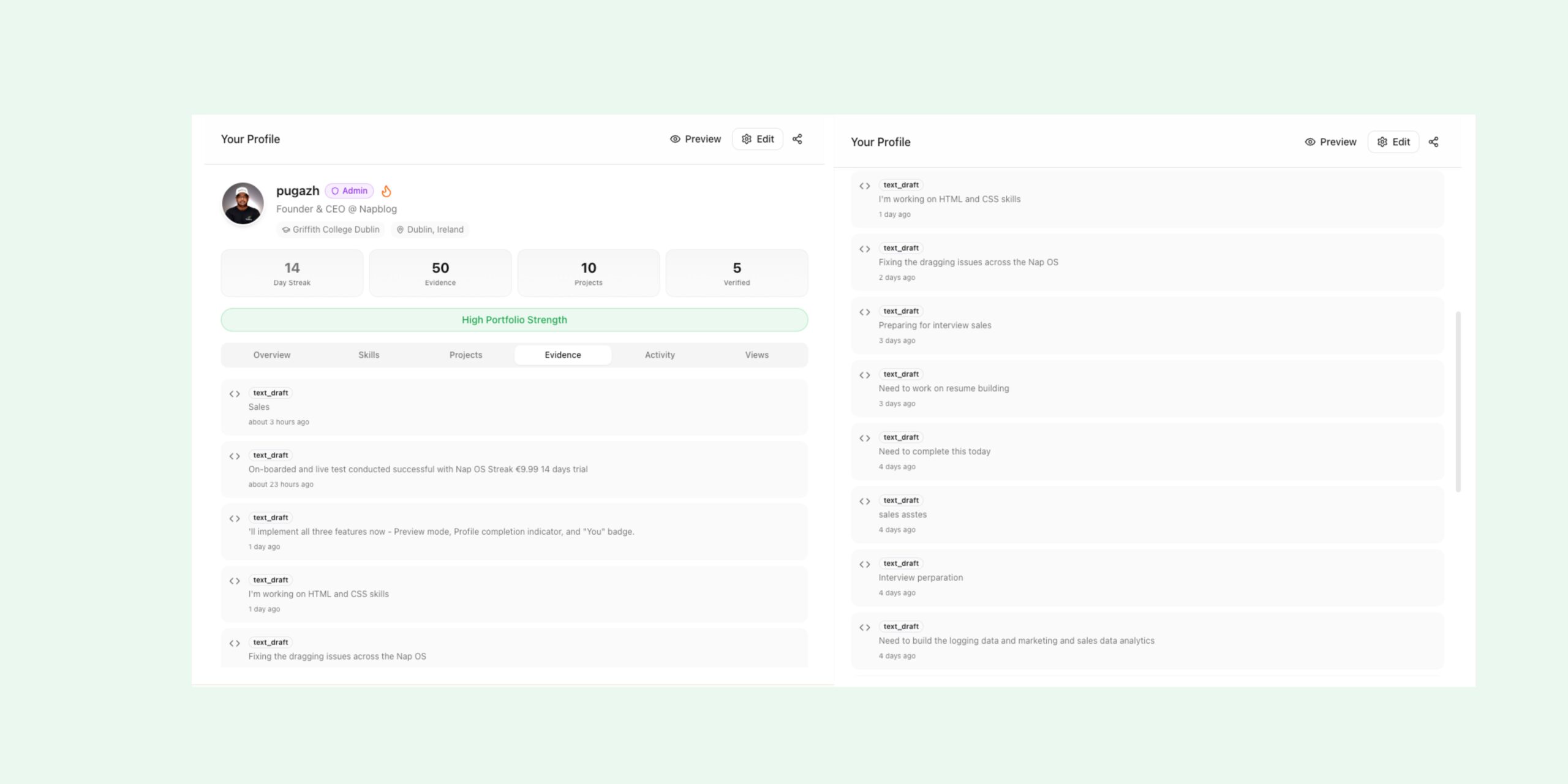
Each Nappers profile is built on five measurable pillars:
- Day Streak (Consistency Signal)
- Tracks how often a candidate logs meaningful professional activity
- Signals discipline, momentum, and execution reliability
- Evidence Count (Proof Density)
- Each log is not a note—it is an evidence unit
- Can include:
- Technical implementation notes
- Business decisions
- Product changes
- Learning milestones
- Interview preparation
- Client work progress
- Projects (Contextual Containers)
- Evidence is not random
- Every action is anchored to a project, goal, or outcome
- Verification (Trust Layer)
- Evidence can be system-verified, peer-validated, or outcome-linked
- Reduces exaggeration and misrepresentation
- Portfolio Strength (Signal Synthesis)
- Nap OS converts raw evidence into a readable strength indicator
- Designed for fast recruiter interpretation
This structure allows Nap OS to answer one critical hiring question better than any resume or ATS today:
“Is this person actually doing the work required for this role—right now?”
From Resume Claims to Evidence Timelines
Traditional Resume Logic
- Static
- Self-reported
- Optimized for keywords
- Updated once every few months
- Detached from real execution
Nappers Streak Logic
- Continuous
- Evidence-driven
- Timeline-based
- Updated daily
- Directly connected to work
Instead of reading:
“Experienced in HTML, CSS, and frontend development”
A recruiter sees:
- Daily logs showing:
- Fixing UI drag issues
- Refactoring layout logic
- Testing responsive breakpoints
- Shipping incremental improvements
- Time-stamped
- Sequential
- Verifiable
This shifts hiring from belief-based to evidence-based.
How Nap ATS Uses Evidence (Not Keywords)
Nap ATS does not match resumes to job descriptions.
It matches evidence patterns to role requirements.
Step 1: Job Description Decomposition
When a recruiter posts a role, Nap ATS breaks it into:
- Core skills
- Execution behaviors
- Consistency expectations
- Output frequency
- Learning curve indicators
For example, a “Frontend Engineer” role is decomposed into:
- UI implementation frequency
- Bug resolution cadence
- Framework usage over time
- Learning velocity
- Independent execution signals
Step 2: Evidence Pattern Matching
Instead of scanning resumes for words like React or CSS, Nap ATS looks for:
- Repeated frontend-related evidence entries
- Project-linked UI tasks
- Time spent resolving interface issues
- Incremental improvements over weeks
- Consistent engagement, not one-off projects
A candidate who has logged:
- 14 consecutive days of frontend-related work
- Across multiple projects
- With increasing complexity
Outranks someone with:
- “5 years experience” written once on a resume
Why This Is Critical for Recruiters and Hiring Managers
1. Faster Shortlisting With Higher Confidence
Recruiters no longer need to:
- Read inflated resumes
- Guess technical depth
- Schedule screening calls just to validate basics
Evidence timelines answer these questions upfront.
2. Reduced False Positives
Keyword-optimized resumes produce false positives.
Evidence-driven profiles eliminate them.
If a candidate claims:
“Strong in sales preparation”
Nap OS shows:
- Daily interview prep logs
- Pitch iteration notes
- Objection handling practice
- CRM workflow evidence
Or it shows nothing.
There is no ambiguity.
Why Decision-Makers Trust Nappers Streak
Because It Measures Behavior, Not Branding
Resumes are branding documents.
LinkedIn profiles are marketing pages.
Nappers Streak is a behavior log.
Behavior is the strongest predictor of future performance.
Because It Captures Momentum
Hiring is not about past glory.
It is about current readiness.
Someone actively preparing, learning, fixing, shipping, and iterating today is more valuable than someone with outdated experience.
Nap OS surfaces momentum visually and structurally.
Why Candidates Cannot Fake This System
Keyword stuffing works because resumes are static.
Nappers Streak requires:
- Daily engagement
- Continuous evidence
- Contextual consistency
- Time-based progression
You cannot fake:
- 14 days of real work
- Incremental improvements
- Logical progression of tasks
- Authentic execution notes
Any inconsistency becomes visible immediately.
The Strategic Advantage for Organizations
For Startups
- Hire builders, not talkers
- Identify doers early
- Reduce hiring mistakes
For Enterprises
- Reduce ATS noise
- Improve quality of hire
- Increase retention by hiring for consistency
For Universities & Accelerators
- Track real student progress
- Replace certificates with evidence
- Show employability outcomes
What a Recruiter Actually Sees
A recruiter opening a Nappers profile sees:
- Who the candidate is
- What they are actively working on
- How consistently they execute
- Which skills are practiced, not claimed
- Evidence mapped to role relevance
No guessing.
No assumptions.
No keyword manipulation.
Just signal.
The End of Resume-First Hiring
Resumes will not disappear overnight.
But they are no longer enough.
Nap OS does not replace resumes—it renders them secondary.
The future of hiring is:
- Evidence first
- Timelines over titles
- Consistency over claims
- Behavior over branding
Nappers Streak is not a feature.
It is a shift in hiring philosophy.
Final Thought for Decision-Makers
If your ATS is still ranking candidates based on:
- Keyword density
- Job title similarity
- Resume formatting
You are optimizing for presentation, not performance.
Nap OS Nappers Streak allows you to hire based on:
- What people are actually doing
- How consistently they do it
- Whether their work aligns with your role—today
That is not innovation.
That is overdue correction.
Move beyond resume keywords with evidence-based hiring through Nappers Streak. Connect on LinkedIn.