Last updated: May 29, 2026
6 min read
Why Connectivity Is the Missing Layer in Student Operating Systems
Most student platforms fail not because they lack features, but because they treat students as isolated users. Dashboards are personal. Portfolios are individual. Progress is private. Even when collaboration exists, it is shallow—comments, likes, or shared folders that do not translate into long-term signal.
NapOS was designed to challenge that assumption.
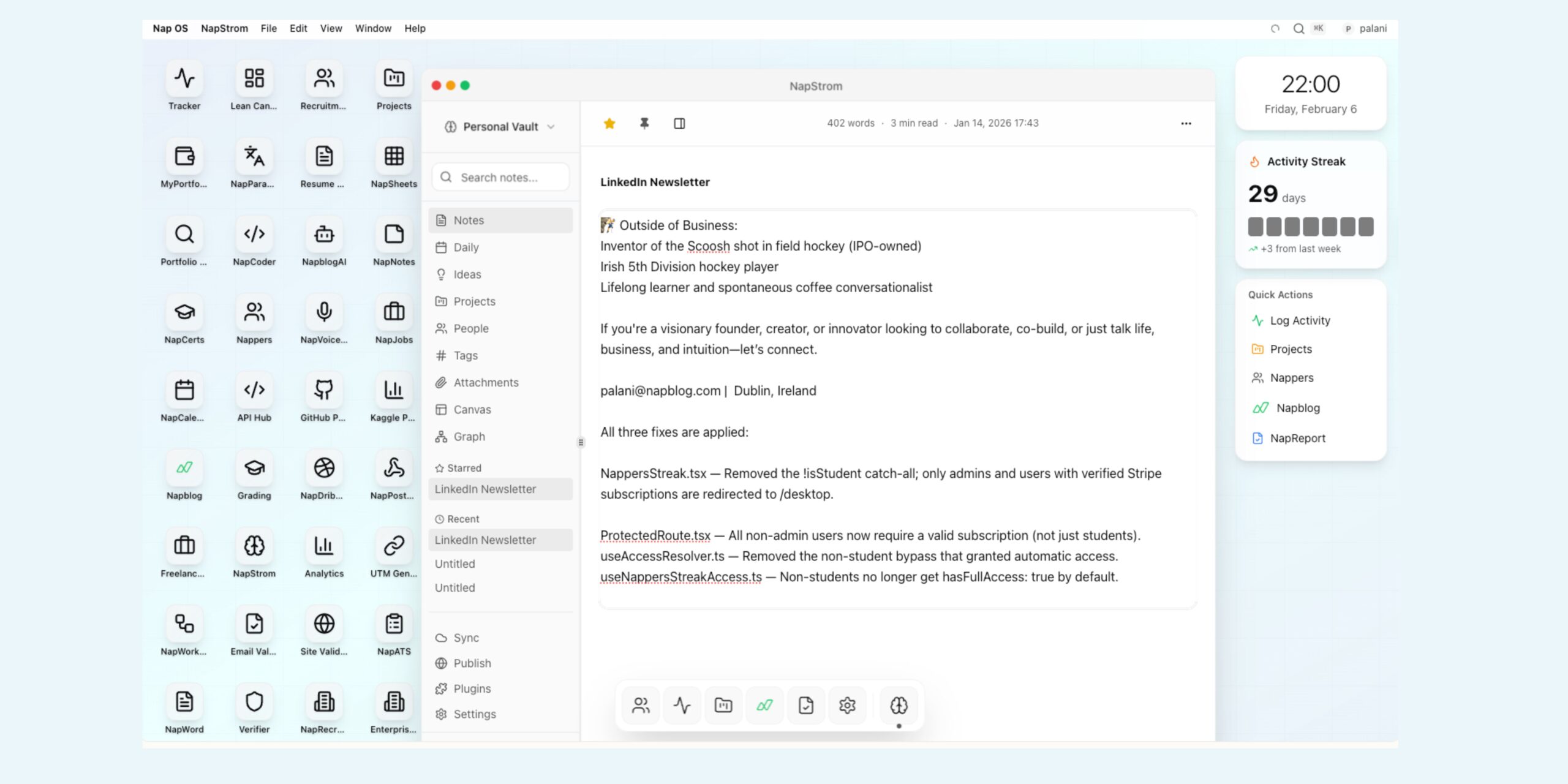
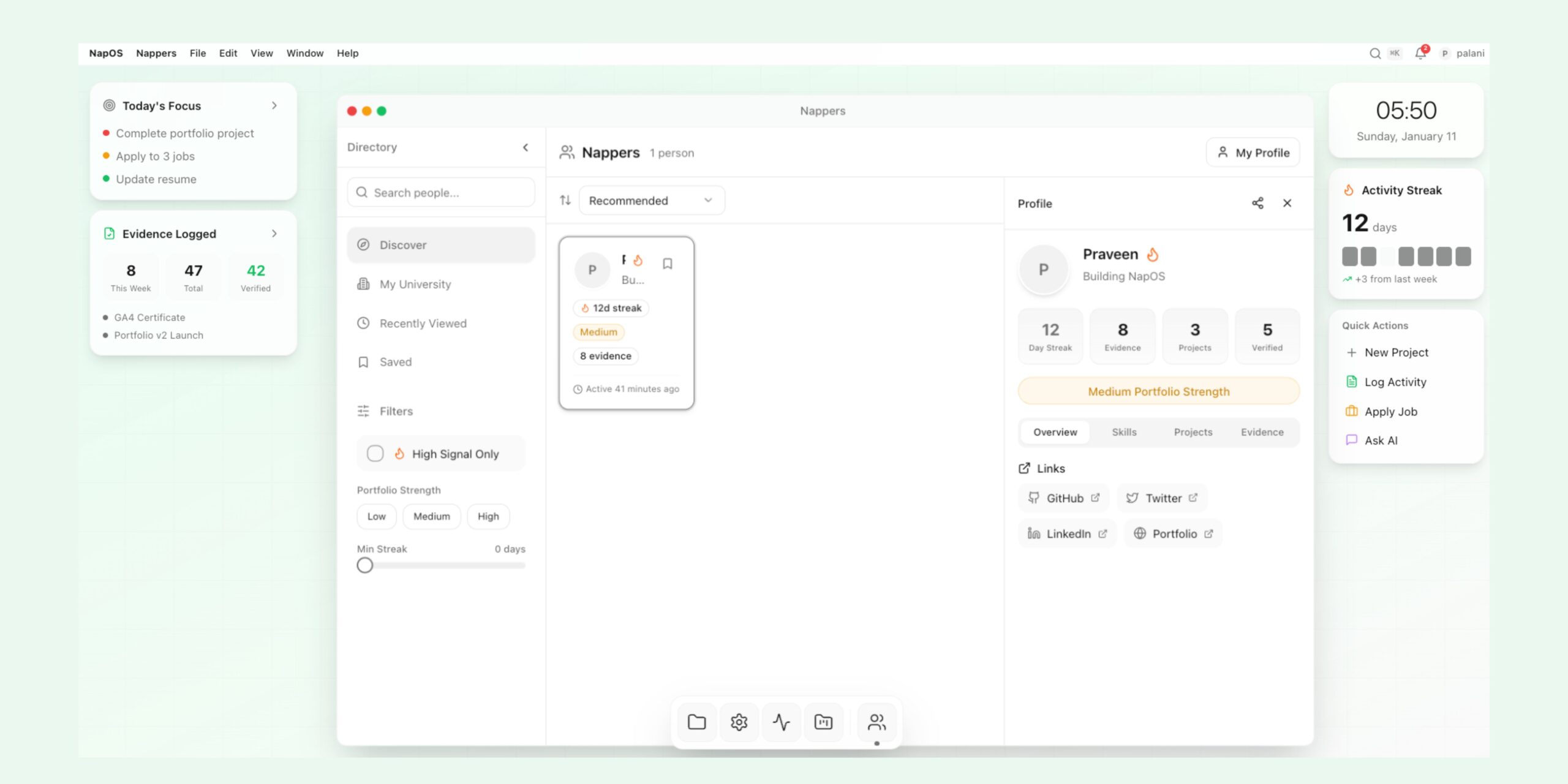
The Nappers Catalogue is not a contact list, not a social feed, and not a traditional network. It is a connectivity layer—a structured, evidence-aware, signal-driven directory of people operating inside NapOS. Its purpose is to turn fragmented individual effort into a visible, navigable, and compounding system of execution.
In NapOS, work matters only when it is logged, verified, connected, and reusable. Nappers is where this principle becomes visible.
What Is the Nappers Catalogue?
At a surface level, Nappers appears simple: a directory of people inside NapOS. But its true function is architectural.
Nappers is a live catalogue of execution profiles, where each individual is represented not by a bio or follower count, but by:
- Evidence logged
- Projects shipped
- Consistency streaks
- Verification status
- Portfolio strength
- Activity recency
This catalogue becomes the human index of NapOS—a way to explore the system through people rather than files or features.
Every Napper is not just a user. They are a node.
And nodes, when connected through shared signals, form a system.
From Contacts to Capability Maps
Traditional platforms store people as contacts:
- Name
- Photo
- Title
- Institution
NapOS stores people as capability maps.
Each Napper profile answers a more important question:
What has this person actually done, consistently, and recently?
Instead of static resumes, the Nappers Catalogue exposes living execution data:
- Active streaks show momentum
- Evidence counts show proof
- Projects show scope
- Verification shows credibility
- Portfolio strength shows readiness
This reframes connectivity from who you know to who is executing.
In an academic and early-career context, this shift is profound. Students no longer compete on polish or confidence alone. They surface through signal density.
Discovery as a First-Class Feature
One of the most important design decisions in Nappers is that discovery comes before connection.
Users do not need to “add” someone to benefit from their presence in the system. Instead, they can:
- Search people by name or signal
- Filter by portfolio strength
- Filter by streak length
- View only high-signal profiles
- Discover peers within their university
- Revisit recently viewed profiles
- Save profiles for later reference
This transforms Nappers into a learning surface.
Students begin to see patterns:
- Who is consistent?
- Who ships projects early?
- Who verifies evidence?
- Who is actively building?
Connectivity emerges naturally from observation, not forced networking.
The Role of Evidence in Connectivity
Evidence is the atomic unit of NapOS.
In the Nappers Catalogue, evidence does more than validate individual work—it becomes connective tissue.
When evidence is logged:
- It strengthens a profile
- It updates portfolio strength
- It contributes to streaks
- It increases discoverability
This creates a feedback loop:
- Work is done
- Evidence is logged
- Visibility increases
- Credibility compounds
- Connections become meaningful
Unlike social platforms where visibility is gamed, NapOS ties visibility to execution behavior.
This is why Nappers does not need likes, comments, or follower counts. The system already knows who is active and who is not.
Portfolio Strength as a Shared Language
One of the most subtle but powerful elements of the Nappers Catalogue is the portfolio strength indicator.
Low. Medium. High.
This simple classification acts as a shared language across the ecosystem:
- Students understand where they stand
- Peers understand readiness
- Mentors know where to guide
- Universities can assess progress at scale
Portfolio strength is not a judgment. It is a diagnostic signal.
Inside Nappers, it allows users to:
- Filter peers realistically
- Benchmark themselves
- Identify growth paths
- Avoid false comparisons
Most importantly, it grounds connectivity in reality, not aspiration.
The Profile Panel: A Living Execution Snapshot
Clicking on a Napper does not open a social profile. It opens an execution snapshot.
The profile panel is intentionally structured to answer four questions immediately:
- Are they consistent?
(Day streak) - Do they produce evidence?
(Evidence count) - Do they ship projects?
(Project count) - Is their work trusted?
(Verified evidence)
Everything else—skills, links, details—comes after.
This ordering is deliberate. NapOS prioritizes behavior over branding.
Links as Extensions, Not Substitutes
External links (GitHub, LinkedIn, Portfolio, Twitter) exist in Nappers, but they are secondary.
NapOS reverses the traditional hierarchy:
- External platforms show presentation
- NapOS shows process
This ensures that connectivity inside NapOS is grounded internally first. External links act as extensions, not proof.
For students, this is critical. It reduces anxiety around perfection and shifts focus toward daily execution.
Activity Streaks and Temporal Awareness
One of the most overlooked dimensions of connectivity is time.
Nappers surfaces temporal signals clearly:
- Day streaks
- Last active timestamp
- Weekly evidence counts
This answers a simple but powerful question:
Is this person active right now?
Connectivity becomes dynamic rather than historical. Students can align with peers who are currently building, not just those who once performed well.
This temporal awareness turns NapOS into a living system, not an archive.
Nappers as a Motivation Engine
Visibility changes behavior.
When students know that:
- Their streak is visible
- Their evidence count is visible
- Their activity status is visible
They behave differently.
Not out of pressure, but out of identity reinforcement.
Nappers creates a quiet but persistent motivation loop:
- Logging evidence feels meaningful
- Consistency feels rewarded
- Progress feels seen
This is motivation without gamification gimmicks.
University-Level Connectivity
At the institutional level, Nappers becomes even more powerful.
The “My University” view transforms Nappers into:
- A cohort map
- A progress dashboard
- A talent surface
Universities can:
- See aggregate execution behavior
- Identify high-performing students early
- Support struggling cohorts proactively
- Align curriculum with real execution gaps
This is not surveillance. It is operational insight.
From Networking to Signal Alignment
Traditional networking asks:
“Who should I talk to?”
Nappers reframes the question:
“Who is operating at a similar or aspirational execution level?”
This reduces noise and increases relevance.
Students connect not because they should, but because their work trajectories align.
Nappers as the Backbone of NapOS Connectivity
NapOS has many components:
- Trackers
- Evidence logs
- Workflows
- APIs
- Projects
- Automation
Nappers is what binds them together through people.
It is the human-facing index of the entire operating system.
Without Nappers:
- Execution remains isolated
- Progress remains private
- Learning remains fragmented
With Nappers:
- Execution becomes visible
- Progress becomes navigable
- Learning becomes communal
Long-Term Vision: A Verifiable Talent Graph
As NapOS evolves, Nappers naturally grows into something larger:
- A verifiable talent graph
- A skills-to-evidence map
- A longitudinal execution record
This has implications far beyond students:
- Hiring pipelines
- Internship matching
- Mentor discovery
- Peer learning networks
All without requiring students to “sell themselves.”
The system speaks on their behalf.
Conclusion: Connectivity Built on Proof, Not Performance
The NapOS Nappers Catalogue is not a feature. It is a philosophy made visible.
It asserts that:
- Connectivity should be earned through execution
- Visibility should be grounded in evidence
- Progress should be observable
- Motivation should be intrinsic
- Systems should reward consistency, not charisma
In doing so, Nappers transforms NapOS from a personal productivity tool into a collective execution ecosystem.
Not a network.
Not a feed.
Not a directory.
A living catalogue of people who are doing the work.
True connectivity means linking individual effort to a living system. See the Nappers Catalogue in action on LinkedIn.