Last updated: May 29, 2026
4 min read
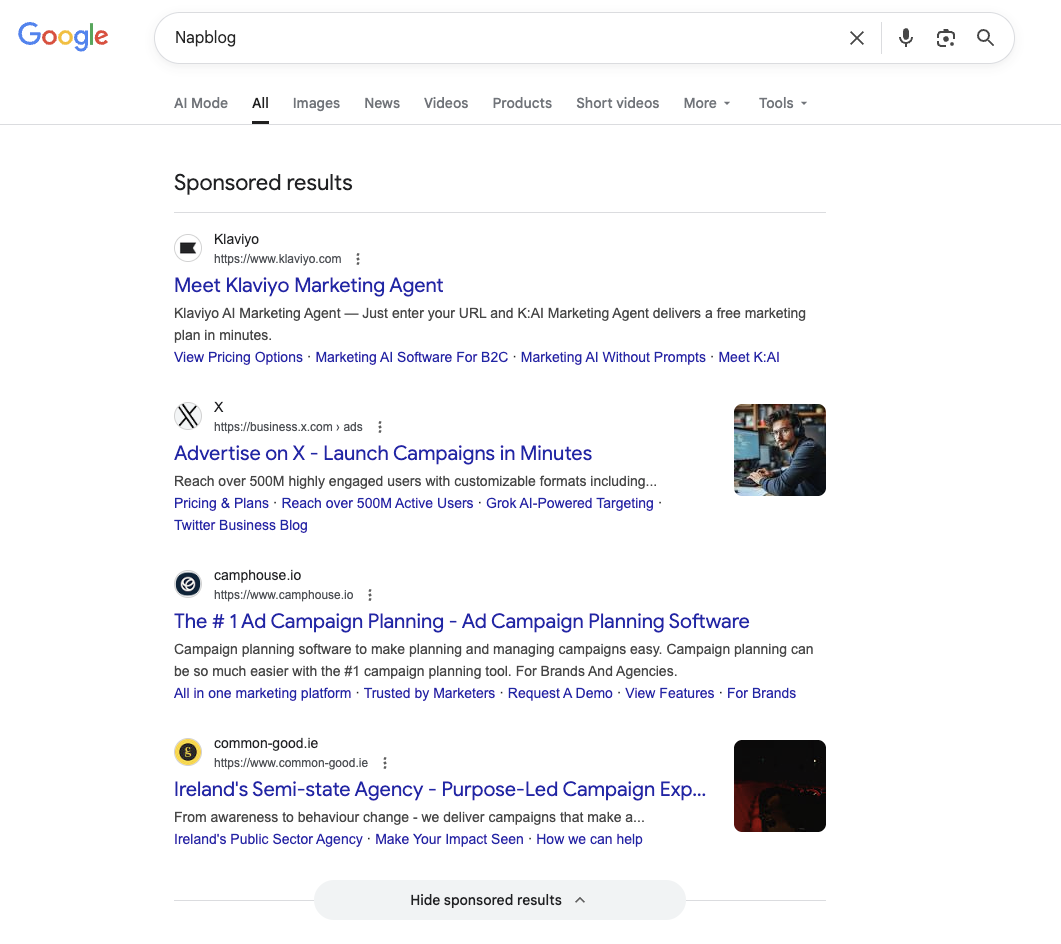
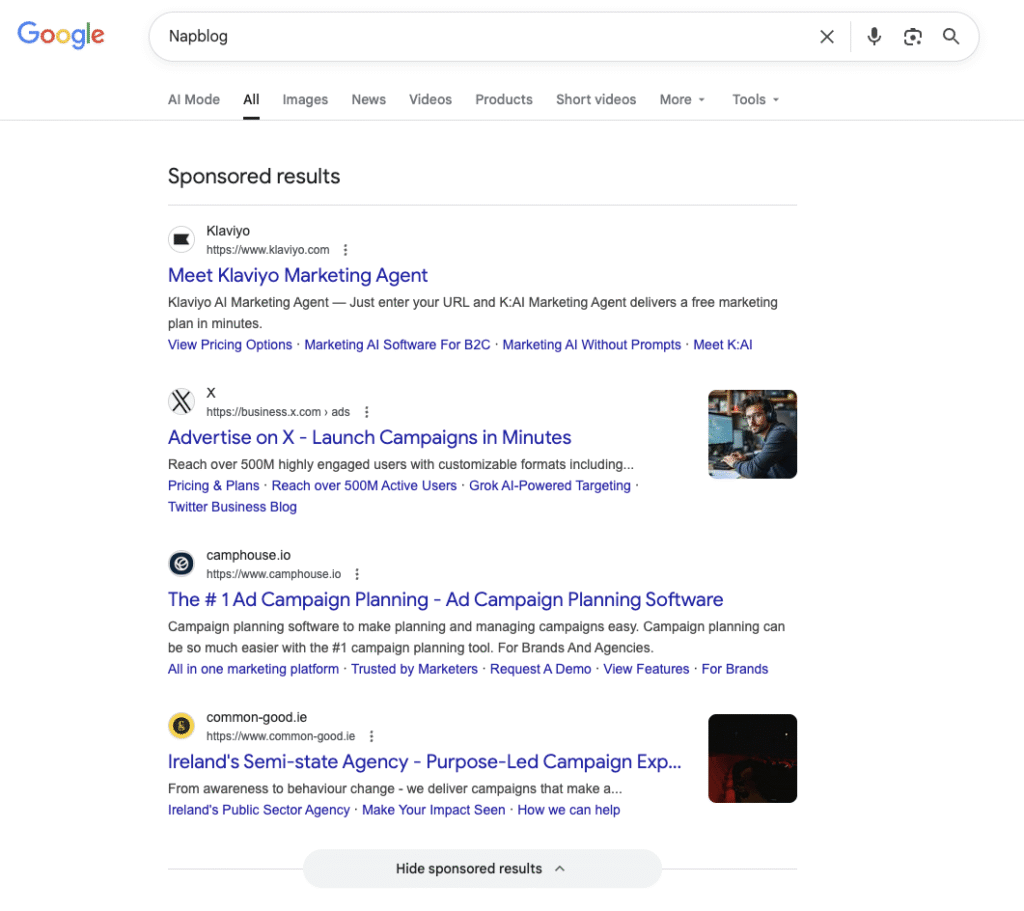
When someone searches for Napblog on Google and encounters sponsored results from global platforms, it is not accidental. It is a deliberate, data-backed decision by mature advertising organisations that understand one truth: branded keywords signal intent. This document analyses how top companies leverage competitor-branded searches—specifically around Napblog—to capture attention, redirect demand, and position themselves as alternatives or category leaders.
This is not a surface-level comparison of ad copies. This is a strategic examination of why companies like Klaviyo, X (formerly Twitter), Camphouse, and Common Good appear in sponsored placements, how their messaging is architected, and what it reveals about the current and future state of marketing competition.
The Strategic Context: Searching for Napblog
A branded search such as “Napblog” represents:
- High-intent curiosity
- Brand recall already established
- A user open to evaluation, learning, or comparison
For competitors, this is premium inventory. For Napblog, it is proof of market relevance.
The sponsored results shown are not random tools; they represent four distinct strategic archetypes:
- AI-first marketing platforms
- Global ad distribution networks
- Media planning and operations software
- Purpose-led communications agencies
Each competes differently, but all intersect at the same moment: attention.
Competitor 1: Klaviyo – Owning the AI Marketing Narrative
Ad Positioning
Klaviyo’s ad focuses on AI autonomy:
- “Meet Klaviyo Marketing Agent”
- “AI that does the work”
- “No prompts required”
This is not feature selling. It is labour displacement messaging—appealing directly to marketers overwhelmed by execution fatigue.
Strategic Objective
Klaviyo is not trying to steal Napblog users directly. Instead, it is:
- Anchoring itself as the default AI marketing platform
- Reframing marketing as an autonomous system
- Conditioning users to associate “modern marketing” with agent-based AI
Competitive Insight
Klaviyo’s weakness is also its strength: scale. It optimises for B2C CRM universality, whereas Napblog operates closer to idea velocity, experimentation, and strategic cognition.
Napblog is not competing with Klaviyo on automation. It competes on thinking.
Competitor 2: X Ads – Monetising Influence at Scale
Ad Positioning
X positions itself around:
- Reach (500M+ users)
- AI-powered targeting
- Lower CPMs
- Sales-driven outcomes
The tone is aggressive, performance-oriented, and numbers-heavy.
Strategic Objective
X Ads intercepts branded searches to:
- Capture advertisers evaluating alternatives
- Reinforce itself as a global attention engine
- Normalise ad buying as an extension of conversation
Competitive Insight
X sells distribution, not strategy. It assumes the marketer already knows:
- What to say
- Who to target
- Why the message matters
Napblog exists earlier in the chain—before media spend—where thinking, framing, and narrative formation occur.
Competitor 3: Camphouse – Controlling the Operations Layer
Ad Positioning
Camphouse uses credibility signals:
- “#1 Media Operations Platform”
- Testimonials
- Cost visibility
- Attribution and reporting
This is CFO-friendly language.
Strategic Objective
Camphouse targets:
- Enterprises
- Public institutions
- Multi-market advertisers
By bidding on Napblog, Camphouse is positioning itself adjacent to strategic planning conversations, not creative ones.
Competitive Insight
Camphouse assumes campaigns already exist. Napblog questions why campaigns exist at all.
Operations versus origination.
Competitor 4: Common Good – Purpose as Differentiation
Ad Positioning
Common Good is values-driven:
- Behaviour change
- Public interest
- Community impact
This is emotional, ethical advertising.
Strategic Objective
They aim to:
- Attract public sector and NGO budgets
- Signal moral credibility
- Differentiate from commercial ad agencies
Competitive Insight
Common Good competes in outcomes, not platforms. Napblog overlaps philosophically but diverges structurally: Napblog is not an agency—it is an ideation engine.
Cross-Competitor Pattern Analysis
1. Everyone Is Buying Thinking Time
Despite different surfaces, all competitors:
- Want early-stage attention
- Want to shape perception before decisions are made
- Value branded searches as cognitive entry points
2. AI Is Table Stakes
AI is no longer differentiation. It is assumed.
The real differentiation is:
- Who controls intent
- Who frames the problem
- Who defines success
3. Napblog Is the Signal
Competitors do not bid on irrelevant brands.
They bid on:
- Brands that generate thought
- Brands that influence exploration
- Brands that sit upstream of spend
Napblog’s presence in competitor ads confirms its strategic gravity.
What Napblog Represents to the Market
Napblog is not perceived as:
- A tool
- A channel
- A dashboard
Napblog is perceived as:
- A thinking surface
- A strategy generator
- A conceptual disruptor
This is why platforms with billions in valuation still feel the need to appear next to it.
Strategic Recommendations for Napblog
- Lean into Pre-Platform Identity
Napblog should position itself explicitly as the layer before CRM, ads, and media planning. - Own the Question Economy
While competitors sell answers, Napblog should own the questions. - Publish Competitive Intelligence Openly
Transparency itself becomes differentiation. - Reframe Competitor Ads as Validation
Every sponsored impression is proof of relevance.
Conclusion: Competition Is Recognition
Competitor ads on Napblog-branded searches are not a threat. They are a recognition signal.
In 2026, competition is no longer about features—it is about where thinking begins.
Napblog occupies that space.
And that is why the world’s largest platforms are paying to stand beside it.
Tracking competitor ads helps protect brand integrity. Stay updated with Napblog’s competitor insights on LinkedIn.