Last updated: May 29, 2026
5 min read
With increasingly obsessed with speed, valuation headlines, and “funding-first” narratives, the story of Napblog between 2024 and 2025 stands out for a different reason. It is not a story of sudden virality or oversized capital injections. It is a story of structure before scale, of services before platforms, and of people before pitch decks.
Between late 2024 and 2025, Pugazheanthi Palani transformed Napblog from a solo marketing practice into a deliberately layered ecosystem—combining client services, coworking energy, internships, incubation, and finally a platform vision (NapblogOS). This transition did not happen overnight, nor was it driven by external funding pressure. Instead, it was built step by step, funded by real client work, and shaped by lived experience in corporate roles, freelancing, and personal failure.
What emerged was not just another digital marketing agency, but a marketing execution and talent engine—one designed to serve SMEs, train future founders, and partner with institutions.
Late 2024: From Individual Expertise to a Service Studio
Napblog’s formal founding in Dublin in October 2024 marked the first structural shift. Until then, Pugazheanthi had spent years building hands-on expertise across PPC, SEO, analytics, automation, and content systems. Rather than packaging this as a personal brand consultancy, he made a conscious decision to position Napblog as a marketing automation and full-stack digital partner.
The emphasis in this phase was intentionally practical.
Napblog focused on SEO, SEM, marketing automation, analytics, and content execution for SMEs and startups across Ireland, the UK, and the United States. Clients came from grounded, operational industries—healthcare, construction, hospitality, and IT—sectors where marketing outcomes are measured not in impressions but in leads, bookings, and revenue.
This was not accidental.
Instead of pitching Napblog as a “visionary startup,” Pugazheanthi chose to build case studies, cash flow, and credibility first. The service-studio model ensured:
- Immediate revenue sustainability
- Real operational constraints to learn from
- Exposure to diverse client problems
- Proof of execution before abstraction
In a climate where many founders chase “idea-stage” funding without market validation, Napblog’s early phase did the opposite—execution first, narrative later.
2024–Early 2025: Shifting From Agency Thinking to Incubation Thinking
As client work stabilized, a deeper pattern emerged.
Pugazheanthi began framing Napblog not merely as an agency, but as a marketing incubation and execution ecosystem. This shift was rooted in personal history—years navigating corporate structures, freelancing uncertainty, and the silent failures that rarely appear on LinkedIn timelines.
Rather than isolating that experience, Napblog began to embed learning into live work.
The guiding philosophy became:
Thought-Inspired Action → Action-Oriented Results → Result-Oriented Services
This was not branding language. It shaped how Napblog operated:
- Blogs were written around real client problems, not SEO trends alone
- Campaigns started with a clear hypothesis, not generic best practices
- Automations were designed to scale what already worked, not mask weak fundamentals
In this phase, Napblog blurred the line between learning and execution. Marketing was no longer treated as a deliverable handed off to clients, but as a system that could be observed, tested, refined, and taught.
This mindset quietly laid the groundwork for incubation—without formally calling it that yet.
2025: Internships, Coworking Energy, and a Talent Engine
By 2025, Napblog’s evolution accelerated—not by adding layers of management, but by bringing people into the work itself.
Napblog began actively recruiting interns and early-career marketers, offering something that many academic programs and agencies struggle to provide: structured, real-world marketing execution.
Interns were not assigned hypothetical projects. They worked on:
- SEO audits for live client websites
- Paid campaign structuring and optimization
- Content strategy tied directly to conversion paths
- Analytics interpretation and reporting
This became what Napblog described as a global internship and AI-powered marketing model—where tools, automation, and mentorship intersected.
At the same time, Napblog adopted a coworking-style ecosystem mindset.
Instead of rigid hierarchies, the environment brought together:
- Interns
- Freelancers
- Mentors
- Early-stage founders
Selection moved away from traditional CV screening. Napblog experimented with:
- Peer voting
- Collaborative auditions
- Conversation-based selection
The result was cultural as much as operational. Interns were no longer passive learners. They became implementers, collaborators, and in some cases, “founders in residence.”
This model aligned directly with Napblog’s broader mission: transforming students into entrepreneurs before graduation, not years after.
Platform Thinking Emerges: NapblogOS
As the ecosystem matured, a natural question surfaced:
How does this scale beyond one company or one city?
The answer became NapblogOS.
Over 2024–2025, Pugazheanthi articulated NapblogOS as an Enterprise Marketing Incubator Operating System—designed not just for agencies, but for universities, incubation centres, and institutions.
NapblogOS represented a shift from services to systems:
- A repeatable framework for teaching marketing through execution
- Integrated tracking of skills, outcomes, and campaigns
- A bridge between education, employability, and entrepreneurship
This narrative allowed Napblog to engage with institutions not as a vendor, but as an infrastructure partner.
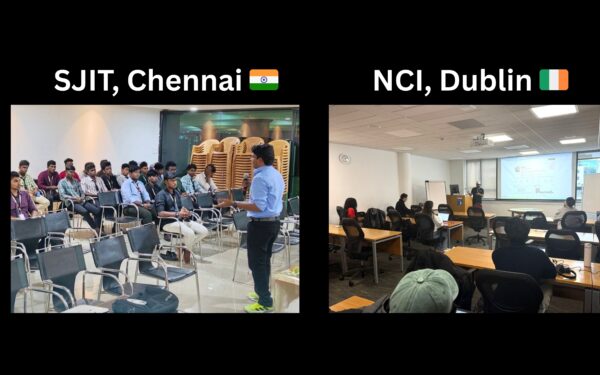
Appearances at ecosystem events like Jobs Expo Dublin and conversations with innovation hubs such as NDRC positioned Napblog within the broader Irish startup and talent ecosystem.
Napblog was no longer just “doing marketing.” It was designing pathways—from learning to execution to employability.
Culture, Storytelling, and Intentional Brand Building
Parallel to operational growth, Napblog invested heavily in public documentation.
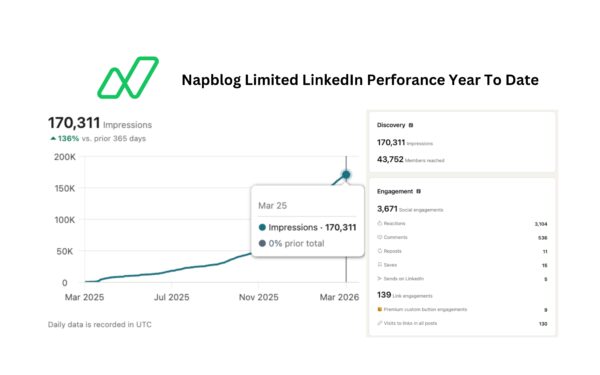
Through consistent blogs and LinkedIn articles—such as reflections on Napblog’s journey, 18-month milestones, and “celebrating little wins”—Pugazheanthi shaped a brand narrative rooted in:
- Resilience over hype
- Reflection over reaction
- Momentum over noise
Stories extended beyond wins. They included:
- The immigrant founder experience
- Graduation milestones
- Challenges like AI Overviews misrepresenting Napblog
Rather than damaging trust, this transparency humanised the brand.
Students, early-career professionals, founders, and partners resonated with a company that openly acknowledged uncertainty while continuing to build.
In an ecosystem saturated with polished success stories, Napblog’s intentional, documented growth between 2024 and 2025 became its differentiator.
Why This Transition Matters
Napblog’s 2024–2025 transition offers a counter-narrative to prevailing startup myths.
It shows that:
- Funding is not the only catalyst for scale
- Services can be a foundation, not a limitation
- Incubation can emerge organically from execution
- Platforms are strongest when born from lived systems
By turning solo expertise into a coworking + incubator ecosystem, layering services, internships, and eventually a platform, Pugazheanthi Palani built Napblog deliberately—one constraint at a time.
The result is not a finished story. It is a working system—still evolving, still learning, and still grounded in real outcomes.
And perhaps that is the most important lesson of Napblog’s 2024–2025 chapter:
sustainable companies are not rushed into existence; they are constructed—carefully, consistently, and in public.
Building a startup takes real work and long-term commitment. Follow the Napblog journey on LinkedIn.
Read more about the founder story on the Napblog blog.