Last updated: May 29, 2026
5 min read
International student mobility is one of the most regulated, high-stakes processes in global education. A single visa refusal can derail years of academic preparation, drain family finances, and permanently damage a student’s future immigration profile. For education consultants and institutions, visa rejections translate into reputational risk, operational inefficiency, and lost trust.
Despite this, visa assessment processes across the education consultancy ecosystem have historically remained fragmented, subjective, and reactive.
VRRI Consultant, a core module within SIOS – Students Ireland Operating System, was built to change this reality.
This article explores how VRRI Consultant systematically reduces student visa rejections by transforming visa assessment from a judgment-based activity into a structured, data-driven, preventative intelligence workflow—and the measurable outcomes it enables for students, consultants, and institutions.
The Structural Problem Behind Visa Rejections
Visa rejections are rarely caused by a single mistake. In most cases, they result from cumulative risk signals that go unnoticed until it is too late.
Across thousands of real-world cases, common patterns emerge:
- Weak financial documentation relative to course and country profile
- Inconsistent academic progression or unexplained study gaps
- Misalignment between student background and chosen program
- Insufficient home-country ties or unclear post-study intent
- Generic or poorly articulated Statements of Purpose
- Documentation inconsistencies introduced through manual handling
The problem is not a lack of effort. It is the absence of a systematic risk detection layer early in the process.
Most consultants still rely on:
- Spreadsheets
- Email threads
- PDF checklists
- Verbal experience and intuition
These tools are not designed to model visa officer decision logic, nor do they scale across teams, countries, or intake cycles.
Introducing VRRI Consultant: Visa Risk Intelligence as Infrastructure
VRRI Consultant is SIOS’s embedded Visa Rejection Risk Indicator system, designed specifically for education consultants managing international student applications to Ireland and other regulated destinations.
Rather than replacing consultants, VRRI augments them with real-time, evidence-based risk intelligence—before applications are submitted.
At its core, VRRI Consultant answers a single critical question:
“What is the likelihood that this student’s visa application will face objections—and why?”
But it does so in a way that is explainable, auditable, and operationally actionable.
How VRRI Consultant Works: From Case Intake to Risk Outcome
1. Structured Case Creation, Not Free-Form Guesswork
Every student case within SIOS enters VRRI Consultant through a structured data model, not an open-ended form.
Key dimensions include:
- Academic history and progression logic
- Financial capacity and source transparency
- Country-of-origin risk factors
- Course-to-background alignment
- Travel, visa, and immigration history
- Documentation completeness and consistency
This ensures no critical variable is overlooked due to human fatigue or time pressure.
2. Risk Signals Mapped to Real Visa Refusal Patterns
VRRI Consultant is built using aggregated intelligence derived from:
- Historical visa refusal reasons
- Education consultancy case outcomes
- Institutional compliance feedback
- Immigration authority documentation standards
Each data point is evaluated against known refusal triggers, not theoretical assumptions.
For example:
- A financial document is not just “uploaded”; it is evaluated against duration, liquidity, sponsor relationship, and plausibility benchmarks.
- A study gap is not just “explained”; it is assessed for narrative credibility and alignment with course choice.
3. Dynamic Risk Scoring, Not Binary Approval Logic
Unlike traditional checklists that result in “ready / not ready” decisions, VRRI produces a multi-level risk profile, typically categorized as:
- Low Risk
- Moderate Risk
- High Risk
- Critical Attention Required
Each risk level is supported by:
- Specific contributing factors
- Documentation gaps
- Narrative weaknesses
- Recommended corrective actions
This transforms visa preparation into an iterative risk-reduction process, rather than a one-time submission gamble.
Consultant Dashboard: Turning Intelligence into Action
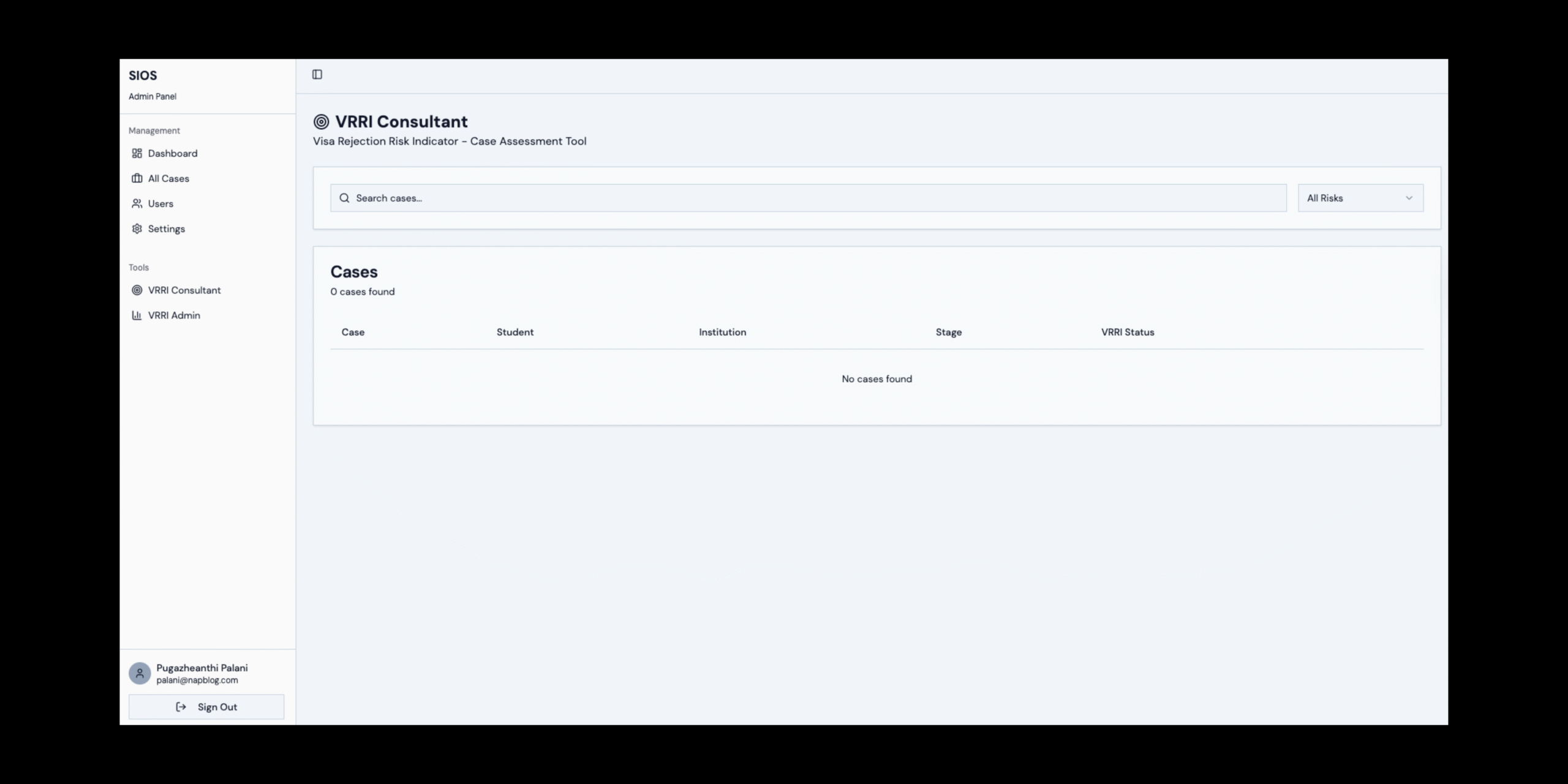
The VRRI Consultant dashboard is designed for operational clarity, not just analytics.
Consultants can:
- View all student cases with current VRRI status
- Filter cases by risk level, intake, or institution
- Identify bottlenecks across teams
- Prioritize high-risk cases early
Crucially, the system does not obscure judgment. It supports it.
Every risk flag is transparent, explainable, and traceable—allowing consultants to intervene intelligently rather than defensively.
Outcomes That Matter: Reduced Rejections, Predictable Success
1. Measurable Reduction in Visa Rejection Rates
Consultancies using VRRI Consultant report a significant decline in preventable visa refusals, particularly those related to:
- Financial inconsistencies
- SOP misalignment
- Documentation gaps
- Course justification weaknesses
By identifying risks months before submission, corrective measures can be implemented without panic or last-minute fabrication.
2. Improved Student Preparedness and Confidence
From the student’s perspective, VRRI introduces transparency into an otherwise opaque process.
Students:
- Understand why additional documents are required
- Receive early warnings about potential weaknesses
- Gain clarity on how visa officers may interpret their profile
This reduces anxiety, improves cooperation, and strengthens trust in consultants.
3. Operational Efficiency for Consultants
VRRI Consultant dramatically reduces:
- Repeated back-and-forth emails
- Manual document audits
- Subjective internal disagreements
- Last-minute emergency escalations
Consultants spend less time firefighting and more time advising.
The result is:
- Higher case throughput
- Lower operational stress
- More predictable timelines
4. Institutional Trust and Compliance Alignment
Institutions benefit indirectly but materially.
When consultants submit:
- Better-prepared students
- Cleaner documentation sets
- Realistic course matches
Universities face:
- Fewer visa-related dropouts
- Higher enrollment yield stability
- Improved compliance reputation
VRRI Consultant therefore acts as a quality control layer across the ecosystem.
From Reactive to Preventative: A Shift in Visa Strategy
Historically, visa processes have been reactive:
- Submission → Wait → Refusal → Explanation
VRRI Consultant inverts this logic:
- Assessment → Risk Detection → Correction → Submission
This shift is fundamental.
It reframes visa success as a managed outcome, not an act of luck or persuasion.
Ethical Design: Risk Reduction, Not Manipulation
A critical design principle of VRRI Consultant is compliance-first intelligence.
The system does not:
- Encourage misrepresentation
- Suggest document fabrication
- Promote unethical narratives
Instead, it highlights:
- Genuine weaknesses
- Structural misalignments
- Readiness gaps
The objective is not to “beat” visa officers, but to prepare students who genuinely meet the criteria.
This approach protects:
- Students’ long-term immigration records
- Consultants’ reputations
- Institutions’ regulatory standing
Why VRRI Consultant Is Not “Just Another Tool”
What differentiates VRRI Consultant is not the interface—it is the systems thinking behind it.
It is:
- Embedded into SIOS, not bolted on
- Designed for longitudinal case management
- Built for real consultancy workflows, not demos
- Grounded in real rejection data, not assumptions
It treats visa assessment as an engineering problem, not an art form.
Strategic Impact: Scaling Without Quality Loss
As consultancies scale, the greatest risk is inconsistency.
VRRI Consultant enables:
- Standardized assessment across teams
- Knowledge transfer from senior to junior consultants
- Reduced dependency on individual intuition
This allows firms to grow without compromising visa success rates.
Conclusion: Visa Success as a System Outcome
Visa rejections are not random events. They are the predictable result of unmanaged risk.
With VRRI Consultant, SIOS introduces a new operating standard for international education:
- Predictable
- Transparent
- Preventative
- Scalable
For students, it means fewer rejections and clearer pathways.
For consultants, it means control, credibility, and efficiency.
For institutions, it means stability and compliance confidence.
VRRI Consultant is not about increasing approvals at any cost.
It is about ensuring that every application submitted is defensible, coherent, and genuinely ready.
In an era of tightening immigration scrutiny, that is not optional—it is essential.
Reducing visa rejection rates is critical for international students. Learn more about SIOS on LinkedIn.
Read more about how SIOS supports students on the Napblog blog.