Last updated: May 29, 2026
7 min read
Every morning at Napblog, before the world wakes up and opens its laptop, our dashboards are already alive — humming, blinking, whispering small signals that something new has entered the digital battlefield.
Some days, it’s expected.
Some days, it’s a pure surprise.
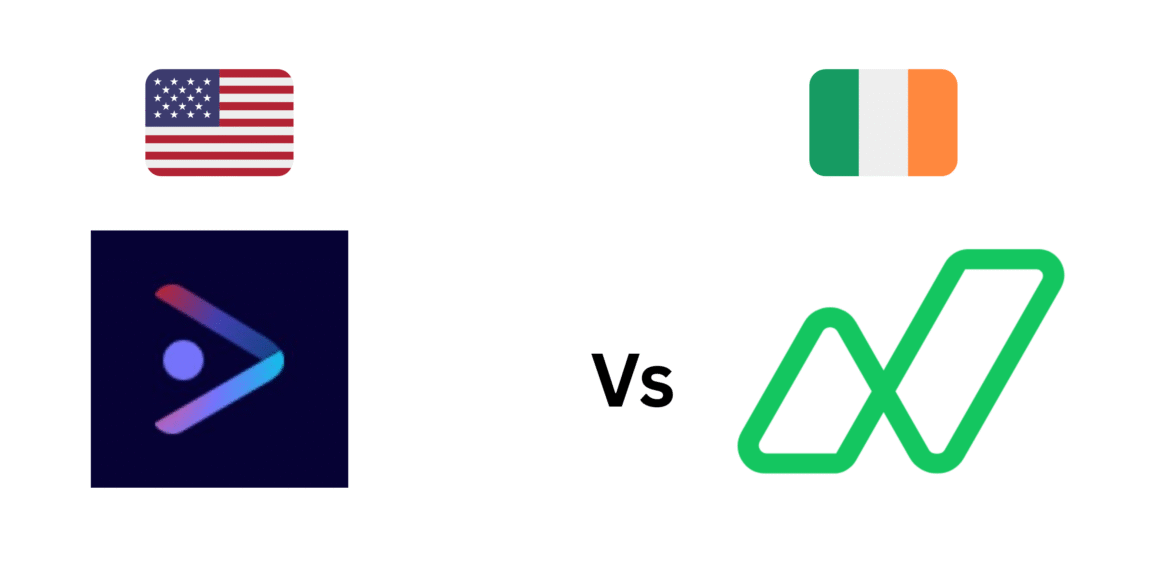
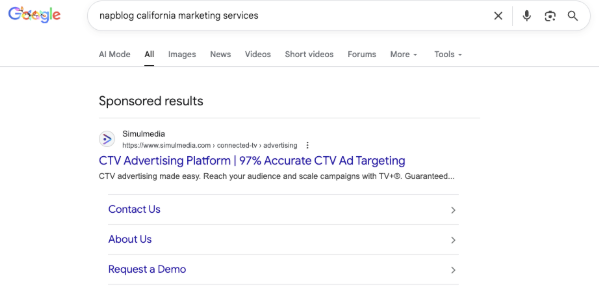
And some days — like today — it’s a New York–based cross-channel TV advertising giant suddenly bidding on a search term like “Napblog California marketing services.”
That’s exactly what happened when we noticed a new USA Google Ads competitor: Simulmedia—a company known primarily for CTV, linear TV, and predictive media buying—showing up on a Napblog-specific keyword.
So why is a TV advertising powerhouse spending money on a search term tied to a digital-first marketing R&D firm based in California?
Why would an enterprise tech company divert budget into such a narrow, almost niche keyword?
And more importantly:
What can every enterprise learn from moments like this?
How does Napblog turn these competitive signals into strategic advantage for the brands we serve?
Let’s break it down.
Chapter 1 — When a Competitor Appears on Your Branded Search, It’s Never an Accident
Brand bidding is a game of intention.
Companies don’t accidentally fall into your branded keywords.
They choose them.
It means one of three things:
1. They’re expanding aggressively into your vertical
Simulmedia traditionally focuses on TV+ (linear + CTV) performance advertising, but when they start bidding on marketing-services keywords, especially region-specific ones like “California,” it signals territory expansion.
2. They’re watching your audience behavior
If people searching for Napblog are also high-intent marketing buyers, then you attract the kind of audience they want.
3. Your brand name is converting
Nobody spends money on a non-performing keyword.
If they are bidding against Napblog, it means:
- Your traffic is valuable
- Your audience is relevant
- Your brand is showing momentum
This isn’t a threat—it’s a compliment.
A very expensive compliment.
Chapter 2 — Enterprise Buyers Don’t Live in One Channel Anymore
Simulmedia’s core strength is TV+.
Napblog’s strength is multi-channel digital R&D.
But what enterprise clients need in 2025 is both:
- Search
- Social
- Long-form storytelling
- Real-time content production
- Brand-specific creative research
- TV/CTV retargeting
- Domain authority growth
- Behavioral psychology-based ads
Enterprise buying journeys no longer happen in one lane.
They take place across 26–64 touches, depending on the industry.
That means even a TV giant is now entering PPC bidding wars—because enterprise customers don’t stay in one lane. They jump across screens, tabs, apps, thoughts.
Napblog studies that human behavior deeply.
Not from a software dashboard.
But from daily R&D, live tests, creative simulation, and behavioral mapping.
That’s why our clients stay ahead, even when unfamiliar competitors suddenly show up on familiar keywords.
Chapter 3 — The Hidden Story Behind Simulmedia’s Appearance
Let’s look at the broader context.

Simulmedia positions itself as:
- A turnkey growth partner
- With data-science-powered TV advertising
- Serving major enterprise brands like Mass Mutual, Monster, Electrolux, Choice Hotels
So when they appear under:
“napblog california marketing services”
It signals that they are:
→ Expanding Attention to Digital-First Service Buyers
They want the same enterprise decision-makers who look for Napblog.
→ Matching Intent Signals From Your Audience
If people who search Napblog later search for TV or cross-channel solutions, Simulmedia wants to intercept.
→ Testing Long-Tail Conversions
Enterprise marketers know:
Long-tail keywords convert better than broad keywords.
Simulmedia launching tests on long-tail, region-specific, brand-adjacent queries means they’re looking for:
- Cheaper CPC
- Higher conversion probability
- Higher intent users
This is exactly the kind of keyword where Napblog has dominated organically.
Which makes your keyword an attractive target.
Chapter 4 — What Clients Often Misunderstand About Competitor Bidding
Enterprises often ask Napblog:
“Should we be worried when competitors bid on our keywords?”
Short answer: No.
Long answer: You should be prepared, not afraid.
Competitor bidding is normal, predictable, and sometimes even useful.
It helps you understand:
- Market movement
- Budget patterns
- Competitor expansion
- Audience shifts
- Industry pressures
- New threats and opportunities
The presence of Simulmedia doesn’t reduce Napblog’s influence.
It increases it.
Because sophisticated companies don’t spend money on irrelevant traffic.
They spend money where value is already proven.
Your brand is becoming that value.
Chapter 5 — How Napblog Helps Enterprise Brands Turn Competitor Bidding Into Strategic Advantage
Here is where Napblog’s marketing R&D DNA becomes invaluable.
When we build Google Ads or Meta Ads for enterprises, we don’t just “run campaigns.”
We build systems.
1. Brand Defense Systems
We prevent competitors from taking your traffic.
Not just with bidding—but with psychological intent capture, using:
- Semantic keyword clusters
- Brand-aligned emotional anchors
- Multi-format serp domination
- Remarketing with high-value creative
2. Competitive Intelligence Layers
Napblog monitors:
- Keyword auctions
- Impression share
- Competitor landing pages
- Budget patterns
- Shifts in messaging
- Region-based bidding experiments
This is the intelligence we apply when new players appear—just like Simulmedia did with our keyword today.
3. Creative War Rooms
Unlike traditional agencies, Napblog runs:
- Hourly idea labs
- 24/7 brainstorm calendars
- Daily narrative iterations
- Vibration-mapping for creative tone
- Pattern-testing through micro-ads
This is why Napblog content cuts through noise—and why our clients dominate their markets even when bigger players enter.
4. Revenue-First Ad Architecture
Our ads don’t start with design.
They start with predicted revenue pathways.
We map:
- Buyer psychology
- Search behavior
- Emotion activation points
- Decision triggers
- Friction points
- Market timing cycles
This turns your Google Ads from “campaigns” into predictable growth engines.
Chapter 6 — The Story Enterprises Need To Hear Right Now
Let me bring this back to you—the enterprise business leader reading this.
You’re not paying for ads.
You’re paying for market position.**
When Simulmedia bids on Napblog keywords, it reflects a simple truth:
Enterprise brands will always have new competitors, new channels, new threats, and new noise.
What decides whether you grow or stall is not the presence of competitors—
It is the quality of the system guiding your brand.
Napblog was built to be that system.
Not a marketing agency.
Not a campaign vendor.
But an R&D engine that constantly monitors, adapts, simulates, and evolves strategy before the competition even wakes up.
Your brand doesn’t need more ads.
It needs more intelligence.
More precision.
More understanding of human behavior.
More awareness of competitor movement.
More ability to turn threats into signals and signals into breakthroughs.
That is what Napblog delivers.
Chapter 7 — Why This Moment Matters (More Than You Think)
Simulmedia is not a small competitor.
They are a 15-year veteran, data-science-driven, TV industry leader.
If they are bidding on keywords tied to Napblog, it means:
- Your brand is crossing categories
- Your influence is expanding beyond your industry
- Your audience resonates enough to attract national players
- Your search term has commercial value
This is the moment enterprises must recognize:
→ If your brand is valuable enough to be targeted,
it is valuable enough to be protected.**
Napblog is built for that protection.
Not reactive.
Proactive.
We build search moats, narrative walls, and emotional resonance deep enough that even large competitors can’t duplicate or intercept.
Because enterprise growth is not about defending traffic—it’s about owning mindshare.
Chapter 8 — The Real Value Napblog Brings To Enterprise Clients
Here’s what we’ve learned managing and studying global brand movements:
1. Ads are commodities.
Strategy is not.**
Anyone can run a Google ad.
Only a few can influence a category.
2. Competitors can buy your keyword.
They cannot copy your DNA.**
Your story.
Your energy.
Your thinking.
Your emotional connection with your audience.
3. Market leadership is a psychological game.
Napblog understands how to build memory, familiarity, and subconscious influence in enterprise buyers.
4. Enterprise brands grow when they stop chasing competitors
and start studying behavior.**
Napblog’s strength is decoding behavior:
- how buyers think
- when they engage
- why they convert
- what triggers belief
- what eliminates doubt
This is why our clients outperform even bigger rivals.
Chapter 9 — A Final Note to All Enterprise Readers:
When you see a new competitor on your branded search, don’t panic.
Don’t cut budgets.
Don’t switch agencies out of fear.
Instead, ask:
“What does this signal tell me about my brand?”
“How can I convert this into strategic advantage?”
“Who can help me turn competitive pressure into category leadership?”
That’s where Napblog thrives.
We don’t just run your ads.
We anticipate threats,
analyze movements,
and engineer high-performance pathways that keep you ahead—
even when unexpected competitors enter your lane.
Simulmedia entering the Napblog keyword today was not an interruption.
It was a reminder.
A reminder that the brands growing the fastest are the brands studying the battlefield—not reacting to it.
And Napblog will always be your partner on that battlefield.