Last updated: May 29, 2026
7 min read
By Napblog | October 2025
Artificial intelligence is no longer the future — it’s the present. Yet as AI tools become woven into everything from design to healthcare, the real differentiator isn’t access to technology — it’s literacy. Who understands AI? Who can use it responsibly? And who will lead the next generation of AI innovation in Europe?
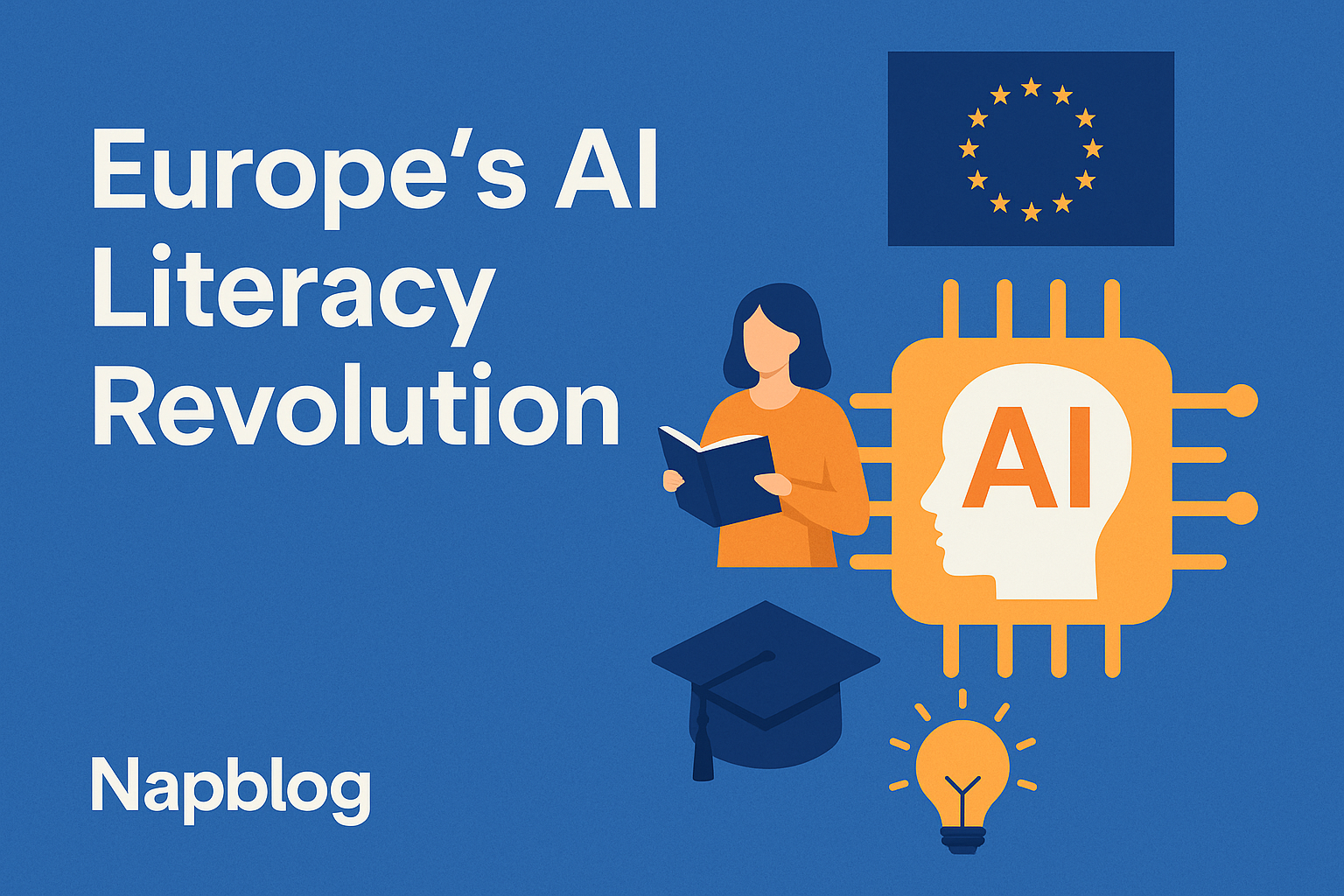
The European Commission’s recent initiatives, including Article 4 of the AI Act (which took effect in February 2025) and the AI Continent Action Plan (published in April 2025), signal a clear shift: Europe wants to be the global leader not just in AI regulation, but in AI education.
At Napblog, where we explore the intersection of technology, creativity, and learning, this transformation resonates deeply. Let’s unpack what these new developments mean — for companies, workers, and the next generation of digital creators.
1. A New Chapter in Europe’s Digital Story
For years, the EU has emphasized ethical and human-centric AI. But 2025 marks a pivot from principles to practice. With the AI Act officially coming into force, Europe now has the world’s first comprehensive legal framework governing artificial intelligence.
While much of the conversation has focused on compliance, Article 4 introduces something far more human: AI literacy.
In essence, Article 4 requires every provider and deployer of AI systems — from startups to corporations — to ensure that their teams possess a “sufficient level of AI literacy.” This means organizations can no longer treat AI as a black box handled only by data scientists. Every person who touches, trains, or deploys an AI tool must understand how it works, what its risks are, and how to use it responsibly.
That’s a powerful cultural shift. It’s no longer enough to have an AI department; every department must understand AI.
2. Why AI Literacy Matters
At Napblog, we see AI literacy not as a technical skill, but as a new form of digital citizenship.
Think about how computer literacy transformed the 1990s. Suddenly, people who could navigate email, spreadsheets, and web browsers gained a professional edge. AI literacy is the same — but amplified.
To be AI-literate is to:
- Understand what AI can and cannot do.
- Recognize bias and misinformation in automated outputs.
- Ask critical questions about data sources and model training.
- Use generative tools ethically and transparently.
This isn’t just about coding or algorithms — it’s about judgment. When AI systems are used in recruitment, healthcare, or education, literacy ensures fairness and accountability.
The EU’s insistence on literacy reflects a broader truth: a society that doesn’t understand its tools risks being controlled by them.
3. The AI Continent Action Plan: Building the Talent Pipeline
In April 2025, the European Commission released the AI Continent Action Plan, a roadmap designed to make Europe a global hub for AI research and expertise.
Its core idea is simple yet ambitious: train, retain, and attract AI talent.
The plan outlines several initiatives, each with a specific focus:
a. Training the Next Generation
Europe will expand its offering of AI-focused bachelor’s, master’s, and PhD programs, and launch the AI Skills Academy — an educational hub for both students and professionals.
What’s exciting is the emphasis on generative AI. The Academy will offer specialized programs in this rapidly evolving field, including pilot degrees, apprenticeships, and research partnerships.
At Napblog, we view this as more than an academic project. It’s an opportunity to integrate creativity, critical thinking, and technology — preparing students not just to build AI, but to co-create with it.
b. Retaining and Re-engaging European Talent
Europe has long struggled with “brain drain,” as top researchers migrate to Silicon Valley or Asia. The Action Plan aims to reverse that trend by offering AI fellowship schemes and returnship opportunities, encouraging European AI professionals abroad to come home.
This signals confidence in Europe’s growing digital ecosystem. With new funding channels and research partnerships, the continent is positioning itself as an attractive environment for AI innovation.
c. Attracting Global Experts
Europe isn’t closing its doors — it’s opening them wider. Through initiatives like the Talent Pool, Talent Partnerships, and Marie Skłodowska-Curie Actions (MSCA Choose Europe), the EU hopes to draw top AI minds from around the world.
These programs make it easier for researchers and professionals to work in EU-based entities, offering long-term prospects and support for permanent positions.
The message is clear: Europe doesn’t just want to use AI — it wants to shape it.
4. Upskilling the Workforce
Beyond universities and research labs, the AI Continent Action Plan also focuses on workers in every sector.
European Digital Innovation Hubs (EDIHs) will play a key role in offering AI training, especially for small and medium-sized enterprises (SMEs) that may lack resources to develop in-house expertise.
At Napblog, we’ve seen firsthand how small businesses can transform with even modest AI adoption — automating workflows, enhancing creativity, and improving customer engagement. But technology without understanding is fragile. The EU’s focus on upskilling and reskilling ensures that innovation is inclusive.
Whether you’re a marketer learning to prompt an AI tool or a factory operator understanding predictive maintenance, literacy bridges the gap between fear and empowerment.
5. AI Literacy as a Shared Responsibility
Article 4 makes one thing explicit: literacy isn’t optional, and it isn’t someone else’s problem.
Providers and deployers of AI — essentially, anyone building or implementing AI systems — must assess their staff’s knowledge and provide suitable training. They must consider:
- Technical backgrounds
- Education and experience
- The specific context in which AI systems are used
- The population affected by the AI system
For example, a healthcare company deploying diagnostic AI must ensure doctors understand not just the tool’s interface, but also its limitations, potential biases, and ethical implications.
National market surveillance authorities will begin overseeing these requirements by August 2025, ensuring that compliance isn’t symbolic but real.
6. How the AI Office Supports Implementation
The newly established AI Office within the European Commission acts as the bridge between policy and practice.
Since February 2025, it has:
- Created a living repository of AI literacy practices — a shared knowledge base of best practices from more than 20 AI Pact pledgers.
- Launched a survey for organizations to share their experiences with AI literacy implementation.
- Hosted webinars and consultations to help companies prepare for compliance.
What’s unique here is transparency. Instead of dictating one-size-fits-all rules, the AI Office encourages collaboration — gathering insights, learning from real cases, and evolving the repository over time.
As Napblog sees it, this “living” approach mirrors how AI itself functions: constantly learning, adapting, and improving.
7. The Gender Dimension: Inclusion in AI
The AI Skills Academy and related EU programs include dedicated efforts to attract more women into AI through scholarships, mentorships, and returnship schemes.
Today, women represent less than 20% of AI professionals worldwide. Closing that gap isn’t just a matter of equality — it’s essential for ethical AI. Diverse teams identify different biases, ask better questions, and design fairer systems.
At Napblog, where mentoring and creative leadership are central values, we strongly support these inclusive pathways. A balanced AI ecosystem is a better one.
8. What This Means for Businesses
If you run or work in an organization that uses AI — even indirectly — the AI Act and Action Plan have immediate implications.
- Audit your team’s AI literacy. Who understands how your AI tools make decisions? Who’s accountable if something goes wrong?
- Create internal learning programs. Blend technical, ethical, and creative training — AI isn’t just for engineers.
- Document compliance efforts. As national authorities begin enforcement, demonstrating literacy initiatives will be crucial.
- Collaborate and share. Join the AI Office’s repository, participate in webinars, and learn from peers.
AI literacy isn’t a box to tick — it’s a long-term investment in resilience and innovation.
9. Napblog’s Take: Literacy as a Cultural Shift
At Napblog, we view the EU’s focus on literacy not as bureaucracy, but as visionary governance.
While the global AI race often prioritizes speed, the European approach values understanding. By embedding literacy into law, the EU is ensuring that progress doesn’t come at the expense of ethics or accessibility.
We believe this model will influence policy far beyond Europe. As AI continues to disrupt industries, other regions may follow suit — emphasizing literacy as the foundation of responsible innovation.
10. The Road Ahead
By 2030, the EU hopes to have a robust ecosystem of AI professionals, ethical frameworks, and educated citizens — a digital Europe where everyone has the skills to participate confidently in an AI-driven world.
Achieving that vision will require sustained effort from governments, educators, businesses, and individuals alike. But the groundwork is there.
The AI Act sets the rules.
The AI Office offers the tools.
The AI Continent Action Plan builds the talent.
Now, it’s up to us — creators, entrepreneurs, and digital citizens — to bring it to life.
Final Thoughts
AI literacy isn’t about mastering algorithms — it’s about mastering curiosity, ethics, and adaptability.
At Napblog, we see this as a generational opportunity: to redefine what it means to be “educated” in the digital age.
As Europe shapes its AI future, one thing is clear — literacy is power. And this time, it’s collective.