
Napblog

January 25, 2026

From Zero Visibility to Organic Leadership: How Napblog and Nap OS Reached the Top of Google—Naturally
Uncategorized

From Zero Visibility to Organic Leadership: How Napblog and Nap OS Reached the Top of Google—Naturally

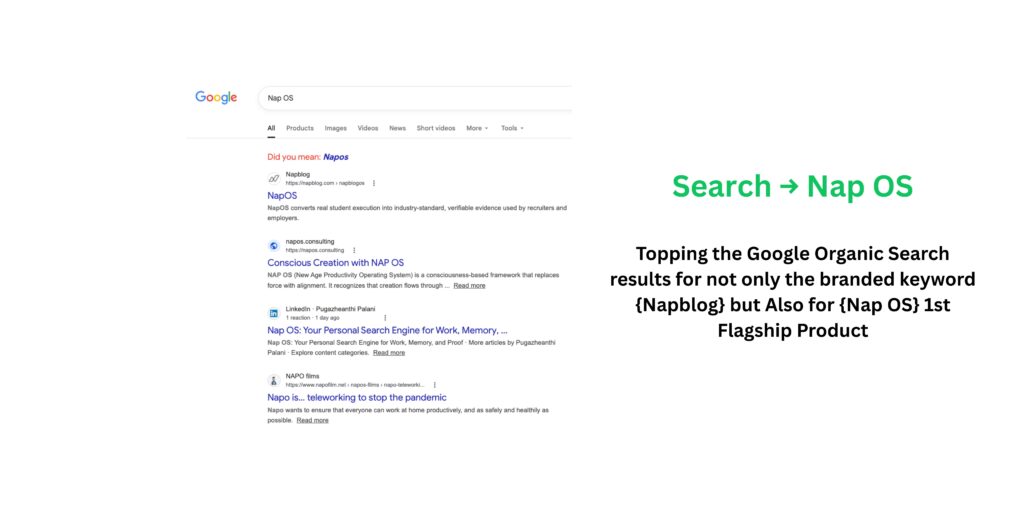
A note from the Napblog team This newsletter is not about growth hacks, paid campaigns, or short-term visibility spikes. It is about something far more meaningful—and far more difficult to achieve: earning trust at internet scale. Today, when someone searches Google for Napblog, they find us.More importantly, when they search for Nap OS, our first flagship product, they find us—organically, consistently, and without paid ads. This milestone matters. Not because of vanity metrics, but because it validates our philosophy: build real products, document real work, and let relevance compound over time. What follows is a transparent, conversational reflection on how we reached this point, why it matters, and what it signals about the future of Napblog Limited. Why organic search leadership matters more than ever In a digital landscape saturated with sponsored placements, inflated claims, and algorithm-gaming, organic search remains the last true signal of credibility. Ranking organically means: For a young product company, this is not trivial. Organic leadership means: When Napblog appears at the top for its own name, that is expected over time.When Nap OS ranks independently as a product concept, that is earned authority. That distinction matters. Nap OS: a product Google understands because users do Search engines do not rank slogans. They rank meaning. Nap OS did not reach organic visibility because of keyword stuffing or SEO tricks. It happened because: Nap OS is not positioned as “just another tool.” It exists as a system of record for execution—and that clarity translates into search relevance. Google surfaced Nap OS because the internet already had enough signals that: Search rankings followed usage, not marketing. The long road of slow, deliberate visibility Napblog did not launch with a marketing budget.We launched with notebooks, prototypes, conversations, and unfinished ideas. Every article published was written from experience.Every product update reflected an actual user problem.Every mention came from collaboration—not campaigns. This approach is slower. It is also harder to fake. But over time, something powerful happens: Organic growth is not linear. It compounds quietly—and then suddenly becomes visible. What you are seeing now is not a breakthrough.It is accumulated consistency becoming measurable. Why Nap OS ranking matters more than Napblog ranking A company ranking for its name is expected.A product ranking for its category is transformative. Nap OS ranking independently means: This is the difference between: “Who are you?”and“I’ve heard about this—tell me more.” That shift is subtle but decisive. It signals that Nap OS is moving from internal innovation to external relevance. Organic trust beats paid attention Paid ads can buy clicks.They cannot buy belief. Organic visibility indicates that: For students, this matters because they trust what surfaces naturally.For educators, it signals seriousness.For employers, it indicates legitimacy without exaggeration. Napblog’s decision to avoid paid acquisition in early stages was intentional. We wanted: If something only works when amplified artificially, it does not scale sustainably. Search visibility as a reflection of product integrity Search engines reward: Nap OS benefited because it was built as a system, not a landing page. Its documentation, articles, and references all reinforce the same narrative: When these signals align, search engines do what they are designed to do: surface the most relevant result. What this means for students using Nap OS For students, organic visibility provides reassurance: When recruiters search Nap OS and find consistent, credible information, it reduces friction in conversations. Context already exists. This is infrastructure, not branding. What this means for educators and institutions For educators, organic ranking demonstrates: This makes Nap OS suitable for: Visibility creates optionality. Optionality creates collaboration. What this means for employers Employers increasingly struggle with: Nap OS positions itself as an antidote: When employers search organically and encounter this narrative consistently, trust forms before the interview. That is the quiet power of discoverability. The compounding effect of being found Organic search leadership is not a destination. It is a responsibility. Now that people can find Napblog and Nap OS easily, expectations increase: Visibility without substance collapses quickly.Substance with visibility compounds. We choose the latter. A reflection on patience and product culture This milestone validates something deeper than SEO success. It validates a culture of patience. In a world chasing virality, Napblog chose: Organic visibility is evidence that: Quiet work, done consistently, eventually becomes loud enough to be heard. What comes next Ranking is not the end. It is the beginning of higher standards. Next priorities include: Search visibility will fluctuate. Algorithms will change.What will not change is our commitment to building things worth finding. A final word of thanks To every student who used Nap OS before it was “discoverable.”To every intern who documented imperfect work.To every educator who asked difficult questions.To every reader who spent time—not clicks—with our content. This milestone belongs to you as much as it belongs to Napblog Limited. We will continue to build slowly, deliberately, and publicly. Because in the long run, being found is not about marketing—it is about meaning. — Napblog LimitedBuilding infrastructure for evidence-based work, one execution at a time.
HOS - Homeschooling OS

Homeschooling OS: Preparing Children for a Future Beyond Grades, Jobs, and Traditional Schooling

If you strip away the noise around education debates, one truth is becoming increasingly hard to ignore: the world our children will work in is not the world our education systems were designed for. Grades, age-based classrooms, fixed curricula, and standardized testing emerged during an industrial era that valued predictability and uniform output. Artificial intelligence, automation, and rapidly compounding technology have inverted those assumptions. Homeschooling, once viewed primarily as an alternative for religious, medical, or philosophical reasons, is now being reconsidered through a very different lens. Parents are no longer asking only, “How do I replicate school at home?” Increasingly, the real question is, “How do I help my child build intelligence, adaptability, and self-learning capacity for a future where many current jobs will not exist?” This is where the idea of a Homeschooling Operating System (Homeschooling OS) begins to make sense. The Cracks in the Grade-Based Model Grades are a convenient abstraction. They compress complex human capability into a single letter or number. That compression worked reasonably well when education’s main function was sorting people into predefined roles. In an AI-shaped economy, that logic breaks down. AI systems already outperform humans in many narrow academic tasks: solving equations, summarizing texts, writing essays, and even tutoring. When knowledge recall and procedural problem-solving are automated, grades lose much of their signaling power. What matters instead are capabilities that are harder to automate: Traditional schooling struggles to cultivate these because it is constrained by scale, standardization, and assessment requirements. Homeschooling, by contrast, operates at human scale. Homeschooling’s Quiet Advantage: Time and Attention One of the least discussed benefits of homeschooling is not curriculum flexibility, but attention density. A parent working with one or a few children can observe patterns that institutional systems miss entirely: when curiosity spikes, when frustration sets in, what environments unlock focus, and which interests recur over months or years. This matters deeply in an AI-driven future. Self-learning capacity is not built through occasional inspiration; it compounds through repeated cycles of curiosity → exploration → feedback → reflection. Homeschooling allows those cycles to run continuously, rather than being interrupted by bells, timetables, and external pacing. A Homeschooling OS formalizes this advantage instead of leaving it to intuition alone. What Is a Homeschooling OS? A Homeschooling OS is not just an app, and it is not a digital replica of school. Conceptually, it functions more like an intelligence layer sitting beneath daily learning activities. At its core, a Homeschooling OS does three things: Instead of asking, “What grade level is my child at?”, parents and children begin asking, “What capabilities are compounding?” and “What kinds of problems can my child now solve that they could not solve before?” AI as a Capability Multiplier, Not a Replacement Teacher Public skepticism around AI in education is understandable. Much of the criticism focuses on short-term academic outcomes, cheating concerns, or over-reliance on tools. But these critiques often assume AI is being used to prop up an old system. In a Homeschooling OS context, AI plays a very different role. It is not there to “teach better lessons” in the traditional sense. It functions as: Used this way, AI strengthens self-learning rather than replacing it. The child remains the primary agent; AI simply lowers the cost of iteration. Learning Without Relying on Jobs That Do Not Yet Exist One of the most uncomfortable truths for parents is that many of today’s “safe” career paths are already eroding. Children entering primary school now may work in roles that have no names yet, or may create their own work entirely. This makes job-centric education planning increasingly fragile. Homeschooling OS reframes preparation away from job titles and toward capability portfolios. These portfolios evolve continuously and may include: This kind of evidence is far more durable than grades. It aligns with how founders, researchers, creators, and adaptive professionals actually operate. Socialization Revisited: From Age Groups to Interest Graphs A persistent concern about homeschooling is socialization. Yet traditional schooling socializes primarily by age cohort, an arrangement that is rare in adult life. Homeschooling, particularly when supported by a structured OS, tends to organize social interaction around shared interests and projects. Children collaborate with peers who care about similar problems, regardless of age. This mirrors how real-world communities of practice function. Communication skills, negotiation, leadership, and empathy emerge organically when collaboration is meaningful rather than compulsory. Ireland, AI, and the Growing Shift Toward Home Education In Ireland, discussions around AI and education have intensified in recent years. Institutions such as Trinity College Dublin have highlighted how AI is already reshaping assessment and homework practices, while outlets like RTÉ have documented the steady rise in families choosing home education for flexibility and child wellbeing. This broader context matters. Homeschooling OS is not an ideological rejection of education systems; it is a pragmatic response to structural lag. Systems move slowly. Children grow quickly. The Parent’s Role: From Instructor to System Steward Perhaps the most significant shift homeschooling enables is not for children, but for parents. In a Homeschooling OS model, parents are no longer expected to be subject-matter experts in everything. Instead, they act as: AI handles much of the informational load. The parent focuses on values, pacing, and long-term coherence. This division of labor is not only more realistic; it is more sustainable. Measuring Progress Without Grades One of the hardest transitions for families leaving traditional schooling is letting go of grades. A Homeschooling OS replaces grades with evidence trails. Progress becomes visible through artifacts, reflections, and capability growth rather than scores. Over time, this creates a narrative of development that is both richer and more motivating. Children see themselves as evolving learners, not static performers. Looking Toward 2040: Education as a Living System By 2040, learning ecosystems are likely to look less like institutions and more like networks. Credentials will matter less than demonstrated capability. Lifelong learning will not be a slogan but a necessity. Homeschooling OS anticipates this future by treating childhood education as the foundation of a

AI Europe OS Perspective
AIEOS - AI Europe OS

Disadvantages of Cloud LLMs and Strategic Advantages of Local LLM Chips for Individual Companies

Across Europe, artificial intelligence is transitioning from experimentation to core enterprise infrastructure. Under the AI Europe OS vision, AI is not merely a productivity layer but a strategic asset tied to competitiveness, sovereignty, and long-term cost control. One of the most consequential architectural decisions facing companies today is whether to rely on cloud-based Large Language Models (LLMs) or to deploy local, on-premise LLMs powered by dedicated AI chips. While cloud LLMs have accelerated early adoption, their structural disadvantages are becoming increasingly evident—particularly for European firms operating under strict regulatory, data protection, and industrial competitiveness requirements. This article provides a comprehensive, enterprise-focused analysis of: 1. Understanding the Cloud LLM Model Cloud LLMs are typically accessed via APIs hosted by hyperscale providers such as OpenAI, Anthropic, and Google (Gemini). Their appeal is straightforward: However, these advantages primarily benefit early-stage experimentation rather than long-term, production-grade enterprise AI. 2. Core Disadvantages of Cloud-Based LLMs 2.1 Data Privacy, Sovereignty, and Compliance Risk From a European enterprise standpoint, data is not merely an asset—it is a regulated liability. When using cloud LLMs: This creates direct friction with European regulatory frameworks such as GDPR and the emerging EU AI Act, which emphasize accountability, traceability, and risk classification. Key structural issue:Compliance becomes a shared responsibility with a vendor whose infrastructure, training pipelines, and update cycles are outside the company’s direct control. 2.2 Escalating and Unpredictable Cost Structures Cloud LLMs operate on a consumption-based pricing model: While initial costs appear low, enterprises face: For high-frequency internal use cases—legal review, engineering copilots, customer support automation—cloud LLMs often evolve into permanent OpEx liabilities rather than efficiency multipliers. 2.3 Latency and Network Dependency Cloud-based inference introduces unavoidable latency: For applications such as: Even milliseconds of delay can degrade usability and operational reliability. Additionally, cloud LLMs cease to function without connectivity, creating systemic risk in environments where availability is mission-critical. 2.4 Vendor Lock-In and Strategic Fragility Cloud LLM users are exposed to: This creates a dependency asymmetry:The vendor controls the roadmap; the enterprise absorbs the impact. From an AI Europe OS perspective, this undermines strategic autonomy, particularly for sectors such as manufacturing, defense, healthcare, and energy. 2.5 Limited Customization and Domain Control Cloud LLMs are optimized for general-purpose performance. As a result: This limits the ability to transform LLMs into true enterprise-specific cognitive systems. 3. The Rise of Local LLM Chips Local LLM deployment leverages on-premise or edge hardware, including: This approach shifts AI from a rented service to owned infrastructure. 4. Strategic Advantages of Local LLM Chips 4.1 Absolute Data Privacy and Sovereignty With local LLMs: This is not merely a legal benefit—it is a competitive advantage in industries where data sensitivity defines market leadership. 4.2 Predictable, Capital-Efficient Economics Local LLMs follow a CapEx-dominant model: For steady, high-volume workloads, total cost of ownership becomes significantly lower than cloud-based alternatives within 12–24 months. 4.3 Ultra-Low Latency and Real-Time Performance On-device or on-premise inference eliminates: This enables: 4.4 Offline and Resilient Operation Local AI systems remain operational: This resilience is critical for industrial, governmental, and security-sensitive deployments. 4.5 Deep Customization and Model Ownership Local deployment allows companies to: This transforms LLMs from generic tools into institutional knowledge engines. 4.6 Immunity from External Censorship and Model Drift Local models are: For regulated industries, this stability is essential for governance and risk management. 5. Cloud vs Local: Strategic Comparison Dimension Cloud LLMs Local LLM Chips Data Control Shared with vendor Fully internal Cost Model Variable OpEx Predictable CapEx Latency Network dependent Near-zero Internet Dependency Mandatory Optional Customization Limited Extensive Strategic Autonomy Low High 6. AI Europe OS: The Broader Implication From an AI Europe OS standpoint, local LLM chips represent more than a technical alternative—they are a foundational pillar of European digital sovereignty. They enable: Cloud LLMs will continue to play a role in: However, core enterprise intelligence—the models that understand, reason over, and act upon proprietary knowledge—will increasingly reside inside the enterprise perimeter. 7. Key Takeaway For individual companies, the choice between cloud and local LLMs is no longer a purely technical decision. It is a strategic one. Under the AI Europe OS vision, enterprises that internalize AI infrastructure today are positioning themselves not just as users of artificial intelligence—but as owners of their cognitive capital. This shift will define the next decade of European competitiveness.

Nap OS - for Power Users €999/monthly
Blog

Nap OS for Power Users (€999/month)

Re-Architecting Professional Intelligence in a Fragmented World Modern professionals do not suffer from a lack of tools.They suffer from too many tools, working against each other. Calendars, task managers, CRMs, note apps, document stores, code repositories, analytics dashboards, learning platforms, communication tools, AI subscriptions, and cloud drives now define professional life. Each promises productivity. Collectively, they create fragmentation, cognitive overhead, duplicated effort, forgotten subscriptions, and a silent erosion of focus. The current system was not designed for human compounding.It was designed for vendor extraction. Nap OS Power is not another productivity layer. It is a systems-level correction—a professional operating system that connects all your existing tools, ingests their data continuously (24×7), and converts fragmented activity into a compounding professional intelligence moat that works for you, not against you. At €999/month, Nap OS Power is not priced for everyone.It is priced for those who understand leverage. The Core Problem: Fragmentation Is the Enemy of Compounding Compounding is the most misunderstood force in professional life. Most people associate compounding with finance. In reality, knowledge, skill, reputation, output quality, and opportunity access all compound—or decay—based on system design. The current digital work environment actively prevents compounding: Even the most disciplined professionals unknowingly operate inside anti-compounding systems. Nap OS exists because this is not a discipline problem.It is an architecture problem. Nap OS Power: One Intelligence Layer Above All Tools Nap OS Power does not replace your tools. It connects them. Your existing stack—email, calendar, GitHub, Notion, Google Drive, Slack, Jira, Figma, Stripe, CRM systems, LMS platforms, analytics tools, personal knowledge bases, and AI tools—feeds into Nap OS as a continuous data stream. Nap OS sits one layer above: The result is not dashboards.The result is professional memory with intelligence. Nap Intelligence: From Activity to Strategic Signal Raw data is cheap. Intelligence is rare. Nap Intelligence transforms 24×7 ingested data into signals that matter: Traditional systems show you what you did.Nap Intelligence shows you what it means. This is the difference between logging activity and building a strategic professional advantage. Why Power Users Need This Now (Not Later) Power users already operate at high output.That is precisely why fragmentation hurts them more. When your time is valuable, the cost of: …is no longer marginal. It is existential. Nap OS Power collapses these inefficiencies into a single compounding system that improves the more you use it. The Compounding Moat: Your Professional Data, Unified Platforms build moats by locking users in.Nap OS builds moats by locking progress in. Over time, Nap OS Power creates a dataset no recruiter, employer, client, or platform can replicate: This is not a resume.It is a living professional ledger. And it compounds daily. Human-Aligned by Design (Unlike the Current System) The modern digital economy optimizes for: Humans are treated as inputs, not beneficiaries. Nap OS is explicitly human-aligned: The system improves only when you improve. This alignment is not philosophical—it is architectural. Energy, Waste, and the Hidden Cost of Fragmentation Few professionals consider the environmental cost of digital fragmentation. Multiple apps mean: Nap OS reduces waste by centralizing intelligence instead of duplicating it. One integrated system requires fewer queries, fewer retries, fewer compute cycles, and fewer parallel infrastructures. Efficiency is not just personal.It is systemic. €999/Month Is Not a Subscription. It Is an Investment. Nap OS Power is priced intentionally. This is not a tool for task management.This is infrastructure for career-scale leverage. Who this is for: If your professional output influences decisions, capital, teams, or markets, then operating without a compounding intelligence layer is a liability. What Happens Over 6–12 Months of Use Short-term tools feel good immediately.Nap OS compounds quietly. Power users typically experience: The system does not push motivation.It removes friction. The End of Working Against Human Nature Humans are pattern-driven, context-dependent, and cumulative learners. The current system ignores this. Nap OS is built on the opposite assumption: Nap OS Power is not about doing more.It is about making everything you already do count. Final Thought: This Is an Operating System Shift Every major leap in productivity came from a new operating system layer: Nap OS represents the next shift: From fragmented productivity to unified professional intelligence. For power users, the question is not whether you can afford Nap OS Power. The question is whether you can afford to let your most valuable asset—your professional life—remain fragmented, forgetful, and non-compounding. Nap OS does not promise shortcuts.It builds something rarer. A system that remembers.A system that compounds.A system that finally works with human nature, not against it.