
Napblog

January 24, 2026

Napblog Limited Processing with A DPIA, or Data Protection Impact Assessment
Blog

Napblog Limited: Building Nap OS & Homeschooling OS with Privacy, DPIA, and GDPR at the Core

Why Privacy Is the Product, Not an Afterthought Across Europe, digital education platforms are under increasing scrutiny—not because innovation is unwelcome, but because trust, accountability, and data protection are now inseparable from product quality. At Napblog Limited, this reality has shaped every architectural and strategic decision behind our two core products: Nap OS and Homeschooling OS. This newsletter provides a detailed, transparent view of how Napblog products are being developed in alignment with EU GDPR regulations, with Data Protection Impact Assessments (DPIAs) embedded into the product lifecycle. Our goal is not simply to comply, but to demonstrate leadership in privacy-by-design for education, skills evaluation, and learning infrastructure. Napblog Limited: A Product-Led Infrastructure Company Napblog Limited operates as an incubation and product company focused on long-term digital infrastructure rather than short-term applications. Our platforms are designed to support: This philosophy directly informs how Nap OS and Homeschooling OS are built, governed, and scaled. Understanding DPIA: The Foundation of Responsible Innovation Under the General Data Protection Regulation (GDPR), a Data Protection Impact Assessment (DPIA) is mandatory where data processing is likely to result in a high risk to the rights and freedoms of individuals. This is particularly relevant when: As an education-focused technology provider, Napblog operates squarely within this scope. DPIA is therefore not a legal formality for us—it is a design instrument. DPIAs at Napblog are used to: This approach is aligned with expectations set by bodies such as the Data Protection Commission and other EU supervisory authorities. Nap OS: Evidence-Based Systems with Privacy at the Core Nap OS is being developed as an operating system–level platform for learning validation, skill evaluation, and outcome-based education models. By design, it moves away from vanity metrics and opaque profiling, focusing instead on verifiable evidence and structured data. From a GDPR and DPIA perspective, Nap OS is built around several non-negotiable principles: 1. Purpose Limitation Every data point processed within Nap OS is linked to a clearly defined purpose—such as assessment, validation, or learning progression. Data is not collected “just in case,” nor reused for unrelated objectives. 2. Data Minimisation Nap OS is engineered to function effectively with the minimum amount of personal data required. Where possible, aggregated or pseudonymised data is used in analytics and reporting layers. 3. Privacy-by-Design Architecture Privacy controls are embedded at system level, not layered on afterward. This includes: 4. DPIA-Driven Feature Releases Every new module, native application, or analytical capability introduced into Nap OS is reviewed through a DPIA lens before release. This ensures innovation does not outpace responsibility. Homeschooling OS: Protecting Children, Families, and Learning Data Homeschooling OS operates in an even more sensitive environment. GDPR explicitly recognises children as vulnerable data subjects, requiring enhanced protection, clarity, and safeguards. Napblog treats Homeschooling OS as a high-risk processing environment by default, which means DPIA requirements are applied rigorously and continuously. Key safeguards include: Lawful Basis and Transparency Processing within Homeschooling OS is grounded in clear lawful bases, typically parental consent and educational necessity. Parents and guardians are provided with transparent information about: Security and Confidentiality All learning records and identifiers are protected through: Avoidance of Behavioural Profiling Homeschooling OS avoids unnecessary behavioural tracking or long-term profiling. The platform focuses on learning support and progression, not surveillance or predictive labelling of children. Data Subject Rights by Design Workflows for access, rectification, restriction, and erasure are designed into the platform from the outset, ensuring GDPR rights are practical and actionable, not theoretical. DPIA as a Living Process, Not a Static Document One of the most common misconceptions about DPIAs is that they are completed once and filed away. At Napblog, DPIAs are treated as living governance tools. DPIAs are reviewed and updated when: This ensures that compliance remains aligned with reality as products evolve. To support this operational discipline, Napblog aligns its internal controls and risk management processes with industry-standard compliance and security frameworks used by modern SaaS and infrastructure companies . Accountability to Institutions, Partners, and Learners Napblog products are designed to operate in partnership with: DPIA documentation and GDPR alignment enable: For institutions, this means engaging with a platform that understands regulatory obligations and actively reduces institutional risk. Trust as Competitive Advantage In a market saturated with platforms that monetise attention, data, or behavioural insight, Napblog takes a different position. Trust is our competitive advantage. By embedding DPIA and GDPR principles into Nap OS and Homeschooling OS: Privacy is not a constraint on our roadmap—it is what makes the roadmap sustainable. Looking Ahead: Responsible Scale Across Europe As Napblog Limited continues to scale its products across Ireland and the wider EU, DPIA-led development will remain non-negotiable. This discipline ensures that: Nap OS and Homeschooling OS are being built to endure—not just technologically, but legally and ethically. Closing Note Napblog Limited believes the future of education technology depends on deliberate, accountable design. By treating GDPR compliance and DPIA as core product infrastructure, we are laying foundations for systems that institutions, parents, and learners can trust—today and in the long term. We remain committed to transparency and welcome constructive engagement from partners, educators, and regulators as our platforms continue to evolve. Napblog LimitedBuilding ethical infrastructure for learning, evaluation, and growth.
Napblog Limited – Homeschooling Os Pilot Launch Article
HOS - Homeschooling OS

Homeschooling OS: A Systems Shift in How Learning Is Designed, Governed, and Lived

Why a Second Flagship, and Why Now? Education systems across the world are under visible strain. Families are responding not with withdrawal from learning itself, but with a reassertion of responsibility for how learning is shaped, paced, and governed. The rapid growth of homeschooling is not a rejection of education; it is a critique of how education has been operationalised at scale. Napblog Limited’s second flagship product, Homeschooling OS, emerges within this context. It is not positioned as a curriculum, a school replacement, or a marketplace of lessons. It is designed as an operating system: an underlying, structured intelligence layer that enables families to design, manage, and evolve learning journeys with clarity, continuity, and intent. The pilot launch—beginning with 1,000 invited homeschooling families—marks a deliberate, measured step. This article does not promote features or pricing. Instead, it explains the conceptual shift Homeschooling OS represents, why such a system is necessary now, and how it reframes the role of parents and children in shaping education from the earliest years. Homeschooling as a Structural Response, Not a Trend Homeschooling has often been discussed as a lifestyle choice or a reaction to institutional shortcomings. In reality, it is better understood as a structural response to complexity. Parents are increasingly required to navigate: Traditional systems centralise authority but decentralise responsibility. Homeschooling reverses this: responsibility becomes explicit, while authority must be intentionally designed. This creates a new challenge—parents become system architects without having access to systems-level tools. Homeschooling OS is built to address that gap. From Tools to Systems: The Missing Layer in Home Education Most homeschooling solutions focus on tools: lesson plans, videos, worksheets, or marketplaces. Tools are useful, but they do not constitute a system. Without an organising framework, families accumulate resources without coherence. A system provides: Homeschooling OS introduces a centralised intelligence stem that sits above individual tools. It does not replace human judgement; it augments it by making learning visible, connected, and evolvable over time. Parental Craftsmanship: Education as a Deliberate Practice A core principle behind Homeschooling OS is the idea of parental craftsmanship. Craftsmanship implies: In this model, parents are not passive facilitators or informal teachers. They are stewards of a learning craft, shaping environments, rhythms, and experiences that align with a child’s emerging identity. Homeschooling OS supports this by giving parents: This is not micromanagement. It is governance. The Child as an Active System Participant One of the risks in any centralised system is over-control. Homeschooling OS is explicitly designed to avoid this by treating the child not as an object of optimisation, but as an active participant in their own learning system. From a young age, children can: The system grows with the child. Early years focus on exploration and foundational patterns. Later stages introduce reflection, self-direction, and long-term goal alignment. The objective is not early specialisation, but early agency. Centralised Intelligence Without Centralised Authority The phrase “centralised intelligence” often raises concerns about uniformity or control. In Homeschooling OS, centralisation refers to coherence, not command. The intelligence stem: Authority remains distributed: This separation of intelligence from authority is a defining architectural choice. Longitudinal Learning: Thinking in Decades, Not Terms Institutional education is structured around terms, grades, and transitions that often reset context. Homeschooling OS is designed for longitudinal continuity. Key questions shift from: To: The system supports: This does not mean predicting a child’s future. It means preserving optionality by building strong, adaptable foundations. Emotional and Cognitive Integration Learning is not purely cognitive. Emotional regulation, confidence, curiosity, and resilience are foundational capacities. Homeschooling OS is designed to integrate these dimensions by: By making these signals visible, parents can respond earlier and more thoughtfully, adjusting environments rather than reacting to outcomes. Why a Pilot, and Why Invitation-Only The decision to begin with a limited pilot is intentional. Homeschooling OS is not a static product. It is a living system that must be shaped alongside real families, real constraints, and real diversity of approaches. An invitation-only pilot allows: The offer of free access during the pilot is not a promotional tactic. It is an acknowledgement that early participants are co-creators, not consumers. A Shift Comparable to Operating Systems, Not Apps The article describes Homeschooling OS as a shift comparable to an operating system rather than an application. This distinction matters. Applications optimise tasks. Operating systems define what tasks are possible and how they relate. By focusing on the operating layer of homeschooling, Napblog Limited is addressing a structural absence rather than adding another option to an already crowded space. Conclusion: Shaping Futures Without Forcing Them Homeschooling OS does not promise outcomes. It offers something more durable: a way to think clearly about learning over time. By combining parental craftsmanship, child agency, and centralised intelligence without centralised control, the system reflects a deeper shift in how education is understood. Not as a service delivered. Not as a curriculum consumed. But as a craft practiced—deliberately, responsibly, and with an eye toward a future that remains open rather than predetermined. The pilot launch marks the beginning of this exploration. Its real success will be measured not in adoption metrics, but in whether families feel more capable, more intentional, and more aligned as they help their children shape their own futures.

Nap OS: Your Personal Search Engine for Work, Memory, and Proof
NapOS

Nap OS: Your Personal Search Engine for Work, Memory, and Proof

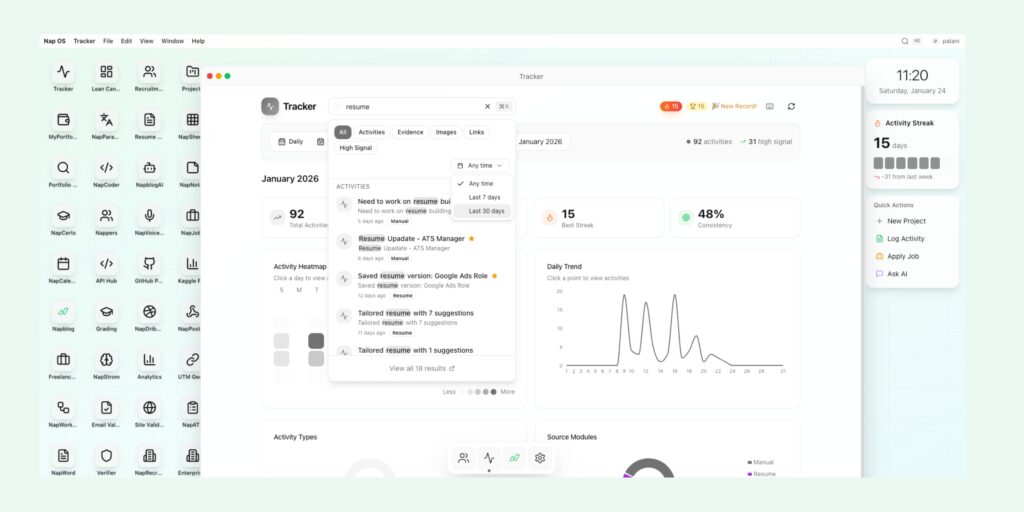
This Is How Work Should Be Recalled Most people do not fail interviews because they lack skills.They fail because they cannot recollect their work clearly, confidently, and on demand. Projects fade.Details blur.Evidence gets buried across tools, folders, emails, and versions. When an interviewer asks: Most candidates mentally scramble. Nap OS exists to eliminate that scramble. Not by teaching you what to say—but by preserving what you actually did, in a way that is searchable, recallable, and usable at any moment. This is not note-taking.This is not journaling.This is not another productivity app. Nap OS is a personal work intelligence system. Work Should Be Searchable—Like Memory, Not Like Files Traditional systems store work as files.Nap OS stores work as activity. Files require remembering where something lives.Nap OS lets you remember that it happened. You do not search folders.You search intent. The moment you type, Nap OS responds—not with documents, but with contextualized actions. What you worked on.When you worked on it.How often.How deeply.With what evidence. This is how human recall works.Nap OS simply mirrors it. Historic Data Feeds: Your Work, Never Lost Every action in Nap OS becomes part of a living historic feed. Not a timeline you have to curate.Not a report you have to generate. It is always there—quietly accumulating. Days later.Weeks later.Months later. You can pull: This matters because interviews are not real-time events.They are retrospective evaluations. Nap OS gives you the ability to time-travel through your own execution. You are no longer guessing what you did last quarter.You are revisiting it—with proof. From Search to Story: Interview Preparation at Your Fingertips Interview preparation usually looks like this: Nap OS changes the workflow entirely. You search → you recall → you speak. When preparing for an interview, Nap OS allows you to: You are not inventing answers.You are extracting reality. This creates confidence—not the performative kind, but the grounded kind. Because you are not “selling yourself.”You are referencing facts. Evidence, Not Claims Resumes are claims.Nap OS is evidence. Every activity can carry: This transforms how you approach assessments. Instead of starting from scratch, you: Nap OS does not make you faster by rushing you.It makes you faster by removing repetition. High Signal vs Noise: What Actually Matters Not all work is equal.Nap OS understands this. Activities are not just logged—they are classified. High-signal work surfaces naturally: Low-effort noise fades into the background. This is critical for decision-makers. When a recruiter, evaluator, or hiring manager looks at Nap OS data, they are not overwhelmed.They see what matters. Consistency.Depth.Trajectory. Native, Intuitive, Human-Centered Design Nap OS does not feel like software you have to “learn.” It feels like software that already understands you. There is no friction between intent and action. You do not ask: You simply work. Nap OS adapts to you—not the other way around. The Emotional Benefit: Calm, Not Anxiety Most productivity tools increase anxiety. They remind you of: Nap OS does the opposite. It creates psychological safety. You know your work is captured.You know your effort is visible.You know your progress is real. This calm changes how you approach opportunities. You stop preparing in panic.You start preparing with clarity. Assessments Without Fear Technical tests.Case studies.Take-home assignments. These no longer feel like threats. Because Nap OS gives you: You are not being tested on memory.You are being tested on thinking. And your thinking is already documented. Nap OS as a Personal Search Engine for Work Think about how you use Google. You do not explain everything.You type fragments. Nap OS works the same way. You do not remember full details.You remember anchors. Nap OS connects those anchors to your lived execution. This is why it feels inevitable. This is how it should have always been. For Individuals, Teams, and Decision-Makers For individuals: For teams: For recruiters and evaluators: Nap OS aligns incentives across all sides. This Is Not Productivity. This Is Identity. Nap OS is not about doing more.It is about knowing what you have done. In a world obsessed with outputs, Nap OS respects process.In a world full of noise, Nap OS surfaces signal. It turns work into memory.Memory into narrative.Narrative into opportunity. Closing Thought When work is searchable, recallable, and provable—confidence becomes natural. Nap OS does not help you pretend you are capable.It helps you see that you already are. This is how work should be remembered.This is how interviews should be prepared.This is how execution should feel. This is Nap OS.